Showing posts with label 9 Schild. Show all posts

Tuesday, June 25, 2024

Ion Antonescu Welcomes Erich von Manstein


Marshal Ion Antonescu (left, Prime Minister of Romania) welcomes Generalfeldmarschall Erich von Manstein (Oberbefehlshaber Heeresgruppe Süd), who arrived in Bucharest for the awarding of the Crimea Shield (that he himself is wearing on his right sleeve). In the background is General der Artillerie Otto Hartmann (Kommandierender General Sicherungstruppen und Befehlshaber Heeresgebiet A ). The picture was taken on 3 July 1943.

Source :
https://forum.axishistory.com/viewtopic.php?f=5&t=14230&p=1556464&hilit=otto+hartmann#p1556464
https://www.ullsteinbild.de/?82231788017539342720

Monday, January 15, 2024

Ferdinand Schörner and Otto Wöhler


General der Gebirgstruppe Ferdinand Schörner (right, Oberbefehlshaber Heeresgruppe Südukraine) and General der Infanterie Otto Wöhler (Oberbefehlshaber 11. Armee) during a briefing on a map. The picture was taken by Bildberichter Heinz Mittelstaedt of PK (Propaganda-Kompanie) 637 in Barlad, Romania, 11 April 1944.

Source :
https://commons.wikimedia.org/wiki/File:Bundesarchiv_Bild_183-2007-0313-500,_Rum%C3%A4nien,_Sch%C3%B6rner_bei_Lagebesprechung.jpg

Wednesday, December 27, 2023

Bio of Feldwebel Willibald Unfried (1919-1994)

Willibald "Willi" Unfried

Date of Birth: 26.06.1919 - Großenried-Feuchtwangen, Bayern (Germany)
Date of Death: 21.07.1994 - Neuendettelsau, Bayern (Germany)

Battles and Operations: Invasion of Yugoslavia (1941), Operation Barbarossa (1941), Crimean Campaign (1941–1942), and Battle of the Kerch Peninsula (1942)

Promotions:
00.00.194_ Feldwebel

Career:
14.08.1940 1.MG-Schütze in 9.Kompanie / Infanterie-Regiment 213 / 73.Infanterie-Division

Awards and Decorations:
00.09.1941 Eisernes Kreuz II.Klasse
00.00.194_ Eisernes Kreuz I.Klasse
00.00.194_ Infanterie-Sturmabzeichen in Silber
00.00.194_ Verwundetenabzeichen in Schwarz
04.03.1942 Ritterkreuz des Eisernen Kreuzes, as Gefreiter and 1.MG-Schütze in 9.Kompanie / III.Bataillon / Infanterie-Regiment 213 / 73.Infanterie-Division. On 15.01.1942 the Infanterie-Regiment 213 launched a counterattack on the town of Bairasch, which was captured after fierce combat. But on the following day the Soviets launched an assault of their own with two regiments at Adzhigol. During this attack it was the actions of Gefreiter Unfried that enabled the enemy forces to be crushed with heavy losses. By his bravery and determination he played a major role in mastering a critical situation and preventing a breakthrough of the German front. For this act, as well as his earlier successes on the Eastern front, he was awarded the Ritterkreuz.
00.00.1942 Medaille "Winterschlacht im Osten 1941/42" (Ostmedaille)
00.00.194_ Verwundetenabzeichen in Silber
00.00.194_ Nahkampfspange in Bronze
00.00.194_ Krimschild

---------------------------------------------------------------------------------------

Willibald Unfried was born on June 16, 1919 in Großenwied/Feuchtwangen.

On August 14, 1940 he joined the 9th company of the 213th Infantry Regiment, the 73rd Infantry Division and took part in the Balkan and Eastern campaigns. Within his company he was deployed as MG Rifleman 1.

In mid-August 1941 he particularly distinguished himself in a battle near Postolany and was one of the first to conquer the town of Novaya Majachka on September 10, 1941, for which he received the EK II.
In the battles around the Isthmus of Perekop and on the Tatar Wall, he repeatedly distinguished himself by his great bravery and enabled his comrades to advance towards the enemy positions, largely under the protection of their own machine-gun fire.

During the fighting for Kerch, he prevented a Russian counterattack and thus prevented the company from suffering heavy losses. For this he received the Iron Cross 1st Class. The enemy's counterattack near Tambovka on December 31, 1941 could only be prevented by Unfried, as was an attack on Adzhigol on January 16, 1942.

For his bravery and courage, the 22-year-old received the Ritterkreuz on March 4, 1942.

The regimental commander at the time, Oberst Otto Hitzfeld, wrote:

"The leader and supreme commander of the Wehrmacht has awarded the Ritterkreuz des Eisernen Kreuzes to Gefreiter Willibald Unfried. This was awarded to a particularly brave and capable soldier in our regiment. Private Unfried took part in all of the regiment's battles in the east. His intrepidity, which he demonstrated several times, was rewarded. We owe the fact that we were able to achieve great success in attacking and defending against the strongest enemy counterattacks primarily to our incomparable fellow soldiers, especially to the intrepid, tough machine gunners. She was not frightened by the enemy's superior strength or by the incredible hardships of this war with Russia. They are the infantrymen who bear the brunt of the battle, the best soldiers in the world. The high award that Unfried received also recognizes the achievements of all of our brave compatriots in the regiment. But it should also be an incentive for the same soldier virtues. We are all proud and happy with our brave Unfried."

Due to the award of the Ritterkreuz, he was given special leave and was welcomed to his adopted home of Uttenhofen for several days. The following poem was written on the occasion of his visit on May 25, 1942:

                 Our Ritterkreuzträger

                 In Crimea - over in the Far East
                 Our Willibald stood at post with his comrades
                 So that the homeland can work in peace
                 Everyone over there is standing his ground today.
                 Once the Bolsheviks came at seven in the morning
                 “There’s something to clear out again today!”
                 That's what our "Willi" thinks and is ready
                 to give them their final escort.
                 They had to go back with bloody heads
                 and our men could breathe again.
                 They came running a second time
                 two companies were named.
                 But they too received a warm welcome
                 and went as the others had gone before.
                 But the Russian commissioners didn't give up yet
                 they constantly chased their men to their deaths.
                 In the afternoon a whole battalion came,
                 Our fuses had already gone back to the main battle line.
                 But our Willibald still remained lying there,
                 because this was about fighting and winning
                 "There's still time to go back!"
                 he thinks and gets ready to welcome the Russians.
                 A great machine gun and 500 rounds of ammunition,
                 A whole battalion can come.
                 He sets aside three drums of 50 each,
                 to send them a ticket for eternity.
                 They get closer and closer - they feel alone
                 and don't even think that there could be a German here.
                 The tension is extremely nerve-wracking
                 but he saves it for his effective fire.
                 Now they are already forming up to attack.
                 Now do what you can, you son of Franconia!
                 But it doesn't take long for him to arrive
                 and spoils the Russians' best trump cards.
                 The opponent is completely taken by surprise -
                 Our “Willi” makes sure that no one limps anymore.
                 But I quickly put another drum on
                 and held in so that it only stains.
                 They lie on their stomachs - one then stands up
                 he also raises his hands - the good man.
                 "Hello Ruski!" Willi calls her
                 and shows them the direction with his arm.
                 30 men come, only a few run away,
                 "Let them go," thinks Willi, "that's enough for them!"
                 So he arrives at his company as a victor,
                 That was a hello - everyone was happy.
                 Our guide gave him the best reward -
                 The Knight's Cross now adorns this brave son of Franconia.
                 He is in our midst today
                 and I know exactly how happy that makes us.
                 May heaven continue to protect him
                 and may the soldier's luck benefit him!

Willibald Unfried died on July 21, 1994 in Neuendettelsau.


Willibald Unfried studio photo.


Willibald Unfried studio photo.


Willibald Unfried with the Ritterkreuz.


Willibald Unfried in a group photo.


A grainy photo of Willibald Unfried.


Ritterkreuzträger Willibald Unfried (holding a bottle) partying with comrades.


Ritterkreuzträger Willibald Unfried (front right) partying with comrades.


Ritterkreuzträger Unteroffizier Willibald Unfried of 9.Kompanie / Infanterie-Regiment 213 / 73.Infanterie-Division during the attack on the Soviet position near Novorossiysk, a Russian port on the Black Sea, August 1942. He is armed with a captured SVT-40 semi-automatic rifle, against the background of a StuG III Ausf.F (7,5 cm Sturmkanone 40 L/43) from Sturmgeschütz-Abteilung 210. Unfried received the Ritterkreuz des Eisernen Kreuzes on 4 March 1942 for his heroic actions as a machine-gunner during the fierce battles at Bairasch and Adzhigol. Other pictures from this sequence can be seen HERE.


Ritterkreuz Vorläufiges Besitzzeugnis (preliminary award document) to Gefreiter Willibald Unfried.


The grave of Willibald Unfried.


Source :
Lionel H. photo collection
Agustin Vazquez photo collection
https://alchetron.com/Willibald-Unfried#willibald-unfried-a220e508-2f51-4f6b-ac41-2d224e35820-resize-750.jpeg
https://www.cafr.ebay.ca/itm/154670848532
https://de.metapedia.org/wiki/Unfried,_Willibald
https://www.facebook.com/Militaergeschichte18131945/photos/a.109126711510491/124069306682898/?type=3
https://forum.axishistory.com/viewtopic.php?f=5&t=159818&p=1418031&hilit=unfried#p1418031
https://imagesdefense.gouv.fr/fr/catalogsearch/result/?avec_visuel=1&q=unfried
https://imtw.ru/topic/5633-mig-voiny/page__st__50
https://military-history.fandom.com/wiki/Willibald_Unfried
http://www.oakleafmilitaria.com/131pc94.html
https://www.tracesofwar.com/persons/38336/Unfried-Willibald-Willi.htm
https://web.archive.org/web/20110105190518fw_/http://ritterkreuztraeger-1939-45.de/Infanterie/U/Unfried-Willibald.htm
https://www.wehrmacht-awards.com/forums/forum/wehrmacht-era-militaria/photos-and-paper-items-forum/832194-over-10-nice-kc-holders-from-my-collection-to-identify-help-needed/page3#post6515305

Tuesday, October 10, 2023

Bio of Oberfeldwebel Johann Port (1915-2006)

Johann Port

Date of Birth: 03.02.1915 - Bernkastel-Kues, Rheinprovinz (German Empire)
Date of Death: 27.03.2006 - Bernkastel-Kues, Rheinland-Pfalz (Germany)

Battles and Operations: Battle of France (1940), Battle of Greece (1941), Operation Barbarossa (1941), and Siege of Sebastopol (1941–1942)

Promotions:
00.00.193_ Gefreiter
00.00.19__ Unteroffizier
00.00.194_ Feldwebel
01.12.1942 Oberfeldwebel

Career:
02.11.1937 Schütze in 8.Kompanie (schwere-Maschinengewehr) / Infanterie-Regiment 105 in Trier
00.00.1938 Gefreiter and Gewehrführer in 8.Kompanie / Infanterie-Regiment 105
01.03.1940 Unteroffizier and Gruppenführer in 8.Kompanie / Infanterie-Regiment 105
03.10.1940 Gruppenführer/Kompanietruppführer in 8.Kompanie / Infanterie-Regiment 266
01.03.1942 Feldwebel and Zugführer/Kompanieführer in 8.Kompanie / Infanterie-Regiment 266
12.06.1942 Wounded and recuperated in Lazerett
00.00.1943 - 00.00.1944 Ausbilder Grenadier-Ersatz-Bataillon 125 in Trier
00.00.1944 Zugführer in Grenadier-Regiment 714
16.03.1945 POW near Hausbach/Saar

Awards and Decorations:
00.00.193_ Deutsches Reichssportabzeichen (DRL-Sportabzeichen) in Bronze
20.03.1940 Deutsches Schutzwall-Ehrenzeichen
21.09.1941 Eisernes Kreuz II.Klasse
01.11.1941 Infanterie-Sturmabzeichen in Silber
15.12.1941 Eisernes Kreuz I.Klasse
00.00.194_ Medalia "Cruciada Impotriua Comunismului" (Romania)
12.06.1942 Verwundetenabzeichen in Schwarz
15.07.1942 Medaille "Winterschlacht im Osten 1941/42" (Ostmedaille)
25.08.1942 Ritterkreuz des Eisernen Kreuzes, as Feldwebel and Zugführer in 8.Kompanie / II.Bataillon / Infanterie-Regiment 266 / 72.Infanterie-Division. The following wartime excerpt describes why Port received the Ritterkreuz: “Feldwebel Johann Port… was decorated with the Ritterkreuz on the 25.08.1942 whilst serving as a Zugführer in an Infanterie-Regiment. He received this award for his actions during the offensive battles around Sevastopol in mid-June 1942. Here he managed to reenergize his Bataillon’s temporarily stalled attack on his own initiative, roll up the enemy’s trench system and then fend off all Bolshevik counterattacks.” "Vorläufiges Besitzzeugnis" (preliminary document) presented on 26.08.1942.
00.00.1943 Krimschild
17.01.1945 Verwundetenabzeichen in Silber

--------------------------------------------------------------------------

Johann Port was born on February 3, 1915 in Bernkastel-Kues in Rhineland-Palatinate and joined the Wehrmacht on November 2, 1937. The only 1.64 m tall but tough rifleman received his basic training at the 105th Infantry Regiment in Trier, where he became a heavy machine gunner (sMG) in the 8th company. When it was formed on October 6, 1936, the regiment was subordinated to the 34th Infantry Division. During the mobilization it was placed under the control of the Trier Border Division on the West Wall. From September 19, 1939, it was placed under the new 72nd Infantry Division.


Gefreiter Johann Port (third from right) with his comrades during peacetime training.


Johann Port as an Unteroffizier before he received the Ritterkreuz.


Ritterkreuz award ceremony for Fahnenjunker-Feldwebel Johann Port (Zugführer in 8.Kompanie / II.Bataillon / Infanterie-Regiment 266 / 72.Infanterie-Division), which were held on 26 August 1942. The medal was presented by Generalleutnant Philipp Müller-Gebhard (Kommandeur 72. Infanterie-Division). Port was formally received the Ritterkreuz des Eisernen Kreuzes a day previously, on 25 August 1942, for his actions during the offensive battles around Sebastopol in mid-June 1942. Here he managed to reenergize his Bataillon’s temporarily stalled attack on his own initiative, roll up the enemy’s trench system and then fend off all Russian counterattacks. More pictures from this sequence can be seen HERE.


Four non-commissioned officers of the Wehrmacht who were also Ritterkreuzträger from Heer, were photographed at the train station after returning home from the front and welcomed by the "fans" who greeted them with great fanfare. They are, from left to right: Obergefreiter Franz Schmitzer (Ritterkreuz on 26 September 1942 as Richtschütze in 4.Batterie / II.Abteilung / Artillerie-Regiment 6 / 6.Infanterie-Division), Feldwebel Johann Port (Ritterkreuz on 25 August 1942 as Zugführer in 8.Kompanie [maschinengewehr] / II.Bataillon / Infanterie-Regiment 266 / 72.Infanterie-Division), Oberfeldwebel Albrecht Schnitger (Ritterkreuz on 7 October 1942 as Zugführer in 6.Kompanie / II.Bataillon / Infanterie-Regiment 18 / 6.Infanterie -Division), and Obergefreiter Joseph Schuss (Ritterkreuz on 4 September 1942 as MG-Schütze in 3.Kompanie / I.Bataillon / Infanterie-Regiment 520 / 296.Infanterie-Division). This photo was taken in the period of October-November 1942, and was first published in the "Illustrierter Beobachter" magazine dated 26 November 1942. Other pictures from this sequence can be seen HERE.


Ritterkreuzträger Feldwebel Johann Port (Zugführer in 8.Kompanie / II.Bataillon / Infanterie-Regiment 266 / 72.Infanterie-Division) at the welcoming celebration in the Marktplatz (Marketplace) of his home town, Bernkastel-Kues, in 1942. Port received the Ritterkreuz on 25 August 1942 for his actions during the offensive battles around Sebastopol, Crimea, in mid-June 1942. Other pictures from the same sequence can be seen HERE.


Feldwebel Johann Port in a propaganda postcard.


Taken from the 'Deutscher Feuerschutz' magazine Nr. 24, December 1942 edition.


Fahnenjunker-Feldwebel Johann Port with the bicycles in the background.


The wedding of Fahnenjunker-Feldwebel Johann Port.


Fahnenjunker-Feldwebel Johann Port with his wife and family.


Fahnenjunker-Feldwebel Johann Port with his wife.


Johann Port with civilian, possibly during home leave.


Johann Port.


Johann Port Showing his Krimschild.


Johann Port in a studio photo.


Johann Port with his comrades, some of them are so young!


Oberfeldwebel Johann Port making a speech.


Oberfeldwebel Johann Port with his comrades in the office, possibly in 1943-1944 when he served as an instructor to the Grenadier-Ersatz-Bataillon 125 which stationed in Trier.


Five Ritterkreuzträger, who served as instructor at the Grenadier-Ersatz-Bataillon 124 and 125 in Trier, posing for the camera in 1944. They were as follow: 1: Johann Biehl (29 January 1917 - 12 March 2017). Ritterkreuz on 30 July 1942 as Feldwebel der Reserve and Zugführer in 2.Kompanie / Infanterie-Regiment 124 / 72.Infanterie-Division, 2: Hans Neumeier (5 February 1917 - 25 April 1990). Ritterkreuz on 6 April 1944 as Feldwebel and Zugführer in 2.Kompanie / Panzergrenadier-Regiment 64 / 16.Panzer-Division, 3: Josef Hollekamp (19 August 1920 - 20 December 1992). Ritterkreuz on 23 July 1943 as Obergefreiter and Gruppenführer in 2.Kompanie (Radfahr) / Aufklärungs-Abteilung 36 / 36.Infanterie-Division (motorisiert), 4: Friedrich Glaser (13 November 1920 - 16 March 1999). Ritterkreuz on 2 November 1943 as Obergefreiter and Richtschütze in 14.Kompanie / Grenadier-Regiment 253 / 34.Infanterie-Division, and 5: Johann Port (3 February 1915 - 27 March 2006). Ritterkreuz on 25 August 1942 as Feldwebel and Zugführer in 8.Kompanie / Infanterie-Regiment 266 / 72.Infanterie-Division


Oberfeldwebel Johann Port as an Ausbilder (Instructor) in Grenadier-Ersatz-Bataillon 125 at Trier, which he served in 1943-1944.


Oberfeldwebel Johann Port as an Ausbilder (Instructor) in Grenadier-Ersatz-Bataillon 125 at Trier, which he served in 1943-1944.


Oberfeldwebel Johann Port mounted a horse when he served as an Ausbilder (Instructor) in Grenadier-Ersatz-Bataillon 125 in Trier, 1943-1944.


Source :
https://www.andreas-thies.de/auktionen/76-752528
https://de.metapedia.org/wiki/Port,_Johann
https://forum.axishistory.com/viewtopic.php?p=1539590#p1539590
https://www.hermann-historica.de/en/auctions/lot/id/39145
https://www.militaria321.com/auktion/7562654/Sale-RKT-Heer%3A-Johann-Port-%281915-2006%29-sign%2E-Foto.html
https://military-history.fandom.com/wiki/Johann_Port
https://www.roland-klinger.de/BKS/port.htm
https://www.tracesofwar.com/persons/38570/Port-Johann.htm

Monday, September 4, 2023

Bio of SS-Sturmbannführer Josef Stigler (1899-1982)

Josef Stigler

Date of Birth: 30.05.1899 - Bayreuth, Oberfranken, Bayern (German Empire)
Date of Death: 10.02.1982 - Erding, Bayern (West Germany)

NSDAP Number: 104.884 (Joined 00.00.1929)
SS Number: 17.427 (Joined 00.00.193_)

Promotions:
04.02.1918 Gefreiter
09.11.1934 SS-Untersturmführer
09.11.1935 SS-Obersturmführer
09.11.1936 SS-Hauptsturmführer
10.07.1936 Oberleutnant der Reserve
01.05.1941 Hauptmann der Reserve
01.05.1943 Major der Reserve
01.09.1943 SS-Sturmbannführer

Career:
00.00.194_ Führer II.Bataillon / Infanterie-Regiment 42 / 46.Infanterie-Division
00.11.1944 Gaustabsführer of the Volkssturm in Bayreuth

Awards and Decorations:
01.09.1918 1914 Eisernes Kreuz II.Klasse
25.01.1919 Verwundetenabzeichen (1918) in Schwarz
09.11.1933 Ehrenzeichen des 9. November 1923 (Blutorden)
00.02.1934 Ehrenwinkel für alte Kämpfer
15.01.1935 Ehrenkreuz für Frontkämpfer 1914-1918 Nr. 3378/35
16.12.1935 Julleuchter der SS
01.12.1936 Totenkopfring der SS (SS-Ehrenring)
01.12.1936 SA-Sportabzeichen in Bronze
01.12.1937 Deutsches Reichssportabzeichen in Bronze
01.12.1937 Ehrendegen des Reichsführers-SS
01.04.1939 Dienstauszeichnung der NSDAP (10 jahre)
00.00.1939 Medaille zur Erinneriung an den 13. März 1938
03.10.1939 1939 Spange zum 1914 Eisernes Kreuz II.Klasse
31.12.1939 Medaille zur Erinneriung an den 1. Oktober 1938
00.00.1939 Medaille zur Erinnerung an den 1. Oktober 1938 mit Spange "Prager Burg"
16.06.1940 1939 Eisernes Kreuz I.Klasse
22.08.1940 Infanterie-Sturmabzeichen in Silber
19.05.1942 Verwundetenabzeichen in Silber
10.07.1942 Ritterkreuz des Eisernen Kreuzes, as Oberleutnant der Reserve and Führer II.Bataillon / Infanterie-Regiment 42 / 46.Infanterie-Division
00.00.1942 Medaille “Winterschlacht im Osten 1941/42”
16.11.1942 Krimschild
08.06.1943 Nahkampfspange in Bronze
00.00.1943 Medalia "Cruciada Impotriua Comunismului" (Romanian Commemorative Medal for the Crusade Against Communism)


Ritterkreuz award ceremony for Oberleutnant der Reserve Josef Stigler (Führer II.Bataillon / Infanterie-Regiment 42 / 46.Infanterie-Division). Stigler received the Ritterkreuz des Eisernen Kreuzes on 10 July 1942. In this picture, we can also see the Blutorden (Ehrenzeichen des 9. November 1923) ribbon on his pocket, which he received on 9 November 1933.


Josef Stigler as Oberleutnant der Reserve and Führer of II.Bataillon / Infanterie-Regiment 42 / 46.Infanterie-Division.


Ritterkreuzträger Josef Stigler as a Major der Reserve. He received the Ritterkreuz des Eisernen Kreuzes on 10 July 1942 as Oberleutnant d.R. and Führer II.Bataillon / Infanterie-Regiment 42 / 46.Infanterie-Division. He is one of the few Ritterkreuz recipients who was also the holder of the Blutorden (Medaille zur Erinnerung an den 9. November 1923). Stigler would ended the war as Gaustabsführer of the Volkssturm in Bayreuth, his birthplace.


Josef Stigler's record as a member of Königliches Bayerische Armee in World War II.


Source :
Michael D. Miller photo collection
https://de.metapedia.org/wiki/Stigler,_Josef
https://forum.axishistory.com/viewtopic.php?p=2280576#p2280576
https://www.tracesofwar.com/persons/66654/Stigler-Josef-Infanterie-Regiment-42.htm
https://www.zinnfigur.com/en/Books-Media/Others/Calendars/Ritterkreuztraeger-in-Farbe-2023.html

Thursday, April 13, 2023

Bio of Generalfeldmarschall Ernst Busch (1885-1945)

Ernst Bernhard Wilhelm Busch

Date of Birth: 06.07.1885 - Essen-Steele, Nordrhein-Westfalen (German Empire)
Date of Death: 17.07.1945 - Aldershot, Hampshire (England)

Promotions:
10.03.1904 Leutnant
16.06.1913 Oberleutnant
27.01.1915 Hauptmann
01.04.1925 Major
01.02.1930 Oberstleutnant
01.12.1932 Oberst
01.09.1935 Generalmajor
01.10.1937 Generalleutnant
01.02.1938 General der Infanterie
19.07.1940 Generaloberst
01.02.1943 Generalfeldmarschall

Career:
00.00.190_ - 10.03.1904 Entered the Army, started the training at the Hauptkadettenanstalt Groß-Lichterfelde, and became Fähnrich in Infanterie-Regiment "Herwart von Bittenfeld" Nr.13 in Münster
10.03.1904 - 17.11.1906 Leutnant in Infanterie-Regiment "Herwart von Bittenfeld" Nr.13
17.11.1906 - 03.08.1914 Transferred to Infanterie-Regiment "Herzog Ferdinand von Braunschweig" (8. Westfälisches) Nr.57
01.10.1909 - 31.08.1910 Detached to the Militärgymnasium
01.10.1910 - 31.08.1911 Detached again to the Militärgymnasium
13.09.1912 - 03.08.1914 Inspektionsoffizier in Kriegsschule Kassel
03.08.1914 - 21.05.1915 Chef 11.Kompanie / Infanterie-Regiment "Vogel von Falkenstein" Nr.56
19.11.1914 - 25.12.1914 At the same time,  delegated with the leadership of II.Bataillon / Infanterie-Regiment "Vogel von Falkenstein" Nr.56
21.05.1915 - 11.06.1915 Wounded in the knees by the artillery fire near La Bassée and Arras. Hospitalized in the Feldlazarett Pont-á-Marcq (France) for three weeks
11.06.1915 - 18.06.1916 Chef 11.Kompanie / Infanterie-Regiment "Vogel von Falkenstein" Nr.56
18.05.1916 - 15.06.1916 Delegated with the leadership of II.Bataillon / Infanterie-Regiment "Vogel von Falkenstein" Nr.56
18.06.1916 - 10.03.1917 Kommandeur II.Bataillon / Infanterie-Regiment "Vogel von Falkenstein" Nr.56
10.03.1917 - 24.03.1917 Wounded in the right hand by the artillery fire near Verdun. Hospitalized in the Feldlazarett for three weeks
24.03.1917 - 07.09.1918 Kommandeur II.Bataillon / Infanterie-Regiment "Vogel von Falkenstein" Nr.56
31.01.1918 - 06.02.1918 Detached to the Nachrichten-Schule 21 in Saarburg
07.03.1918 - 11.03.1918 Leadership-Course in Wörth
07.09.1918 - 10.01.1919 Kompaniechef in Infanterie-Regiment "Vogel von Falkenstein" Nr.56
11.12.1918 - 19.12.1918 Führer Infanterie-Regiment "Vogel von Falkenstein" Nr.56
10.01.1919 - 25.04.1919 Chef MG-Kompanie / Infanterie-Regiment "Vogel von Falkenstein" Nr.56
25.04.1919 - 13.08.1919 Officers training course in Münster
13.08.1919 - 15.09.1919 MG-Offizier in the Staff of 7. Brigade (Reichswehr)
15.09.1919 - 15.05.1920 Kompaniechef in Infanterie-Regiment Libau (Reichswehr)
15.05.1920 - 01.10.1920 Kompaniechef in Schützen-Regiment 13 (Reichswehr)
01.10.1920 - 08.08.1921 Kompaniechef in 18. Infanterie-Regiment (Reichswehr)
08.08.1921 - 01.10.1924 Stabsoffizier 6. Division (Reichswehr)
01.10.1924 - 01.10.1925 Generalstabsoffizier in Gruppenkommando 1
01.10.1925 - 01.10.1928 Detached to the Reichswehrministerium
01.10.1928 - 01.03.1930 Stabsoffizier in 2. Division (Reichswehr)
01.03.1930 - 01.01.1932 Kommandeur III.Bataillon / 9.(Preußische) Infanterie-Regiment
01.01.1932 - 01.10.1934 Kommandeur 9. (Preußische) Infanterie-Regiment
01.10.1934 - 15.10.1935 Kommandeur Infanterie-Regiment Potsdam
15.10.1935 - 04.02.1938 Kommandeur 23. Infanterie-Division
29.11.1937 - 11.12.1937 At the same time, Director of the Staff-Officers Course of 23. Infanterie-Division
04.02.1938 - 23.10.1939 Kommandierender-General VIII. Armeekorps
01.03.1938 - 31.08.1939 At the same time, Kommandeur Wehrkreis VIII
23.10.1939 - 04.11.1943 Oberbefehlshaber 16. Armee
28.10.1943 - 06.05.1944 Führerreserve OKH and, at the same time, delegated with the temporary leadership of Heeresgruppe Mitte
06.05.1944 - 28.06.1944 Oberbefehlshaber Heeresgruppe Mitte
28.06.1944 - 16.08.1944 Removed from command and granted leave
16.08.1944 - 14.03.1945 Führerreserve OKH
14.03.1945 - 20.03.1945 Oberbefehlshaber Führungsstab Nordküste
20.03.1945 - 01.05.1945 Oberbefehlshaber Nordwest
02.05.1945 - 04.05.1945 Oberbefehlshaber Nord
04.05.1945 - 17.07.1945 In British captivity, and died as POW because of natural causes (Angina)

Awards and Decorations:
20.09.1914 1914 Eisernes Kreuz II. Klasse
06.03.1915 1914 Eisernes Kreuz I. Klasse
14.06.1917 Ritterkreuz des Königlichen Hausordens von Hohenzollern mit Schwertern
00.00.1918 Verwundetenabzeichen 1918 in Silber
04.10.1918 Pour le mérite, as Hauptmann and Kommandeur II.Bataillon / Infanterie-Regiment “Vogel von Falckenstein“ Nr.56
01.01.1935 Ehrenkreuz für Frontkämpfer
02.10.1936 Wehrmacht-Dienstauszeichnung IV. bis I. Klasse
00.00.193_ Medaille zur Erinnerung an den 1. Oktober 1938 mit Spange “Prager Burg”
18.09.1939 1939 Spange zum 1914 Eisernes Kreuz II. Klasse
25.09.1939 1939 Spange zum 1914 Eisernes Kreuz I. Klasse
26.05.1940 Ritterkreuz des Eisernes Kreuz #45, as General der Infanterie and Oberbefehlshaber 16. Armee
06.08.1941 Mentioned in the Wehrmachtbericht
16.09.1941 Mentioned in the Wehrmachtbericht
21.10.1941 Mentioned in the Wehrmachtbericht
30.07.1942 Medaille “Winterschlacht im Osten 1941/1942“ (Ostmedaille)
00.00.194_ Demjanskschild
28.01.1943 Mentioned in the Wehrmachtbericht
29.03.1943 Vapaudenristin Ritarikunta (Finnish Order of the Cross of Liberty), 1st Class with Star and Swords
21.08.1943 Ritterkreuz des Eisernen Kreuzes mit Eichenlaub #274, as Generaloberst and Oberbefehlshaber 16.Armee


Raising the flag and swearing in the recruits of the Potsdam garrison in the Lustgarten, 7 November 1935. Generaloberst Werner von Blomberg inspecting the Guard of Honor from 23. Infanterie-Division. From left to right: Ernst Schaumburg, Blomberg, and Generalmajor Ernst Busch (Kommandeur 23. Infanterie-Division).


France, near Sedan, 23 May 1940: General der Infanterie Ernst Busch (right, Oberbefehlshaber 16. Armee)  shaking hands with Oberst Fritz Krause, Kommandeur Artillerie-Regiment 36 / 36.Infanterie-Division (both with binoculars hanging around their necks). Dedication on the back of the photo: To my exemplary artillery commander, Colonel Krause, in memory of the battle in the Bois de Sommauthe and the France, near Sedan on May 23, 1940. by his grateful (...) commander Georg Lindemann Generalleutnant. The picture was taken by Bildberichter von der Piepen.


The ceremony for the appointment of the new generals and marshals of Germany which was held on 19 July 1940 in Krolloper, Berlin. This photo shows Hitler greeting the new Generaloberst appointed on the same day. From left to right: Großadmiral Erich Raeder (Oberbefehlshaber der Kriegsmarine), Generalfeldmarschall Walther von Brauchitsch (back to the camera, Oberbefehlshaber des Heeres), and Generalfeldmarschall Erhard Milch (Generalinspekteur der Luftwaffe als Vertreter des Oberbefehlshabers Göring). Next is the officers who were promoted to Generaloberst: General der Artillerie Franz Halder (Chef des Generalstabes des Heeres), General der Artillerie Friedrich Dollmann (tidak kelihatan, Oberbefehlshaber 7. Armee), General der Kavallerie Ewald von Kleist (not visible, Kommandierender General XXII. Armeekorps [motorisiert]), General der Kavallerie Maximilian Reichsfreiherr von Weichs (Oberbefehlshaber 2. Armee), General der Artillerie Georg von Küchler (Oberbefehlshaber 18. Armee), General der Infanterie Eugen Ritter von Schobert (shake hands with Hitler, Kommandierender General VII. Armeekorps), General der Infanterie Ernst Busch (Oberbefehlshaber 16. Armee), General der Panzertruppe Heinz Guderian (Kommandierender General XIX. Armeekorps [motorisiert]), and General der Infanterie Hermann Hoth (Kommandierender General XV. Armeekorps). Interestingly, the new Generaloberst (from Halder to Hoth) stands according to the order of seniority. Other Generaloberst appointed on the same day but not seen in this photo are (in order from left to right after Hoth): General der Infanterie Adolf Strauß (Kommandierender General II. Armekorps), General der Artillerie Curt Haase (Kommandierender General III. Armekorps) ), General der Infanterie Nikolaus von Falkenhorst (Oberbefehlshaber Armeegruppe XXI), General der Kavallerie Erich Hoepner (Kommandierender General XVI. Armekorps [motorisiert]), and General der Artillerie Friedrich "Fritz" Fromm (Chef der Heeresrüsheeber und Erfesatzheeber und Befehlerie). There are 14 new Generalobers in total!


Generaloberst Ernst Busch (Oberbefehlshaber 16. Armee) in a picture taken 1940. He is wearing the Ritterkreuz des Eisernen Kreuzes, which he received on 26 May 1940 as General der Infanterie dan Oberbefehlshaber 16.Armee / Heeresgruppe A. You can buy the original picture at www.weitze.com
 

Generalfeldmarschall Ernst Busch with his officers. He received the Ritterkreuz des Eisernen Kreuzes on 26 May 1940 and Eichenlaub on 21 August 1943, both as Oberbefehlshaber 16. Armee.

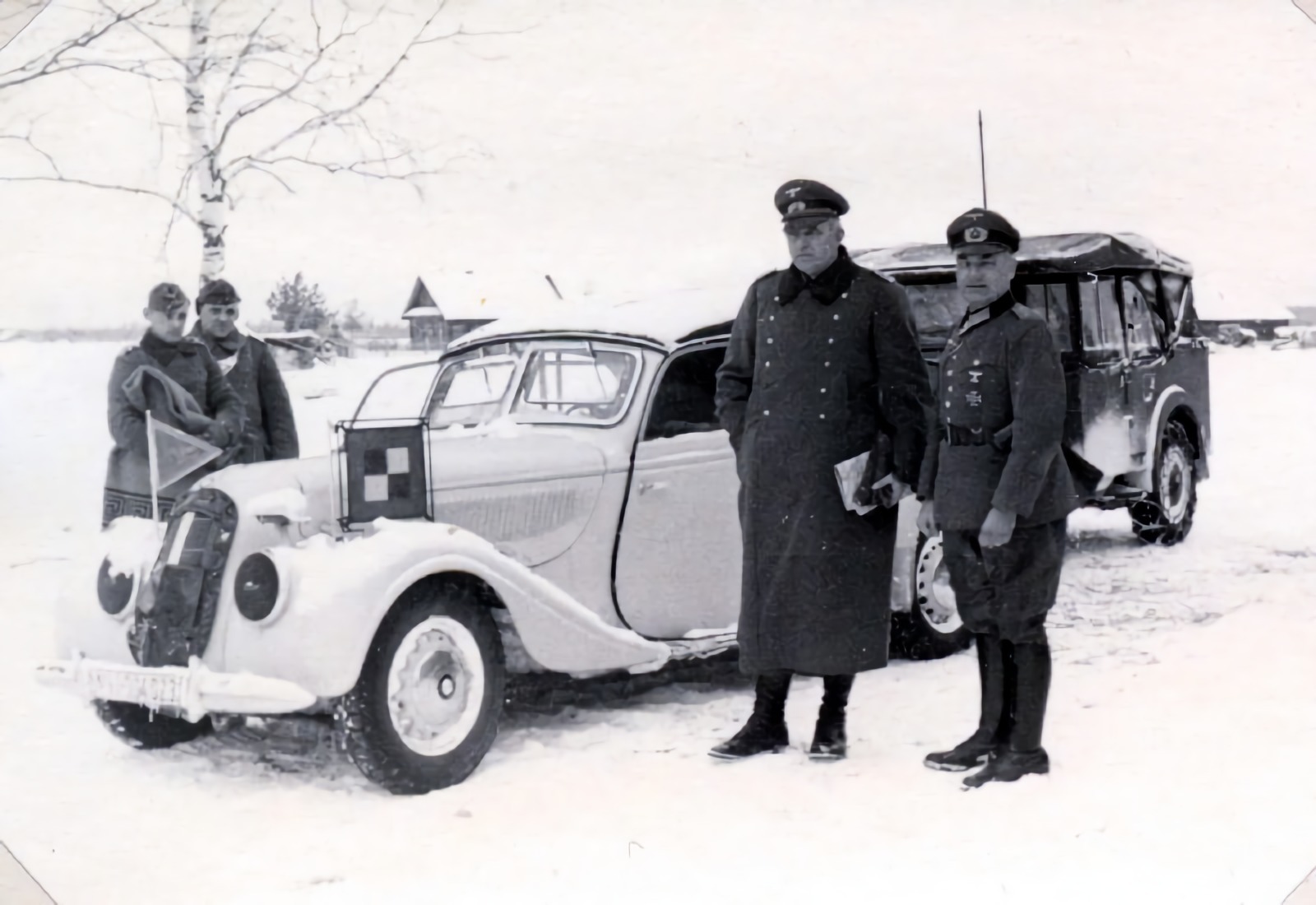
Generaloberst Ernst Busch (Oberbefehlshaber 16. Armee) poses with Oberst Erich Jaschke (right, Kommandeur Infanterie-Regiment 90 / 20.Infanterie-Division) in front of a BMW 335. This photo was most likely taken on the Volkhov front, northern sector of the Eastern Front, in the winter of 1941/42. At that time the Germans were not yet equipped with the winter white clothes and gear, so they wore the standard Wehrmacht coats or any other thick garment they could find in the field.


From left to right: General der Infanterie Gustav Höhne (Kommandierender General VIII. Armeekorps), Generalfeldmarschall Ernst Busch (Oberbefehlshaber 16. Armee), and Oberst i.G. Eberhard von Schönfeldt (Chef des Generalstabes VIII. Armeekorps). This picture was taken at Volkhov (Wolchow), Leningrad Front, probably in the fall of 1943.


Generalfeldmarschall Ernst Busch with his troops, possibly in the Eastern Front. No other information available. We can see the Eichenlaub hanging in his Ritterkreuz. He received the Ritterkreuz des Eisernen Kreuzes on 26 May 1940, while Eichenlaub on 21 August 1943.


Generalfeldmarschall Ernst Busch, possibly in the Eastern Front. No other information available. We can see the Eichenlaub hanging in his Ritterkreuz. He received the Ritterkreuz des Eisernen Kreuzes on 26 May 1940, while Eichenlaub on 21 August 1943.


Wehrmacht generals pose together in front of a wooden house in the central sector of the Eastern Front. Standing in the front row, from left to right: Generalfeldmarschall Ernst Busch (Oberbefehlshaber Heeresgruppe Mitte), Generaloberst Walter Weiss (Oberbefehlshaber 2. Armee), Generalleutnant Hans Krebs (Chef des Generalstabes Heeresgruppe Mitte), General der Infanterie Friedrich Hoßbach (Kommandierender General LVI. Panzerkorps), General der Artillerie Rudolf Freiherr von Roman (Kommandierender General XX. Armekorps), and Generalleutnant Hans Speth (Führer-Reserve Oberkommando des Heeres). Standing directly behind Weiss is Generalleutnant Gustav Harteneck (Kommandeur 72. Infanterie-Division). This photo was taken in May 1944 by Kriegsberichter Thiemann of Propaganda-Kompanie 670. Just one month later, this area under the command of Heeresgruppe Mitte fell apart after the Red Army launched Operation Bagration!


Generalfeldmarschall Ernst Busch in May 1944.

Source :
Bundesarchiv photo collection
ECPAD Archive (PK697 F798 L27)
https://www.alexautographs.com/auction-lot/ernst-busch_EEA4DAE81Dhttp:http://alifrafikkhan.blogspot.com/2017/10/generalfeldmarschall-ernst-busch-1885.html
https://www.ebay.de/itm/184886702008?mkevt=1&mkcid=1&mkrid=707-53477-19255-0&campid=5338722076&toolid=10001