Showing posts with label Milch - Erhard. Show all posts

Monday, July 20, 2026

Erhard Milch in the Nuremberg Trials (1945)


The Nuremberg trial of German Luftwaffe Generalfeldmarschall Erhard Milch in 1945. Milch (30 March 1892 – 25 January 1972) served as State Secretary in the Reichsluftfahrtministerium from 1933 to 1944 and Inspector General of the Luftwaffe from 1939 to 1945, playing a central role in the rearmament and wartime expansion of German air power through mass production of aircraft such as the Messerschmitt Bf 109 and oversight of the Jägerstab (Fighter Staff) initiative launched in March 1944 alongside Albert Speer to dramatically increase fighter output amid mounting Allied bombing. Captured by British forces on 4 May 1945 near the Baltic coast, Milch was indicted on 14 November 1946 and tried before United States Military Tribunal II in the Milch Trial (officially United States of America v. Erhard Milch), the second of the twelve Subsequent Nuremberg Trials held at the Palace of Justice in Nuremberg from 2 January to 17 April 1947. The three-count indictment charged him with war crimes for participating in the planning and execution of the ill-treatment, enslavement, and use of forced labor involving prisoners of war and deported foreign civilians to support Luftwaffe production (often sourced from concentration camps via SS cooperation under inhumane conditions); with crimes against humanity encompassing similar acts against civilians and German nationals; and specifically with involvement in fatal high-altitude and freezing medical experiments on unwilling subjects (Count II). Defended by his brother Werner Milch and other counsel, with the prosecution presenting 34 witnesses and 212 exhibits over 39 trial days, Milch was acquitted on the medical experiments charge but found guilty on the war crimes and crimes against humanity counts related to slave labor exploitation; he was sentenced to life imprisonment on 17 April 1947 and initially held at Rebdorf Prison near Munich (later transferred to Landsberg). In 1951 U.S. High Commissioner John J. McCloy commuted the sentence to fifteen years, leading to Milch’s parole in June 1954; he lived out his remaining years quietly in Düsseldorf as the last surviving Generalfeldmarschall of the Luftwaffe, having been central to the Nazi regime’s aircraft production efforts that relied heavily on the systematic exploitation of forced labor.


Source :
https://pixpast.wordpress.com/?query-10-page=3&cst&str=428&id_parent=7898&items=12&vd=downloaded&category=7902&flow=1

Wednesday, August 14, 2024

Eduard Dietl Funeral


Taken from 'Die Deutsche Wochenschau' Nr. 722 -5 July 1944: Black 4-door sedan drives up to group of German officers, doors opened by German soldier, Generaloberst Eduard Dietl wearing black leather coat steps out and is greeted by German Naval Officers. Dietl inspecting troops. Image and sound of German military snare drums, German Nazi flag waves in the breeze. Hitler arrives at state funeral for Generaloberst Dietl. Hitler shakes hands with widow, three young German girls and touches face of young German boy. Hitler delivers eulogy (no audio of Hitler). Hitler helps place large wreath at casket and gives Hitler or Nazi salute. All in attendance gives Hitler salute. Casket carried by German soldiers outside and placed on gun carriage. View of Nazi flag.


On Friday, 23 June 1944, exactly at 7:42 a.m., a Junkers Ju 52/3mg11 "A2+AA" (Werknummer 7596) transport aircraft belonging to the Wehrmacht crashed near the small village of Rettenegg, Styria (Austria). At the time of the incident, the aircraft was occupied by nine passengers, seven of whom died at the scene. Among those who lost their lives in the crash were leading Heer generals: Generaloberst Eduard Dietl (Oberbefehlshaber 20. Gebirgsarmee), General der Infanterie Thomas-Emil von Wickede (Kommandierender General X. Armeekorps), General der Gebirgstruppe Karl Eglseer (Kommandierender General XVIII. Gebirgskorps), and Generalleutnant Franz Rossi (Kommandeur Divisionsgruppe Rossi). Dietl last words were to the pilot shortly before take-off:  “No, we are not going to fly over the plain.  The clouds are six hundred meters above the ground.  I know the area and am glad to finally be back in my mountains.  I want to see them from above once more.  In Finland, everything is flat.  We will fly from Graz along the valley that goes to Judenberg.  From there we will follow the Semmering trace that goes to Mürzuschlag and from there to Vienna.”

The "Staatsbegräbnis" (State Funeral) was held on 3 July 1944. The honor guards were high-ranking Wehrmacht officers who were also Ritterkreuzträger (recipients of the Ritterkreuz des Eisernen Kreuzes): General der Gebirgstruppe Rudolf Konrad (Führerreserve) and General der Gebirgstruppe Georg Ritter von Hengl (Chef Nationalsozialistische-Führungsstabes im Oberkommando des Heeres).


Wehrmacht Honor guards during "Staatsbegräbnis" (State Funeral) of Generaloberst Eduard Dietl, 3 July 1944. At front left is General der Gebirgstruppe Rudolf Konrad (Führerreserve), while at front right is General der Gebirgstruppe Georg Ritter von Hengl (Chef Nationalsozialistische-Führungsstabes im Oberkommando des Heeres).


General der Gebirgstruppe Rudolf Konrad. Received the Ritterkreuz des Eisernen Kreuzes on 1 August 1942 as General der Gebirgstruppe and Kommandierender General XXXXIX. Gebirgskorps.


Major Wilhelm von Goriany. Received the Ritterkreuz des Eisernen Kreuzes on 18 July 1943 as Major and Kommandeur II.Abteilung / Gebirgs-Artillerie-Regiment 85 / 101.Jäger-Division.


Feldwebel Ulrich Karg. Received the Ritterkreuz des Eisernen Kreuzes on 5 July 1943 as Oberjäger and Zugführer in Radfahrzug 17 / Gebirgsjäger-Regiment 91 / 4.Gebirgs-Division.


Feldwebel Josef Ehinger. Received the Ritterkreuz des Eisernen Kreuzes on 22 August 1943 as Oberjäger and Gruppenführer in 6.Kompanie / II.Bataillon / Gebirgsjäger-Regiment 10 / 5.Gebirgs-Division.


From left to right: Generalfeldmarschall Erhard Milch (Generalinspekteur der Luftwaffe) and Generalfeldmarschall Günther von Kluge (Oberbefehlshaber West und Oberbefehlshaber Heeresgruppe D).


Source :
http://alifrafikkhan.blogspot.com/2010/11/album-foto-eduard-dietl.html
https://www.buyoutfootage.com/pages/titles/pd_dc_502a.php
https://www.thefifthfield.com/2000-quotes/state-funeral-for-general-dietl/
https://www.youtube.com/watch?v=dHL8cxpPj1w

Sunday, October 29, 2023

New Generalfeldmarschall Ceremony in 1940


The 1940 Field Marshal Ceremony refers to a promotion ceremony held at the Kroll Opera House in Berlin in which Adolf Hitler promoted twelve generals to the rank of Generalfeldmarschall ("field marshal") on 19 July 1940. It was the first occasion in World War II that Hitler appointed field marshals due to military achievements.

The prestigious rank of field marshal had been banned after World War I. As part of German rearmament, the rank was revived. Hitler promoted twelve selected generals to field marshal during the ceremony in Berlin for their role in the swift victory in the Battle of France and to raise morale. The ceremony highlighted the power and prestige of the Wehrmacht; France was considered to have had the strongest army in Europe, yet had been humiliatingly defeated in just six weeks. The ceremony was the first time Hitler appointed field marshals due to military achievements and was celebrated like no other promotion ceremony of the war.

During the same ceremony, Göring, already Generalfeldmarschall since 1938, was promoted to the rank, newly-created especially for him, of Reichsmarschall.

After World War I, the prestigious rank of field marshal was banned in the Weimar Republic, alongside other restrictions of the Treaty of Versailles. After Hitler and the Nazi Party came to national power in January 1933, they began an expansion of the military; it was part of Hitler's desire to restore the army's power and prestige. In 1936, he revived the rank of Generalfeldmarschall. It was the highest and most prestigious military rank in Germany, originally only for the use of War Minister and Commander-in-Chief Werner von Blomberg. The traditional attribute distinguishing a German field marshal was an ornately decorated baton. More tangible benefits included a yearly salary of 36,000 Reichsmarks for life (a Field Marshal was deemed never to retire, but to remain permanently on active duty) and all earnings being exempt from income tax.

Flushed with enthusiasm by the swift defeat of the French army, considered to have been the strongest in Europe, and the Low Countries in June 1940, Hitler wanted to mark the occasion with a grand promotion ceremony. He also hoped the promotions would strengthen his influence over the traditional German General Staff. The twelve generals chosen for promotion, who all had played an important role in the victory, were (with the position they occupied during the Battle of France):

Generaloberst Wilhelm Keitel (Chef Oberkommando der Wehrmacht)
Generaloberst Walther von Brauchitsch (Oberbefehlshaber des Heeres)
Generaloberst Gerd von Rundstedt (Oberbefehlshaber Heeresgruppe A)
Generaloberst Fedor von Bock (Oberbefehlshaber Heeresgruppe B)
Generaloberst Wilhelm Ritter von Leeb (Oberbefehlshaber Heeresgruppe C)
Generaloberst Erwin von Witzleben (Oberbefehlshaber 1. Armee)
Generaloberst Günther von Kluge (Oberbefehlshaber 4. Armee)
Generaloberst Walther von Reichenau (Oberbefehlshaber 6. Armee)
Generaloberst Wilhelm List (Oberbefehlshaber 12. Armee)
Generaloberst Erhard Milch (Generalinspekteur der Luftwaffe)
General der Flieger Albert Kesselring (Chef Luftflotte 2)
General der Flieger Hugo Sperrle (Chef Luftflotte 3)

In addition, 19 high-ranking officers were also appointed as new Generaloberst (14 from the Heer and 5 from the Luftwaffe):

General der Artillerie Franz Halder (Chef des Generalstabes des Heeres)
General der Artillerie Friedrich Fromm (Chef Heeresrüstung und Befehlshaber des Ersatzheeres)
General der Infanterie Nikolaus von Falkenhorst (Oberbefehlshaber Heeresgruppe XXI)
General der Kavallerie Maximilian von Weichs (Oberbefehlshaber 2. Armee)
General der Artillerie Friedrich Dollmann (Oberbefehlshaber 7. Armee)
General der Infanterie Adolf Strauß (Oberbefehlshaber 9. Armee)
General der Infanterie Ernst Busch (Oberbefehlshaber 16. Armee)
General der Artillerie Georg von Küchler (Oberbefehlshaber 18. Armee)
General der Artillerie Curt Haase (Kommandierender General III. Armeekorps)
General der Infanterie Eugen von Schobert (Kommandierender General VII. Armeekorps)
General der Infanterie Hermann Hoth (Kommandierender General XV. Armeekorps [mot.])
General der Kavallerie Erich Hoepner (Kommandierender General XVI. Armeekorps [mot.])
General der Panzertruppe Heinz Guderian (Kommandierender General XIX. Armeekorps [mot.])
General der Kavallerie Ewald von Kleist (Kommandierender General XXII. Armeekorps [mot.])
General der Flieger Ernst Udet (Generalluftzeugmeister und Chef Planungsamts der Luftwaffe)
General der Flieger Hans-Jürgen Stumpff (Chef Luftflotte 5)
General der Flieger Ulrich Grauert (Kommandierender General I. Fliegerkorps)
General der Flieger Alfred Keller (Kommandierender General IV. Fliegerkorps)
General der Flakartillerie Hubert Weise (Kommandierender General I. Flakkorps)

In particular, all Army Group commanders were promoted Field Marshal. In the case of Kesselring and Sperrle, the rank of Colonel General was bypassed. The commanders-in-chief of Navy and Air Force, Erich Raeder and Hermann Göring respectively, were not promoted Field Marshals because they already held the rank (or its equivalent Grand Admiral respectively). Given that Field Marshal was no longer as exceptional a rank as it was before, Göring, to satisfy his thirst for prestige, was promoted to the specially created rank of Reich Marshal. This made Göring the senior officer of the military, without, however, making him an actual superior of Army and Navy. It also underscored his status as Hitler's designated successor. He was the only person awarded this rank during the Nazi era, and it was abolished after the fall of the Nazi regime.

On 19 July 1940, Hitler summoned the generals to a ceremony in Berlin's Kroll Opera House (which housed the Reichstag after the Reichstag fire). After a speech regarding a peace proposal directed at Britain, Hitler personally rewarded his generals with their expensively decorated batons, and thanked them for their contributions to the victory.

The 1940 Field Marshal Ceremony was the first occasion Hitler appointed field marshals due to military achievements and was celebrated like no other promotion ceremony in Germany. The remaining five years of the war saw an additional twelve promotions, most of which were without ceremony, such as Friedrich Paulus's promotion, which was conferred over the radio by Hitler.

All of the generals promoted went on to achieve further success in their careers during the early years of victory which the German military obtained in the Second World War. Brauchitsch, Bock, Kesselring, Keitel, Leeb, List, Reichenau, Rundstedt, and Göring would all play decisive and important roles in the German-led Axis invasion of the Soviet Union in 1941. Sperrle spent the rest of the war in semi-retirement, based with his unit in France. Milch was transferred to the production department and was responsible for aircraft production until the end of the war. Following his avid extermination of Jews in the autumn of 1941 (Severity Order, Babi Yar), Reichenau died on 14 January 1942. In 1943, after a series of German defeats on the Eastern Front, and the Allied invasion of Italy, the German military lost all initiative. Hitler's leadership became increasingly disconnected from reality as the war turned against Germany, with the military's defensive strategies often hindered by his slow decision making and frequent directives to hold untenable positions. His response to the worsening war situation was to unceremoniously sack general after general, a routine which ultimately affected the field marshals promoted at the ceremony. Erwin von Witzleben and Günther von Kluge were both involved in the 20 July Plot to assassinate Hitler. After it became clear that the assassination attempt had failed, Kluge committed suicide by taking cyanide poison on 17 August 1944. Witzleben was to have become Commander-in-Chief of the Wehrmacht if the attempt had succeeded. He was arrested, stripped of his rank and expelled from the Army so that he could be tried in a civilian court, and sentenced to death; the execution was carried out on 8 August 1944. On 4 May 1945, less than a week before Nazi Germany surrendered, Bock died of wounds inflicted the day before by a strafing British fighter-bomber.


Shoulder strap rank insignia of a Generalfeldmarschall (field marshal) in 1940.


A Marschallstab (Field Marshal baton) of the Nazi German era.


New Generalfeldmarschall ceremony for Wehrmacht high ranking officers which were held at Krolloper, Berlin, on 19 July 1940. Adolf Hitler (Führer und Oberster Befehlshaber der Wehrmacht) handed over the Marschallstab to the new Field Marshals. From left to right: Oberst Rudolf Schmundt (Chefadjutant des Heeres beim Führer und Oberbefehlshaber der Wehrmacht), Adolf Hitler (Führer und Reichskanzler), serta para penerima: Fedor von Bock (Oberbefehlshaber Heeresgruppe B), Wilhelm Ritter von Leeb (Oberbefehlshaber Heeresgruppe C), Wilhelm List (Oberbefehlshaber 12. Armee), Hans-Günther von Kluge (Oberbefehlshaber 4. Armee), Erwin von Witzleben (Oberbefehlshaber 1. Armee), and Walther von Reichenau (Oberbefehlshaber 6. Armee).


New Generalfeldmarschall ceremony for Wehrmacht high ranking officers which were held at Krolloper, Berlin, on 19 July 1940. Adolf Hitler (Führer und Oberster Befehlshaber der Wehrmacht) posed with 9 new Field Marshals from Heer, along with Generalfeldmarschall Hermann Göring (Oberbefehlshaber der Luftwaffe) who was promoted to the Reichsmarschall rank. They're already holding the Marschallstab (Marshal Baton), specially designed for them. From left to right: Wilhelm Keitel (Chef des Oberkommando der Wehrmacht), Gerd von Rundstedt (Oberbefehlshaber Heeresgruppe A), Fedor von Bock (Oberbefehlshaber Heeresgruppe B), Göring and Hitler, Walther von Brauchitsch (Oberbefehlshaber des Heeres), Wilhelm Ritter von Leeb (Oberbefehlshaber Heeresgruppe C), Wilhelm List (Oberbefehlshaber 12. Armee), Hans-Günther von Kluge (Oberbefehlshaber 4. Armee), Erwin von Witzleben (Oberbefehlshaber 1. Armee), and Walther von Reichenau (Oberbefehlshaber 6. Armee).


New Generalfeldmarschall ceremony for Wehrmacht high ranking officers which were held at Krolloper, Berlin, on 19 July 1940. Adolf Hitler (Führer und Oberster Befehlshaber der Wehrmacht) posed with 3 new Field Marshals from Luftwaffe, along with Generalfeldmarschall Hermann Göring (Oberbefehlshaber der Luftwaffe) who was promoted to the Reichsmarschall rank. They're already holding the Marschallstab (Marshal Baton), specially designed for them. From left to right: Generalfeldmarschall Erhard Milch (Generalinspekteur der Luftwaffe als Vertreter des Oberbefehlshabers Göring), Generalfeldmarschall Hugo Sperrle (Chef Luftflotte 3), Hitler, Göring, and Generalfeldmarschall Albert Kesselring (Chef Luftflotte 2). In total there were five Luftwaffe Marshals during World War II, with the remaining two were appointed after this event: Generalfeldmarschall Wolfram Freiherr von Richthofen (16 February 1943) and Generalfeldmarschall Robert Ritter von Greim (25 April 1945).


Still at the special promotion ceremony for Germany's new generals and marshals which was held on 19 July 1940 in Krolloper, Berlin. This photo shows Hitler greeting the new Generaloberst (Colonel-General), one rank lower than Generalfeldmarschall. From left to right: Großadmiral Erich Raeder (Oberbefehlshaber der Kriegsmarine), Generalfeldmarschall Walther von Brauchitsch (back to the camera, Oberbefehlshaber des Heeres), and Generalfeldmarschall Erhard Milch (Generalinspekteur der Luftwaffe als Vertreter des Oberbefehlshabers Göring). Next are the officers who were promoted to the rank of Generaloberst: General der Artillerie Franz Halder (Chef des Generalstabes des Heeres), General der Artillerie Friedrich Dollmann (blocked by Hitler, Oberbefehlshaber 7. Armee), General der Kavallerie Ewald von Kleist (blocked by Hitler, Kommandierender General XXII. Armeekorps [motorisiert]), General der Kavallerie Maximilian Reichsfreiherr von Weichs (Oberbefehlshaber 2. Armee), General der Artillerie Georg von Küchler (Oberbefehlshaber 18. Armee), General der Infanterie Eugen Ritter von Schobert (bersalaman dengan Hitler, Kommandierender General VII. Armeekorps), General der Infanterie Ernst Busch (Oberbefehlshaber 16. Armee), General der Panzertruppe Heinz Guderian (Kommandierender General XIX. Armeekorps [motorisiert]), and General der Infanterie Hermann Hoth (Kommandierender General XV. Armeekorps). Interestingly, the new Generaloberst (from Halder to Hoth) stand in order of seniority. Other generaloberst appointed on the same day but not visible in this photo were (in order from left to right after Hoth): General der Infanterie Adolf Strauß (Kommandierender General II. Armeekorps), General der Artillerie Curt Haase (Kommandierender General III. Armeekorps), General der Infanterie Nikolaus von Falkenhorst (Oberbefehlshaber Armeegruppe XXI), General der Kavallerie Erich Hoepner (Kommandierender General XVI. Armeekorps [motorisiert]), and General der Artillerie Friedrich "Fritz" Fromm (Chef der Heeresrüstung und Befehlshaber des Ersatzheeres). In total there are new 14 Generaloberst!


The Wehrmacht generals sat in the Krolloper (Kroll Opera House) during the Reichstagssitzung (Reichstag session) on July 19 1940, where Germany had just won the war over France and England in the Battle of France, and several new Marshals were appointed by Hitler with other generals in the lower rank. For the identification based on numbers: 1: Hans-Günther von Kluge (promoted to Generalfeldmarschall), 2: Fedor von Bock (promoted to Generalfeldmarschall), 3: Gerd von Rundstedt (promoted to Generalfeldmarschall), 4: Wilhelm Ritter von Leeb (promoted to Generalfeldmarschall), 5: Wilhelm List (promoted to Generalfeldmarschall), 6: Johannes Blaskowitz (promoted to Generaloberst), 7: Ernst Busch (promoted to Generaloberst), 8: Georg von Küchler (promoted to Generaloberst), 9: unknown admiral, 10: Alfred von Vollard Bockelberg (General der Artillerie), 11: Curt Ludwig Freiherr von Gienanth (General der Kavallerie z.V.), 12: Ewald von Kleist (promoted to Generaloberst), 13: Friedrich "Fritz" Fromm (promoted to Generaloberst), 14: Franz Halder (promoted to Generaloberst), 15: Walter Heitz (General der Artillerie), 16: Adolf Strauß (promoted to Generaloberst), 17: unknown, 18: unknown, 19: unknown, 20: Walther von Reichenau (promoted to Generalfeldmarschall), 21: Alexander von Falkenhausen (Char. General der Infanterie), 22: Werner Kienitz (General der Infanterie), 23: Hermann Hoth (promoted to Generaloberst), 24: Sigismund von Förster (Generalleutnant), 25: unknown, 26: unknown, 27: Richard Ruoff (General der Infanterie), 28: Erich Hoepner (promoted to Generaloberst), 29: unknown, 30: Emil Leeb (General der Artillerie), 31: Alfred Streccius (bearded, Charakter als General der Infanterie), 32: unknown, 33: Friedrich Olbricht (General der Infanterie), 34: Curt Haase (promoted to Generaloberst), 35: Georg Hans Reinhardt (General der Panzertruppe), 36: Rudolf Schmidt (General der Panzertruppe), 37: Heinrich von Vietinghoff (General der Panzertruppe), 38: Erich von Manstein (hand on nose, General der Infanterie), 39: Georg Stumme (General der Kavallerie), 40: unknown, 41: unknown, 42: unknown, 43: Joachim von Kortzfleisch (Generalleutnant), 44: unknown, and 45: unknown. The one who gave the "Hitlergruß" (Nazi salute) is Ewald von Kleist, who stand after his name is mentioned from the loud spaker. Additional Information: BTW, the rank in the brackets is the rank when this photo was taken (July 19, 1940) and not their last rank!


Source :
http://alifrafikkhan.blogspot.com/2018/10/upacara-marsekal-baru-tahun-1940.html
https://audiovis.nac.gov.pl/obraz/27767/fbd6827600bbc526b48cf694702bcfd2/
https://en.wikipedia.org/wiki/1940_Field_Marshal_Ceremony
https://forum.axishistory.com/viewtopic.php?f=5&t=45458&hilit=brauchitsch
https://www.gettyimages.com/detail/news-photo/hitlers-speech-and-honor-of-the-leadership-of-the-wehrmacht-news-photo/548866851

Sunday, March 26, 2023

Heldengedenktag (Heroes' Remembrance Day) 1943

On 21 March 1943, all of Germany commemorates 'Heldengedenktag' (Heroes' Remembrance Day). On this occasion, a state ceremony took place in the Berliner Zeughaus (Berlin armory), in which Hitler also took part. Seated in the front-left row, from left to right: Reichskriegsopferführer Hanns Oberlindober, Generalfeldmarschall Fedor von Bock (Führerreserve), Generalfeldmarschall Erhard Milch (Generalinspekteur der Luftwaffe), Reichsführer-SS Heinrich Himmler (Chef der SS und deutschen Polizei), Großadmiral Karl Dönitz (Oberbefehlshaber der Kriegsmarine), Generalfeldmarschall Wilhelm Keitel (Chef Oberkommando der Wehrmacht), Reichsmarschall Hermann Göring (Oberbefehlshaber der Luftwaffe), and Adolf Hitler (Führer und Oberster Befehlshaber der Wehrmacht). Seated in the front-right row, from left to right: Reichsminister Joachim von Ribbentrop, Reichsminister Dr. Joseph Goebbels, Reichsminister Dr. Wilhelm Frick, SS-Oberstgruppenführer und Generaloberst der Polizei Kurt Daluege, Reichsminister Franz Seldte, Reichsleiter Dr. Robert Ley, and SS-Obergruppenführer Dr. Philipp Bouhler.


Source :
https://www.gettyimages.com/detail/news-photo/german-military-officers-including-hermann-goering-wilhelm-news-photo/493272171
https://ww2db.com/image.php?image_id=11336

Saturday, December 17, 2022

Udet, Milch and Stumpff in Leather Coat


Cool picture of Luftwaffe high ranking officials wearing ledermantel (leather coat), 18 October 1937. Front row from left to right: Generalmajor Ernst Udet (Direktor des Technischen Amts der Luftwaffe im Reichsluftfahrtministerium), General der Flieger Erhard Milch (Generalinspekteur der Luftwaffe), Generalleutnant Hans-Jürgen Stumpff (Chef des Generalstabes der Luftwaffe), and Generalmajor Ralph Wenninger (Luftwaffenattaché an der Deutschen Botschaft in London).

Source :
https://forum.axishistory.com/viewforum.php?f=5

Wednesday, December 14, 2022

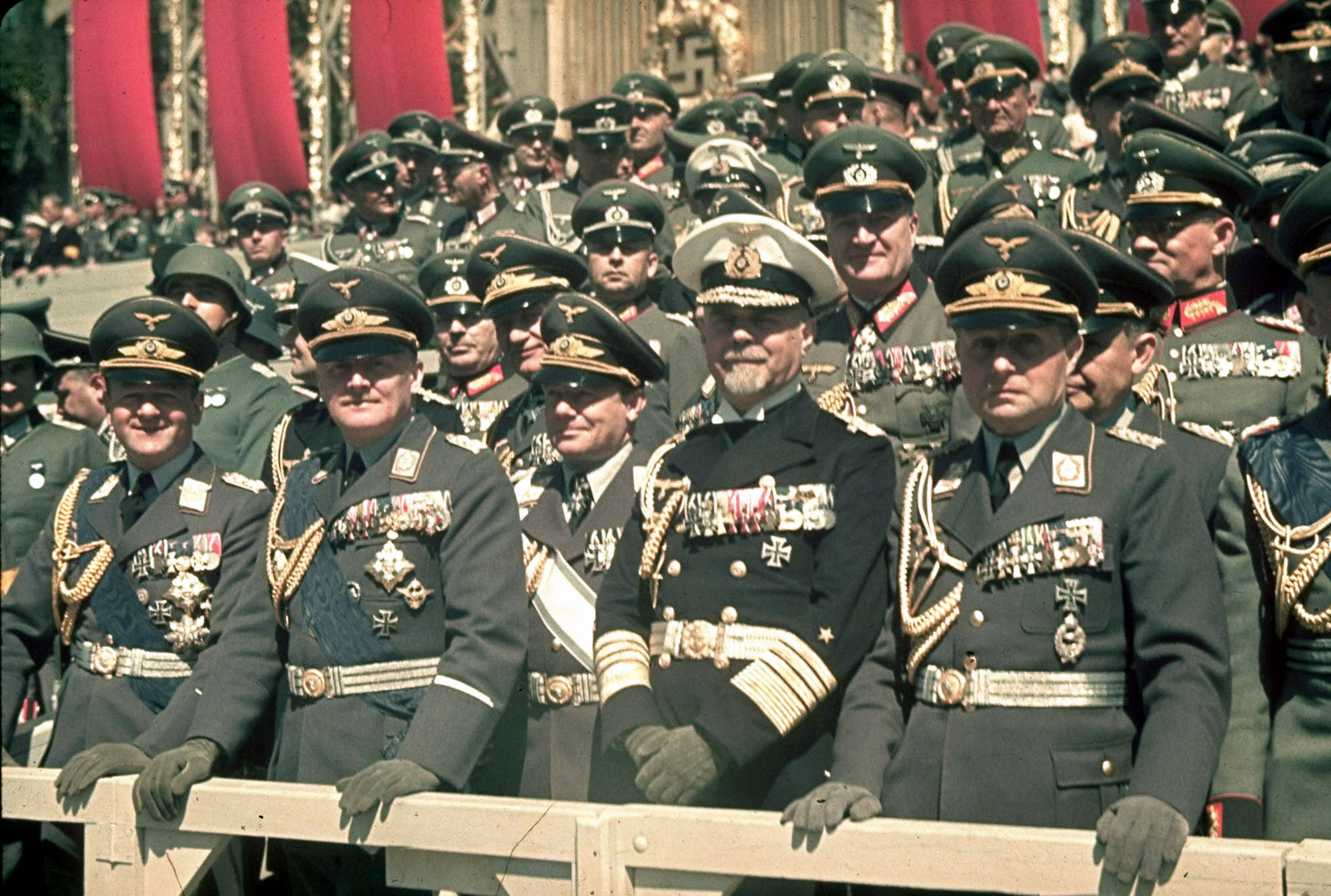
German Generals and Admirals at Führergeburtstag


Generals and admirals of the Wehrmacht stood in the stands of honor at the culmination of Adolf Hitler's 50th birthday celebration, which was held in Berlin on April 20, 1939. They all wore paradeanzug (parade uniform), complete with feldbinde (brocade belt), auszeichnungen (medal bars) and schnurr (lanyard). Front row from left to right: Generaloberst Erhard Milch (Generalinspekteur der Luftwaffe), General der Flieger Hans-Jürgen Stumpff (Chef der Luftwehr), Generalleutnant Ernst Udet (Generalluftzeugmeister und Chef Planungsamts der Luftwaffe), Admiral Max Bastian (Präsident Reichsfürsorge- und Versorgungsgerichts der Wehrmacht), and Generalmajor Friedrich Fahnert (Höheren Kommandeur Luftnachrichtenschule Berlin). For additional identification: Generalleutnant Walter Petzel (Inspekteur der Artillerie) is the bespectacled man standing behind Fahnert; Generalmajor Hermann von Hanneken (Bevollmächtigter für Eisen- und Stahl auch zum Leiter der Hauptabteilung II Industrie) stood between Bastian and Fahnert, Generaloberst Wilhelm List (Oberbefehlshaber Heeres-Gruppenkommando 5) between Udet and Bastian, and General der Flieger Friedrich Christiansen (Korpsführer NSFK) between Stumpff and Udet. This photo itself was made by Hitler's personal photographer, Hugo Jaeger. Note that Milch and Stumpff both wear the Star of the Yugoslav Order of the Crown on their chests!

Source :
http://alifrafikkhan.blogspot.com/2010/10/koleksi-ratusan-foto-berwarna-dari-life.html
https://artsandculture.google.com/entity/m064km4b?hl=en

Thursday, December 1, 2022

Erhard Milch during 'Tag der Luftwaffe'

Berlin-Gatow, 21 April 1936 - The dedication of pilot flags ceremony during 'Tag der Luftwaffe' (Day of the Air Force), on the occasion of the 18th anniversary of the death of Manfred von Richthofen, the famous German flying ace in World War I. From left to right: General der Flieger Leonhard Kaupisch (Befehlshaber vom Luftkreiskommando II in Berlin), General der Flieger Erhard Milch (Generalinspekteur der Luftwaffe), and unknown. The picture was taken by Georg Pahl.

Source :
https://forum.axishistory.com/viewforum.php?f=5

Sunday, October 16, 2022

Ceremony for New Generaloberst in 1940

The ceremony for the appointment of the new generals and marshals of Germany which was held on 19 July 1940 in Krolloper, Berlin. This photo shows Hitler greeting the new Generaloberst appointed on the same day. From left to right: Großadmiral Erich Raeder (Oberbefehlshaber der Kriegsmarine), Generalfeldmarschall Walther von Brauchitsch (back to the camera, Oberbefehlshaber des Heeres), and Generalfeldmarschall Erhard Milch (Generalinspekteur der Luftwaffe als Vertreter des Oberbefehlshabers Göring). Next is the officers who were promoted to Generaloberst: General der Artillerie Franz Halder (Chef des Generalstabes des Heeres), General der Artillerie Friedrich Dollmann (tidak kelihatan, Oberbefehlshaber 7. Armee), General der Kavallerie Ewald von Kleist (not visible, Kommandierender General XXII. Armeekorps [motorisiert]), General der Kavallerie Maximilian Reichsfreiherr von Weichs (Oberbefehlshaber 2. Armee), General der Artillerie Georg von Küchler (Oberbefehlshaber 18. Armee), General der Infanterie Eugen Ritter von Schobert (shake hands with Hitler, Kommandierender General VII. Armeekorps), General der Infanterie Ernst Busch (Oberbefehlshaber 16. Armee), General der Panzertruppe Heinz Guderian (Kommandierender General XIX. Armeekorps [motorisiert]), and General der Infanterie Hermann Hoth (Kommandierender General XV. Armeekorps). Interestingly, the new Generaloberst (from Halder to Hoth) stands according to the order of seniority. Other Generaloberst appointed on the same day but not seen in this photo are (in order from left to right after Hoth): General der Infanterie Adolf Strauß (Kommandierender General II. Armekorps), General der Artillerie Curt Haase (Kommandierender General III. Armekorps) ), General der Infanterie Nikolaus von Falkenhorst (Oberbefehlshaber Armeegruppe XXI), General der Kavallerie Erich Hoepner (Kommandierender General XVI. Armekorps [motorisiert]), and General der Artillerie Friedrich "Fritz" Fromm (Chef der Heeresrüsheeber und Erfesatzheeber und Befehlerie). There are 14 new Generalobers in total!

Source :
http://alifrafikkhan.blogspot.com/2018/10/upacara-marsekal-baru-tahun-1940.html

Saturday, October 15, 2022

Wehrmacht High Ranking Officers at Reichsparteitag

From left to right: General der Flieger Erhard Milch (Staatssekretär im Luftfahrtministerium), General der Artillerie Wilhelm Keitel (Chef Oberkommando der Wehrmacht), Generaloberst Walther von Brauchitsch (Oberbefehlshaber des Heeres), Generaladmiral Erich Raeder (Oberbefehlshaber der Kriegsmarine), and General der Kavallerie Maximilian Reichsfreiherr von Weichs (Kommandierender General XIII. Armeekorps). This photo was taken on September 12, 1938, during the closing ceremony of the Reichsparteitag Großdeutschland Tag der Wehrmacht which were held in Nuremberg (Germany). This event itself has been taking place from September 5, 1938.

Source :
https://commons.wikimedia.org/wiki/File:Erhard_Milch,_Wilhelm_Keitel,_Walther_von_Brauchitsch,_Erich_Raeder,_and_Maximilian_von_Weichs.jpg

Sunday, October 9, 2022

48th Birthday of Hermann Göring

Commander in Chief of the German Air Force Reichsmarschall Hermann Göring posing together with other high ranking Luftwaffe officers on the occasion of his 48th birthday celebration, 12 January 1941. From left to right: Generaloberst Hans-Jürgen Stumpff (Chef Luftflotte 5 und Befehlshaber Nord), Generalfeldmarschall Albert Kesselring (Chef Luftflotte 2), General der Flieger Friedrich Christiansen (Wehrmachtbefehlshaber in den von Deutschland besetzten Niederlanden), Generalfeldmarschall Erhard Milch (Generalinspekteur der Luftwaffe), Göring (Oberbefehlshaber der Luftwaffe), Generaloberst Alfred Keller (Chef Luftflotte 1), General der Flieger Hans Jeschonnek (Chef des Generalstabes der Luftwaffe), Generaloberst Ernst Udet (Generalluftzeugmeister und Chef des Planungsamts der Luftwaffe), Generaloberst Hubert Weise (Befehlshaber der Luftverteidigung für die Luftgaue III und IV), and Generalleutnant Gustav Kastner-Kirdorf (Chef des Luftwaffen-Personalamtes).

Source :
https://www.kometmilitaria.com/product-page/period-press-picture-G%C3%B6ring-Milch

Sunday, February 21, 2021

The Visit of Miklós Horthy to Kiel

The official visit of Hungarian leader Miklós Horthy de Nagybánya to the launching of the German heavy cruiser (schwere kreuzer) "Prinz Eugen",which were  held at the Germaniawerft (Kiel) shipyard on 22 August 1938. Walking at the front is the commander of Hitler's SS bodyguards, Sepp Dietrich, followed by Adolf Hitler (Führer und Reichskanzler), Miklós Horthy, Generaladmiral Erich Raeder (Oberbefehlshaber der Kriegsmarine), General der Artillerie Wilhelm Keitel (Chef des Oberkommando der Wehrmacht), Generaloberst Walther von Brauchitsch (Oberbefehlshaber des Heeres), Vizeadmiral Karlgeorg Schuster (Befehlshaber der Sicherung der Ostsee), and General der Flieger Erhard Milch (Generalinspekteur der Luftwaffe als Vertreter des Oberbefehlshabers Göring).


Source :
Denis Daum photo collection

Wednesday, December 30, 2020

Parade of Legion Condor at Hamburg

Parade of the "Legion Condor" in front of Generalfeldmarschall Hermann Göring (Oberbefehlshaber der Luftwaffe) at the Karl Muck-Platz, Hamburg, 31 May 1939. The other identification as follow:

1.Generalmajor Dr.Ing. Wolfram Freiherr von Richthofen (third and last commander of Legion Condor)
2.Generalleutnant Hellmuth Volkmann (second commander of Legion Condor)
3.General der Flieger Hugo Sperrle (first commander of Legion Condor)
4.Generaloberst Erhard Milch (Generalinspekteur der Luftwaffe)
5.Generaladmiral Conrad Albrecht (Marinegruppenbefehlshaber Ost)
6.General der Kavallerie Wilhelm Knochenhauer (Kommandierender General X. Armeekorps)


Source :
Photo and ID courtesy of Graveland
https://search.iisg.amsterdam/Record/838364

Sunday, December 20, 2020

State Funeral of Generalmajor Fritz Löb (Luftwaffe)


25 June 1940: Staatsbegräbnis (State Funeral) for Generalmajor der Luftwaffe Fritz Löb (14 September 1895 - 22 June 1940), Kommandierender General und Befehlshaber im Luftgau Belgien-Nordfrankreich, who died in an air accident in Belgium. Wehrmacht officers lined up to accompany the body to the final resting place at Waldfriedhof Dahlem, Berlin. The identification is as follows: 1.Generalmajor Otto Mooyer (Bevollmächtigter des Reichsluftfahrtministeriums für das Luftfahrtindustriepersonal und Kommandeur der Fliegertechnischen Vorschulen), 2.Charakter als General der Flieger Erich Quade (Höheren Flieger-Ausbildungs-Kommandeur III), 3.Generalmajor Hermann von Hanneken (Bevollmächtigter für Eisen- und Stahl auch zum Leiter der Hauptabteilung II - Industrie), 4.Generalleutnant Ernst Seifert (Kommandant von Berlin), 5.General der Flieger Wilhelm Wimmer (Chef Luftflotte 1), 6.General der Infanterie Waldemar Erfurth (Oberquartiermeister V im Oberkommando des Heeres), 7.General der Flakartillerie Günther Rüdel (Befehlshaber der Luftverteidigung und Inspekteur des Luftschutzes), 8.Charakter als General der Flieger Eduard Dransfeld (Inspekteur des Kraftfahrwesens der Luftwaffe im Reichsluftfahrtministerium), 9.Charakter als Generalmajor Fritz Todt (Reichsminister für Bewaffnung und Munition), 10.Generaloberst Erhard Milch (Generalinspekteur der Luftwaffe), 11.General der Flieger Bodo von Witzendorff (Chef vom Zentralamt), and 12.General der Flieger Waldemar Klepke (Höheren Flieger-Ausbildungs-Kommandeur 3).


Source :
https://audiovis.nac.gov.pl/obraz/36514/51d72c2b91bff7a91d0c0351702b774e/
https://forum.axishistory.com/viewtopic.php?f=5&t=14230&p=1771458&hilit=mooyer+erfurth#p1771458