Showing posts with label 9 Pour le Merite. Show all posts

Sunday, July 19, 2026

Original Color Photographs of Fedor von Bock by Walter Frentz


Generalfeldmarschall Fedor von Bock (Oberbefehlshaber Heeresgruppe Süd) in a picture taken in 1942 by Walter Frentz, during a meeting with Hitler. Von Bock served as commander in chief of Heeresgruppe Süd from 20 January 1942, succeeding Generalfeldmarschall Walter von Reichenau who had died of a stroke, and immediately faced the challenge of stabilizing the southern sector of the Eastern Front after the Red Army's winter counteroffensive had pushed German forces back from their advanced positions. A highly experienced Prussian staff officer and field commander known for his methodical approach and loyalty to traditional military principles, Bock took charge of a massive formation encompassing the 2. Armee under Maximilian von Weichs, the 6. Armee under Friedrich Paulus, the 17. Armee, the 1. Panzerarmee, and various allied contingents from Romania, Hungary, and Italy. In May 1942 he masterminded the successful German response to the Soviet Kharkov offensive, launching a devastating counterstroke that encircled and largely destroyed the Soviet South-Western Front, inflicting around 280,000 casualties and capturing enormous quantities of tanks, artillery, and supplies, thereby restoring the initiative to the Wehrmacht in the south and severely weakening Soviet armored capabilities ahead of the summer campaign. On 28 June 1942 Bock directed the launch of Operation Blue, the major German summer offensive, with his armies striking from the Kharkov and Kursk areas, rapidly advancing toward Voronezh and the Don River through coordinated panzer thrusts by Hoth's 4. Panzerarmee and Paulus's 6. Armee, achieving deep penetrations that split Soviet defenses and opened pathways toward the Volga and Caucasus. Despite these early gains Bock clashed repeatedly with Adolf Hitler over operational priorities, urging the destruction of remaining Soviet forces around Voronezh to secure flanks before committing to further eastward drives, warnings that highlighted his cautious professionalism against Hitler's more ambitious and risk-tolerant directives. These disagreements culminated on 7 July when Hitler split Heeresgruppe Süd into separate Army Groups A and B, and on 17 July relieved Bock of command, placing him in the Führerreserve for the remainder of the war and effectively ending his active military career despite the significant momentum his leadership had restored to German operations in the east that year.


Source :
https://www.tracesofwar.com/persons/193/Bock-von-Moritz-Albrecht-Friedrich-Franz-Fedor.htm
https://www.walter-frentz-collection.de/fotoarchiv/personenarchiv-a-z/personen-a-b/

Friday, June 26, 2026

Ritterkreuzträger with Pour le Mérite


The Pour le Mérite, informally known as the "Blue Max" or "Blauer Max" after World War I flying ace Max Immelmann, is a prestigious Prussian order of merit established between 7 and 15 June 1740 by King Frederick II of Prussia, succeeding the earlier Ordre de la Générosité founded in 1667. Named in French, the court language of the era, its military class became the Kingdom of Prussia's highest decoration for bravery and leadership among officers of all ranks, awarded for repeated acts of gallantry or outstanding command rather than single heroic deeds, with the insignia consisting of a blue-enameled Maltese cross edged in gold, featuring golden eagles between the arms, the Prussian royal cypher, and the words "Pour le Mérite" inscribed in gold. Initially open to both military and civilian recipients, it was restricted to active military officers in 1810, with additional distinctions like gilt oak leaves added in 1813 for further exceptional achievement—often for high-ranking officers or, in World War I, for fighter pilots after accumulating increasing numbers of aerial victories—and a rare Grand Cross class introduced in 1866. During World War I, it gained legendary status with 1,687 awards, including to aces such as Manfred von Richthofen, Oswald Boelcke, and Hermann Göring, as well as U-boat commanders and generals like Paul von Hindenburg and Erwin Rommel, though it was never awarded posthumously and required recipients to wear it at all times in uniform. The military class became extinct with the fall of the Prussian monarchy in November 1918 after a total of around 5,415 awards since its inception, while a separate civil class for achievements in sciences and arts, established in 1842 by Frederick William IV and revived in 1952 by the Federal Republic of Germany, continues today under the patronage of the Federal President as an independent order limited to outstanding German and international figures in those fields.

------------------------------------------------------------------------------------------------------------------

HEER


Generalfeldmarschall Fedor von Bock (1880-1945), born Moritz Albrecht Franz Friedrich Fedor von Bock on 3 December 1880 in Cüstrin into a traditional Prussian military family, rose steadily through the ranks of the Imperial German Army, Reichswehr, and Wehrmacht to become one of the leading commanders of the early phases of the Second World War, earning the Ritterkreuz des Eisernen Kreuzes on 30 September 1939 as Generaloberst and Oberbefehlshaber of Heeresgruppe Nord for his decisive leadership in the Invasion of Poland. A highly motivated staff officer who had already received the Pour le Mérite in 1918 for his contributions during the German Spring Offensive on the Western Front, Bock commanded the 8. Armee during the Anschluss of Austria in 1938 and played a prominent role in the occupation of the Sudetenland before being assigned Heeresgruppe Nord for the Polish campaign. Operating from Pomerania and East Prussia, he directed the 3. Armee under General Georg von Küchler and the 4. Armee under General Günther von Kluge in a swift double envelopment that severed the Polish Corridor, achieved rapid link-ups with southern forces, executed major encirclements such as at Kutno, and secured the fall of key positions leading to the collapse of organized Polish resistance north of the Vistula within five weeks, despite determined local counterattacks, through effective coordination of infantry, panzer formations, and Luftwaffe support that maintained relentless operational tempo against an outmatched but courageous opponent. This outstanding success in the rapid conquest of Poland directly resulted in his award of the Ritterkreuz, after which he continued to command Heeresgruppe B in the 1940 Western campaign, Heeresgruppe Mitte during the early triumphs of Operation Barbarossa with its vast encirclements at Białystok-Minsk and Smolensk, and briefly Heeresgruppe Süd in 1942, until strategic disagreements with Hitler over priorities such as the advance on Moscow and the splitting of forces toward Stalingrad and the Caucasus led to his relief; the aristocratic Prussian officer, known for his professionalism and critical diary entries on the conduct of the war, was killed on 4 May 1945 along with his wife and daughter when their car was strafed by Allied aircraft near Oldenburg while traveling toward the final Reichsregierung under Großadmiral Dönitz.


Erwin Rommel, the future Generalfeldmarschall known as the Desert Fox, earned Germany's highest military honor of the First World War, the Pour le Mérite, also called the Blue Max, on 18 December 1917 for his outstanding leadership and bold tactical actions during the Battle of Caporetto on the Italian Front. As an Oberleutnant commanding the 2nd Company of the Württembergische Gebirgs-Bataillon, part of the Alpenkorps, the 26-year-old Rommel played a pivotal role in the German-Austro-Hungarian offensive that shattered the Italian lines in the Isonzo sector in late October 1917. On 25 October, his company spearheaded an infiltration attack through difficult mountain terrain, advancing rapidly under cover of fog and surprise to outflank Italian positions. Over the following days, Rommel's small force of roughly 150 men breached two successive enemy defensive lines, captured three strategically vital mountain peaks including the heavily defended Mount Matajur, and forced the surrender of thousands of Italian troops—estimates suggest his detachment took over 9,000 prisoners while suffering minimal casualties. By personally leading assaults, maintaining relentless momentum, and using terrain and surprise to compensate for numerical inferiority, Rommel's actions contributed significantly to the breakthrough that routed the Italian Second Army. For this remarkable feat of aggressive mountain warfare and the capture of Mount Matajur, which General Otto von Below had promised the Pour le Mérite to the first officer who reached its summit, Rommel received the coveted blue-enameled cross, an award rarely given to junior infantry officers and one he proudly wore for the rest of his life. This early success laid the foundation for his legendary reputation as a daring commander who emphasized speed, initiative, and leading from the front.


Ferdinand Schörner, born on 12 June 1892 in Munich, Bavaria, and who died on 2 July 1973 in the same city, was a German military officer who rose from the rank of Einjährig-Freiwilliger in the Bavarian Army to Generalfeldmarschall in the Wehrmacht, the only soldier to achieve this ascent, ultimately serving as the last Commander-in-Chief of the German Army in the final days of the Third Reich and earning notoriety as one of Hitler's most fanatically loyal and ruthless commanders, nicknamed "Blutiger Ferdinand" for his harsh treatment of troops. Entering service in October 1911 with the Bayerisches Leib-Regiment, Schörner was commissioned Leutnant der Reserve by November 1914 and saw extensive action in World War I; he received the Pour le Mérite, Imperial Germany's highest military decoration for bravery, on 5 December 1917 as a Leutnant while participating in the Battle of Caporetto on the Italian front, where Austro-German forces under General Otto von Below executed a stunning breakthrough that shattered the Italian lines in the autumn offensive. Specifically, Schörner distinguished himself through bold leadership in mountain and assault operations amid the rugged terrain of the Isonzo sector, contributing to the capture of key positions such as Hill 114 on the Kolovrat Ridge during the intense fighting that routed Italian forces and led to a massive advance; the award recognized his personal courage and decisive role in these actions, though it sparked some controversy when fellow officer Erwin Rommel, who also earned the Pour le Mérite at Caporetto, formally protested the bestowal upon Schörner. This early honor, alongside other decorations like the Iron Cross 1st Class and Bavarian Military Merit Order, propelled Schörner's interwar career in the Reichswehr as a staff officer and instructor, setting the foundation for his later prominence in World War II, where his blend of tactical skill, organizational ability, and ideological fervor would see him command mountain divisions, panzer corps, and army groups on the Eastern Front while enforcing draconian discipline until his desertion and postwar convictions for war crimes.

------------------------------------------------------------------------------------------------------------------

LUFTWAFFE


Generalfeldmarschall Robert Ritter von Greim (1892-1945) was a senior Luftwaffe officer who rose to command key air formations on both the Western and Eastern Fronts during the Second World War and earned the Ritterkreuz des Eisernen Kreuzes, the Eichenlaub and the Schwerter for his leadership in delivering effective close air support and coordinated operations in direct aid of ground forces. As Generalleutnant and Kommandierender General of the V. Flieger-Korps he directed intensive low-level attacks and tactical air support that materially assisted German army units in breaking through the heavily fortified Maginot Line during the 1940 campaign in France, actions for which he received the Ritterkreuz on 24 June 1940 as the 76th recipient. Transferred to the Eastern Front, he later served as Generaloberst and Befehlshaber of Luftwaffenkommando Ost (redesignated Luftflotte 6 on 6 May 1943) where he oversaw large-scale air operations in support of Heeresgruppe Mitte, including the commitment of roughly 730 aircraft during Operation Citadel at Kursk in July 1943; despite mounting attrition these sustained efforts earned him the Eichenlaub on 2 April 1943 as the 216th recipient. Continuing in command of Luftflotte 6 through the following year he maintained critical air-ground coordination and close support for Heeresgruppe Mitte amid increasingly difficult conditions and dwindling resources, achievements recognised by the award of the Schwerter on 28 August 1944 as the 92nd recipient, confirming his central role in sustaining Luftwaffe effectiveness on the central sector of the Eastern Front.


Source :
https://alifrafikkhan.blogspot.com/2011/05/album-para-peraih-pour-le-merite.html

Thursday, February 19, 2026

Bio of Reichsmarschall Hermann Göring (1893-1946)


Hermann Wilhelm Göring


Date of Birth: 12.01.1893 - Rosenheim, Kingdom of Bavaria, German Empire
Date of Death: 15.10.1946 - Nuremberg, Bavaria, Germany

Battles and Operations: Western Front World War I, Polish Campaign 1939, Western Campaign 1940, Battle of Britain, Operation Barbarossa air support, Eastern Front operations 1941-1945, defense of the Reich

NSDAP membership: joined October 1922, Goldenes Ehrenzeichen der NSDAP
SS-Number: none
Religion: No information
Parents: Heinrich Ernst Göring (former cavalry officer and governor-general of German South West Africa) and Franziska Tiefenbrunn
Siblings: Karl Göring, Olga Göring, Paula Göring, Albert Göring
Spouse: Carin von Kantzow (married 03.02.1922, died 17.10.1931), Emmy Sonnemann (married 10.04.1935)
Children: Edda Göring (born 02.06.1938)

Promotions:
00.00.1912 Fahnenjunker, Infanterie-Regiment Prinz Wilhelm Nr. 112
00.00.1914 Leutnant
00.00.1917 Oberleutnant
30.01.1933 General der Infanterie
01.04.1935 General der Flieger
01.02.1938 Generalfeldmarschall
19.07.1940 Reichsmarschall

Career:
00.00.1900-00.00.1911 various schools and cadet training, Haupt-Kadettenanstalt Berlin-Lichterfelde
00.00.1912 joined Prussian Army, Infanterie-Regiment Prinz Wilhelm Nr. 112, Mülhausen
01.08.1914-00.00.1915 infantry service on Western Front, wounded and hospitalized with rheumatism
00.00.1915 transferred to aviation as observer with Feldflieger Abteilung 25, reconnaissance and bombing missions
00.00.1915 pilot training at Flying School Freiburg
00.00.1916 Jagdstaffel 5, wounded in aerial combat
02.1917 Jagdstaffel 26 under Bruno Loerzer
05.1917 commander Jagdstaffel 27
07.07.1918 commander Jagdgeschwader 1 Richthofen
11.1918 demobilized, refused to surrender aircraft to Allies
00.00.1919-00.00.1920 barnstorming pilot and test pilot for Fokker
00.00.1920-00.00.1921 aviation work in Denmark and Sweden with Svensk Lufttrafik
03.02.1922 married Carin von Kantzow
00.00.1922 joined NSDAP after hearing Adolf Hitler speak, appointed Oberster SA-Führer
08.-09.11.1923 participation in Beer Hall Putsch, severely wounded in groin, fled to Austria, morphine addiction began
00.00.1925-00.00.1927 periods in Swedish asylum for morphine withdrawal
05.1928 elected to Reichstag for NSDAP
30.08.1932 President of the Reichstag
30.01.1933 Reichsminister ohne Portfolio, Reichskommissar für die Luftfahrt
11.04.1933 Minister-President of Prussia and Prussian Interior Minister, created Gestapo
1933-1945 President of the Prussian State Council
1935 appointed Oberbefehlshaber der Luftwaffe and Reichsminister der Luftfahrt
1936 Plenipotentiary for the Four Year Plan, established Reichswerke Hermann Göring
01.02.1938 promoted Generalfeldmarschall
19.07.1940 promoted Reichsmarschall, designated successor to Hitler
1939-1945 Commander-in-Chief Luftwaffe during all major campaigns
22.04.1945 dismissed from all posts after telegram requesting succession
09.05.1945 captured by U.S. forces near Radstadt, Austria
1945-1946 prisoner, Nuremberg Trials
15.10.1946 suicide by cyanide capsule hours before scheduled execution

Awards and Decorations:
Eisernes Kreuz 2. Klasse 1914 (15.09.1914)
Königlich Preussisches Flugzeugbeobachter-Abzeichen (15.11.1914)
Eisernes Kreuz 1. Klasse 1914 (22.03.1915)
Ritter II. Klasse zu dem Orden der Löwen von Zähringen mit Schwertern (19.08.1915)
Königlich Preußische Militär-Flugzeugführer-Abzeichen (12.10.1915)
Ehrenbecher für den Sieger im Luftkampfe (15.04.1916)
Ritter des Königlicher Preussischer Hausordens von Hohenzollern mit Schwertern (20.10.1917)
Ritterkreuz des Militär Karl-Friedrich-Verdienstorden (02.06.1918)
Pour le Mérite (02.06.1918) as Oberleutnant and Führer Jagdstaffel 27 for repeated outstanding success in aerial combat over the Western Front in 1917-1918, scoring 22 confirmed victories as a fighter pilot and squadron leader, including numerous dogfights supporting ground operations and reconnaissance missions, culminating in command of elite Jagdgeschwader 1 after the death of Manfred von Richthofen
Ehrenzeichen des 9. November 1923 (Blutorden) (09.11.1933)
Goldenes Ehrenzeichen der NSDAP (01.12.1933)
Ehrenkreuz für Frontkämpfer (01.09.1934)
1939 Spange zum Eisernen Kreuz 2. Klasse (20.09.1939)
1939 Spange zum Eisernen Kreuz 1. Klasse (30.09.1939)
Ritterkreuz des Eisernen Kreuzes (30.09.1939) for direction of Luftwaffe in Polish Campaign
Großkreuz des Eisernen Kreuzes (19.07.1940) as Generalfeldmarschall and Oberbefehlshaber der Luftwaffe for the decisive victories of the Luftwaffe during the Western Campaign (Fall Gelb) in May-June 1940, where air superiority, close support to armored advances, rapid seizure of airfields in the Netherlands, Belgium and northern France, and relentless bombing of enemy positions enabled the unprecedented Blitzkrieg breakthrough at Sedan, encirclement of Allied forces at Dunkirk, and swift collapse of France in six weeks, making him the sole recipient of this highest grade during the entire Second World War
Numerous foreign orders including Grand Cross of the Order of the White Rose of Finland, Grand Cross of the Order of the Sword of Sweden, Grand Cross of the Order of St. Stephen of Hungary, and others
Gemeinsames Flugzeugführer-Beobachter Abzeichen mit Brillianten

-------------------------------------------------------------------

Hermann Wilhelm Göring rose from a World War I fighter ace and commander of the legendary Jagdgeschwader Richthofen to become the second most powerful man in the Third Reich and creator of the modern Luftwaffe. His bravery in the skies over Verdun and the Western Front earned him the Pour le Mérite for relentless combat missions and leadership that produced 22 victories. After the war he drifted through aviation jobs abroad before committing to the Nazi movement in 1922, surviving wounds in the Beer Hall Putsch and building key institutions including the Prussian police and air force. As Reichsmarschall his direction of air operations brought spectacular early successes in Poland and the West, rewarded by the unique Grosskreuz for the triumph in France. Later campaigns saw declining influence amid failures over Britain and the Reich, leading to his arrest in 1945. Convicted at Nuremberg he chose suicide rather than the gallows, ending one of the most dramatic careers of the era.


Source:
https://www.lexikon-der-wehrmacht.de/
https://en.wikipedia.org/
https://www.tracesofwar.com/
https://rk.balsi.de/index.php?action=list&cat=300
https://www.unithistories.com/units_index/index.php?file=/officers/personsx.html
https://web.archive.org/web/20091027052912fw_/http://geocities.com/orion47.geo/index2.html
https://forum.axishistory.com/
https://www.wehrmacht-awards.com/forums/
https://www.bundesarchiv.de/en/
https://www.geni.com/
https://books.google.com/
http://de.metapedia.org/
https://www.tracesofwar.com/persons/207/G%C3%B6ring-Hermann-Wilhelm.htm
Manvell, Roger and Fraenkel, Heinrich: Hermann Göring, Heinemann, London 1962
Evans, Richard J.: The Third Reich in Power, Penguin Press, New York 2005
Franks, Norman and Van Wyngarden, Greg: Fokker Dr I Aces of World War I, Osprey Publishing, Oxford 2003

Saturday, February 17, 2024

Ferdinand Schörner in Color


Generaloberst Ferdinand Schörner (Oberbefehlshaber Heeresgruppe Nord) posed for the camera after the audience with Hitler who congratulates him for the award of the Schwerter #93 for his Ritterkreuz des Eisernen Kreuzes, which he received on 28 August 1944. The following press article (dated 1 September 1944) describes why Schörner would receive the Schwerter: “Generaloberst Ferdinand Schörner is the commander-in-chief of our troops fighting in the Courland region, against whom the surge of enemy forces from the east has failed to overcome for many weeks. Despite already having been cut off once completely, our troops in Courland have defied all the odds as the cornerstone of the Eastern front. They embodied the spirit of their commander-in-chief, and his skillful leadership has guided them to a victorious outcome over the course of incessant battle against the hordes of enemies.”


Generaloberst Ferdinand Schörner (Oberbefehlshaber Heeresgruppe Nord) posed for the camera after the audience with Hitler who congratulates him for the award of the Schwerter #93 for his Ritterkreuz des Eisernen Kreuzes, which he received on 28 August 1944. The following press article (dated 1 September 1944) describes why Schörner would receive the Schwerter: “Generaloberst Ferdinand Schörner is the commander-in-chief of our troops fighting in the Courland region, against whom the surge of enemy forces from the east has failed to overcome for many weeks. Despite already having been cut off once completely, our troops in Courland have defied all the odds as the cornerstone of the Eastern front. They embodied the spirit of their commander-in-chief, and his skillful leadership has guided them to a victorious outcome over the course of incessant battle against the hordes of enemies.”


From left to right: Oberfeldwebel Helmuth Valtiner (Zugführer in 1.Kompanie / I.Bataillon / Gebirgsjager-Regiment 143 / 6.Gebirgs-Division) and Generalmajor Ferdinand Schörner (Kommandeur 6. Gebirgs-Division). Valtiner received the Ritterkreuz des Eisernen Kreuzes on 13 June 1941 for his bravery and decisiveness during the German invasion of Greece, two months previously. On 18 April 1941 the First Battalion of Gebirgsjäger-Regiment 143 was ordered to force a crossing over the river Pinios and capture the position Evangelismos. The Bataillon ordered its 1. Kompanie to lead the way, intending for it to have established a bridgehead on the south bank of the river by 14:00. But by the ordered time a large portion of the Kompanie had not even reached the river, only Valtiner and 6 men. After a brief examination of the situation he swam over the river in full combat gear with his comrades. In doing so he was able to determine the most favourable crossing point over the river, and despite strong enemy artillery, mortar and MG fire he was able to hang on to a small toehold on the opposite bank. This was later exploited when the rest of 1. Kompanie arrived, and it led to the successful creation of the first bridgehead over the Pinios


Source :
Michal S. photo collection
https://en.m.wikipedia.org/wiki/File:Ferdinand_Sch%C3%B6rner.jpg

Friday, February 9, 2024

Ferdinand Schörner, Erwin Rommel and August Wittmann


From left to right: Oberstleutnant Ferdinand Schörner (Kommandeur Gebirgsjäger-Regiment 98 / 1.Gebirgs-Division), Oberst Erwin Rommel (Lehrgruppenkommandeur der Lehrgruppe A an der Kriegsschule Potsdam), unknown Hitlerjugend official, and Major August Wittmann (Kommandeur II.Abteilung / Gebirgs-Artillerie-Regiment 79 / 1.Gebirgs-Division). The picture was taken at a ski event before the Second World War, 1937-1938. Schörner and Rommel served in the same unit in World War I. Both had been awarded the coveted Pour le Mérite in December of 1917, Schörner on the 5th and Rommel on the 18th.


From left to right: Oberstleutnant Ferdinand Schörner (Kommandeur Gebirgsjäger-Regiment 98 / 1.Gebirgs-Division), Oberst Erwin Rommel (Lehrgruppenkommandeur der Lehrgruppe A an der Kriegsschule Potsdam), and unknown Hitlerjugend official. The picture was taken at a ski event before the Second World War, 1937-1938.


From left to right: Oberst Erwin Rommel (Lehrgruppenkommandeur der Lehrgruppe A an der Kriegsschule Potsdam), two unknown Hitlerjugend member, and Oberstleutnant Ferdinand Schörner (Kommandeur Gebirgsjäger-Regiment 98 / 1.Gebirgs-Division). The picture was taken at a ski event before the Second World War, 1937-1938.


Source :
https://medium.com/@managing2024/ferdinand-sch%C3%B6rner-a-controversial-figure-in-german-military-history-b29323abea76
https://www.reddit.com/r/GermanWW2photos/comments/u94eru/oberst_ferdinand_sch%C3%B6rner_and_oberst_erwin_rommel/

Sunday, January 14, 2024

Ferdinand Schörner in Bulgaria


The picture was taken by Kriegsberichter Theodor Scheerer in Bulgaria, 3 March 1941, and it shows from left to right: Oberstleutnant i Max-Josef Pemsel (Chef des Generalstabes XVIII. Gebirgskorps), Generalmajor Ferdinand Schörner (Kommandeur 6. Gebirgs-Division), and General der Infanterie Franz Böhme (Kommandierender General XVIII. Gebirgskorps). In the invasion of Greece one month later, the 6th Mountain Division played a role in cutting off the important city of Salonika off from the rest of the nation. Schörner then took part in the conquest of Athens and was given the Ritterkreuz des Eisernen Kreuzes by Hitler on 20 April 1941.


The picture was taken by Kriegsberichter Theodor Scheerer and it shows Generalmajor Ferdinand Schörner (left, Kommandeur 6. Gebirgs-Division) in Bulgaria, 3 March 1941.

Source :
https://en.wikipedia.org/wiki/File:Bundesarchiv_Bild_183-L22898,_Bulgarien,_Generaloberst_Ferdinand_Sch%C3%B6rner.jpg
https://www.warhistoryonline.com/instant-articles/germanys-last-field-marshal-the-butcher-ferdinand-schornerand.html

Erwin Rommel with His Commanding Officer in WW1


Major Theodor Sproesser (left, Kommandeur Württembergische Gebirgs-Bataillon) with Oberleutnant Erwin Rommel (Kompaniechef in Württembergische Gebirgs-Bataillon). They were pictured after both receives the Pour le Mérite in the same day, 10 December 1917. Sproesser and Rommel recieves the coveted medal for chasing the Italians in the Alps during the Battle of Caporetto in the First World War. The unrelenting pursuit by Rommel, compelled Sproesser to give Rommel a unit of the size of a battalion (2-3 reinforced companies) usually commanded by a Captain or Major. Rommel completely take the Italians by surprise and surround all the 9,000 enemy troops and take them as prisoners. So, it is fair to say that Sproesser recieved his fame due to Rommel's brave infiltration into enemy lines!


Source :
https://www.facebook.com/DeutscheWehrmacht1234/photos/a.147057989344199/173140180069313/?type=3
https://gmic.co.uk/topic/71444-my-precious/page/2/#comment-654272
https://twitter.com/masaccio60/status/1662006429396475904/photo/3

Ferdinand Schörner with His Comrades in WW 1


Later Ritterkreuzträger Ferdinand Schörner (2nd from right) with cadre from 12. Kompanie / Bayerische Infanterie-Leib-Regiment in early April 1918 just before the Battle for Kemmel. From left to right: Feldwebelleutnant Fritz Baier (born 11 September 1884), Fähnrich Richard Steinhäuser (11 November 1897), Kompanieführer Leutnant Ferdinand Schörner (12 June 1892), and Bernhard Freiherr von Pechmann (14 May 1898). Fw. Lt. Fritz Baier is a recipient of the Austrian Golden Bravery medal; Richard Steinhäuser was promoted to Leutnant on 11 April 1918; Schörner is a recipient of Pour le mérite; while Bernhard von Pechmann received the Eisernes Kreuz I.Klasse on 20 March 1918 but buried by shellfire and reported as badly wounded and MIA at Kemmel on 29 April 1918, two weeks before his 20th birthday.

Source :
https://gmic.co.uk/topic/73564-fantastic-lil-photo-before-the-battle/#comment-668572
https://www.pressreader.com/uk/iron-cross/20200930/282621740435210

Friday, January 12, 2024

Three Interesting Stories about Ferdinand Schörner in Norway

Here's some stories of "Ferdinand the bull" Schörner when he was in Lapland as a Commander of 6. Gebirgs-Division. Stories are from 'Kansa Taisteli' magazine and told by Finn Leo Lahdenperä who served at Finnish navy:

Just before Chrismas in 1941, German ship was sunk in Kirkenes. It's cargo was christmas rations, including beer. Next spring part of its cargo was raised and beer with other stuff was transported to Kirkenas and Liinahamari. In Liinahamari local commandant gave permission to give some beer to cantines. German supply Unteroffizier made fatal error and gave his friends a sausage and beer that evening. Night was a success, no drunks and no brawl. When the Unteroffizer woke up in next morning, military police did came. He was taken to Schörner and then to courtmarshal. In the afternoon he was shot.

In the summer 1942 German merchant ship was anchored in Liinahamari. It's Captain had invited German and Finnish naval officers to the ship for afternoon coffee. A German Major, who was in charge of Northern supply traffic, was also present. Suddenly Schörner enters to cabin. He greets the Captain who was also a Kriegsmarine officer. Then he turns to Major: "you are not a Major anymore. You are now a Private. You will report to me after one hour in my HQ!".Then he went to the ex-Major, ripped off his shoulder boards and shouted "Hinaus!". The Captain said: "General, you are in my ship and she's in my command. You can take disciplinary actions in your own territory". Schörner bowed and marched out. It's 14.00 and the poor Major was actually in his "dienst" (duty) time and should not be having coffee! When he did came to Lapland, Schörner ordered "luxury" furnitures removed from the officer's quarters and collected cars and motorcycles away from the ex-Major. They could only use them in service matters and not on their free time. He then send some fat supply personel to frontline or ordered them on diet, while leaner men were send to kitchen duties!

In autum 1942 war exercise was ordered between Germans and the Finns. 30 Finnish naval personel "fought" against 2 companies of Germans. In the end, the Finns won. In after evolution, Schörner yelled to his men: "these Finns could have wiped out all of you. Shame on you! After this is over, every day is 'mehr übung'!" Then he asked commander of the Finnish team how did they win?.The Finn get mixed up in German language and said: "Herr General, wir scheissen so gut (we shit so well)." He obviously meant to say "wir schiessen so gut (we shoot so well)." Then even Schörner smiled.


Source :
https://forum.axishistory.com/viewtopic.php?f=5&t=6813&hilit=ferdinand+sch%C3%B6rner

Thursday, January 11, 2024

Ferdinand Schörner during World War I

Ferdinand Schörner during the WW1.

Son of a superintendent of the police of Munich has never been able to hide his origin of petty bourgeois. Throughout his life he avoided mentioning his parents in their conversations. The school teacher candidate served between 1911/12 as a one-year volunteer at the Leibregiment in Munich in Bavaria. At the beginning of the war he was a reserve NCO. In November 1914, he became Vizefeldwebel of the Reserve and was badly injured as an officer candidate in the assault on the Fleury fortress in the Verdun Massif. He was already a reserve lieutenant and the leader of the 12. Company of the Leibregiment, when in October 1917 he had the luck of war during the battle of the Piave. At that time Schörner already had a tendency to self-exaltation.

The goal of General von Below was to penetrate the main line of defense south of the Isonzo River. The key points of the line were the imposing Mount Mataiur, Mount Kuk, Kolovrat mountain range and Hill 1114. Lieutenant Ferdinand Schörner, a Bavarian commander, set the pace, urging his coughing and staggering volunteers forward so ruthlessly in spite of their heavy loads of machine guns and ammunition that one of its men fell dead of exhaustion before the unit reached the objective: Hill 1114, key of all the mountain range of Kolovrat, whose fortress was occupied by an Italian unit numerically very superior. The professional mountaineers of his company suggested to Schörner that he should tackle the task under the cover of darkness. Schörner decided. The company climbed through a hole in the wire obstacle to the Italian position. At dawn, 300 frightened Italians surrendered without resistance.

By taking Hill 1114, Schoerner was awarded the highest Prussian medal, the Pour le Mérite. That outraged Rommel, who considered that he owed the credit to him. With the Pour le Mérite around his neck, Schörner decided to change his career as a school teacher to that of an active officer. A lieutenant with the Pour le Mérite was also attractive after the lost war for the new Reichswehr. There were only 101 bourgeois subaltern infantry soldiers with the Pour le Mérite. Schörner was accepted.


Source :
"The Trail of the Fox" by David Irving
https://forum.axishistory.com/viewtopic.php?f=5&t=94182&hilit=ferdinand+sch%C3%B6rner

Saturday, December 16, 2023

Erwin Rommel in France with Guard


Generalfeldmarschall Erwin Rommel (Oberbefehlshaber Heeresgruppe B und Generalinspekteur der Küstenbefestigungen West) in France, 1944. After Heeresgruppe B was pulled out of the Eastern Front, its remaining staff elements were combined on 19 July 1943 with another staff, Task Force Rommel (German: Arbeitsstab Rommel), named after its leading officer Erwin Rommel (whose Army Group Afrika had recently been decisively defeated with the ends of the Tunisian campaign). Rommel on the same 19 July became the commander of Heeresgruppe B. The army group was deployed to northern Italy, where much of its staff was restructured into Heeresgruppe C ("Supreme Commander South West") on 26 November 1943. On the same day that the staff of Army Group B was dissolved in Italy (26 November 1943), an army group high command by the same name was created in German-occupied France with Rommel as the leading man.


Source :
https://www.ebay.de/itm/145487418963?hash=item21dfb9d653:g:1KYAAOSwTXhlcu~k&autorefresh=true
https://en.wikipedia.org/wiki/Army_Group_B

Sunday, October 8, 2023

Ferdinand Schörner as the Commander of Gebirgsjäger-Regiment 98


Oberst Ferdinand Schörner as the Commander of Gebirgsjäger-Regiment 98, part of 1. Gebirgs-Division. Schörner became the Regimentskommandeur from 12 October 1937 to 24 May 1940. In this picture, he is wearing the neck-order Pour le Mérite, which he received during World War I on 5 December 1917 as Leutnant der Reserve and Führer 12.Kompanie / Bayerischer Leib-Infanterie-Regiment. The picture itself was taken from the album belong to the member of III.Bataillon / Gebirgsjäger-Regiment 98, with the time period between November 1938 - August 1939 during the training period in Mittenwald and in the Alps.

Source :
https://www.andreas-thies.de/auktionen/64-750269

Sunday, May 7, 2023

Pour le Mérite Action of Erwin Rommel


Oberleutnant Erwin Rommel (Kompaniechef in Württembergische Gebirgs-Bataillon) in a photo taken in December 1917. In that month, on December 10, 1917, he was awarded the most prestigious military medal of the German Empire, the Pour le Mérite. During the German offensive in the Italian front known as the Battle of Caporetto (began on 24 October 1917), Rommel's battalion, consisting of three rifle companies and a machine gun unit, was part of an attempt to take enemy positions on three mountains: Kolovrat, Matajur, and Stol. In two and a half days, from 25 to 27 October, Rommel and his 150 men captured 81 guns and 9,000 men (including 150 officers), at a loss of six dead and 30 wounded. Rommel achieved this remarkable success by taking advantage of the terrain to outflank the Italian forces, attacking from unexpected directions or behind enemy lines, and taking the initiative to attack when he had orders to the contrary. In one instance, the Italian forces, taken by surprise and believing that their lines had collapsed, surrendered after a brief firefight. In this battle, Rommel helped pioneer infiltration tactics, a new form of manoeuvre warfare just being adopted by German armies, and later by foreign armies, and described by some as "Blitzkrieg without tanks", though he played no role in the early adoption of Blitzkrieg in World War II. Acting as advance guard in the capture of Longarone on 9 November, Rommel again decided to attack with a much smaller force. Convinced that they were surrounded by an entire German division, the 1st Italian Infantry Division – 10,000 men – surrendered to Rommel. For this and his actions at Matajur, he received the order of Pour le Mérite.


Source :
https://en.wikipedia.org/wiki/Erwin_Rommel
https://www.leo-bw.de/detail/-/Detail/details/PERSON/kgl_biographien/118602446/Rommel+Erwin+Eugen+Johannes

Oberstleutnant Erwin Rommel


Erwin Rommel as an Oberstleutnant, in the period between March 1935 to July 1937. At that time he served as "Lehrgruppenkommandeur der Lehrgruppe A an der Kriegsschule Potsdam".

Source :
https://www.leo-bw.de/detail/-/Detail/details/PERSON/kgl_biographien/118602446/Rommel+Erwin+Eugen+Johannes

Thursday, April 13, 2023

Bio of Generalfeldmarschall Ernst Busch (1885-1945)

Ernst Bernhard Wilhelm Busch

Date of Birth: 06.07.1885 - Essen-Steele, Nordrhein-Westfalen (German Empire)
Date of Death: 17.07.1945 - Aldershot, Hampshire (England)

Promotions:
10.03.1904 Leutnant
16.06.1913 Oberleutnant
27.01.1915 Hauptmann
01.04.1925 Major
01.02.1930 Oberstleutnant
01.12.1932 Oberst
01.09.1935 Generalmajor
01.10.1937 Generalleutnant
01.02.1938 General der Infanterie
19.07.1940 Generaloberst
01.02.1943 Generalfeldmarschall

Career:
00.00.190_ - 10.03.1904 Entered the Army, started the training at the Hauptkadettenanstalt Groß-Lichterfelde, and became Fähnrich in Infanterie-Regiment "Herwart von Bittenfeld" Nr.13 in Münster
10.03.1904 - 17.11.1906 Leutnant in Infanterie-Regiment "Herwart von Bittenfeld" Nr.13
17.11.1906 - 03.08.1914 Transferred to Infanterie-Regiment "Herzog Ferdinand von Braunschweig" (8. Westfälisches) Nr.57
01.10.1909 - 31.08.1910 Detached to the Militärgymnasium
01.10.1910 - 31.08.1911 Detached again to the Militärgymnasium
13.09.1912 - 03.08.1914 Inspektionsoffizier in Kriegsschule Kassel
03.08.1914 - 21.05.1915 Chef 11.Kompanie / Infanterie-Regiment "Vogel von Falkenstein" Nr.56
19.11.1914 - 25.12.1914 At the same time,  delegated with the leadership of II.Bataillon / Infanterie-Regiment "Vogel von Falkenstein" Nr.56
21.05.1915 - 11.06.1915 Wounded in the knees by the artillery fire near La Bassée and Arras. Hospitalized in the Feldlazarett Pont-á-Marcq (France) for three weeks
11.06.1915 - 18.06.1916 Chef 11.Kompanie / Infanterie-Regiment "Vogel von Falkenstein" Nr.56
18.05.1916 - 15.06.1916 Delegated with the leadership of II.Bataillon / Infanterie-Regiment "Vogel von Falkenstein" Nr.56
18.06.1916 - 10.03.1917 Kommandeur II.Bataillon / Infanterie-Regiment "Vogel von Falkenstein" Nr.56
10.03.1917 - 24.03.1917 Wounded in the right hand by the artillery fire near Verdun. Hospitalized in the Feldlazarett for three weeks
24.03.1917 - 07.09.1918 Kommandeur II.Bataillon / Infanterie-Regiment "Vogel von Falkenstein" Nr.56
31.01.1918 - 06.02.1918 Detached to the Nachrichten-Schule 21 in Saarburg
07.03.1918 - 11.03.1918 Leadership-Course in Wörth
07.09.1918 - 10.01.1919 Kompaniechef in Infanterie-Regiment "Vogel von Falkenstein" Nr.56
11.12.1918 - 19.12.1918 Führer Infanterie-Regiment "Vogel von Falkenstein" Nr.56
10.01.1919 - 25.04.1919 Chef MG-Kompanie / Infanterie-Regiment "Vogel von Falkenstein" Nr.56
25.04.1919 - 13.08.1919 Officers training course in Münster
13.08.1919 - 15.09.1919 MG-Offizier in the Staff of 7. Brigade (Reichswehr)
15.09.1919 - 15.05.1920 Kompaniechef in Infanterie-Regiment Libau (Reichswehr)
15.05.1920 - 01.10.1920 Kompaniechef in Schützen-Regiment 13 (Reichswehr)
01.10.1920 - 08.08.1921 Kompaniechef in 18. Infanterie-Regiment (Reichswehr)
08.08.1921 - 01.10.1924 Stabsoffizier 6. Division (Reichswehr)
01.10.1924 - 01.10.1925 Generalstabsoffizier in Gruppenkommando 1
01.10.1925 - 01.10.1928 Detached to the Reichswehrministerium
01.10.1928 - 01.03.1930 Stabsoffizier in 2. Division (Reichswehr)
01.03.1930 - 01.01.1932 Kommandeur III.Bataillon / 9.(Preußische) Infanterie-Regiment
01.01.1932 - 01.10.1934 Kommandeur 9. (Preußische) Infanterie-Regiment
01.10.1934 - 15.10.1935 Kommandeur Infanterie-Regiment Potsdam
15.10.1935 - 04.02.1938 Kommandeur 23. Infanterie-Division
29.11.1937 - 11.12.1937 At the same time, Director of the Staff-Officers Course of 23. Infanterie-Division
04.02.1938 - 23.10.1939 Kommandierender-General VIII. Armeekorps
01.03.1938 - 31.08.1939 At the same time, Kommandeur Wehrkreis VIII
23.10.1939 - 04.11.1943 Oberbefehlshaber 16. Armee
28.10.1943 - 06.05.1944 Führerreserve OKH and, at the same time, delegated with the temporary leadership of Heeresgruppe Mitte
06.05.1944 - 28.06.1944 Oberbefehlshaber Heeresgruppe Mitte
28.06.1944 - 16.08.1944 Removed from command and granted leave
16.08.1944 - 14.03.1945 Führerreserve OKH
14.03.1945 - 20.03.1945 Oberbefehlshaber Führungsstab Nordküste
20.03.1945 - 01.05.1945 Oberbefehlshaber Nordwest
02.05.1945 - 04.05.1945 Oberbefehlshaber Nord
04.05.1945 - 17.07.1945 In British captivity, and died as POW because of natural causes (Angina)

Awards and Decorations:
20.09.1914 1914 Eisernes Kreuz II. Klasse
06.03.1915 1914 Eisernes Kreuz I. Klasse
14.06.1917 Ritterkreuz des Königlichen Hausordens von Hohenzollern mit Schwertern
00.00.1918 Verwundetenabzeichen 1918 in Silber
04.10.1918 Pour le mérite, as Hauptmann and Kommandeur II.Bataillon / Infanterie-Regiment “Vogel von Falckenstein“ Nr.56
01.01.1935 Ehrenkreuz für Frontkämpfer
02.10.1936 Wehrmacht-Dienstauszeichnung IV. bis I. Klasse
00.00.193_ Medaille zur Erinnerung an den 1. Oktober 1938 mit Spange “Prager Burg”
18.09.1939 1939 Spange zum 1914 Eisernes Kreuz II. Klasse
25.09.1939 1939 Spange zum 1914 Eisernes Kreuz I. Klasse
26.05.1940 Ritterkreuz des Eisernes Kreuz #45, as General der Infanterie and Oberbefehlshaber 16. Armee
06.08.1941 Mentioned in the Wehrmachtbericht
16.09.1941 Mentioned in the Wehrmachtbericht
21.10.1941 Mentioned in the Wehrmachtbericht
30.07.1942 Medaille “Winterschlacht im Osten 1941/1942“ (Ostmedaille)
00.00.194_ Demjanskschild
28.01.1943 Mentioned in the Wehrmachtbericht
29.03.1943 Vapaudenristin Ritarikunta (Finnish Order of the Cross of Liberty), 1st Class with Star and Swords
21.08.1943 Ritterkreuz des Eisernen Kreuzes mit Eichenlaub #274, as Generaloberst and Oberbefehlshaber 16.Armee


Raising the flag and swearing in the recruits of the Potsdam garrison in the Lustgarten, 7 November 1935. Generaloberst Werner von Blomberg inspecting the Guard of Honor from 23. Infanterie-Division. From left to right: Ernst Schaumburg, Blomberg, and Generalmajor Ernst Busch (Kommandeur 23. Infanterie-Division).


France, near Sedan, 23 May 1940: General der Infanterie Ernst Busch (right, Oberbefehlshaber 16. Armee)  shaking hands with Oberst Fritz Krause, Kommandeur Artillerie-Regiment 36 / 36.Infanterie-Division (both with binoculars hanging around their necks). Dedication on the back of the photo: To my exemplary artillery commander, Colonel Krause, in memory of the battle in the Bois de Sommauthe and the France, near Sedan on May 23, 1940. by his grateful (...) commander Georg Lindemann Generalleutnant. The picture was taken by Bildberichter von der Piepen.


The ceremony for the appointment of the new generals and marshals of Germany which was held on 19 July 1940 in Krolloper, Berlin. This photo shows Hitler greeting the new Generaloberst appointed on the same day. From left to right: Großadmiral Erich Raeder (Oberbefehlshaber der Kriegsmarine), Generalfeldmarschall Walther von Brauchitsch (back to the camera, Oberbefehlshaber des Heeres), and Generalfeldmarschall Erhard Milch (Generalinspekteur der Luftwaffe als Vertreter des Oberbefehlshabers Göring). Next is the officers who were promoted to Generaloberst: General der Artillerie Franz Halder (Chef des Generalstabes des Heeres), General der Artillerie Friedrich Dollmann (tidak kelihatan, Oberbefehlshaber 7. Armee), General der Kavallerie Ewald von Kleist (not visible, Kommandierender General XXII. Armeekorps [motorisiert]), General der Kavallerie Maximilian Reichsfreiherr von Weichs (Oberbefehlshaber 2. Armee), General der Artillerie Georg von Küchler (Oberbefehlshaber 18. Armee), General der Infanterie Eugen Ritter von Schobert (shake hands with Hitler, Kommandierender General VII. Armeekorps), General der Infanterie Ernst Busch (Oberbefehlshaber 16. Armee), General der Panzertruppe Heinz Guderian (Kommandierender General XIX. Armeekorps [motorisiert]), and General der Infanterie Hermann Hoth (Kommandierender General XV. Armeekorps). Interestingly, the new Generaloberst (from Halder to Hoth) stands according to the order of seniority. Other Generaloberst appointed on the same day but not seen in this photo are (in order from left to right after Hoth): General der Infanterie Adolf Strauß (Kommandierender General II. Armekorps), General der Artillerie Curt Haase (Kommandierender General III. Armekorps) ), General der Infanterie Nikolaus von Falkenhorst (Oberbefehlshaber Armeegruppe XXI), General der Kavallerie Erich Hoepner (Kommandierender General XVI. Armekorps [motorisiert]), and General der Artillerie Friedrich "Fritz" Fromm (Chef der Heeresrüsheeber und Erfesatzheeber und Befehlerie). There are 14 new Generalobers in total!


Generaloberst Ernst Busch (Oberbefehlshaber 16. Armee) in a picture taken 1940. He is wearing the Ritterkreuz des Eisernen Kreuzes, which he received on 26 May 1940 as General der Infanterie dan Oberbefehlshaber 16.Armee / Heeresgruppe A. You can buy the original picture at www.weitze.com
 

Generalfeldmarschall Ernst Busch with his officers. He received the Ritterkreuz des Eisernen Kreuzes on 26 May 1940 and Eichenlaub on 21 August 1943, both as Oberbefehlshaber 16. Armee.

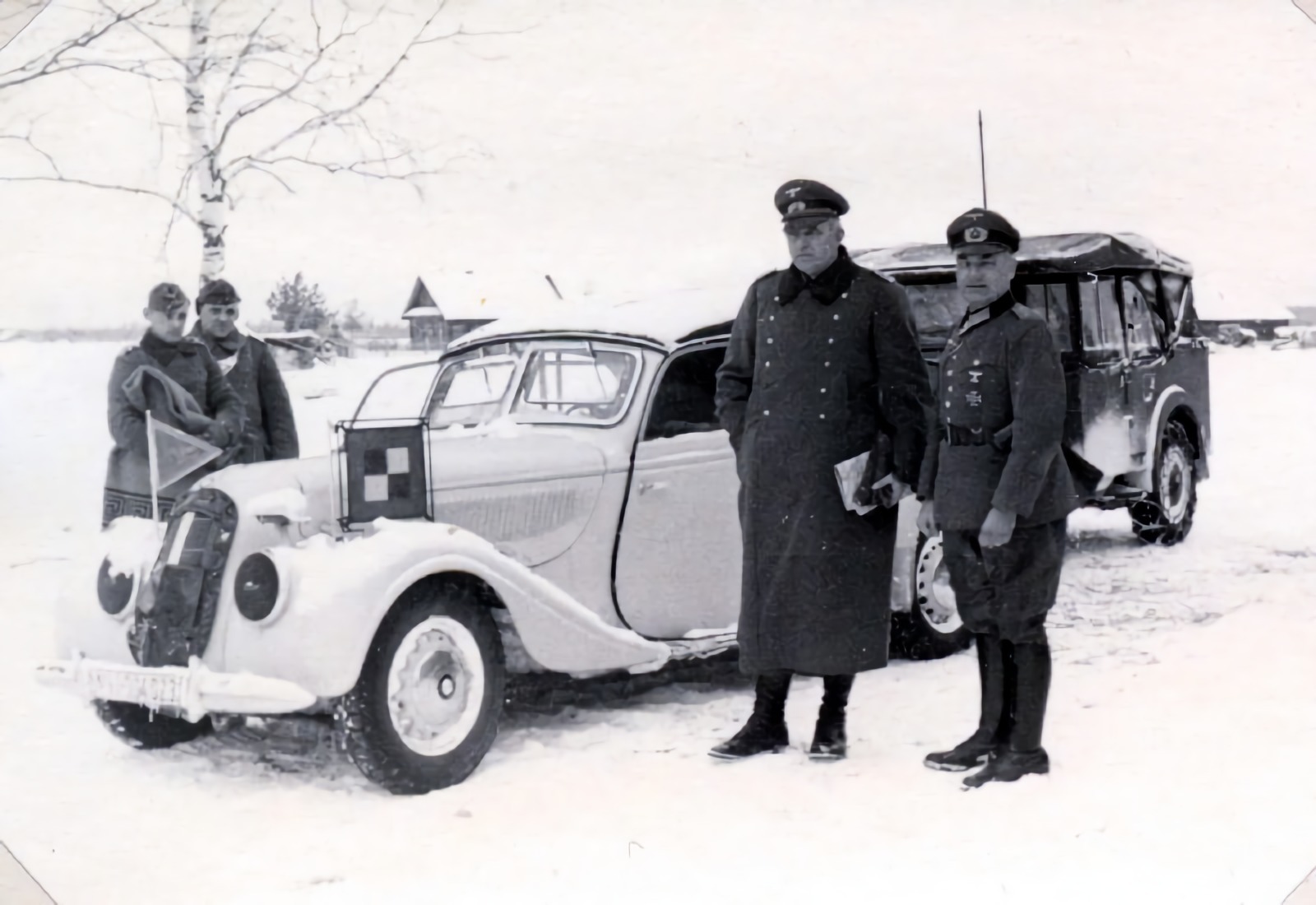
Generaloberst Ernst Busch (Oberbefehlshaber 16. Armee) poses with Oberst Erich Jaschke (right, Kommandeur Infanterie-Regiment 90 / 20.Infanterie-Division) in front of a BMW 335. This photo was most likely taken on the Volkhov front, northern sector of the Eastern Front, in the winter of 1941/42. At that time the Germans were not yet equipped with the winter white clothes and gear, so they wore the standard Wehrmacht coats or any other thick garment they could find in the field.


From left to right: General der Infanterie Gustav Höhne (Kommandierender General VIII. Armeekorps), Generalfeldmarschall Ernst Busch (Oberbefehlshaber 16. Armee), and Oberst i.G. Eberhard von Schönfeldt (Chef des Generalstabes VIII. Armeekorps). This picture was taken at Volkhov (Wolchow), Leningrad Front, probably in the fall of 1943.


Generalfeldmarschall Ernst Busch with his troops, possibly in the Eastern Front. No other information available. We can see the Eichenlaub hanging in his Ritterkreuz. He received the Ritterkreuz des Eisernen Kreuzes on 26 May 1940, while Eichenlaub on 21 August 1943.


Generalfeldmarschall Ernst Busch, possibly in the Eastern Front. No other information available. We can see the Eichenlaub hanging in his Ritterkreuz. He received the Ritterkreuz des Eisernen Kreuzes on 26 May 1940, while Eichenlaub on 21 August 1943.


Wehrmacht generals pose together in front of a wooden house in the central sector of the Eastern Front. Standing in the front row, from left to right: Generalfeldmarschall Ernst Busch (Oberbefehlshaber Heeresgruppe Mitte), Generaloberst Walter Weiss (Oberbefehlshaber 2. Armee), Generalleutnant Hans Krebs (Chef des Generalstabes Heeresgruppe Mitte), General der Infanterie Friedrich Hoßbach (Kommandierender General LVI. Panzerkorps), General der Artillerie Rudolf Freiherr von Roman (Kommandierender General XX. Armekorps), and Generalleutnant Hans Speth (Führer-Reserve Oberkommando des Heeres). Standing directly behind Weiss is Generalleutnant Gustav Harteneck (Kommandeur 72. Infanterie-Division). This photo was taken in May 1944 by Kriegsberichter Thiemann of Propaganda-Kompanie 670. Just one month later, this area under the command of Heeresgruppe Mitte fell apart after the Red Army launched Operation Bagration!


Generalfeldmarschall Ernst Busch in May 1944.

Source :
Bundesarchiv photo collection
ECPAD Archive (PK697 F798 L27)
https://www.alexautographs.com/auction-lot/ernst-busch_EEA4DAE81Dhttp:http://alifrafikkhan.blogspot.com/2017/10/generalfeldmarschall-ernst-busch-1885.html
https://www.ebay.de/itm/184886702008?mkevt=1&mkcid=1&mkrid=707-53477-19255-0&campid=5338722076&toolid=10001

Sunday, March 26, 2023

Bio of Generalfeldmarschall Fedor von Bock (1880-1945)

Moritz Albrecht Franz Friedrich Fedor von Bock

Date of Birth: 03.12.1880 - Küstrin, Neumark (German Empire)
Date of Death: 04.05.1945 - Oldenburg Naval-Hospital, Holstein (Germany)

Nickname: "Holy Fire of Küstrin"
Parents: Moritz Albert Karl von Bock and Olga Helene Franziska von Falkenhayn
Wife: 1st wife: Mally von Reichenbach (1887–1910). Married in 1905. One daughter. 2nd wife: Wilhelmine von Boddien (1893–1945). Married in 1936

Promotions:
15.03.1898 Sekondeleutnant
10.09.1908 Oberleutnant
22.03.1912 Hauptmann
30.12.1916 Major
18.12.1920 Oberstleutnant
01.05.1925 Oberst
01.02.1929 Generalmajor
01.02.1931 Generalleutnant
01.03.1935 General der Infanterie
15.03.1938 Generaloberst
19.07.1940 Generalfeldmarschall

Career:
Entered Army Service (15 Mar 1898)
Sekondeleutnant in the 5th Foot Guards-Regiment (15 Mar 1898-12 Jul 1904)
Detached to the 3rd Pioneer-Battalion (01 Jun 1902-28 Jun 1902)
Detached to the Military Gymnasium (01 Oct 1903-29 Feb 1904)
Detached as Auxiliary-Instructor to the Military Gymnasium (01 Mar 1904-10 Jul 1904)
Adjutant of the I. Battalion of the 5th Foot Guards-Regiment (12 Jul 1904-28 Jan 1906)
Regiments-Adjutant of the 5th Foot Guards-Regiment (28 Jan 1906-22 Mar 1910)
Detached to the Grand General Staff (01 Apr 1910-22 Mar 1912)
Hauptmann in the Grand General Staff (22 Mar 1912-01 Oct 1913)
Chief Supply Officer (Ib) in the General-Staff of the Guards-Corps (01 Oct 1913-00 Sep 1914)
Acting-Chief of Operations (Ia) in the General-Staff of the Guards-Corps (00 Sep 1914-21 Jan 1915)
Chief of Operations (Ia) in the General-Staff of the Guards-Corps (21 Jan 1915-00 May 1915)
Transferred into the General-Staff of the 11th Army (00 May 1915-06 Aug 1916)
At the same time, Detached as Battalion-Leader of the 4th Foot Guards-Regiment (28 Jan 1916-10 Feb 1916)
Chief of Operations (Ia) of the 200th Infantry-Division (06 Aug 1916-24 Mar 1917)
Chief of Operations (Ia) in the General-Staff of the Guards-Corps (24 Mar 1917-11 Apr 1917)
Chief Supply Officer (Ib) in the General-Staff of Army-Group Deutscher Kronprinz (11 Apr 1917-27 Jul 1917)
Chief of Operations (Ia) in the General-Staff of Army-Group Deutscher Kronprinz (27 Jul 1917-10 Jan 1919)
Placed to the Disposal of the General-Command of the III. Army-Corps and then the Army-Peace-Commission (10 Jan 1919-12 Jan 1919)
Officer of the Army and Placed to the Disposal of the General-Command of the Guards-Corps for Special Use (12 Jan 1919-22 Feb 1919)
Transferred into the Grand General Staff (22 Feb 1919-14 Mar 1919)
Member of the Military Representation in the German Peace Embassy (14 Mar 1919-25 May 1919)
Transferred into the 5th Foot Guards-Regiment and Assigned to the Reichswehr-Group-Command 1 for Special Use (25 May 1919-26 Sep 1919)
Relieved of Command in the Reichswehr-Group-Command 1 (26 Sep 1919)
Detached to the General-Staff of the Reichswehr-Group-Command 1 (12 Dec 1919-03 Jan 1920)
Chief of Staff of Military-District-Command III (16 May 1920-01 Oct 1920)
Chief of Staff of the 3rd Division (01 Oct 1920-01 Apr 1924)
Commander of the II. Battalion of the 4th Infantry-Regiment (01 Apr 1924-01 Feb 1926)
At the same time, Detached to Artillery-Course for Night-Artillery in Jüterbog (05 Oct 1925-31 Oct 1925)
Transferred into the Staff of the 4th Infantry-Regiment (01 Feb 1926-01 Jun 1926)
Commander of the 4th Infantry-Regiment (01 Jun 1926-01 Nov 1929)
At the same time, Detached to Battle-School-Course in Döberitz (05 Nov 1926-16 Nov 1926)
Transferred into the Staff of Group-Command 1 (01 Nov 1929-01 Dec 1929)
Commander of the 1st Cavalry-Division (01 Dec 1929-01 Oct 1931)
Commander of the 2nd Division and Commander in Military-District II, Stettin (01 Oct 1931-01 Apr 1935)
Commander of the Army-Service-Office Dresden (01 Apr 1935-20 May 1935)
Delegated with the Leadership of Group-Command 3 (20 May 1935-15 Oct 1935)
Commander-in-Chief of Group-Command 3 (15 Oct 1935-04 Feb 1938)
Commander-in-Chief of Army-Group-Command 3 (04 Feb 1938-10 Nov 1938)
At the same time, Acting-Commander of the Austrian Federal Army (12 Mar 1938-03 Apr 1938)
Commander-in-Chief of Army-Group-Command 1 (10 Nov 1938-26 Aug 1939)
Commander-in-Chief of Army-Group North (26 Aug 1939-10 Oct 1939)
Commander-in-Chief of Army-Group B (10 Oct 1939-22 Jun 1941)
Commander-in-Chief of Army-Group Centre (22 Jun 1941-19 Dec 1941)
Führer-Reserve OKH (19 Dec 1941-16 Jan 1942)
Commander-in-Chief of Army-Group South (16 Jan 1942-09 Jul 1942)
Commander-in-Chief of Army-Group B (09 Jul 1942-15 Jul 1942)
Taken ill – Placed to the Disposal of the Führer (15 Jul 1942-03 May 1945)
Badly wounded due to an Air Strafing Attack by British fighters near Lensahn, Holstein (03 May 1945)
Died in Hospital as a result of his wounds (04 May 1945)

Awards and Decorations:
13.09.1911 Königlich Preußische Kronen-Orden IV.Klasse
18.09.1914 1914 Eisernes Kreuz II.Klasse
00.10.1914 Fürstlich Hohenzollernsches Ehrenkreuz III.Klasse mit Schwertern
30.10.1914 1914 Eisernes Kreuz I.Klasse
24.06.1915 k.u.k. Österreichische Militär-Verdienstkreuz III.Klasse mit der Kriegsdekoration
25.10.1916 Ritterkreuz des Königlich Preußische Hausordens von Hohenzollern mit Schwertern
09.02.1917 k.u.k. Österreichische Orden der Eisernen Krone III. Klasse mit der Kriegsdekoration
03.08.1917 Grossherzoglich Mecklenburg-Schwerinsches Militär-Verdienstkreuz II. Klasse
19.09.1917 Hamburgisches Hanseatenkreuz
10.01.1918 Ritterkreuz I.Klasse des Grossherzoglich Badischen Ordens vom Zähringer Löwen mit Schwertern
25.01.1918 Ritterkreuz des Ordens der Württembergischen Krone mit Schwertern
30.01.1918 Bremisches Hanseatenkreuz:
01.04.1918 Pour le mérite
02.08.1918 Kommandeurkreuz des Königlich Bulgarische Militär-Verdienstordens
00.03.1920 Königlich Preußische Dienstauszeichnungskreuz
15.04.1921 Schlesischer Adler-Orden II.Stufe und I.Stufe
14.12.1934 Ehrenkreuz für Frontkämpfer 1914-1918
02.10.1936 Wehrmacht-Dienstauszeichnung IV. bis I. Klasse
21.11.1938 Medaille zur Erinnerung an den 13.03.1938
01.06.1939 Königlich Jugoslawische Orden der Krone I.Klasse
00.00.1939 Medaille zur Erinnerung an den 01.10.1938
12.09.1939 Eichenlaub zur Wehrmacht-Dienstauszeichnung I.Klasse
22.09.1939 1939 spange zum 1914 Eisernes Kreuz II.Klasse
22.09.1939 1939 spange zum 1914 Eisernes Kreuz I.Klasse
30.09.1939 Ritterkreuz des Eisernen Kreuzes #1, as Generaloberst and Oberbefehlshaber Heeresgruppe Nord
27.08.1940 Grosskreuz des Königlich Italienische Ordens der Krone
07.08.1941 Mentioned in the Wehrmachtbericht
19.09.1941 Mentioned in the Wehrmachtbericht
18.10.1941 Mentioned in the Wehrmachtbericht
30.05.1942 Mentioned in the Wehrmachtbericht
29.07.1942 Ordinul Mihai Viteazul (Romanian Order of Michael the Brave), 3rd to 2nd Class
01.09.1942 Ordinul Mihai Viteazul (Romanian Order of Michael the Brave), 1st Class
27.11.1942 Magyar Érdemkereszt (Hungarian Order of Merit), Grand Cross with Swords

-------------------------------------------------------------------------------------

Moritz Albrecht Franz Friedrich Fedor von Bock (3 December 1880 – 4 May 1945) was born into an old Prussian military family in Cüstrin, Germany (now Kostrzyn, Poland), a fortress city on the banks of the Oder River in the Province of Brandenburg.

His father, Moritz Albert Karl von Bock, had commanded a division in the Franco-Prussian War of 1870–1871. His mother, Olga Helene Franziska von Falkenhayn, was the sister of Erich von Falkenhayn, Chief of the German General Staff during the First World War. At the age of eight, Bock went to study at a military academy in Berlin. The education emphasized Prussian militarism, and he quickly became adept in academic subjects such as modern languages, mathematics, and history. He spoke fluent French, and some English and Russian. At an early age, and largely due to his father, Bock developed an unquestioning loyalty to the state and dedication to the military profession.

While not a brilliant theoretician, Bock was a highly motivated officer. As one of the highest-ranking officers in the Reichswehr, he often addressed graduating cadets at his alma mater, which closed in 1920. His theme was always that the greatest glory that could come to a German soldier was to die for the Fatherland. He quickly earned the nickname "Holy Fire of Küstrin".

In 1905, Bock married Mally von Reichenbach (1887–1910), a young Prussian noblewoman. They had a daughter. In 1908, Bock entered the War Academy in Berlin, and after a year's study he joined the ranks of the General Staff. He soon joined the Army League (Deutscher Wehrverein) and came to know Walther von Brauchitsch, Franz Halder, and Gerd von Rundstedt. By the time World War I began in 1914, Bock was a captain; he served as a battalion commander in January and February 1916. He was decorated with Pour le Mérite, German Empire's highest military decoration.

Bock stayed on as an officer of the post-war Reichswehr, and rose through the ranks. In the 1920s, Bock was together with Kurt von Schleicher, Eugen Ott, and Kurt von Hammerstein-Equord a member of a secret group known as Sondergruppe R, selected by and responsible to Hans von Seeckt, who were in charge of helping Germany evade the Part V of the Treaty of Versailles, which had disarmed Germany.

The officers of Sondergruppe R formed the liaison with Major Bruno Ernst Buchrucker, who led the so-called Arbeits-Kommandos (Work Commandos), which was officially a labor group intended to assist with civilian projects, but were in reality thinly disguised soldiers that allowed Germany to exceed the limits on troop strength set by Versailles. Buchrucker's so-called "Black Reichswehr" became infamous for its practice of murdering all those Germans who were suspected of working as informers for the Allied Control Commission, which was responsible for ensuring that Germany was in compliance with Part V.

The killings perpetrated by the "Black Reichswehr" were justified under the so-called Femegerichte (secret court) system. These killings were ordered by the officers from Sondergruppe R. Regarding the Femegerichte murders, Carl von Ossietzky wrote: "Lieutenant Schulz (charged with the murder of informers against the "Black Reichswehr") did nothing but carry out the orders given him, and that certainly Colonel von Bock, and probably Colonel von Schleicher and General Seeckt, should be sitting in the dock beside him".

Several times Bock perjured himself in court when he denied that the Reichswehr had had anything to do with the "Black Reichswehr" or the murders they had committed.

On 27 September 1923, Buchrucker ordered 4,500 men of the Black Reichswehr to assemble outside of Berlin as the first preparatory step toward a coup. Bock, who was Buchrucker's contact with the Reichswehr, was enraged, and in a stormy meeting berated Buchrucker for mobilizing the Black Reichswehr without orders.

Bock stated the Reichswehr wanted no part in Buchrucker's coup and that "If Seeckt knew you were here, he would screw his monocle into his eye and say "Go for him!"". Despite Bock's orders to demobilize at once, Buchrucker went ahead with his coup on 30 September 1923, which ended in total failure.

In 1935, Adolf Hitler appointed Bock as commander of the Third Army Group. Bock was one of the officers not removed from his position when Hitler reorganized the armed forces during the phase of German rearmament before the outbreak of the Second World War. He remained a monarchist. Hitler reportedly said of him, "Nobody in the world but Bock can teach soldiers to die." In 1936 Bock married Wilhelmine, née von Boddien (1893–1945).

Bock commanded the invasion of Vienna in March 1938 for the Anschluss and then the Invasion of Czechoslovakia.

By 25 August 1939, Bock was in command of Army Group North in preparation for the invasion and conquest of Poland. The objective of Army Group North was to destroy the Polish forces north of the Vistula. Army Group North was composed of General Georg von Küchler's 3rd Army, and General Günther von Kluge's 4th Army. These struck southward from East Prussia and eastward across the base of the Polish Corridor, respectively.

On 10 September Bock ordered the forces under his command to burn Polish villages located behind the front line to the ground if they were fired upon from the settlement and "if it proves impossible to identify the house from which the shots came". By the end of the military occupation of the country on 26 October 1939 531 towns and villages had been destroyed across Poland. In five weeks, Poland was overrun by German and Soviet forces.

Shortly after the conquest of Poland, on 12 October 1939 Bock was given command of Army Group B, with 29½ divisions, including three armoured divisions. These were tasked with advancing through the Low Countries and luring the northern units of the Allied armies into a pocket. Army Group B consisted of the 18th and 6th Armies. While his units were overrunning the Netherlands, in May 1940, Bock attempted to call on the exiled former Kaiser—Wilhelm II—at Doorn, but Bock was unable to gain admittance, the German troops guarding the residence having been instructed to prevent such visits.

Bock participated in the Armistice with France in late June 1940.

On 19 July 1940, Bock was promoted to the rank of field marshal during the 1940 Field Marshal Ceremony. At the end of August, Army High Command transferred Army Group B to East Prussia; this included Kluge's 4th Army. On 11 September, Bock relinquished command of his occupation area in France to Field Marshal Wilhelm Ritter von Leeb.

On 2 February, Bock met with Hitler and questioned whether the Russians could be forced to make peace even if the Red Army was brought to battle and defeated. Hitler airily assured Bock that Germany's resources were more than sufficient and that he was determined to fight. In preparation for Operation Barbarossa, on 1 April 1941 Army Group B was re-designated as Army Group Center. Deployed in Poland, Army Group Center was one of the three army formations which were to lead the invasion of the Soviet Union. It included the 4th and 9th Armies, the 3rd and 2nd Panzer Armies and Luftflotte 2. On the left flank of Bock's Army Group Center was Army Group North, commanded by Wilhelm Ritter von Leeb; on the right flank was Army Group South, commanded by Gerd von Rundstedt.

The main objective of Army Group Center was to follow the route north of the Pripyat Marshes to Moscow. Following the border battles, the task of Army Group Center was to drive towards the cities of Minsk and Smolensk, and destroy the Soviet armies stationed there in encirclement battles.

At 03:15 on 22 June 1941, the first shots of Operation Barbarossa were fired; Germany invaded the Soviet Union with a timed declaration of war.

Elements of Heinz Guderian's force had crossed the Bug River and were bypassing the city of Brest-Litovsk. Hermann Hoth's tanks were heading for Grodno on the Nieman River to seize the important river crossings. Several reconnaissance units from the 4th and 9th Armies had already crossed the Bug and Desna Rivers.

At 07:00, Bock flew from Posen to an advance airfield near the headquarters of XIII Infantry Corps. There, Major General Erich Jaschke gave Bock a summary of the progress of the invasion. Following this meeting, Bock visited Guderian's forward command post at Bokhaly. Bock then visited Joachim Lemelsen, who gave a report from the front. The roads on the Soviet side of the Bug River were already becoming too soft to support the weight of tanks. Despite this, the first day of the invasion had been spectacularly successful. Soviet resistance was reported as being light and complete surprise was achieved. All along the front rapid progress was being made.

On the second day of Barbarossa, Bock crossed the Bug River escorted by Major General Gustav Schmidt. Later that day Bock was presented with reports that Soviet resistance was stiffening all along the front, especially on Guderian's southern flank. Meanwhile, Hoth's forces were advancing with much more ease through the Baltic states and Belarus. The first two days of Army Group Center's advance proved to be highly successful.

Hoth's army advanced so quickly that Bock immediately contacted Walter von Brauchitsch, requesting the bypassing of Minsk in favour of attacking toward Vitebsk so that a drive could be made for Moscow. Initially, the change in plan was accepted but it was soon overruled by Hitler, who favoured the encirclement and destruction of the large Soviet armies near Minsk. Bock wrote in his diary:

    The envelopment of Minsk is not decisive. Besides, I am sure that the enemy expects us to attack Minsk, the next natural objective, and will concentrate defence forces there.

Differences between Bock's strategic intent and the intent of High Command repeatedly surfaced. Bock continued to favour a direct drive toward Moscow, bypassing Soviet armies and leaving them to be destroyed by infantry, which advanced on foot, well behind tank columns. Bock argued that if encirclement were truly necessary then instead of diverting his tanks north and south to encircle and destroy smaller Soviet armies, a larger encirclement should be made eastward toward the Dvina-Dnieper River basins.

Hitler decided against this plan, and insisted that the pockets containing Soviet armies must be destroyed before advancing deeper into Russia. Bock, enraged by this decision, was quoted as saying: "We are permitting our greatest chance of success to escape us by this restriction placed on our armour!"

He hesitantly gave the order to abandon the drive toward Vitebsk and assist in the destruction of the pockets. On 25 June, Bock moved his headquarters from Posen to Kobryn, a town about 15 mi (24 km) northeast of Brest-Litovsk. On 30 June, the 4th and 9th Armies met each other near Slonim, trapping thousands of Soviet soldiers. However, many Soviet soldiers managed to escape eastward. Bock soon gave the order to disengage from the encirclement and prepare for a full-scale drive to the east. This order once again caused a confrontation between Bock and Brauchitsch.

On 3 July, Bock's forces were once again advancing eastward, with Guderian's tanks crossing the Berezina and Hoth's tanks crossing the Duna. This day marked the furthest distance covered by Bock's troops in a single day, with over 100 mi (160 km) travelled. Four days later, Guderian's tanks crossed the Dnieper, the last great obstacle before Smolensk. However, Guderian was soon ordered by Günther von Kluge to withdraw back across the river. Bock soon reversed this order, and Guderian was allowed to re-cross the river. Bock protested Kluge's actions to High Command, to no avail. On 11 July, Bock moved his headquarters again to Borisov, a Soviet town near the Berezina River.

On 9 September, Army High Command instructed Bock to prepare an operational order for the assault on Moscow. Operation Typhoon was the code-name given to this new attack, which was to begin no later than 30 September. Bock supervised the planning and preparation of the operation, and a few days later it was approved by the High Command.

As part of the preparation for Operation Typhoon, Army Group Center would be reinforced and replenished with men and vehicles; it would be composed of three infantry armies (the 2nd, 4th, and 9th) and three tank armies (2nd, 3rd, and 4th Panzers). Colonel General Erich Hoepner would command the 4th Panzer Army, while the former two were outgrowths of Hoth's and Guderian's original Panzer Groups. The replenishment of Army Group Center for Operation Typhoon caused it to increase greatly in size: with almost 1.5 million soldiers, it was now larger than it was at the outset of Operation Barbarossa. Bock spent most of the remainder of September on inspection tours of his reinforced Army Group Center. On one occasion, Bock—along with Albert Kesselring—flew over Moscow.

On 29 September, Bock held a conference with his senior commanders Strauss, Hoth, Kluge, Weichs, Hoepner, Guderian, and Kesselring. During the meeting the main operational plan was reviewed, with Bock again stressing that Moscow must be taken by 7 November, before the onset of winter, and to coincide with the anniversary of the Russian Revolution. The following day, Operation Typhoon began with attacks from Guderian's and Hoth's armored forces. Several days later, the infantry armies began to move toward Moscow. With less than 150 km between the most advanced troops and Moscow, Bock estimated that his troops would enter the city in three to four weeks. Almost immediately, Bock's forces encountered stiff Soviet resistance on the road to Moscow.

The 2nd Panzer Army—along with the XLVIII Panzer Corps—attacked important rail junctions near Oryol (Orel) and Bryansk. Hoepner's 4th Panzer Army soon crossed the Desna River and gained access to deep Russian territory. Meanwhile, Hoth's 3rd Panzer Army struck toward Rzhev on the Volga River.

On 3 October, Guderian's forces captured Orel and subsequently gained access to a paved highway which led to Moscow, some 180 mi (290 km) away. Meanwhile, elements of the 2nd Panzer Army reported that they had bypassed Bryansk and were heading toward Karachev. Bock ordered Guderian to press on toward Tula, but within hours this order had been reversed by High Command. The reversal of the order called for Guderian to attack Bryansk where—along with Vyazma—two massive encirclements of Soviet forces were occurring. Bock argued that the area between Orel and Tula remained relatively free of Soviet forces and that Tula could be captured within hours. Ultimately, Bock agreed to divert Guderian's tanks toward Bryansk.

Cold rain soon began to fall over the northern sectors of Army Group Center's front, and the roads soon turned into quagmires as part of the Rasputitsa. Virtually the entire front became stuck; the only vehicles capable of negotiating the mud were tanks and other tracked vehicles. However, these moved at a snail's pace (sometimes less than 2 mi (3.2 km) per day), and fuel consumption soared. This further aggravated the problem of already poor supply lines.

Slight improvements in the weather soon made it possible for Bock's forces to continue to seal the pockets around Bryansk and Vyazma. The dual encirclements of Soviet forces around Vyazma and Bryansk yielded some of the largest Soviet casualties since the beginning of Operation Barbarossa: some 650,000 prisoners were taken during these two encirclements, after which the Soviet armies facing Bock's Army Group Center no longer had the advantage of superior numbers. Bock was one of the few German officers to protest the systematic maltreatment of Soviet prisoners of war, but took few steps to improve the conditions of those being held in the areas under his command.

The weather soon deteriorated again, with the roads once more turning into impassable, muddy quagmires. Since 30 September, Bock had lost some 35,000 men, 250 tanks and artillery pieces, and several hundred other vehicles, many of which were mired in the mud. Fuel and ammunition supplies became dangerously low. Despite these problems, the advance toward Moscow continued as Hitler became increasingly impatient. When advance units of the 4th Panzer Army reached Kaluga and Maloyaroslavets, German forces were within 40 mi (64 km) of Moscow. Guderian's advance in the south was much slower. An attempt by his forces to capture Tula had failed, with considerable losses of men and tanks. However, other units captured Stalinogorsk and Venev, indicating the possibility of bypassing Tula.

As Bock's forces smashed through the Red Army defense lines at Mozhaisk in mid-October, panic struck in the capital. Hundreds of thousands of civilians began to evacuate the city while others were forced into emergency volunteer units. Martial law was instituted as looting and pillaging of deserted stores increased. Marshal Semyon Timoshenko was relieved of command in favor of Georgy Zhukov, who had been organizing the defense of Leningrad. The main bulk of the Soviet government was evacuated to Kuibyshev, 500 mi (800 km) southeast of Moscow; however, Stalin remained in the capital after being reassured by Zhukov that the capital would not fall.

The further Bock's forces advanced, the stiffer Soviet resistance became. The paved roads leading to Moscow became craters under constant Russian artillery fire, rendering them impassable. This forced the German troops into the mud and Army Group Center soon became stuck once again. The goal of capturing Moscow by mid-October could no longer be achieved. However, the sheer weight of the German advance could not be fully stopped, and on 21 October units of the 9th Army captured Kalinin.

As November arrived the mud soon turned into ice as temperatures dropped to −28 °C (−20 °F). While the ground hardened sufficiently enough to support vehicles, the cold weather added to the miseries of the German soldiers as many had not received winter clothing. Frostbite soon took its toll; many soldiers were severely affected and had to be evacuated.

On 20 November, Bock moved his field headquarters to an advanced forward position near the front lines. There he visited an artillery command post, where he could see the buildings of Moscow through his field glasses. Several days later, German forces crossed the Moscow-Volga Canal and reached Khimki but soon fell back due to Soviet resistance. On 29 November, elements of the 4th Panzer Army reached the western suburbs of Moscow. On 4 December, units of the 2nd Army reached Kuntsevo, a western suburb of Moscow. Several units of Guderian's army bypassed Kolomna and reached the Moscow River. Meanwhile, the 3rd Panzer Army once again fought into Khimki. These were the last advances made by Army Group Center under Bock's command.

On 6 December, with the temperature at −45 °C (−50 °F), fresh Russian troops commanded by Zhukov launched a huge counterattack. All along the front near Moscow German troops retreated, destroying whatever equipment they could not salvage. Several days later, High Command ordered a halt to all offensive operations. Bock wrote in his diary:

    All along, I demanded of Army High Command the authority to strike down the enemy when he was wobbling. We could have finished the enemy last summer. We could have destroyed him completely. Last August, the road to Moscow was open; we could have entered the Bolshevik capital in triumph and in summery weather. The high military leadership of the Fatherland made a terrible mistake when it forced my army group to adopt a position of defense last August. Now all of us are paying for that mistake.

By 13 December, German forces had retreated more than 80 km (50 mi) from the capital. On 18 December, Bock was relieved of his command of Army Group Center. The official pretext of this decision was health problems. However, this was just one case out of some 40 high-ranking officers being relieved of their command following the failure to capture Moscow.

He was reassigned to lead Army Group South on 20 January 1942, after the death of Generalfeldmarshall Walter von Reichenau from a stroke. Thus, in May 1942, he commanded the defending forces that delivered the devastating defeat to the Soviet winter offensive and severely depleted Soviet tank strength in the Second Battle of Kharkov. On 28 June 1942, Bock's offensive split the Russian front into fragments on either side of Kursk. Three armies (Weich's 2nd Army, Hoth's 4th Panzer, and Paulus' 6th Army)—along with 11 panzer divisions—fanned out toward Voronezh and the Don River. Paulus' armoured divisions reached the Don on either side of Voronezh on 5 July. The Soviet High Command created a Voronezh Front under Nikolai Vatutin, who reported directly to Moscow. Bock wanted to eliminate Vatutin's forces before extending his own flank too deeply into the void created by the strength and speed of the German offensive. Hitler was not pleased with Bock's plan to delay the push toward Stalingrad. On 7 July, Hitler split Army Group South into Army Groups A and B. Army Group A was given to Field Marshal Wilhelm List to command. On 17 July, Hitler relieved Bock as commander of Army Group B, replacing him with Maximilian von Weichs. Bock never again occupied a senior command position.

Bock was injured on 3 May 1945, as his car was strafed by a Hawker Tempest from No. 486 Squadron RNZAF killing his wife, stepdaughter, and a friend. Initially the only survivor of the attack, Bock died of his injuries the following day. He was buried in a cemetery in Lensahn.


Source :
Bundesarchiv photo collection
https://www.alamy.com/stock-photo/fedor-von-bock.html?sortBy=relevant
https://audiovis.nac.gov.pl/search/
https://beeldbankwo2.nl/nl/beelden/detail/ccff2da8-0259-11e7-904b-d89d6717b464/media/a4e31d65-1980-fd6b-a9ec-0e9aea76ea12?mode=detail&view=horizontal&q=fedor%20von%20bock&rows=1&page=1
https://en.wikipedia.org/wiki/Fedor_von_Bock
https://www.gettyimages.com/search/2/image?phrase=fedor%20von%20bock
https://invenio.bundesarchiv.de/invenio/main.xhtml
https://web.archive.org/web/20091027112658fw_/http://www.geocities.com/~orion47/WEHRMACHT/HEER/Generalfeldmarschall/BOCK_FEDOR.html