Johann Ferdinand Schörner
Date of Birth: 12.06.1892 - Münich, Königreich Bayern (German Empire)
Date of Death: 02.07.1973 - Münich, Bayern (West Germany)
Promotions:01.04.1912 Gefreiter
01.08.1912 Unteroffizier
22.05.1913 Vizefeldwebel der Reserve
28.08.1914 Offiziers-Stellvertreter
29.11.1914 Leutnant der Reserve (ohne Patent)
26.12.1917 Leutnant (aktiv; 04.02.1918: Granted Patent vom 18.06.1913)
15.07.1918 Oberleutnant (mit Patent vom 15.07.1918; 01.07.1922: Granted RDA vom 22.03.1918)
01.08.1926 Hauptmann (mit Wirkung & RDA vom 01.07.1926)
14.08.1934 Major (mit Wirkung & RDA vom 01.08.1934)
16.03.1937 Oberstleutnant (mit Wirkung & RDA vom 01.03.1937)
27.08.1939 Charakter als Oberst (mit Wirkung vom 27.08.1939)
30.01.1940 Oberst (mit Wirkung & RDA vom 01.02.1940)
01.08.1940 Generalmajor (RDA vom 01.10.1941)
28.02.1942 Generalleuntant (mit Wirkung vom 15.01.1942; 28.02.1942: Granted RDA vom 01.03.1942)
15.05.1942 General der Gebirgstruppe (mit Wirkung & RDA vom 01.06.1942)
20.05.1944 Generaloberst (mit Wirkung vom 01.03.1944 & RDA vom 01.08.1943)
05.04.1945 Generalfeldmarschall
Career:01.10.1911 - 30.09.1912 as a one-year volunteer in the 12.Kompanie / Bayer. Infanterie-Leib-Regiment
30.09.1912 Released to became a reserve soldier
00.10.1912 - 00.06.1915 6 semesters of modern languages and philosophy in Munich, Lausanne and Grenoble; Interpreter exam in French and Italian
23.03.1913 - 22.05.1915 called up for reserve exercise A at Bayerische Infanterie-Leib-Regiment
04.08.1914 drafted to the Bayerische Infanterie-Leib-Regiment
07.08.1914 Reserveoffiziersanwärter in the Bayerische Infanterie-Leib-Regiment, Zugführer
02.09.1915 - 10.10.1915 Führer 12. Kompanie / Bayerische Infanterie-Leib-Regiment
20.12.1915 - 15.01.1916 in Reservelazarett München A after a shoulder injury
22.06.1916 - 04.09.1916 Wounded by shrapnel (left upper arm) near Fleury, hospitals in Mainz and Darmstadt, in the I.Ersatz-Bataillon / Bayerische Infanterie-Leib-Regiment; into the field again on 18.09.1916
25.09.1916 Führer 12. Kompanie / Bayerische Infanterie-Leib-Regiment
26.12.1917 activated in Bayerische Infanterie-Leib-Regiment
12.08.1918 - 28.09.1918 wounded in the abdomen and right extremities by artillery shells in front of Reims (near Hallu), hospitals St. Quentin, Metz and München A
28.09.1918 into the field again with Bayerische Infanterie-Leib-Regiment
00.00.1919 with Freikorps Epp in Münich, also in the Battle of the Rhine and Ruhr
00.04.1919 member of Bayerische Schützen-Regiment 1
08.05.1919 Kompanieführer in Gebirgsjäger-Bataillon 21
00.06.1919 1. Bayerisches Reichswehr-Schützen-Regiment 41
14.08.1919 - 30.09.1920 Führer 11. Kompanie / 1.Bayerischen Reichswehr-Schützen-Regiment 41
01.10.1920 Hauptmann in the Stab / 1.Bayerischen Reichswehr-Schützen-Regiment 41
01.01.1921 transferred to the Ausbildungs-Bataillon / 19. (Bayerische) Infanterie-Regiment
04.04.1921 - 28.08.1921 Zugführer in 16.Kompanie / 19. (Bayerische) Infanterie-Regiment
29.08.1921 - 09.11.1921 Führer 16.Kompanie / 19. (Bayerische) Infanterie-Regiment
10.11.1921 - 28.02.1922 Kompaniechef in 16.Kompanie / Infanterie-Regiment 19
01.03.1923 - 30.09.1923 in 9.Kompanie / Infanterie-Regiment 19
01.10.1923 transferred to the Reiter-Regiment 17 under command of Wehrkreis-Kommando VII in Münich, completing his first year as Assistant Leader (1. Führergehilfenjahre)
01.10.1924 transferred back to Infanterie-Regiment 19, completing his second year as Assistant Leader (2. Führergehilfenjahre)
01.07.1925 - 31.07.1925 in the Artillerie-Regiment 7
01.08.1925 - 12.09.1925 in the Kraftfahr-Abteilung 7
13.09.1925 - 23.09.1925 again assigned to Artillerie-Regiment 7
01.10.1925 - 01.10.1926 in Reichswehrministerium, completing his third year as Assistant Leader (3. Führergehilfenjahre)
01.06.1926 - 30.06.1926 assigned to Nachrichten-Abteilung 1
01.07.1926 - 31.08.1926 transferred to Kraftfahr-Abteilung 1 in Königsberg
01.09.1926 - 06.09.1926 transferred back to Nachrichten-Abteilung 1
01.10.1926 in the Stab / Infanterie-Regiment 21
01.11.1926 Chef 16.Kompanie (A) / Infanterie-Regiment 19 in Landshut an der Isar
01.10.1928 Chef 10.Kompanie (Hochgebirgsjäger) / Infanterie-Regiment 19 in Kempten
20.07.1931 - 30.08.1931 assigned to the staff of Italian Alpini-Regiment 4 / 1st Alpini-Brigade
1933, 1935 and 1937 participated in the great Italian autumn maneuvers in Liguria
01.10.1931 Teacher for tactics and war history at Infanterie-Schule Dresden
01.10.1934 at the same time, Adjutant Infanterie-Schule Dresden
01.05.1935 Adjutant Kriegsschule Dresden
24.03.1936 Gruppenleiter in 3.Abteilung (Fremde Heere) / Generalstab des Heeres
14.05.1936 - 31.07.1937 Gruppenleiter 4 in 3.Abteilung / Generalstab des Heeres
01.08.1937 - 07.08.1937 participated in the great Italian autumn maneuver in Liguria
12.10.1937 - 24.05.1940 Kommandeur Gebirgsjäger-Regiment 98 in Mittenwald
17.10.1939 - 25.10.1939 assigned to Attaché-Gruppe III / Generalstab des Heeres
28.10.1939 - 07.11.1939 assigned to Militär-Attaché in Rome (Enno von Rintelen)
24.05.1940 Führerreserve
31.05.1940 Führer 6. Gebirgs-Division
14.08.1940 - 15.01.1942 Kommandeur 6. Gebirgs-Division
27.04.1941 at the same time, Stadtkommandant von Athen
15.01.1942 Kommandierender General Gebirgskorps Norwegen (assumption on command 23.01.1942)
10.11.1942 - 23.10.1943 Kommandierender General XIX. Gebirgskorps (renamed)
24.07.1943 joined the NSDAP (effective 01.01.1943)
23.10.1943 Führerreserve, but:
24.10.1943-12.11.1943 Führer XXXX. Panzerkorps
28.10.1943 ineffective command as z.b.V. Offizier in the Führerhauptquartier
28.10.1943 transferred to Heeresgruppe Süd as Führer of Armeegruppe (ineffective);
02.11.1943 submits report to OKH instead
22.11.1943 the commissioning of the leadership of the 6. Armee does not take effect (instead General der Artillerie Maximilian de Angelis was chosen)
12/14.11.-25.11.1943 Schörner's position at this time is unclear
25.11.1943 - 15.02.1944 Führer Gruppe Schörner (XXXX. Panzerkorps), also known as Armeeabteilung Nikopol: formed from XIX. Gebirgskorps and IV. Armeekorps (Gruppe Mieth), a total of 9 Infantry Divisions plus 24. Panzer-Division; later also XVII. Armeekorps (Kreysing)
02.03.1944 - 14.03.1944 mit der Stellvertreter Führer 17. Armee beauftragt (for Jaenecke)
15.03.1944 Chef NS-Führungsstabes / OKH (Feld- und Ersatzheer); serious disagreements with Bormann, who wanted to use "Alte Kämpfer" as NSFO. It was only with effect from 15.05.1944 that the successor, General der Gebirgstruppe Hengl, was appointed by the Führer's order dated 28.05 1944.
28.03.1944 Schörner's “Guidelines for the National Socialist Leadership in the Army” appear, according to which the ideological battle is superior to the enemy's superior weaponry
31.03.1944 mit der Führung der Heeresgruppe Südukraine beauftragt
06.05.1944 - 23.07.1944 Oberbefehlshaber Heeresgruppe Südukraine
23.07.1944 - 17.01.1945 Oberbefehlshaber Heeresgruppe Nord (exchange with Generaloberst Frießner)
17.01.1945 Oberbefehlshaber Heeresgruppe A. Arrival 18.01.1945 in Oppeln, Reichsverkehrsminister Dorpmüller and Rüstungsminister Speer are present
25.01.1945 - 08.05.1945 Oberbefehlshaber Heeresgruppe Mitte (renamed)
15.04.1945 Flies with his Heinkel He 111 from Josephstadt to Cottbus (3 Me 109 as escort), from there by car to Berlin; Hitler offers in vain to move the Führerhauptquartier to the Heeresgruppe Mitte
23.04.1945 Schörner received the Marschallstab from Hitler in Berlin in the evening and flew back from Gatow that night (according to Wolfgang Paul "The Final Battle in Germany"; other sources are silent on this)
30.04.1945 as Oberbefehlshaber des Heeres in the Hitler's Testament. One of the three copies was to be picked up in Berlin on Schörner's orders. For this purpose, Oberstleutnant Graßmann was supposed to pick up Major Johannmeyer from the Führer's Army Adjutantry with Fieseler Storch on Pfaueninsel around midnight on 01-02.05.1945, and flown him to the headquarters of the field marshal, who knew nothing of his appointment. However, the “Stork” could no longer land in Berlin, turned around and had to make an emergency landing in the Erzgebirge.
08.05.1945 at 09.45 a.m. Oberst i.G. Meyer-Detring from the WFSt is at the Gef.St. in the Wolchow sanatorium 10 km west of Josephstadt near Schörner to transmit the surrender on behalf of the OKW. The colonel was on May 7th. from Flensburg with an English Transport machine was flown to Pilsen. After returning with the same plane, he reported on 10.05.1945 in Flensburg about the Americans' lack of understanding of the German desire to capitulate to them, about their own signs of disintegration and the beginning of an armed uprising by the Czechs against the German occupiers.
09.05.1945 Schörner flies out of Podersam at 3 a.m. in civilian clothes (dark suit that the local Ortsgruppenleiter had gotten him) with a Fieseler Fi 156 "Stork” and lands near Mittersill in Tyrol, where Guderian is supposed to be, but he is already in captivity; he hide in an alpine hut for the next few days. Later he repeatedly claimed that Hitler gave him the instructions to build the “Alpine Fortress” (on 25.04.1945).
15.05.1945 he went to the American headquarters of the 1st Army and presented himself to the US Army near Kitzbühel in “Krachledernen”, which he had obtained in Pinzgau
00.06.1945 Handed over to the Soviets, Camp 27 at Krasnogorsk near Moscow
07.08.1945 - 19.09.1949 detained in Lubjanka prison
19.09.1949 - 01.04.1950 detained in Lefortowskaja prison (penitentiary)
01.04.1950 - 00.01.1952 detained in Butyrskaja prison (European Wing)
00.01.1952 - 19.02.1952 back to Lefortowskaja prison (penitentiary)
08.02.1952 trial before the Supreme Court Martial of the USSR, in camera, without defense counsel. Sentenced to 25 years by the Supreme Military Court in Moscow. Accusation of overthrow of the communist Uprising in Rhineland-Westphalia Industrial area after the First World War and activity at T 3 (Fremde Heere)
00.04.1952 after a letter complaining to Stalin about the prison conditions, the sentence was reduced to 18 years. Indignantly rejects the Soviet offer to join the “National Committee”. Taken to the Vladimir camp (“Politisolator”), 200 km from Moscow
00.02.1954 moved to Voikowo
25.12.1954 Released from prison and taken to a villa near Moscow
15.01.1955 Finally released from captivity and sent to East Berlin with Vice Admiral Hans-Erich Voß in a special compartment. While he was still on the platform, he gave a speech (which record kept in the GDR archives until after the fall of communism). A delegation with Generals Lattmann, Arthur Brandt (Luftwaffe) and Haehling received him. The attempt to persuade him to stay in the GDR (possibly as Generalinspekteur of the People's Army) failed, and he traveled on to Munich via Hof . (His wife and eldest son had already committed suicide in 1949)
28.01.1955 Schörner's arrival triggers a press storm, the Munich public prosecutor's office immediately begins to investigate and publicly asks for material for an indictment
23.05.1955 Discontinuation of the proceedings: no criminal relevance could be derived from 62 reports in almost 100 cases, as very few allegations could be substantiated by facts. However, the bad reputation that the “Gendarme of Courland” had acquired became apparent. The executions of 5 soldiers in mid-October 1944 were recognized by the court as legal: Schörner had picked up Feldwebel F. from Grenadier Regiment 409 (122nd ID) which was slightly wounded with 4 companions who pretended to want to bring him to the battle squad. The military judge, who was immediately involved, ordered the death penalty for cowardice in front of the enemy, which was carried out on the same day after confirmation by Schörner
31.03.1955 Initiation of disciplinary proceedings against the background of Schörner's attempt to enforce pension claims as field marshal, which they wanted to deny him. In the summer of 1955, the German Bundestag therefore passed a supplementary law to the federal disciplinary code, which Schörner's camp elevated to the “Lex Schörner”. It made it possible to freeze the amounts while disciplinary proceedings were ongoing. He was accused of fleeing his army group on May 9, 1945, as well as several arbitrary demotions and interference in ongoing court-martial proceedings.
31.08.1956 the Munich public prosecutor's office brought charges of manslaughter and attempted manslaughter. On March 22, 1945, Schörner had the commander of the Neisse Fortress, Oberst Georg Sparre, and his supposed deputy, Major Dr. Jüngling, sentenced to death without trial because they had surrendered the fortress to the Bolsheviks almost without a fight. Commander-in-Chief of the 1st Panzer Army, Generaloberst Heinrici had it clarified by court-martial that Sparre was in the hospital after a serious heart attack and later had to be treated as an outpatient, and was therefore innocent. Schörner insisted on immediate shooting, although Heinrici had intervened by explaining the above facts. GdI Friedrich Schulz, as Commander-in-Chief of the 17th Army, forbade the execution and only under the impression of another counter-statement from Heinrici, supported by Schulz, did Schörner forego following the order. Then, on March 24, 1945, near Groß-Gorschütz (near Mährisch-Ostrau), he sentenced Gefreiter Walter Arndt, who was driving his ammunition truck while drunk, to death without a court martial.
01.10.1957 - 15.10.1957 Jury trial before the Munich District Court I. Verdict: 4 years and 6 months in prison (prosecutor's request: 8 years). The court withheld the death sentence, even though the GFM tried to justify its measures by maintaining discipline, especially under the difficult conditions of the last months of the war against the Red Army. As a witness, his chief of staff, GLt Oldwig von Natzmer, stated that Schörner loved to spread fear and terror. However, he often tacitly tolerated the fact that the staff reversed the spontaneous activities (demotions, withdrawal of medals). However, this was no longer possible during the executions!
04.08.1958 - 03.08.1960 in prison in Landsberg am Lech. The appeal and constitutional complaint had previously been rejected! While still in custody, he tried to have him readmitted because several witnesses said to have seen the executed driver alive after the war, but they couldn't prove it!
03.08.1960 Suspension of sentence until August 1965 with the granting of probation for health reasons
10.12.1962 the Higher Regional Court rejects the reopening of the proceedings
22.12.1966 Remission of the remaining sentence
Ferdinand Schörner remained the incorrigible Nazi general until the end, supported financially by admirers.
Awards and Decorations:22.12.1914 1914 Eisernes Kreuz II.Klasse
11.10.1915 Königlich Bayerische Militär-Verdienstorden IV.Klasse mit Schwertern
20.04.1916 k.u.k. Österreichische Militär-Verdienstkreuz III.Klasse mit der Kriegsdekoration
27.01.1917 1914 Eisernes Kreuz I.Klasse
24.10.1917 Königlich Bayerische Militär-Verdienstorden IV Klasse mit der Krone und Schwertern
05.12.1917 Pour le mérite as Leutnant d. R. and Fhr. 12.Kompanie / Bayer. Leib-Infanterie-Regiment
20.02.1918 E.Z. der goldenen Hochzeit S.M.
00.00.1918 Verwundetenabzeichen 1918 in Silber
16.03.1934 Chilean Orden al Mérito, Officer Class
21.12.1934 Ehrenkreuz für Frontkämpfer 1914-1918
02.10.1936 Wehrmacht-Dienstauszeichnung IV.Klasse
02.10.1936 Wehrmacht-Dienstauszeichnung III.Klasse
02.10.1936 Wehrmacht-Dienstauszeichnung II.Klasse
02.08.1938 Italian Ordine della Corona d'Italia - Commendatore
00.00.1939 Medaille zur Erinnerung an den 13. März 1938
00.00.1939 Medaille zur Erinnerung an den 1. Oktober 1938
12.09.1939 1939 spange zum 1914 Eisernes Kreuz II.Klasse
20.09.1939 1939 spange zum 1914 Eisernes Kreuz I.Klasse
20.04.1941
Ritterkreuz des Eisernen Kreuzes #268, as Generalmajor and Kommandeur 6. Gebirgs-Division. The following wartime excerpt describes why Schörner received the Ritterkreuz: “Before dawn on the 06.04.1941 Generalmajor Schörner (commander of the 6. Gebirgs-Division) and his troops succeeding in overrunning the enemy outposts on the snow covered Belaaica mountain through a surprise thrust. There two enemy bunker lines of the Metaxas Line were penetrated, and before long the whole division was in position in the valley before the enemy line at the Krusa mountain. Later on the 08.04.1941, and on his own initiative, Schörner launched a surprise attack against the Allied forces on the northern part of the Krusa mountain. He and his men successfully ejected the defenders from this area and advanced towards Salonika. In conjunction with the advancing 2. Panzer-Division, these actions contributed significantly to the fall of Greece/Macedonia.”
15.07.1941 Bulgarian Tsarski Orden "Sv. Aleksandar" II stepen (with Swords)
01.06.1942 Finnish Vapaudenristin ritarikunta, 1st Class with Oak Leaves
20.08.1942 Medaille “Winterschlacht im Osten 1941/1942” (Ostmedaille)
30.01.1943 Goldenes Ehrenzeichen der NSDAP
17.02.1944
Ritterkreuz des Eisernen Kreuzes mit Eichenlaub #398, as General der Gebirgstruppe and Kommandierender General XXXX. Panzerkorps. The following press article (dated 21.02.1944) describes why Schörner would receive the Eichenlaub: “Schörner has been in command of the Nikopol bridgehead since the 25.11.1943. The Wehrmachtbericht of 18.02.1944 goes into further detail as to the achievements of Schörner and his men in this area in their battles against a relentless enemy. Great difficulties were encountered during the evacuation of the bridgehead (which began on 04.02.1944) due to the extremely bad roads and terrain. Through the leadership and skillful handling of the commanding general (who could always be found at the hot spots of the front), as well as the bravery and dedication of his men, it was possible to carry out the planned withdrawal movements successfully.”
18.02.1944 mentioned in the Wehrmachtbericht
28.08.1944
Ritterkreuz des Eisernen Kreuzes mit Eichenlaub und Schwertern #93, as Generaloberst and Oberbefehlshaber Heeresgruppe Nord. The following press article (dated 01.09.1944) describes why Schörner would receive the Schwerter: “Generaloberst Ferdinand Schörner is the commander-in-chief of our troops fighting in the Courland region, against whom the surge of enemy forces from the east has failed to overcome for many weeks. Despite already having been cut off once completely, our troops in Courland have defied all the odds as the cornerstone of the Eastern front. They embodied the spirit of their commander-in-chief, and his skillful leadership has guided them to a victorious outcome over the course of incessant battle against the hordes of enemies.”
30.11.1944 mentioned in the Wehrmachtbericht
01.01.1945
Ritterkreuz des Eisernen Kreuzes mit Eichenlaub, Schwerter und Brillanten #23, as Generaloberst and Oberbefehlshaber Heeresgruppe Nord. On 14.09.1944 the Soviets launched a major assault on the German forces still fighting in Estonia and NE Latvia. Under Schörner’s leadership these soldiers were able to withdraw from these territories without significant loss. Schörner also commanded Army Group North during the first three battles of Courland, throughout which the Soviets were only able to make minor gains against the German positions (and then only after heavy losses). Schörner’s iron resolve and frontline presence no doubt played a role in ensuring the Soviet defeat here, and for overseeing one of the last German triumphs of the war he would receive the Brillanten.
01.01.1945 mentioned in the Wehrmachtbericht
05.04.1945 mentioned in the Wehrmachtbericht
00.00.1945 Ärmelband “Kurland”
09.05.1945 mentioned in the Wehrmachtbericht
----------------------------------------------------------------------------------------------
Johannes Ferdinand Schörner was born on 12 June 1892 in Munich, Kingdom of Bavaria, German Empire. He entered the Bavarian Army in October 1911 as a one-year volunteer with the Bavarian Leib Regiment, and by November 1914 he was a Leutnant der Reserve. Serving in World War I, he was awarded the Pour le Mérite military order as a lieutenant when he took part in the Battle of Caporetto, which shattered the Italian lines in autumn 1917. Continuing in the Reichswehr, between the two wars, Schörner served as a staff officer and instructor. In 1923 he was adjutant to General Otto von Lossow, the commander of Wehrkreis VII (military district) in Munich and participated in the defeat of the Beer Hall Putsch.
Schörner commanded the 98th Mountain Regiment in the invasion of Poland in 1939. During the 1941 Balkans campaign, he commanded the German 6th Mountain Division and earned the Knight's Cross for his role in breaching the Metaxas Line. With this division, Schörner took part in Operation Barbarossa in June 1941. The 6th Gebirgs Division was assigned to the Arctic sectors in the Eastern Front. In 1942 as a General der Gebirgstruppe he took command of the XIX Mountain Corps, part of the German Army in Finland. With this command he participated in the failed attack on Murmansk and the stalemate war that followed. Schörner's task was to keep the Pechenga Nickel Works in German hands. When the Soviets opened an offensive against the Arctic sector, the division took part in the fighting. In February 1942, Schörner was promoted to the rank of Generalleutnant, commanding the Mountain Corps Norway.
He later commanded the XXXX Panzer Corps on the Eastern Front from November 1943 to January 1944. In March 1944 he was made commander of Army Group A, and in May commander of Army Group South Ukraine. After stating that the Crimean port of Sevastopol could be held for a long time even if Crimea fell, he changed his mind and against Hitler's wishes, evacuated the Black Sea port. This retreat occurred too late and the German–Romanian 17th Army that was holding Crimea suffered severe losses, with many men killed or captured while waiting on the piers to be evacuated. During the late spring of 1944, Schörner oversaw the retreat from the Dniester River in Romania, a country hovering on the brink of defecting from their alliance with Germany as the war was going disastrously on the Eastern Front. The Romanians were notably upset at how their German ally with cynical callousness treated Romanian forces as expendable.
Schörner was not a stupid commander Even he saw the senselessness of standing ground like Hitler demanded. History over simplifies this complex man as a slavish follower of Hitler and a willing accomplice to his follies in standing firm against the enemy, no retreat, fighting to the last man, to the last spent bullet.
In actual fact, Schörner was a talented commander with extraordinary organizational abilities in the face of hardships and setbacks as experienced on the Eastern Front in late 1944 and early 1945.
Schörner was promoted to the rank of Generaloberst in May 1944. In July he became commander of Army Group North, which was later renamed Army Group Courland, where he stayed until January 1945 when he was made commander of Army Group Centre, defending Czechoslovakia and the upper reaches of the River Oder. He became a favorite of high-level Nazi leaders such as Joseph Goebbels, whose diary entries from March and April 1945 have many words of praise for Schörner and his methods.
It was in the Courland pocket that Schörner acquired his fearsome reputation of being cruel, ruthless, and insufferable, feared and hated by his men.
He was adamant that German soldiers who were stragglers or who were found behind the front lines without the requisite papers or orders were to be immediately court-martialed on the spot and then if found guilty executed for cowardice and desertion, usually by hanging.
Typically, the executed were hung with cardboard placards about their necks proclaiming:
"Ich bin ein Deserteur. Ich habe mich geweigert, deutsche Frauen und Kinder zu beschützen und bin deshalb aufgehängt worden." ( I am a deserter. I have declined to defend German women and children and therefore I have been hanged,)
He acquired nicknames because of this as he was harsh to superior officers as well as the lower ranks. Blutiger Ferdinand (Bloody Ferdinand) was one of them. Another was Ungeheuer in Uniform (Monster in Uniform).
Many of the executed were very likely innocent, they were shell shocked, or in the chaos of battle ended up separated from their units and were trying desperately to find their way back to them, or they were simply exhausted and worn out from the vagaries of fighting a Red Army that wouldn’t let up .
Nevertheless, Bloody Ferdinand would countenance no excuses. he was merciless and as a consequence he was hated by the men of his command, a reviled Nazi Captain Bligh of the highest order.
Gottlob H. Bidermann, an infantry officer of the 132nd Infantry Division who served under Schörner in 1944/45, states in his memoirs that the General never uttered a word of praise to his subordinates for work well done or an objective achieved. He never recommended anyone for promotion and would punitively demote or transfer officers and soldiers on the spot for the most minor transgressions.
On 5 April 1945, Schörner was promoted to field marshal and was named as the new commander-in-chief of the German Army High Command (OKH, Oberkommando des Heeres) in Hitler's last testament. He nominally served in this post until the surrender of the Third Reich on 8 May 1945 but continued to command his army group, since no staff was available to him. He did not have any discernible influence in the final days of the Reich.
On 7 May, the day General Alfred Jodl, Chief-of-Staff of the OKW was negotiating the surrender of all German forces at SHAEF, the last the OKW had heard from Schörner was on 2 May. He had reported he intended to fight his way west and surrender his army group to the Americans. On 8 May, OKW colonel Wilhelm Meyer-Detring was escorted through the American lines to contact Schörner. The colonel reported that Schörner had ordered his operational command to observe the surrender but he could not guarantee that he would be obeyed everywhere. Schörner ordered a continuation of fighting against Red Army and the Czech insurgents of the Prague uprising. Later that day, Schörner deserted and flew to Austria, where he was arrested by the Americans on 18 May. Elements of Army Group Centre continued to resist the overwhelming force of the Red Army invading Czechoslovakia during the final Prague Offensive. Units of Army Group Centre, the last big German units to surrender, capitulated on 11 May 1945.
With the war over, Generalfeldmarschall Schörner handed himself in to the Americans on 18 May 1945, who a few weeks later passed him over to the Soviet authorities as a prisoner of war. In August 1951 he was charged with war crimes, and in February 1952 the Military Board of the Soviet Supreme Court sentenced him to 25 years imprisonment. A decree of the Presidium of the Supreme Soviet in April 1952 reduced this sentence to 12 and a half years. A decree[by whom?] of December 1954 allowed him to be handed over to authorities of East Germany, and he was released in 1955. Returning to West Germany, he was arrested and charged with executions of German Army soldiers accused of desertion. Schörner was found guilty of manslaughter and attempted manslaughter and sentenced to four and a half years in prison. He was released on 4 August 1960 and lived in obscurity in Munich until his death in 1973. At the time of his death, he was the last surviving field marshal of the Third Reich. In the late 1960s, he gave a lengthy interview to Italian historian Mario Silvestri on his role and actions during the Austro-German victory at the Battle of Caporetto in World War I, but rarely spoke about his World War II service.
German veterans particularly criticized Schörner for a 1945 order that all soldiers found behind the front lines, who did not possess written orders to be there, were to be court-martialled on the spot and hanged if found guilty of desertion. This is mentioned in the writings of Siegfried Knappe, Hans von Luck and Joseph Goebbels. "Deserters get no mercy from him" Goebbels wrote of Schörner on 11 March 1945. "They are hanged from the nearest tree with a placard round their necks." Goebbels continued with, "Naturally such methods are effective. Every man in Schörner's area knows that he may die at the front but will inevitably die in the rear".
Schörner was said to be devoted to Hitler, a view that is seen as confirmed by Hitler's appointment of Schörner as his replacement as Commander-in-Chief of the German Army on his suicide in the Last will and testament of Adolf Hitler. Schörner did not hesitate to second Hitler's fantasy in the last weeks of the war, agreeing that the Red Army's main objective would be Prague instead of Berlin (in itself a colossal strategic blunder) and so leading him to weaken the critically thin defense lines in front of Berlin. Historian Ian Kershaw described him in 2011 (BBC History Magazine) as "extraordinarily brutal".
In The End (2012) Kershaw describes Schörner as "a fanatical (Nazi) loyalist", an indication of this being that he had served for a brief spell in March 1944 as Chief of the NS Leadership Staff of the Army. The latter was responsible for coordinating relations between the military and the Nazi Party.
------------------------------------------------------------------------------------

Ferdinand Schörner during the World War 1. Son
of a superintendent of the police of Münich has never been able to hide
his origin of petty bourgeois. Throughout his life he avoided
mentioning his parents in their conversations. The school teacher
candidate served between 1911/12 as a one-year volunteer at the
Leibregiment in Munich in Bavaria. At the beginning of the war he was a
reserve NCO. In November 1914, he became Vizefeldwebel of the Reserve
and was badly injured as an officer candidate in the assault on the
Fleury fortress in the Verdun Massif. He was already a reserve
lieutenant and the leader of the 12. Company of the Leibregiment, when
in October 1917 he had the luck of war during the battle of the Piave.
At that time Schörner already had a tendency to self-exaltation. The
goal of General von Below was to penetrate the main line of defense
south of the Isonzo River. The key points of the line were the imposing
Mount Mataiur, Mount Kuk, Kolovrat mountain range and Hill 1114.
Lieutenant Ferdinand Schörner, a Bavarian commander, set the pace,
urging his coughing and staggering volunteers forward so ruthlessly in
spite of their heavy loads of machine guns and ammunition that one of
its men fell dead of exhaustion before the unit reached the objective:
Hill 1114, key of all the mountain range of Kolovrat, whose fortress was
occupied by an Italian unit numerically very superior. The professional
mountaineers of his company suggested to Schörner that he should tackle
the task under the cover of darkness. Schörner decided. The company
climbed through a hole in the wire obstacle to the Italian position. At
dawn, 300 frightened Italians surrendered without resistance. By
taking Hill 1114, Schoerner was awarded the highest Prussian medal, the
Pour le Mérite. That outraged Rommel, who considered that he owed the
credit to him. With the Pour le Mérite around his neck, Schörner decided
to change his career as a school teacher to that of an active officer. A
lieutenant with the Pour le Mérite was also attractive after the lost
war for the new Reichswehr. There were only 101 bourgeois subaltern
infantry soldiers with the Pour le Mérite. Schörner was accepted.

From
left to right: Feldwebelleutnant Fritz Baier (born 11 September 1884),
Fähnrich Richard Steinhäuser (11 November 1897), Leutnant Ferdinand
Schörner (12 June 1892), and Bernhard Freiherr von Pechmann (14 May
1898). The picture was taken in early April 1918 just before the Battle
for Kemmel. Fw. Lt. Fritz Baier is a recipient of the Austrian Golden
Bravery medal; Richard Steinhäuser was promoted to Leutnant on 11 April
1918; Schörner is a recipient of Pour le mérite; while Bernhard von
Pechmann received the Eisernes Kreuz I.Klasse on 20 March 1918 but
buried by shellfire and reported as badly wounded and MIA at Kemmel on
29 April 1918.

Oberleutnant Ferdinand
Schörner (Führer 11. Kompanie / 1.Bayerischen
Reichswehr-Schützen-Regiment 41 / Schützen-Brigade "Epp") at the head of his company during the parade in Dortmund, 10 April 1920.

Young Ferdinand Schörner as an officer of the Reichswehr (German armed forces during the Weimar Republic and the first years of the Third Reich). Continuing in the Reichswehr after the end of World War I, Schörner served as a
staff officer and instructor. In 1923 he was adjutant to General Otto
von Lossow, the commander of Wehrkreis VII (military district) in Munich
and participated in the defeat of the Beer Hall Putsch.

From
left to right: unknown Wehrmacht officer, unknown Italian officer,
Generalleutnant Herbert Fischer (Verfügung des Oberbefehlshaber des
Heeres), unknown Wehrmacht officer, General der Infanterie Curt Liebmann
(Kommandeur Kriegsakademie), and Oberstleutnant Ferdinand Schörner
(Gruppenleiter 4 in 3.Abteilung / Generalstab des Heeres). The picture
was probably taken during the great Italian autumn maneuver in Liguria,
1-7 August 1937.

Ferdinand Schörner (right) with one of his officer.

From
left to right: Oberstleutnant Ferdinand Schörner (Kommandeur
Gebirgsjäger-Regiment 98 / 1.Gebirgs-Division), Oberst Erwin Rommel
(Lehrgruppenkommandeur der Lehrgruppe A an der Kriegsschule Potsdam),
unknown, and Major August Wittmann (Kommandeur II.Abteilung /
Gebirgs-Artillerie-Regiment 79 / 1.Gebirgs-Division). The picture was
taken at a ski resort before the Second World War (1937-1938). Schörner
and Rommel served in the same unit in World War I. Both had been awarded
the coveted Pour le Mérite in December of 1917, Schörner on the 5th and
Rommel on the 18th. Other pictures from this occasion can be seen
HERE.

Oberstleutnant
Ferdinand Schörner (second from right, Kommandeur Gebirgsjäger-Regiment
98 / 1.Gebirgs-Division) during "Anschluss" (the annexation of the Federal State of Austria into the German Reich), March 1938.

Oberstleutnant
Ferdinand Schörner (left, Kommandeur Gebirgsjäger-Regiment
98 / 1.Gebirgs-Division) with Nazi officials, possibly during the latter's visit to his homebase.

Ferdinand Schörner.

Oberst
Ferdinand Schörner as the Commander of Gebirgsjäger-Regiment 98, part
of 1. Gebirgs-Division. Schörner became the Regimentskommandeur from 12
October 1937 to 24 May 1940. In this picture, he is wearing the
neck-order Pour le Mérite, which he received during World War I on 5
December 1917 as Leutnant der Reserve and Führer 12.Kompanie /
Bayerischer Leib-Infanterie-Regiment. The picture itself was taken from
the album belong to the member of III.Bataillon / Gebirgsjäger-Regiment
98, with the time period between November 1938 - August 1939 during the
training period in Mittenwald and in the Alps.

Oberst Ferdinand Schörner (Kommandeur Gebirgsjäger-Regiment 98 / 1.Gebirgs-Division) with unknown officer at right. The picture was probably taken before the war or early in the war.

Oberst
Ferdinand Schörner (Kommandeur Gebirgsjäger-Regiment 98 / 1.Gebirgs-Division) in France, May 1940. The picture was taken from the personal
photo album belong to Gefreiter Walter Beynun (final rank Oberfeldwebel). He was a Feuerwerker and they were assigned to the regimental staff, this explains why he was so close to his regimental commander to take a photo of him.

Oberst Ferdinand Schörner (center, Führer 6. Gebirgs-Division) and three other officers at a briefing during the battle of St.Dié in France, June 1940. In the background there's a street sign: La Vacherie 2km - St. Dié 5km. This picture was taken from the photo album of the officer at left, who was a member of Gebirgsjäger-Regiment 143, part of 6. Gebirgs-Division.

From left to right: SS-Hauptsturmführer Joachim "Jochen" Peiper (1.
Adjutant Reichsführer-SS), SS-Obergruppenführer Werner Lorenz
(Reichskommissar für die Festigung deutschen Volkstums),
SS-Gruppenführer und Generalleutnant der Waffen-SS Karl Wolff (Chef des
Hauptamtes Persönlicher Stab Reichsführer-SS), SS-Brigadeführer Ulrich
Greifelt (Chef des Generalstabes Reichskommissar für die Festigung
deutschen Volkstums), Reichsführer-SS Heinrich Himmler (Chef der SS und
deutschen Polizei), and Oberst Ferdinand Schörner (Führer 6.
Gebirgs-Division). The picture was taken on 15 July 1940 at
Verrières-de-Joux, on the border between France and Switzerland, during
personal inspection by Reichsführer-SS Himmler. Oberst Schörner, as head
of the sector for being the Commander of the 6th Mountain Division,
guided him and answered his questions. Other pictures from this event can be seen
HERE.

Studio portrait of Generalmajor Ferdinand Schörner (Kommandeur 6. Gebirgs-Division) with his signature and Pour le Mérite, a World War I medal which he received on 5 December 1917 as Leutnant der Reserve and Führer 12.Kompanie / Bayerische Leib-Infanterie-Regiment.

The picture was taken by Kriegsberichter Theodor Scheerer in Bulgaria, 3
March 1941, and it shows from left to right: Oberstleutnant i Max-Josef
Pemsel (Chef des Generalstabes
XVIII. Gebirgskorps), Generalmajor Ferdinand Schörner (Kommandeur 6.
Gebirgs-Division), and General der Infanterie Franz Böhme
(Kommandierender General
XVIII. Gebirgskorps). In the invasion of Greece one month later, the 6th
Mountain Division played a role in cutting off the important city of
Salonika off from the rest of the nation. Schörner then took part in the
conquest of Athens and was given the Ritterkreuz des Eisernen Kreuzes
by Hitler on 20 April 1941. Other pictures taken at the same time can be seen HERE.

Generalmajor Ferdinand Schörner (Kommandeur 6. Gebirgs-Division) during a visit to the Acropolis, Greece, April 1941. He received the Ritterkreuz des Eisernen Kreuzes on 20 April 1941. The following wartime excerpt
describes why Schörner received the medal: “Before dawn on 6 April 1941 Generalmajor Schörner (commander of 6th Mountain Division)
and his troops succeeding in overrunning the enemy outposts on the snow
covered Belaaica mountain through a surprise thrust. There two enemy
bunker lines of the Metaxas Line were penetrated, and before long the
whole division was in position in the valley before the enemy line at
the Krusa mountain. Later on 8 April 1941, and on his own initiative,
Schörner launched a surprise attack against the Allied forces on the
northern part of the Krusa mountain. He and his men successfully ejected
the defenders from this area and advanced towards Salonika. In
conjunction with the advancing 2. Panzer-Division, these actions
contributed significantly to the fall of Greece/Macedonia.” The picture was taken by Kriegsberichter Theodor Scheerer.

Generalmajor Ferdinand Schörner (Kommandeur 6. Gebirgs-Division) in 1941.

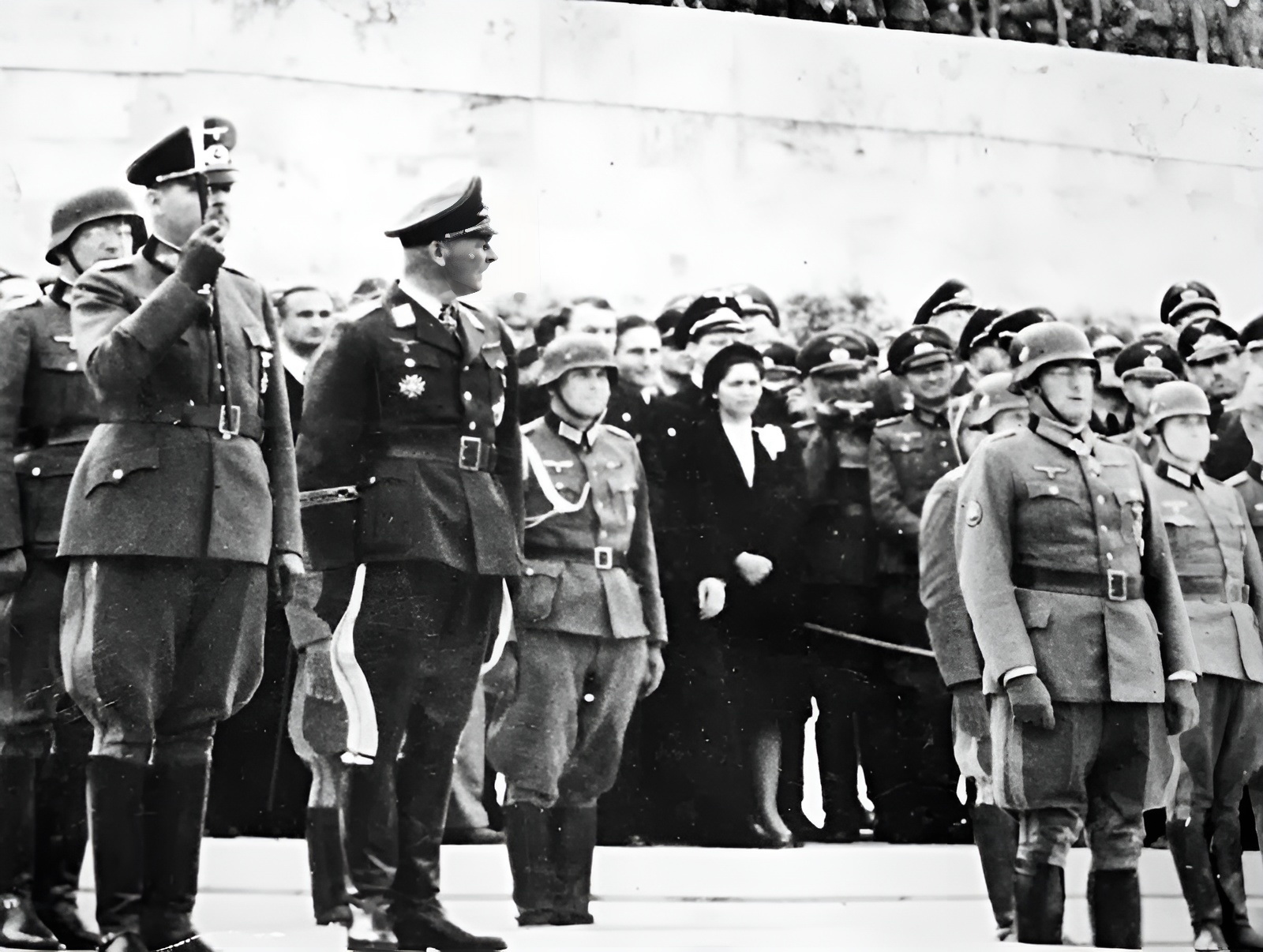
German victory parade in Athens, 1941. After the end of the southeastern
campaign, a large parade of contingents from the Heer and Luftwaffe
regiments took place in Athens in front of Generalfeldmarschall Wilhelm
List on Sunday, 4 May 1941. Italian combat troops also took part in the
parade, which were held in front of the old Royal Palace in Syntagma
Square. This picture shows Mountain Troops from 6. Gebirgs-Division
during the march past Field Marshal List. For the identification, from
left to right: 1.General der Infanterie Franz Böhme (Kommandierender General
XVIII. Gebirgskorps), 2.Generalfeldmarschall Wilhelm List (Oberbefehlshaber 12.
Armee), 3.General der Flieger Wolfram Freiherr von
Richthofen (Kommandierender General VIII. Fliegerkorps), and 4.Generalmajor
Ferdinand Schörner (Kommandeur 6. Gebirgs-Division). Other pictures from this occasion can be seen
HERE.

This
photo was taken in May 1941 during Von Brauchitsch's visit to the
Balkans shortly after the Germans occupied Greece and Yugoslavia. It
looks like that the Army Commander in Chief is inspecting the array of
German war machines used in recent military campaigns. The cannon in the
back is a Flak 30 (Flugabwehrkanone 30) 20mm caliber but without a
towing vehicle underneath, and is mounted on a trailer. For the
identification of the people, from left to right: 1.Oberstleutnant Heinz
von Gyldenfeldt (Erster Generalstabsoffizier beim Oberbefehlshaber des
Heeres), 2.Generalfeldmarschall Walther von Brauchitsch
(Oberbefehlshaber des Heeres), 3.Oberstleutnant i.G. Max-Josef Pemsel
(Chef des Generalstabes XVIII. Gebirgskorps), 4.Generalmajor Ferdinand
Schörner (Kommandeur 6. Gebirgs-Division), and General der Infanterie
Franz Böhme (Kommandierender General XVIII. Gebirgskorps).

Italian military parade in front of German and Italian officials in
Greece, summer 1941. Standing in the podium are General der
Gebirgstruppe Franz Böhme (saluting, Kommandierender General XVIII.
Gebirgskorps) and Generalmajor Ferdinand Schörner (Kommandeur 6.
Gebirgs-Division). Italian officer in the helmet is Generale di
divisione Paolo Berardi (21 June 1885 - 13 December 1953). In 1941 he
was the divisional commander of the "Brennero" division in Greece, while
in 1942 he took command of the "Sassari" in Yugoslavia. In this
picture, he is wearing the collar patch of "Brennero" (the vertically
separated yellow/red color). Other pictures from this occasion can be seen HERE.

From
left to right: Oberfeldwebel Helmuth Valtiner (Zugführer in 1.Kompanie /
I.Bataillon / Gebirgsjager-Regiment 143 / 6.Gebirgs-Division) and
Generalmajor Ferdinand Schörner (Kommandeur 6. Gebirgs-Division).
Valtiner received the Ritterkreuz des Eisernen Kreuzes on 13 June 1941
for his bravery and decisiveness during the German invasion of Greece,
two months previously. On 18 April 1941 the First Battalion of
Gebirgsjäger-Regiment 143 was ordered to force a crossing over the river
Pinios and capture the position Evangelismos. The Bataillon ordered its
1. Kompanie to lead the way, intending for it to have established a
bridgehead on the south bank of the river by 14:00. But by the ordered
time a large portion of the Kompanie had not even reached the river,
only Valtiner and 6 men. After a brief examination of the situation he
swam over the river in full combat gear with his comrades. In doing so
he was able to determine the most favourable crossing point over the
river, and despite strong enemy artillery, mortar and MG fire he was
able to hang on to a small toehold on the opposite bank. This was later
exploited when the rest of 1. Kompanie arrived, and it led to the
successful creation of the first bridgehead over the Pinios.

Generalmajor
Ferdinand Schörner (left, Kommandeur 6. Gebirgs-Division) in the inspection to Lapland area in the arctic during Operation Silver Fox, November 1941. The picture
was taken from the private archive of Wehrmacht soldier Hans Greber.

Generalmajor Ferdinand Schörner (Kommandeur 6. Gebirgs-Division) in Scandinavia, early 1942.

Generalmajor Ferdinand Schörner (Kommandeur 6. Gebirgs-Division) with his soldier in the area of the Western Zapadnaya Litsa River in the north of the Kola Peninsula in Murmansk. The picture was taken from the photo album of W. Scheran, courtesy of Revda Museum.

Ferdinand Schörner.

Generalleutnant
Ferdinand Schörner (right, Kommandierender General Gebirgskorps
Norwegen) with the commander of the Finnish Petsamo Battalion,
Lieutenant-Colonel Antti Pennanen (center), inspects the equipment of
the reindeer sled at "Taka-Lapin poppoossa". The German general got to
know reindeer herders and their equipment with great interest. The
picture was taken in Finland, March 1942. Other pictures from this occasion can be seen
HERE.

General
der Gebirgstruppe Ferdinand Schörner (left, Kommandierender General
Gebirgskorps Norwegen) with Finnish Lieutenant-Colonel Carl-Gustaf
Wahren and Lieutenant Vartia in front of the German general's Finnish
sauna. Litsa, Finland, 27 July 1942.

From
left to right: Generalmajor Georg Ritter von Hengl (Kommandeur 2.
Gebirgs-Division), Generaloberst Eduard Dietl (Oberbefehlshaber 20.
Gebirgsarmee), unknown Kriegsmarine officer, Konteradmiral Heinz
Nordmann (Admiral norwegische Polarküste), General der Gebirgstruppe
Ferdinand Schörner (Kommandierender General XIX. Gebirgskorps), and
Generalarzt Dr.med. Rudolf Lipf (Korpsarzt XIX. Gebirgskorps). There is
no information about when and where this picture was taken, but possibly
between April-December 1942 in the Norwegian Front.

This image come from "
Mit dem Reichskommissar nach Nordnorwegen und Finnland 10. bis 27. Juli 1942" (Photo Album from Terboven's journey to Nothern Norway and Finland 10–27 July 1942), which contains about 375 images, uploaded to
www.flickr.com by Riksarkivet (National Archives of Norway) in 2012. This picture shows General der Gebirgstruppe
Ferdinand Schörner (second from right, Kommandierender General XIX. Gebirgskorps) with his staff officers. Original caption: "General Schörner und sein Adjutant." At right is Oberst Hans Degen (Chef des Generalstabes XIX. Gebirgskorps).

This image come from "
Mit dem Reichskommissar nach Nordnorwegen und Finnland 10. bis 27. Juli 1942"
(Photo Album from Terboven's journey to Nothern Norway and Finland
10–27 July 1942), which contains about 375 images, uploaded to
www.flickr.com
by Riksarkivet (National Archives of Norway) in 2012. This picture
shows General der Gebirgstruppe
Ferdinand Schörner (sitting in the middle, Kommandierender General XIX.
Gebirgskorps) with SS officers. Sitting at left with him is SS-Obergruppenführer Karl Kaufmann (Reichskommissar für die deutsche Seefahrt). Original caption: "RK, RKS und General Schörner."

Ferdinand Schörner (center) shaking hands with Kriegsmarine officer. There is no information about when and where this picture was taken.

Ferdinand Schörner (left) and Eduard Dietl (center). There is no information about when and where this picture was taken, but probably when Schörner served as Kommandierender General XIX. Gebirgskorps,while Dietl as Oberbefehlshaber 20. Gebirgsarmee in the Eismeer Front.
General der Gebirgstruppe Ferdinand Schörner (Kommandierender General XIX. Gebirgskorps) meets with German soldiers near his residence on 2 December 1942 in Mittendorf, Germany, possibly during home leave.

From left to right: Generaloberst Eduard Dietl (Oberbefehlshaber 20.
Gebirgsarmee), unknown Kriegsmarine officer, and General der Gebirgstruppe
Ferdinand Schörner (Kommandierender General XIX. Gebirgskorps). The picture was taken in the Murmansk Front, winter of 1942-43.

From
left to right: General der Gebirgstruppe Ferdinand Schörner
(Kommandierender General XIX. Gebirgskorps), Oberst Hans Degen (Chef des
Generalstabes XIX. Gebigrskorps), and Generaloberst Eduard Dietl
(Oberbefehlshaber 20. Gebirgsarmee). There is no information about when
and where this picture was taken, but possibly in the Scandinavian front
in 1942-1943 period.

From
left to right: unknown, General der Gebirgstruppe Ferdinand Schörner
(Kommandierender General XIX. Gebirgskorps), Generaloberst Eduard Dietl
(Oberbefehlshaber 20. Gebirgsarmee), Generalmajor Georg Ritter von Hengl
(Kommandeur 2. Gebirgs-Division), and another unknown. This picture was
taken at the Finnish theater of war on 2 January 1943. Other pictures from this sequence can be seen
HERE.

From left to right: unknown Kriegsmarine officer, Generalleutnant Karl
Wintergest (Kommandeur 210. Infanterie-Division), unknown Kriegsmarine
Admiral, Generaloberst Eduard Dietl (Oberbefehlshaber 20. Gebirgsarmee),
and General der Gebirgstruppe Ferdinand Schörner (Kommandierender
General XIX. Gebirgskorps). There is no information about when or where
this picture was taken, but probably in Kirkenes, Norway, between
April-October 1943.

Generaloberst Eduard Dietl
(second from right, Oberbefehlshaber 20. Gebirgsarmee) and General der Gebirgstruppe Ferdinand Schörner
(right, Kommandierender General XIX. Gebirgskorps) during the inspection tour to the arctic front, August-September 1943.

Another picture showing General der Gebirgstruppe Ferdinand Schörner
(Kommandierender General XIX. Gebirgskorps) and Generaloberst Eduard Dietl
(Oberbefehlshaber 20. Gebirgsarmee) in the Scandinavian Front, 1942-43.

General der Gebirgstruppe Ferdinand Schörner is seen wearing the Eichenlaub zum Ritterkreuz des
Eisernen Kreuzes which he received on 17 February 1944 as Kommandierender General XXXX. Panzerkorps. The following press article (dated 21 February 1944) describes why Schörner would receive the Eichenlaub: “Schörner has been in command of the Nikopol bridgehead since 25 November 1943. The Wehrmachtbericht of 18 February 1944 goes into further detail as to the achievements of Schörner and his men in this area in their battles against a relentless enemy. Great difficulties were encountered during the evacuation of the bridgehead (which began on 4 February 1944) due to the extremely bad roads and terrain. Through the leadership and skillful handling of the commanding general (who could always be found at the hot spots of the front), as well as the bravery and dedication of his men, it was possible to carry out the planned withdrawal movements successfully.”

This picture was taken in the spring of 1944 (possibly in April), and it shows General der Gebirgstruppe Ferdinand Schörner (right, mit der Führung der Heeresgruppe Südukraine beauftragt) discussed the war situation with Generalleutnant August Wittmann (center, Kommandeur 3. Gebirgs-Division).

General
der Panzertruppe Joachim Lemelsen (left) and General der Gebirgstruppe
Ferdinand Schörner in swimming trunks. There is no information about
when and where this picture was taken, but probably in March-May 1944
when 6. Armee (Lemelsen) were subordinated to Heeresgruppe Südukraine
(Schörner).

General
der Gebirgstruppe Ferdinand Schörner (right, Oberbefehlshaber
Heeresgruppe Südukraine) and General der Infanterie Otto Wöhler
(Oberbefehlshaber 11. Armee) during a briefing on a map. The picture was
taken by Bildberichter Heinz Mittelstaedt of PK (Propaganda-Kompanie)
637 in Barlad, Romania, 11 April 1944.
Around
the map table, from left to right: Generalleutnant Walther Wenck (Chef
des Generalstabes Heeresgruppe Südukraine), Marshal Ion Antonescu
(Commander in Chief of Romanian Armed Forces), and Generaloberst
Ferdinand Schörner (Oberbefehlshaber Heeresgruppe Südukraine). The
officer at far left behind Wenck is probably Oberst i.G. Ivo-Thilo von
Trotha (Ia Heeresgruppe Südukraine). The picture was taken on 1 May 1944
by unknown photographer from Presse-Illustrationen Heinrich Hoffmann
and was first published by 'Deutsche Allgemeine Zeitung' (DAZ) on 10 May
1944. Other pictures from this sequence can be seen
HERE.

This
picture was taken on 10 May 1944 and it shows, from left to right:
Generalleutnant Walther Wenck (Chef des Generalstabes Heeresgruppe
Südukraine), General de armată Petre Dumitrescu (Commander in Chief
Armeegruppe Dumitrescu), Generaloberst Ferdinand Schörner
(Oberbefehlshaber Heeresgruppe Südukraine), and SS-Obergruppenführer und
General der Polizei Richard Hildebrandt (Höherer SS- und Polizeiführer
"Schwarze Meer"). Original caption: "Im Zeichen der deutsch-rumänischen
Verbundenheit. Am rumänischen Staatsfeiertag wohnten der
Oberbefehlshaber einer deutschen Heeresgruppen, Eichenlaubträger
Generaloberst Schörner, und der rumänische Armeeführer,
Ritterkreuzträger Dunitrescu, einer Feierstunde bei." (In the spirit of
German-Romanian solidarity. On the Romanian national holiday, the
commander-in-chief of a German army group, oak leaf bearer Colonel
General Schörner, and the Romanian army leader, Knight's Cross holder
Dunitrescu, attended a ceremony). Other pictures from this sequence can be seen
HERE.

19
June 1944: Generalleutnant Walther Wenck (left, Chef des Generalstabes
Heeresgruppe Südukraine) and Generaloberst Ferdinand Schörner
(Oberbefehlshaber Heeresgruppe Südukraine) congratulates Major Georg
Jakob (Geschwaderkommodore Schlachtgeschwader 10) who has just completed
his 1000th Feindflug (combat mission)! For this extraordinary
achievement, on 30 September 1944 Jakob was awarded the Eichenlaub for
his Ritterkreuz (which he had previously obtained on 27 April 1942). In
this photo, Jakob hugs the mascot of SG 10, a pig, with the number
"1,000" written on the animal's body.

Hitler
took a small walk with his "trusted people" in the Führerhauptquartier
Wolfsschanze (Rastenburg/East Prussia), the afternoon after the failed
bomb attempt on 20 July 1944. From left to right: Generalfeldmarschall
Wilhelm Keitel (Chef Oberkommando der Wehrmacht), Reichsmarschall
Hermann Göring (Oberbefehlshaber der Luftwaffe), Adolf Hitler (Führer
und Oberster Befehlshaber der Wehrmacht), and Reichsleiter Martin
Bormann (Leiter Parteikanzlei der NSDAP und Privatsekretär Führer und
Reichskanzler). Behind Göring is SS-Hauptsturmführer Otto Günsche
(Persönlicher Adjutant Führer und Reichskanzler), while behind Hitler
with a bandaged head is Generaloberst Alfred Jodl (Chef der
Wehrmachtsführungsamt). Between Hitler and Bormann is Oberst Nicolaus
von Below (Adjutant der Luftwaffe beim Führer und Oberster Befehlshaber
der Wehrmacht). The three men chatting in the right corner are, from
left to right: Reichsführer-SS Heinrich Himmler (Chef der SS und
Deutschen Polizei), SS-Gruppenführer und Generalleutnant der Waffen-SS
Hermann Fegelein (Verbindungsoffizier zwischen dem Reichsführer-SS und
dem Führerhauptquartier ), and Generaloberst Ferdinand Schörner
(Oberbefehlshaber Heeresgruppe Südukraine). Other pictures from this sequence can be seen HERE.

The
visit of Generaloberst Ferdinand Schörner (Oberbefehlshaber
Heeresgruppe Nord) to the operational area of Panzergrenadier-Division
"Grossdeutschland", summer 1944. This picture shows the general
inspecting the soldiers from Panzer-Pionier-Bataillon
"Grossdeutschland".
.jpg)
Ritterkreuz
award ceremony for General de corp de armata (Lieutenant general)
Mihail Racovita (right) of Armata a 4-a (4th Romanian Army), which were
held in early August 1944. With him is Generaloberst Ferdinand Schörner
(Oberbefehlshaber Heeresgruppe Nord). Racovita received the Ritterkreuz
des Eisernen Kreuzes on 7 July 1944. Previously he was recalled into
active service on 25 January 1944 and took over the command of the 4th
Army, which had to be completely rebuilt after the Battle of Stalingrad.
He led the army in spring and summer of 1944, in defensive battles in
Northern Romania against the advancing Red Army. Together with the
Wehrmacht, the 4th Army repulsed several Soviet attacks in the First
Jassy-Kishinev Offensive, First Battle of Târgu Frumos and Second Battle
of Târgu Frumos. The picture was taken by Kriegsberichter Model. Other pictures from this occasion can be seen HERE.

Ritterkreuz
award ceremony for Generalleutnant Hermann Foertsch (left, Kommandeur
21. Infanterie-Division) which were held in the northern sector of the
Eastern Front, October 1944. Foertsch received the Ritterkreuz des
Eisernen Kreuzes on 27 August 1944 for his leadership of the 21st
Infantry Division during the summer of 1944. In response to a Soviet
breakthrough he launched a counterattack that succeeded in closing a
frontline gap east of Lake Hino (in turn west of Pskov). In this
picture, awarded the medal is Generaloberst Ferdinand Schörner
(Oberbefehlshaber Heeresgruppe Nord), while facing the camera in the
background is General der Infanterie Ehrenfried-Oskar Boege
(Oberbefehlshaber 18. Armee).


Generaloberst
Ferdinand Schörner (Oberbefehlshaber Heeresgruppe Nord) posed for the
camera after the audience with Hitler who congratulates him for the
award of the Schwerter #93 for his Ritterkreuz des Eisernen Kreuzes,
which he received on 28 August 1944. The following press article (dated 1
September 1944) describes why Schörner
would receive the Schwerter: “Generaloberst Ferdinand Schörner is the
commander-in-chief of our troops fighting in the Courland region,
against whom the surge of enemy forces from the east has failed to
overcome for many weeks. Despite already having been cut off once
completely, our troops in Courland have defied all the odds as the
cornerstone of the Eastern front. They embodied the spirit of their
commander-in-chief, and his skillful leadership has guided them to a
victorious outcome over the course of incessant battle against the
hordes of enemies.”

Generaloberst Ferdinand Schörner (Oberbefehlshaber Heeresgruppe Nord) in the autumn of 1944. He is wearing the Schwerter zum Ritterkreuz des Eisernen Kreuzes which he received on 28 August 1944. The following press article (dated 1 September 1944) describes why Schörner
would receive the Schwerter: “Generaloberst Ferdinand Schörner is the
commander-in-chief of our troops fighting in the Courland region,
against whom the surge of enemy forces from the east has failed to
overcome for many weeks. Despite already having been cut off once
completely, our troops in Courland have defied all the odds as the
cornerstone of the Eastern front. They embodied the spirit of their
commander-in-chief, and his skillful leadership has guided them to a
victorious outcome over the course of incessant battle against the
hordes of enemies.”
.jpg)
Another picture of Ferdinand Schörner with the Schwerter.
Reichsminister
Dr.phil. Joseph Goebbels visits the Silesian front town of Lauban
(Luban, Poland) on 9 March 1945. He meets with Generaloberst Ferdinand
Schörner (Oberbefehlshaber Heeresgruppe Mitte). Goebbels greets troops,
including 16 year old Hitler Youth member Wilhelm Hübner, on the market
square of the town. View of the square shot through a broken window
pane. Goebbels speaks to the soldiers. Graphic shots of dead civilians
from the same area. The narrator describes the perpetrators as
"Untermenschen" and the associates of Roosevelt's Christian soldiers.
Original sound of Goebbels giving a speech in Görlitz a day later, 10
March 1945. He says that the German soldiers will show no mercy to the
enemy on the Eastern Front and that Hitler will overcome this crisis as
he had been in the past. He tells of a conversation in which Hitler
stated that he believes that victory will be theirs. Close ups of men
and women in the crowd. After Goebbels is finished speaking the crowd is
led in a chorus of "Sieg Heil."

Generaloberst
Ferdinand Schörner (Oberbefehlshaber Heeresgruppe Mitte) wearing his
set of Brillanten which he received on 1 January 1945. Other pictures from this occasion can be seen
HERE.

This
photo - taken inside the Führerbunker in Berlin - was shot in late
February or early March 1945 and shows Adolf Hitler (Führer und Oberster
Befehlshaber der Wehrmacht) congratulating Generaloberst Ferdinand
Schörner on the award of the Brillanten #23 for his Ritterkreuz, which
he had received previously on 1 January 1945 as Oberbefehlshaber
Heeresgruppe Nord. Standing by the door was Hitler's loyal Chief Aide,
SS-Obergruppenführer Julius Schaub. Some sources say that this photo was
taken in April 1945, but this claim is false because no photographers
or cameramen were allowed to remain in the bunker since 20 March 1945!

Generalfeldmarschall Ferdinand Schörner (center), Commander of Germans
forces in Czechoslovakia, is pictured on 25 May 1945, with guard in a
U.S. Army jeep after being turned over to the 42nd Ïnfantery "Rainbow"
Division, Seventh U.S. Army, by headquarters of the First German Army in
Austria. Field Marshal Schorner sought refuge in the Tyrolean Alps
after fleeing Czechoslovakia. He reported to the First German Army when
42nd division troops cut off all escape routes. But, hated by the rank
and file of his fellow officers, he was promptly handed over to the
American forces and made a prisoner-of-war. This photo shows two U.S.
Army soldiers from "Rainbow Division" who provides the armed guard on
the way to a headquarters in Austria. Seated in the back of the jeep is
Sergeant Howard A. Larson of St. Paul, Minnesota, while Corporal Kenneth
M. Thompson of Marshalltown, Iowa, is in the driver's seat. The picture
was first published in 29 May 1945.

Mugshot
of Generalfeldmarschall Ferdinand Schörner (12 June 1892 – 2 July 1973)
while a Russian prisoner. He was captured by American troops in Austria
on May 18, 1945, but then extradited to the Soviet Union in 1951. His
initial sentence was 12 years in prison for alleged war crimes, but then
it was suspended continuously until he was finally released in 1954.
When he returned to his country, Schörner was thrown back behind bars on
charges of "illegal execution of deserted German soldiers". It wasn't
until 1963 that he finally breathed free air, and then spent the
reminder of his life away from public view in Munich, Germany. When he
died in 1973, Schörner was recorded as the last German Field Marshal to
die, 23 days after Erich von Manstein! For the war crime testimony of Ferdinand Schörner to the Soviets can be read
HERE.

Ferdinand Schörner after being released from the Soviet prison in early 1955. Original Caption: "Former German field marshal Ferdinand (The Bloody) Schoerner, is shown reading a newspaper in a train at Munich shortly after his release from Russian captivity. Schoerner's grim face might be explained by the newspaper headline of a report that he may face a war crimes court on charges of inhumanity to his own troops in World War II. Schoerner earned the nickname "Ferdinand the Bloody" because of cruel punishment of his troops during the unsuccessful attacks on the Russian front. At a news conference Schoerner said he was authorized to announce that all remaining German prisoners of war soon would be freed by the Soviets. West German minister without portfolio Franz Josef Strauss promptly said that the Soviet action was a political maneuver."

Ferdinand Schörner after being released from the Soviet prison in early 1955. Original Caption: "Field-Marshal of the former German Army Schörner shortly after set free by the Russians arrived at Bavaria. he left the train at Freising near Munich, rushed to a waiting car and will probably stay at his relations."

On
15 January 1955 ex Generalfeldmarschall Ferdinand Schörner was released
from Soviet captivity and sent to East Berlin with Vizeadmiral
Hans-Erich Voß in a special compartment. While he was still on the
platform, he gave a speech (which record kept in the GDR archives until
after the fall of communism). A delegation with Generals Lattmann,
Arthur Brandt (Luftwaffe) and Haehling received him. The attempt to
persuade him to stay in the GDR (possibly as Generalinspekteur of the
People's Army) failed, and he traveled on to Münich via Hof (his wife
and eldest son had already committed suicide in 1949). This picture was
taken on the evening of 28 January 1955 and it shows Schörner with his
remaining children, Anneliese and Peter.

Ferdinand
Schörner after being released from the Soviet prison in early 1955.
Original Caption: "On January 28th evening Ex-field-marshal Friedrich
Schörner shortly set free by the Russians arrived at Münich. He stayed
at his children. Photo shows The general (left) visited by a late
officer of the Austrian Armee.

On
1 October 1957 the trial against ex German field marshal Ferdinand
Schörner began in a Münich court. The 65 year old was defended by three
attorneys and was accused of one account of manslaughter and two more
accounts of attempted manslaughter. This picture was taken on 4 October
1957 when Schörner enters the courtroom during his trial. He is charged
with ordering the execution without court-martial of two Wehrmacht
officers and an NCO during World War II. Other pictures from this trial can be seen
HERE.

Ferdinand Schörner biography by Roland Kaltenegger.
Source :
NARA photo archive
Bundesarchiv photo archive
Bayerische Staatsbibliothek photo archive
Agustin Vazquez photo collection
Josef Bremm photo collection
Michal S. photo collection
Rune Rautio photo collection
Stefan K. photo collection
"Feldmarschall der letzten Stunde" by Roland Kaltenegger
"Generalfeldmarschall Ferdinand Schörner" by Erich Kern
"Panzergrenadier-Division Großdeutschland" by Horst Scheibert
https://www.alamy.com/stock-photo/sch%C3%B6rner.html?imgt=1&sortBy=relevant
https://www.andreas-thies.de/auktionen/64-750269
https://audiovis.nac.gov.pl/obraz/54656/5d129355608ee73a1e66e787e58a02d9/
https://beeldbankwo2.nl/nl/beelden/detail/e1b4651a-0259-11e7-904b-d89d6717b464/media/0054a76c-7869-09d5-1dd3-36eeb5d8b874?mode=detail&view=horizontal&q=sch%C3%B6rner&rows=1&page=3
http://des.genealogy.net/search/show/8255121
https://digitaltmuseum.no/021019081611/general-ferdinand-schorner-i-samtale-med-en-annen-soldat-ukjent-sted-ostfronte/media?slide=0
https://dzen.ru/a/ZKWuB45ROgzsWpJh
https://en.wikipedia.org/wiki/Ferdinand_Sch%C3%B6rner
https://www.facebook.com/frontsoldaten/photos/pcb.1427064307682315/1427063381015741/?type=3&eid=ARA0RDVxaseB5qfvNtrVlfqPpgfmCmt54_qPiXGx-x7wUKKeac0e7HPis-iOd2YKoms4fqLpbK_FmF0a&locale=hi_IN&paipv=0&eav=AfaudWlsuFc7oZjjfNSXWX4JDhci4WICtvNuVbZ_pGukicGqZeSQVclpf6pWit7zcKU&_rdr
https://forum.axishistory.com/viewtopic.php?f=5&t=94182&hilit=ferdinand+sch%C3%B6rner&sid=319cb1647229b75e663c01794b52be7c
https://kalevimikkonen27.blogspot.com/2018/09/ferdinand-schorner-petsamon-verihurtta.html
http://lexicon.dobrohot.org/index.php/%D0%A8%D0%81%D0%A0%D0%9D%D0%95%D0%A0_%D0%A4%D0%B5%D1%80%D0%B4%D0%B8%D0%BD%D0%B0%D0%BD%D0%B4_(SCH%C3%96RNER_F.)
https://www.lexikon-der-wehrmacht.de/Personenregister/S/SchoernerF.htm
https://media.digitalarkivet.no/view/13188/2
https://militariarelics.com/german/rk-autographs/war-time-signed/5141
https://www.quora.com/Which-WW2-German-general-was-most-disliked-by-his-men
https://www.shutterstock.com/video/clip-5078219-mittendorfgermany---december-22-nazi-general-field
https://www.televignole.it/foto-storie-guerra-43/
https://www.tracesofwar.com/persons/1054/Sch%C3%B6rner-Johann-Ferdinand.htm
https://www.warhistoryonline.com/instant-articles/germanys-last-field-marshal-the-butcher-ferdinand-schornerand.html
https://www.wehrmacht-awards.com/forums/forum/wehrmacht-era-militaria/photos-and-paper-items-forum/108154-soldier-of-which-nationality#post1759839
https://wwii.space/%D1%84%D0%BE%D1%82%D0%BE-%D0%B3%D0%B5%D1%80%D0%BC%D0%B0%D0%BD%D0%B8%D1%8F-%D0%BF%D0%BE%D0%BB%D0%BA%D0%BE%D0%B2%D0%BE%D0%B4%D1%86%D1%8B-%D1%87%D0%B0%D1%81%D1%82%D1%8C-9/2/


%20and%20Hans%20K%C3%84LLNER%20(right).jpg)




.jpg)


.jpg)


