
The
Wehrmacht victory parade through the streets of Athens on 3 May 1941
marked a formal public celebration of the rapid German success in the
Balkans during Operation Marita. It came just six days after advance
German units entered the Greek capital on 27 April 1941, symbolizing the
effective end of organized resistance on the Greek mainland and the
beginning of Axis occupation.
The German 12. Armee, commanded by Generalfeldmarschall Wilhelm List, had spearheaded the invasion of Greece (and Yugoslavia) starting on 6 April 1941. By late April, German forces had outflanked Allied and Greek defenses. On the morning of 27 April 1941, vanguard elements reached Athens from the north. These included troops of the 6. Gebirgs-Division and the 2. Panzer-Division, advancing in armored vehicles, tanks, cars, and motorcycles.
Greek police continued patrolling the streets as thousands of civilians watched the columns move into the city center. Later that morning, German troops reached the Acropolis and raised the Reichskriegsflagge, replacing the Greek national flag. At approximately 10:45 a.m., the city was formally handed over during a meeting between the mayor of Athens and Generalleutnant Georg Stumme, commander of the XXXX. Panzerkorps.
On 3 May 1941, the Wehrmacht staged its victory parade, reviewed by Generalfeldmarschall Wilhelm List. The event featured selected German units marching and driving through central Athens, likely passing areas near the Royal Palace or Syntagma Square. Contemporary accounts describe a two-hour procession that included infantry, artillery, motorized elements, and armored vehicles.
Participating German formations included elements of the 6. Gebirgs-Division and Detachement Süßmann. Armored and motorized units featured prominently, with Panzer III tanks and columns of Sd.Kfz. 251 half-tracks parading past the reviewing stand. Some soldiers wore parade uniforms, while others appeared in standard field dress.
Photographs from the event show disciplined columns of troops and vehicles moving through the city, with German flags and swastika banners displayed on buildings. Crowds of Greek civilians watched from streets, balconies, and rooftops. Berlin radio reported that German troops were joined by Italian detachments, reflecting the joint Axis nature of the campaign, although the review and primary participation remained German.
Hitler had initially been reluctant to stage a grand entry into Athens to avoid wounding Greek national pride, but pressure from Mussolini led to Italian participation in the broader celebrations. The parade on 3 May stood in contrast to the more subdued or somber mood among many Athenian civilians, who had already witnessed the raising of the German flag on the Acropolis days earlier.
In the immediate aftermath, Greece was divided into occupation zones: Germany controlled key areas including Athens, Thessaloniki, and parts of Macedonia and Crete; Italy took most of the mainland and islands; and Bulgaria occupied northeastern territories. A puppet Greek government under General Georgios Tsolakoglou was soon installed. The occupation brought severe repression, food shortages, and eventual famine, claiming hundreds of thousands of Greek lives over the following years.
Key German Units and Formations Mentioned:
12. Armee (commanded by Generalfeldmarschall Wilhelm List)
XXXX. Panzerkorps (commanded by Generalleutnant Georg Stumme)
6. Gebirgs-Division
2. Panzer-Division
Detachement Süßmann
Armored elements with Panzer III tanks and Sd.Kfz. 251 half-tracks
The German 12. Armee, commanded by Generalfeldmarschall Wilhelm List, had spearheaded the invasion of Greece (and Yugoslavia) starting on 6 April 1941. By late April, German forces had outflanked Allied and Greek defenses. On the morning of 27 April 1941, vanguard elements reached Athens from the north. These included troops of the 6. Gebirgs-Division and the 2. Panzer-Division, advancing in armored vehicles, tanks, cars, and motorcycles.
Greek police continued patrolling the streets as thousands of civilians watched the columns move into the city center. Later that morning, German troops reached the Acropolis and raised the Reichskriegsflagge, replacing the Greek national flag. At approximately 10:45 a.m., the city was formally handed over during a meeting between the mayor of Athens and Generalleutnant Georg Stumme, commander of the XXXX. Panzerkorps.
On 3 May 1941, the Wehrmacht staged its victory parade, reviewed by Generalfeldmarschall Wilhelm List. The event featured selected German units marching and driving through central Athens, likely passing areas near the Royal Palace or Syntagma Square. Contemporary accounts describe a two-hour procession that included infantry, artillery, motorized elements, and armored vehicles.
Participating German formations included elements of the 6. Gebirgs-Division and Detachement Süßmann. Armored and motorized units featured prominently, with Panzer III tanks and columns of Sd.Kfz. 251 half-tracks parading past the reviewing stand. Some soldiers wore parade uniforms, while others appeared in standard field dress.
Photographs from the event show disciplined columns of troops and vehicles moving through the city, with German flags and swastika banners displayed on buildings. Crowds of Greek civilians watched from streets, balconies, and rooftops. Berlin radio reported that German troops were joined by Italian detachments, reflecting the joint Axis nature of the campaign, although the review and primary participation remained German.
Hitler had initially been reluctant to stage a grand entry into Athens to avoid wounding Greek national pride, but pressure from Mussolini led to Italian participation in the broader celebrations. The parade on 3 May stood in contrast to the more subdued or somber mood among many Athenian civilians, who had already witnessed the raising of the German flag on the Acropolis days earlier.
In the immediate aftermath, Greece was divided into occupation zones: Germany controlled key areas including Athens, Thessaloniki, and parts of Macedonia and Crete; Italy took most of the mainland and islands; and Bulgaria occupied northeastern territories. A puppet Greek government under General Georgios Tsolakoglou was soon installed. The occupation brought severe repression, food shortages, and eventual famine, claiming hundreds of thousands of Greek lives over the following years.
Key German Units and Formations Mentioned:
12. Armee (commanded by Generalfeldmarschall Wilhelm List)
XXXX. Panzerkorps (commanded by Generalleutnant Georg Stumme)
6. Gebirgs-Division
2. Panzer-Division
Detachement Süßmann
Armored elements with Panzer III tanks and Sd.Kfz. 251 half-tracks




Following the rapid German conquest of Greece in Operation Marita, Wehrmacht forces under Generalfeldmarschall Wilhelm List entered Athens on 27 April 1941 after a series of decisive victories that forced the evacuation of remaining Greek and British Commonwealth troops, and a formal victory parade was staged in the Greek capital on 3 May 1941 to mark the triumph, with troops marching through central squares and streets under the gaze of senior Axis commanders. Among the units participating in this display of strength were elite elements of the Fallschirmjäger from Detachement Süßmann, drawn from the 7. Flieger-Division commanded by Generalleutnant Wilhelm Süssmann; these paratroopers had played a key role just one week earlier during the airborne assault on the Corinth Canal bridge on 26 April, when glider-borne engineers and parachute infantry from the Fallschirmjäger-Regiment 2 seized both ends of the vital crossing in a surprise operation intended to cut off Allied lines of retreat and open the way for pursuing panzer columns, although fierce fighting and the eventual destruction of the bridge by Allied action resulted in significant casualties on both sides. Marching with precision in their distinctive Fallschirmjäger attire—including the characteristic jump smock, Stahlhelm helmets, and full combat equipment—these highly trained airborne troops exemplified the innovative vertical envelopment tactics that had accelerated the German advance across the Balkans, parading as a symbol of Luftwaffe prowess just prior to their major commitment in the upcoming Battle of Crete. The event featured a combined German and Italian procession in line with Axis agreements, with the Fallschirmjäger contingent standing out for their specialized role and elite status amid the broader Wehrmacht formations, while the historic backdrop of Athens, including views toward the Acropolis, underscored the propaganda value of the parade in consolidating the occupation.

Among the units participating in the German victory parade in Athens on 3 May 1941 were elite elements of the Fallschirmjäger from Detachement Süßmann, drawn from the 7. Flieger-Division commanded by Generalleutnant Wilhelm Süssmann; these paratroopers had played a key role just one week earlier during the airborne assault on the Corinth Canal bridge on 26 April, when glider-borne engineers and parachute infantry from the Fallschirmjäger-Regiment 2 seized both ends of the vital crossing in a surprise operation intended to cut off Allied lines of retreat and open the way for pursuing panzer columns, although fierce fighting and the eventual destruction of the bridge by Allied action resulted in significant casualties on both sides. Marching with precision in their distinctive Fallschirmjäger attire—including the characteristic jump smock, Stahlhelm helmets, and full combat equipment—these highly trained airborne troops exemplified the innovative vertical envelopment tactics that had accelerated the German advance across the Balkans, parading as a symbol of Luftwaffe prowess just prior to their major commitment in the upcoming Battle of Crete.

In the wake of the swift German conquest of mainland Greece during Operation Marita in April 1941, the elite Gebirgsjäger of the 6. Gebirgs-Division (6th Mountain Division) formed a prominent contingent in the Axis victory parade staged in Athens on 3 May 1941, reviewed by Generalfeldmarschall Wilhelm List of the 12. Armee. This mountain infantry division, commanded within the XVIII. Gebirgs-Korps by General der Gebirgstruppen Franz Böhme and comprising regiments such as the Gebirgsjäger-Regiment 141 and Gebirgsjäger-Regiment 143, had played a decisive role in breaching the heavily fortified Metaxas Line and advancing through rugged, snow-covered passes around Mount Olympus before its vanguard elements—alongside motorcycle units of the 2. Panzer-Division—first entered the Greek capital from the north on the morning of 27 April 1941, raising the swastika flag over the Acropolis while Greek civilians largely remained indoors behind shuttered windows. During the formal parade, columns of Gebirgsjäger in their distinctive mountain uniforms adorned with the Edelweiss insignia marched in precise formation through central Athens streets past landmarks including the Parliament building and in view of the ancient Acropolis, showcasing German military discipline and prowess alongside panzer elements and Italian detachments (included at Mussolini’s insistence despite Hitler’s initial reluctance to stage a grand spectacle that might offend Greek pride); the event, witnessed by subdued onlookers and captured in contemporary photographs, underscored the rapid collapse of Greek and Allied resistance that culminated in the occupation of the country and the subsequent transfer of the 6. Gebirgs-Division to other theaters.

Following the swift German triumph in Operation Marita, the April 1941 invasion of Greece and Yugoslavia, advance elements of the Wehrmacht, including units of the 2. Panzer-Division, entered Athens on 27 April and raised the Reichskriegsflagge on the Acropolis. In May 1941 a formal victory parade was held through the streets of the occupied capital, reviewed by Generalfeldmarschall Wilhelm List, commander of the 12. Armee, who inspected the columns of troops and vehicles assembled to celebrate the rapid conquest. Among the mechanized forces on display were the Sd.Kfz. 251 Schützenpanzerwagen, the Hanomag-designed armored half-tracked personnel carriers that formed the backbone of the armoured battalions in panzer-grenadier regiments, allowing Panzergrenadiere to keep pace with tanks across the rugged Balkan terrain. A complete platoon of four early-model Sd.Kfz. 251 half-tracks from a motorisierte Infanterie-Kompanie, each fitted with a pintle-mounted MG 34 machine gun protected by a small shield, passed in review before the Generalfeldmarschall, vividly demonstrating the combined-arms tactics that had overwhelmed Greek and Allied defenses; German censors later altered photographs of the event by painting out registration numbers and overpainting the rectangular tactical signs denoting the motorized infantry company. These versatile Sonderkraftfahrzeuge, together with lighter half-tracks such as the Sd.Kfz. 10 used for towing artillery, underscored the technological and organizational superiority of the Wehrmacht during the Balkans campaign, contrasting with the more traditional marching infantry also present in the parade.

Elements of Sturmgeschütz-Abteilung 191, which had already distinguished itself earlier in the operation near Katerini, were among the mechanized forces prominently featured in the German victory parade in Athens, 3 May 1941. Their low-profile assault guns highlighting the effectiveness of the Sturmartillerie concept in providing close infantry support against fortified positions and rearguards in the Balkan theater.

German victory parade in Athens, 1941. After the end of the southeastern campaign, a large parade of contingents from the Heer and Luftwaffe regiments took place in Athens in front of Generalfeldmarschall Wilhelm List on Sunday, 4 May 1941. Italian combat troops also took part in the parade, which were held in front of the old Royal Palace in Syntagma Square. The picture was taken by Kriegsberichter Theodor Scheerer from PK (Propaganda-Kompanie) 690.

German victory parade in Athens, 1941. After the end of the southeastern campaign, a large parade of contingents from the Heer and Luftwaffe regiments took place in Athens in front of Generalfeldmarschall Wilhelm List on Sunday, 4 May 1941. Italian combat troops also took part in the parade, which were held in front of the old Royal Palace in Syntagma Square. The picture was taken by Kriegsberichter Theodor Scheerer from PK (Propaganda-Kompanie) 690.

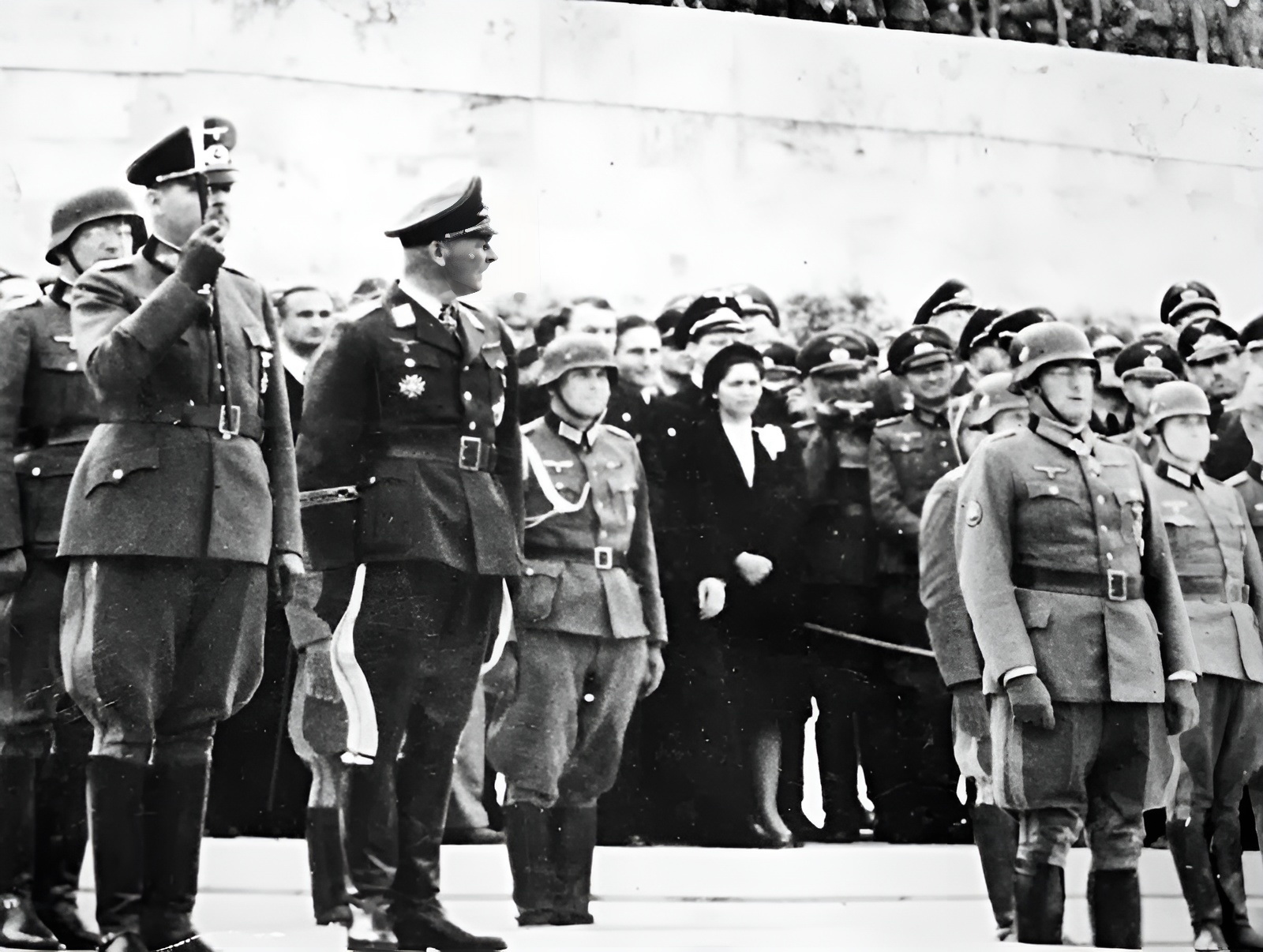
Ritterkreuzträger Hauptmann Wilhelm Walther (Führer I.Bataillon / Lehr-Regiment "Brandenburg" z.b.V. 800) watching the Wehrmacht victory parade in Athens, Greece, on 3 May 1941. During Operation Marita, the German invasion of Yugoslavia and Greece that began on 6 April 1941, the Lehr-Regiment "Brandenburg" z.b.V. 800, an elite Abwehr special forces formation composed of linguistically gifted volunteers trained for sabotage, reconnaissance and the surprise seizure of vital objectives while often operating in disguise or enemy uniforms, played a decisive role in paving the way for the rapid advance of conventional Wehrmacht formations. On 5 April, one day before the main assault, a 54-man detachment from the II. Bataillon secured the strategically important docks at Orsova on the Danube River at the Iron Gates gorge, preventing their demolition by Yugoslav forces and ensuring the river remained open for German supply traffic. During the subsequent drive through northern Greece, Leutnant Siegfried Grabert led a small Brandenburg team that, on 12 April 1941, prevented the destruction of the vital 400-metre road bridge over the Vardar River east of Axiupolis by surprising and capturing a British demolition party at the last moment; he personally took the enemy soldiers prisoner and then held the bridge with his limited forces for approximately ninety minutes until reinforcements arrived, an action that enabled the immediate pursuit of retreating Allied troops and for which Grabert was awarded the Ritterkreuz des Eisernen Kreuzes. Elements of the regiment also secured a key bridge over the Vardar in the opening phase of the campaign, while shortly afterwards other units captured the island of Euböa, demonstrating the Lehr-Regiment "Brandenburg" z.b.V. 800’s effectiveness in conducting high-risk commando operations ahead of the main forces to disrupt enemy defences and seize critical infrastructure throughout the Balkans campaign.
Source :
Bundesarchiv photo archive
"Brandenburger: Wartime Photographs of Wilhelm Walther" by Anthony Rogers
https://www.alamy.com/stock-photo/german-parade-athens-1941.html?sortBy=relevant
https://www.gettyimages.co.uk/search/2/image?family=editorial&phrase=parade%20athens%201941
https://trove.nla.gov.au/newspaper/article/41952152
No comments:
Post a Comment