Showing posts with label 5 Jäger-Division 8. Show all posts

Sunday, May 24, 2026

Ritterkreuzträger of 8. Infanterie-Division / 8. leichte-Division / 8. Jäger-Division

The 8. Infanterie-Division, also known as the 8. leichte-Division and later the 8. Jäger-Division, was a versatile Wehrmacht unit with a long combat history on the Eastern Front. Formed in October 1934 in Oppeln, Silesia (hence its nickname "Schlesische Division"), it initially served as a standard infantry division during the invasions of Poland and France. In December 1941, after suffering heavy losses in the campaign against the Soviet Union with Army Group Center, it was reorganized in France as the 8th Light Infantry Division and redesignated as the 8th Jäger Division on 30 June 1942. Equipped as a lighter, more mobile mountain-capable force with two Jäger regiments, it returned to the Eastern Front in 1942, fighting with distinction in Army Group North around the Leningrad and Staraya Russa sectors before transferring south. The division continued to see intense combat through the defensive battles of 1943–1945, ultimately surrendering to Soviet forces in May 1945. Its evolution reflected the German Army's need for agile light infantry units suited to difficult terrain and prolonged attritional warfare.

---------------------------------------------------------------------------------------------------

8. LEICHTE-DIVISION (December 1941 - June 1942)


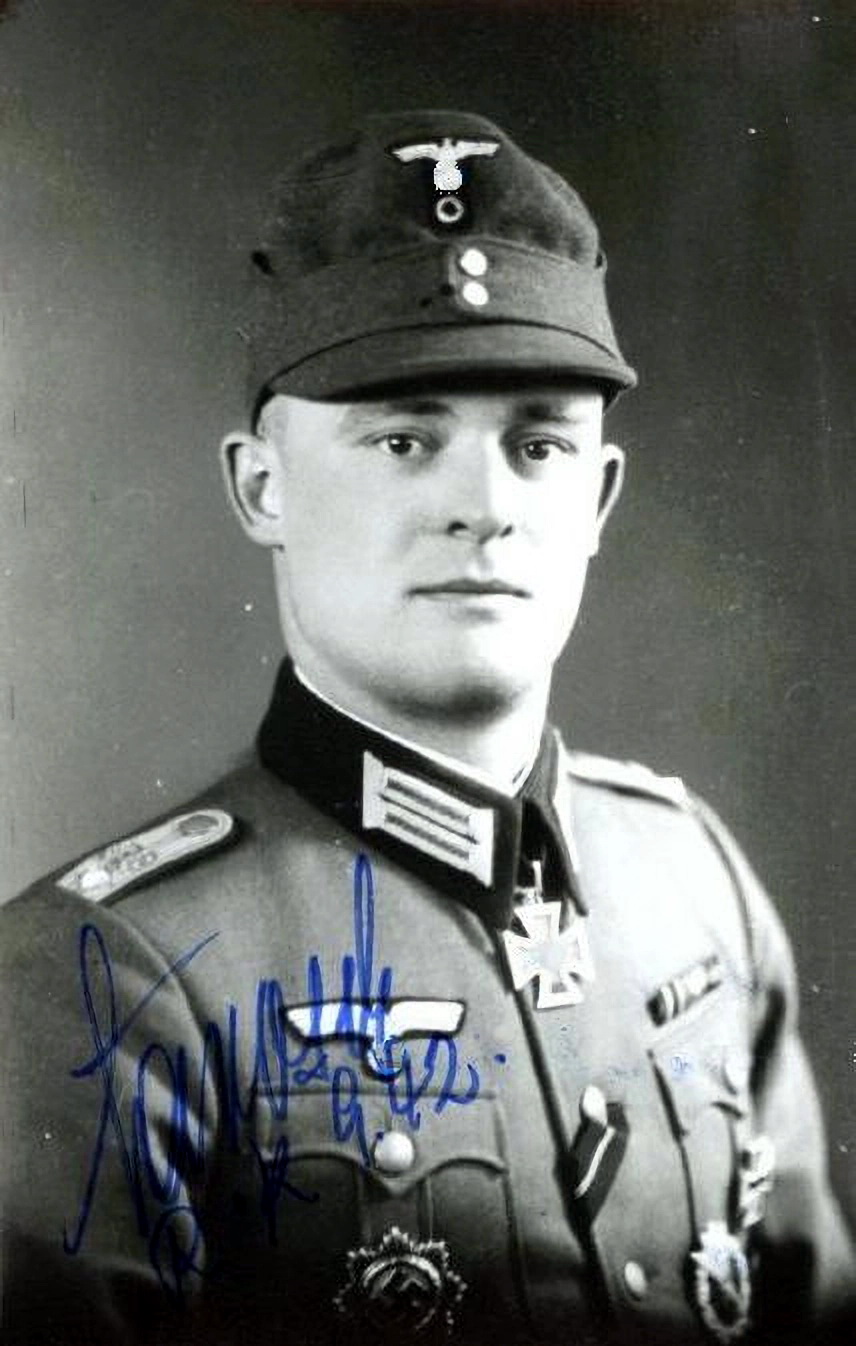
Oberleutnant Karl Hausmann (1912-1997), born on 10 January 1912 in Neuweistritz-Habelschwerdt, Silesia, rose to prominence during the intense fighting on the Eastern Front. Serving initially with Infanterie-Regiment 28 of the 8. Infanterie-Division and later with Jäger-Regiment 28 of the 8. leichte-Division (redesignated as 8. Jäger-Division), he participated in campaigns in Poland, the West, and Operation Barbarossa before distinguishing himself in the brutal winter battles of 1942. As Oberfeldwebel and Führer of 3.Kompanie / I.Bataillon / Jäger-Regiment 28, Hausmann earned the Ritterkreuz des Eisernen Kreuzes on 15 May 1942 for his outstanding bravery and decisive leadership during Operation Bruckenschlag, the relief effort to break through to the encircled German forces in the Demyansk Pocket. In extreme winter conditions with temperatures below -30 degrees Celsius, deep snow, and fierce Soviet resistance, he personally led his Jäger troops in repeated assaults on fortified enemy positions near the Lovat River and Ramushewo, overcoming machine-gun fire and counterattacks through hand-to-hand combat and determined advances that helped secure the vital corridor, turning a stalled attack into a successful link-up with the trapped troops.


Source :
https://en.wikipedia.org/wiki/8th_J%C3%A4ger_Division_(Wehrmacht)

Saturday, May 23, 2026

Bio of Oberleutnant Karl Hausmann (1912-1997)


Full name: Karl Heinz Hausmann  
Nickname: None widely documented  
 
Date of birth: 10.01.1912 - Neuweistritz-Habelschwerdt, Glatz, Provinz Schlesien (German Empire)  
Date of death: 27.07.1997 - Edling, Bavaria (Germany)

Campaign and Operation: Invasion of Sudetenland (1938), Invasion of Czechoslovakia (1939), Invasion of Poland (1939), Invasion of Low Countries and France (1940), Unternehmen Barbarossa (1941), Eastern Front (1941-1944)

Religion: Catholic
Parents: Leo Hausmann (Landwirt) and Anna Guder 
Siblings: No detailed records available.  
Spouse: Christel Jendralski (married 26.02.1942)
Children: No confirmed public information on children.  

Promotions:
00.00.1935 Gefreiter
00.00.1936 Unteroffizier
00.00.1938 Feldwebel
00.00.1940 Oberfeldwebel
01.06.1942 Leutnant (406 C)
01.11.1942 Oberleutnant (310)
06.06.1956 Hauptmann (Bundeswehr)

Career:
04.04.1934 Enlisted in the Heer as a soldier in the 6.Kompanie / Infanterie-Regiment 7 in Glas (Silesia)
00.09.1939 Served in the 8. Infanterie-Division during the Polish Campaign.  
00.00.1940 Participated in the campaign in the West as a Stab and adjutant.
00.00.1940 - 00.12.1941 Zugführer in Infanterie-Regiment 28 / 8.Infanterie-Division.
00.00.1941 Transferred with the division to the Eastern Front as part of Operation Barbarossa.
00.12.1941 - 00.00.1942 Zugführer in Jager-Regiment 28 / 8.leichte-Division
00.06.1942 8. leichte-Division was redesignated as 8. Jager-Division.
00.00.1942 - 00.00.1944 Führer and then Chef of 3.Kompanie / Jager-Regiment 28 / 8.Jager-Division
15.05.1942 Awarded the Ritterkreuz for outstanding bravery and leadership against Soviet forces.
03.06.1942 Lightly wounded by grenade splinter in the left elbow.
04.06.1942 Fell ill with influenza / Feldlazarett 8 in Aleskino.
10.12.1942 Transferred to Jäger-Ersatz-Bataillon 28 in Metz (as the only son left in the family).
00.00.1944 - 04.05.1945 Kompaniechef in Wachbataillon "Großdeutschland".
04.05.1945 - 01.01.1950 Survived the war and became a prisoner of war.  
01.01.1950 Released from the POW camp and settled in bavaria.
06.06.1956 Enlisted in the West German Bundeswehr. Served in Personal-Abteilung / Bundesminister der Verteidigung
30.09.1967 Retired
He Lived quietly until his death in 1997. He occasionally signed postcards and photos for collectors as a ritterkreuztrager.  

Awards and Decorations:
00.11.1939 Eisernes Kreuz II.Klasse
00.00.194_ Infanterie-Sturmabzeichen
18.08.1941 Eisernes Kreuz I.Klasse
00.00.1942 Medaille "Winterschlacht im Osten 1941/42" (Ostmedaille)
00.00.194_ Verwundetenabzeichen in Schwarz
00.00.194_ Nahkampfspange in Bronze
15.05.1942 Ritterkreuz des eisernen kreuzes #990 as Oberfeldwebel and Führer 3.Kompanie / I.Bataillon / Jäger-Regiment 28 / 8.leichte-Division. In early 1942, Soviet forces had trapped around 100,000 German troops in the Demyansk area, south of Lake Ilmen near Staraya Russa. The pocket endured months of brutal winter isolation, supplied only by air. The 8. leichte-Division, together with the 5. leichte-Division, took part in Operation Bruckenschlag, the ground relief attack to link up with the encircled forces.
The offensive launched on 21 March 1942 under extreme winter conditions: temperatures dropping below -30 degrees Celsius, waist-deep snow, dense forests, and frozen swamps. The Jager troops advanced through this frozen wasteland toward the Lovat River and the village of Ramushewo. Hausmann led his company in these assaults as part of Jager-Regiment 28. His leadership and bravery stood out during what the original account described as "a fight of superhuman exertions, courage, intrepidity and bravery and many sacrifice."
The Jager moved forward in white winter camouflage that helped them blend into the snow but gave almost no protection against the freezing wind. Their breath turned to ice on scarves and beards. Rifles and machine guns frequently jammed as the cold thickened the oil inside the mechanisms. Soldiers dragged sleds loaded with ammunition and wounded comrades, or pushed ahead on skis wherever the terrain allowed.
Soviet positions were well-hidden in the snow, behind fallen trees and in fortified villages. Machine-gun fire ripped across the open ground, with glowing tracer rounds slicing through the dim light. Artillery and mortar shells exploded, throwing up columns of snow, ice, and frozen earth. Shrapnel hissed through the air, cutting men down in sudden sprays of red against the white landscape.
Hausmann's company repeatedly stormed these defenses. In fierce assaults they charged through deep snowdrifts under heavy fire. Hausmann led from the front, shouting encouragement and directing his men. They closed the final distance with grenades and bayonets in savage hand-to-hand combat: rifles swung like clubs, knives flashed, and desperate struggles played out in the snow. Soviet counterattacks came in screaming waves of "Hurrah!" charges, often with superior numbers. Hausmann's troops held their ground or pushed back with disciplined fire and determined counter-charges, relying on their training and willpower.
When April arrived, the thaw transformed the battlefield into a nightmare of mud. Melting snow created knee-deep slush and icy swamps. Vehicles sank and became useless. Men waded through freezing water that soaked their uniforms and worsened frostbite into trench foot. What the cold had not taken, the mud and exhaustion now threatened to destroy. Supplies were scarce, rations minimal, and every step required immense effort.
Despite these conditions, on 20 April 1942 the relief forces, including units from the 8. Jager-Division, finally restored the connection with the encircled comrades at Ramushewo on the Lovat River. The narrow corridor allowed the trapped troops to be relieved after months of suffering.
The Ritterkreuz recommendation: "Reason for the award: Oberfeldwebel (Sergeant Major) Hausmann, through personally exemplary bravery and leadership qualities, when the battalion’s attack came to a halt, used his platoon to seize enemy resistance strongpoints — especially trained for house-to-house combat — despite being heavily outnumbered, and held them until reinforcements arrived three hours later. The independently made decision was of decisive importance for the subsequent fighting.”
(12.05.1942 recommendation received; 13.05.1942 forwarded; 15.05.1942 awarded. Preliminary notification of award and decorations: from 16.05.1942 to the Armee Oberkommando 16)

----------------------------------------------------------------------------------------------

Karl Hausmann was a German soldier who served in the Heer during World War II. He earned the Ritterkreuz des Eisernen Kreuzes as an Oberfeldwebel and acting company commander on the Eastern Front for exceptional bravery and leadership in combat. Born on 10 January 1912 in Neuweistritz-Habelschwerdt in Silesia, Hausmann rose through the ranks as a non-commissioned officer known for his steadfastness in the face of overwhelming Soviet opposition. He later lived in Bavaria after the war until his death on 27 July 1997 in Edling.

Hausmann came from Silesia and enlisted in the German Army during the 1930s. He received standard infantry training and was assigned to what became the 8. Infanterie-Division. With the outbreak of war in 1939 he participated in the Polish campaign followed by operations in the west in 1940. When the division moved east for Operation Barbarossa in 1941 it was redesignated first as 8. Leichte Infanterie-Division and then as 8. Jäger-Division. Hausmann served with Jäger-Regiment 28 where he advanced to Feldwebel and then Oberfeldwebel while training as an Offiziersanwärter.

During the harsh fighting on the northern sector of the Eastern Front in 1941 and early 1942 Hausmann demonstrated growing leadership qualities amid mud, snow and relentless enemy attacks. The Jäger troops faced difficult terrain with dense forests and limited visibility that favored Soviet infiltration tactics. As a platoon leader he earned the Eisernes Kreuz 2. Klasse and Eisernes Kreuz 1. Klasse for repeated acts of courage under fire. His experience in close-quarters combat and ability to maintain unit cohesion under pressure marked him as a reliable frontline commander.

In spring 1942 the 8. leichte/Jäger-Division engaged in intense defensive operations against repeated Soviet attempts to break through German lines. On a critical day in early May waves of Red Army infantry supported by heavy mortar and machine gun fire assaulted the positions held by 3. Kompanie of Jäger-Regiment 28. With communications disrupted and casualties mounting Hausmann as acting Führer of the company personally led from the front. Exposed to enemy fire he rallied his Jäger soldiers and destroyed a key Soviet machine gun nest with hand grenades. His decisive counterattack sealed a dangerous breach, recaptured lost ground and inflicted heavy losses on the attackers preventing a collapse of the sector. For these actions he received the Ritterkreuz des Eisernen Kreuzes on 15 May 1942.

Hausmann continued to serve with Jäger-Regiment 28 through the demanding defensive battles of 1942 to 1944. The division participated in numerous withdrawal actions and counterattacks as the Eastern Front shifted westward under growing Soviet pressure. Promoted later to Leutnant he held various leadership roles helping to stabilize positions during critical moments. Some postwar memorabilia connect him through signatures to associations with elements of the Großdeutschland Division though his primary service remained with the 8. Jäger-Division. He survived the final campaigns of 1945 and was taken into captivity as a prisoner of war.

After release from captivity Hausmann settled quietly in Bavaria where he lived a private life. Like many Ritterkreuzträger he occasionally signed postcards and photographs for military history collectors. He passed away on 27 July 1997 in Edling. His military career exemplified the role of experienced non-commissioned officers who provided crucial leadership and resilience for German units throughout the Eastern Front campaigns.

Hausmann received several awards during his service including the Ritterkreuz des Eisernen Kreuzes, the Eisernes Kreuz 2. Klasse, the Eisernes Kreuz 1. Klasse, the Infanterie-Sturmabzeichen, the Nahkampfspange and the Ostmedaille for the Winterschlacht im Osten 1941/42 along with other campaign and wound badges typical for veteran Jäger soldiers. His story remains part of the historical record of the 8. Jäger-Division and its contributions in the Second World War.


Oberleutnant Karl Hausmann as an officer in the Wachbataillon "Großdeutschland".


This propaganda photo shows three women donating money to two soldiers representing the Kriegswinterhilfswerk, a regular fundraising program aimed at helping underprivileged Germans in winter. The two soldier asking for donations themselves were not ordinary soldiers, but war heroes and Ritterkreuzträger from the Wachbataillon (Watch Battalion) Großdeutschland. They are, from left to right: Leutnant Karl Hausmann (Ritterkreuz on 15 May 1942 as Oberfeldwebel and Führer 3.Kompanie / I.Bataillon / Jäger-Regiment 28 / 8. leichte Infanterie-Division) and Oberfeldwebel Josef Dörfel (Ritterkreuz on 4 March 1942 as Oberfeldwebel and Zugführer in 6.Kompanie / II.Bataillon / Infanterie-Regiment 439 / 134.Infanterie-Division). This photo itself was taken in March 1943.


This famous video - taken from 'Die Deutsche Wochenschau Nr. 726, 3 August 1944 - shows Otto Ernst Remer (then Major, later promoted straight to Oberst!) giving a propaganda speech to troops of the Wachbataillon Großdeutschland (Greater German Guard Battalion) in Berlin, late July 1944. He stands in front of a Nazi flag, addresses the soldiers, and they march past him. This was a propaganda piece filmed to celebrate the failure of the 20 July 1944 plot and emphasize the unity between the Wehrmacht and the Nazi Party (NSDAP). In his speech, Remer, addressing his troops and emphasizing loyalty to Hitler and the state after the failed plot. Oberleutnant Karl Hausmann is shown in 00:50.


From left to right: Oberleutnant Rudolf Schlee (Chef 5.Kompanie / Wachbataillon "Großdeutschland") and Oberleutnant Karl Hausmann (Kompaniechef in Wachbataillon "Großdeutschland"). This is a screenshot taken from 'Die Deutsche Wochenschau' Nr. 726 (3 August 1944) which shows the speech of the commander of Wachbataillon "Großdeutschland", Oberst Otto Ernst Remer, shortly after the failed 20 July 1944 Plot. Other images from this occasion can be seen HERE.


Karl Hausmann as a Hauptmann (Captain) in the Bundeswehr. He Enlisted in the West German Armed Forces on 6 June 1956, served mostly in the Personal-Abteilung of Bundesminister der Verteidigung, and retired on 30 September 1967 with the last rank as Hauptmann.


Source:
Https://www.tracesofwar.com/persons/47768/hausmann-karl.htm  
Https://www.lexikon-der-wehrmacht.de/personenregister/h/hausmann.htm  
Https://en.wikipedia.org/wiki/list_of_knights_cross_of_the_iron_cross_recipients_(ha-hm)  
Https://wolfganghistorica.com (memorabilia and signature pages)  
https://forum.axishistory.com/search.php?keywords=hausmann&t=29879&sf=msgonly
https://www.wehrmacht-awards.com/forums/forum/wehrmacht-era-militaria/-1957-medals-orders-and-decorations/705921-kc-group-from-karl-hausmann
http://wehrmachtss.blogspot.com/2018/10/donasi-kriegswinterhilfswerk-oleh.html

Sunday, June 18, 2023

Bio of Hauptmann Alfred Jarosch (1915-2001)


Alfred Karl Max Jarosch

Date of Birth: 10.10.1915 - Skrebenski-Golkowitz, Oberschlesien (German Empire)
Date of Death: 30.08.2001 - Wilhelmsfeld, Baden-Württemberg (Germany)

Promotions:
00.00.194_ Hauptmann
00.00.19__ Major der Reserve (Bundeswehr)

Career:
00.04.1934 joined the Reichswehr and posted in 7. (Preußische) Infanterie-Regiment
00.00.194_ Führer 8.Kompanie / II.Bataillon / Jäger-Regiment 38 / 8.Jäger-Division
00.00.194_ Kommandeur Sturm-Bataillon in 16. Armee and Leiter Lehrstabes "Infanterie" of Armee-Waffenschule 16. Armee
00.00.1956 Reserveoffizier in the Bundeswehr

Awards and Decorations:
00.00.193_ Medaille zur Erinnerung an den 1. Oktober 1938
00.00.193_ Medaille zur Erinnerung an den 1. Oktober 1938 mit Spange "Prager Burg"
00.00.19__ Dienstauszeichnung der Wehrmacht IV.Klasse (4 Jahre)
00.00.194_ Eisernes Kreuz II.Klasse
00.00.194_ Infanterie-Sturmabzeichen in Silber
00.00.194_ Eisernes Kreuz I.Klasse
00.00.194_ Verwundetenabzeichen in Schwarz
00.00.194_ Verwundetenabzeichen in Silber
00.00.194_ Verwundetenabzeichen in Gold
19.05.1942 Deutsches Kreuz in Gold
00.00.1942 Medaille "Winterschlacht im Osten 1941/42" (Ostmedaille)
24.09.1942 Ritterkreuz des Eisernen Kreuzes, as Leutnant and Führer 8.Kompanie / II.Bataillon / Jäger-Regiment 38 / 8.Jäger-Division
00.00.194_ Nahkampfspange in Silber
07.07.1943 Vapaudenristin ritarikunta, with Swords (Finland)

---------------------------------------------------------------------------------

After graduating from high school in April 1934, Jarosch joined the Reichswehr in the 7th (Prussian) Infantry Regiment. In the course of the expansion of the Reichswehr, the regiment was renamed the Schweidnitz Infantry Regiment in 1934. At the same time, the regiment also formed the Breslau Infantry Regiment. In 1936 the 1st Battalion then moved from Breslau to Schweidnitz. In addition, the II. (Jäger) Battalion was renamed from the regiment in Glatz to the II. Battalion of the 38th Infantry Regiment. In 1938 the I. Battalion of the regiment became the III. Renamed 38th Infantry Regiment Battalion. 1941/42 the I. and III. Battalion of Infanterie-Regiment 38 renamed Jäger-Regiment 38. The 14th company was renamed the 16th company of Jäger-Regiment 38 at the same time. In 1942 the 13th company was canceled. At the same time, the regimental staff and the 2nd Battalion were also renamed Jäger-Regiment 38 (under Eichenlaubträger Johann-Heinrich Eckhardt).

In the end of the war, Jarosh, who was wounded six times during the war, was commander of an assault battalion in Army High Command 16 and head of the infantry teaching staff at Army Weapons School AOK 16.

After the war and being a prisoner of war, Jarosch, who was 60% disabled, became an entrepreneur with his own production facility (from April 1950) and became a member of the Gemeinschaft der Ritterkreuzträger / community of Knight's Cross recipients (application dated May 4, 1952). He received his ID card on June 9, 1952. In 1955/56 he became a reserve officer in the Bundeswehr, with the last rank as a Major der Reserve.


Oberleutnant Alfred Jarosch with signature.


Alfred Jarosch wearing Feldmütze M43.


Alfred Jarosch wearing Feldmütze M43.


Application for the membership of OdR (Ordensgemeinschaft der Ritterkreuzträger e. V.) belong to Alfred Jaroch, dated 4 May 1952.


Source :
Jim Haley photo collection
Bernd R. photo collection
https://de.metapedia.org/wiki/Jarosch,_Alfred
https://forum.axishistory.com/viewtopic.php?p=1403301#p1403301
http://www.ritterkreuztraeger.info/rk/j.html
https://www.tracesofwar.com/persons/7371/Jarosch-Alfred-J%C3%A4ger-Regiment-38.htm

Saturday, November 12, 2022

Reinhold Böhmke, Wilhelm Bürgel and Robert Rahlenbeck

From left to right: Oberfeldwebel der Reserve Reinhold Böhmke (Zugführer in 13.Kompanie / III.Bataillon / Grenadier-Regiment 162 / 61.Infanterie-Division. Ritterkreuz on 6 April 1944), Oberwachtmeister Wilhelm Bürgel (Batterieoffizier in 5.Batterie / II.Abteilung / Gebirgs-Artillerie-Regiment 8 / 8.Jäger-Division. Ritterkreuz on 29 February 1944), and Gefreiter Robert Rahlenbeck (Richtschütze in 16.Kompanie / III.Bataillon / Jäger-Regiment 38 / 8.Jäger-Division. Ritterkreuz on 23 August 1943). The picture was probably taken during the spring or summer 1944.

Source :
https://forum.axishistory.com/viewtopic.php?p=2440357#p2440357

Saturday, December 5, 2020

Generalleutnant Friedrich-Jobst Volckamer von Kirchensittenbach

Friedrich-Jobst Volckamer von Kirchensittenbach (16 April 1894 – 3 April 1989) received the Ritterkreuz des Eisernen Kreuzes on 3 November 1943 as Generalleutnant and Kommandeur 8. Jäger-Division.


Source :

Denis Daum photo collection

Sunday, September 20, 2020

Bio of Generalleutnant Christian Philipp


Christian Philipp (3 September 1893 - 16 October 1963) joined the Royal Bavarian Army as a war volunteer on August 4, 1914. The teacher's son came to the 3rd Royal Bavarian Field Artillery Regiment "Prince Leopold". Later he decided to become an officer in the infantry. He then came to the 6th Royal Bavarian Infantry Regiment "Kaiser Wilhelm, King of Prussia". With this he was promoted to lieutenant on December 31, 1915. His patent was then dated May 11, 1914. During the First World War, he was awarded both Iron Crosses. After the war he was first used in the Epp Freikorps. Then he came to the Iron Division in the Baltic States. Adopted from the army on March 31, 1920. He was now in the service of the Bavarian police. With this he was initially used as a lieutenant in Aschaffenburg. There he was promoted to first lieutenant of the police on August 1, 1922. As such, he married Hildegard Stadler in 1923. On June 1, 1929, he was promoted to captain of the police. On July 1, 1935, he even made it to major in the police. As such, he was accepted into the army on October 1, 1935 when the Reichswehr was expanded to include the Wehrmacht. His seniority was set on February 1, 1935. He was then appointed commander of 2nd Battalion of the 109th Infantry Regiment on April 1, 1936. On October 1, 1937, he was promoted to lieutenant colonel. On August 1, 1938, he was appointed commander of the 2nd Battalion of the new Mountain Jäger Regiment 138 in Graz. He led this battalion into the Polish campaign at the beginning of World War II in the summer of 1939. In the western campaign in the spring of 1940 he was also used as commander of the 2nd Battalion of the 138 Mountain Infantry Regiment. After the campaign in the west he gave up his command of the battalion. He was already wearing both clasps on his iron crosses. He was appointed commander of the 524 Infantry Regiment on October 1, 1940. On the same day he was also promoted to colonel. At that time, this regiment was in Poland as an occupying force. He then led the regiment first in the beginning of the summer of 1941 in the eastern campaign during the attack on southern Russia. On October 10, 1941, he was awarded the Army Honorary Leaf Clasp. On October 27, 1941, he was awarded the German Cross in Gold. In November 1941 he then gave up his command. He apparently took over as commander for a short time of the Mountain Infantry Regiment 138, which was in Finland at the time. In mid-January 1942 he was then given the command of the 6th Mountain Division. On February 1, 1942, he was appointed commander of the 6th Mountain Division on the Murmansk Front while being promoted to major general. His seniority was set on April 1, 1942. For the next two and a half years, he and his division were deployed primarily on the Arctic front. He was promoted to lieutenant general on January 1, 1943. In mid-August 1944 he handed over his command of the 6th Mountain Division to Major General Max-Josef Pemsel. He was then transferred to the Führerreserve. On September 1, 1944, he was appointed as the successor to Lieutenant General Friedrich-Jobst Volckamer von Kirchensittenbach as commander of the 8th Jäger Division. As a result, he led the division in the southern section of the Eastern Front. On March 11, 1945 he was awarded the Knight's Cross of the Iron Cross. In April 1945 he gave his command of the 8th Jäger Division to Colonel Bergener. He was apparently still with the deputy leadership from XXIX. Army Corps instructed. According to other information, he took over the leadership of the 88th Infantry Division. When he surrendered, he was taken prisoner. From this he was released on June 11, 1947.

Ritterkreuz des Eisernen Kreuzes (11 March 1945) as a Generalleutnant and Kommandeur 8. Jäger-Division


Source :

https://forum.axishistory.com/viewtopic.php?p=1983125#p1983125

Friday, July 31, 2020

Ritterkreuz Actions of Fritz Müller


Fritz Müller (3 October 1907 - 26 January 1994) received the Ritterkreuz des Eisernen Kreuzes on 25 August 1942 as Hauptmann and Kommandeur II.Bataillon / Jäger-Regiment 38 / 8.Jäger-Division. The medal was awarded for the exemplary defense of his battalion while positioned along the Demyansk corridor on 10 August 1942. Here they were charged with defending the so called “Feuerberg”. In total the battalion repelled 12 overwhelming enemy attacks on this day, which were supported by tanks, artillery and Katyushas. Multiple break-ins were cleaned up via counterattacks launched by the exhausted defenders. Fritz Müller’s leadership was critical in the successful outcome of the fighting on this day, and for this he would receive the coveted Ritterkreuz. He had already been recommended for the award unsuccessfully in light of his brilliant attack during the fighting to recapture Wassiljewtschina (19-24 July 1942).

On 14 May 1944 Müller received the Eichenlaub #477 for his Ritterkreuz as Oberst and Kommandeur Grenadier-Regiment 208 / 79.Infanterie-Division. The medal was awarded for the defense accomplishments of his Regiment during the fighting around Nikopol in the previous April. The Wehrmachtbericht of 29 April 1944 edition mentioned his name: "In the heavy fighting in recent days, the German Grenadier-Regiment 208 under the leadership of Ritterkreuzträger Oberst Fritz Müller, and the Romanian Cavalry Regiment 11 under command of Colonel Cheruvin, have particularly distinguished themselves."

Source :
Kenneth Hellmann photo collection
https://www.facebook.com/photo.php?fbid=10158688988529374&set=pcb.905032506658856&type=3&ifg=1&__tn__=HH-R&eid=ARBPElO8a9c7M3iBXezWwmODmaV7t1wCgyGsf8NXqf5tuHyrkpBBpimu_SMDCHyqGJlduZ7q39yst5Yt
https://www.tracesofwar.com/persons/12389/M%C3%BCller-Fritz-WH-J%C3%A4ger-Grenadier.htm