Showing posts with label 5 Infanterie-Division 20. Show all posts

Sunday, July 12, 2026

Ritterkreuzträger of 20. Infanterie-Division (mot.) / 20. Panzergrenadier-Division


The 20. Infanterie-Division (mot.) was a fully motorized infantry formation of the German Wehrmacht, originally established on 1 October 1934 in Hamburg under the cover name Reichswehrdienststelle Hamburg and officially designated as the 20. Infanterie-Division on 15 October 1935, before being motorized in autumn 1937 with core units including Infanterie-Regiment (mot.) 69, 76, and 90, Artillerie-Regiment (mot.) 20, Aufklärungs-Abteilung (mot.) 20, Panzerabwehr-Abteilung 20, and Pionier-Bataillon (mot.) 20. It first saw combat during the 1939 invasion of Poland as part of XIX. Armeekorps under General Heinz Guderian, advancing rapidly through central Poland, crossing the Narew River, engaging in battles south of Zambrow, and participating in the fighting around the fortress of Brest-Litovsk before serving as occupation troops. In May 1940 it joined the Westfeldzug with XVI. Armeekorps, breaking through the Dyle Line, fighting in Flanders and around Dunkirk, then pushing across the Aisne to the Moselle, after which it performed occupation duties in France until early 1941. Deployed to the Eastern Front for Operation Barbarossa in June 1941 under Panzergruppe 3 and Army Group Centre, it advanced through Bialystok and Minsk before transfer to Army Group North in September, where it endured heavy defensive actions on the Volkhov Front throughout 1942, including relief efforts at Velikiye Luki, before returning to Army Group Centre. On 23 July 1943 it was redesignated the 20. Panzergrenadier-Division, reinforced with an assault gun battalion, and continued fighting on the Eastern Front through grueling campaigns such as the Kamenets-Podolsky pocket, ultimately ending the war in the Battle of Berlin in May 1945 under LVI. Panzerkorps after successive commanders including Generals Mauritz von Wiktorin, Hans Zorn, Erich Jaschke, and Georg Jauer. Renowned for its mobility and rapid deployment capabilities that complemented panzer operations, the division exemplified the Wehrmacht's early Blitzkrieg doctrine but suffered attrition in prolonged defensive struggles, maintaining significant manpower strength into 1945 before its final destruction.

-------------------------------------------------------------------------------------------------------------

RITTERKREUZTRÄGER


Generalleutnant Hans Traut (1895-1974), born on 25 January 1895 in Saargemünd and deceased on 9 December 1974 in Darmstadt, was a German officer who rose through the ranks of the Wehrmacht during World War II, ultimately commanding several infantry formations on both the Western and Eastern Fronts after serving in the First World War and the Reichswehr. As Oberstleutnant and commander of I./Infanterie-Regiment 90 of the 20. Infanterie-Division (mot.), he earned the Ritterkreuz des Eisernen Kreuzes on 5 August 1940 for his bold thrust during the Westfeldzug in France, where on 16 June 1940 he advanced from Langres toward Vesoul to seize the vital railroad junction and block enemy retreat routes southward; despite threats from the north, he reinforced his battalion, fought through to secure the Pont-sur-Saône river crossing, and personally led a renewed nighttime assault up a heavily defended mountain slope under intense machine-gun fire to capture the heights overlooking Vesoul by dawn, sealing the town's fate. Promoted to Oberst and given command of Infanterie-Regiment 41 (mot.) within the 10. Infanterie-Division, he received the Eichenlaub on 23 January 1942 as the 67th recipient for his outstanding leadership during Operation Barbarossa, including the fierce fight for Shlobin and the Dnieper crossing on 6 July 1941, the prolonged defense of Propoisk from 19 to 25 July, repelling a Soviet battalion incursion near Novosybkov with improvised supply troops and a Flak Zug on 24 August, holding against attacks by elements of four Soviet divisions north of the Desna on 27 August, pushing back strong enemy forces at the Glukhov bridgehead in late September to capture 1,700 prisoners, the contested battle for Negino in October, the storming of Yefremov in November while subordinated to the 18. Panzer-Division, and a decisive counterattack at Gorlovo on 8 December that recaptured heights at Klekotki, freed 39 German prisoners, and reopened key supply routes. Later rising to Generalleutnant, Traut commanded the 263. Infanterie-Division and then the 78. Sturm Division, participating in Unternehmen Zitadelle and subsequent defensive battles before being captured by Soviet forces during the Vitebsk–Orsha Offensive in July 1944, after which he endured imprisonment as a war criminal until his release in 1955.


Source :
https://en.wikipedia.org/wiki/20th_Infantry_Division_(Wehrmacht)

Wednesday, March 4, 2026

Bio of General der Panzertruppe Gerhard Graf von Schwerin (1899-1980)


Full name: Gerhard Helmut Detleff Graf von Schwerin
Nickname: Gerd

Date of Birth: 23.06.1899 - Hannover, German Empire
Date of Death: 29.10.1980 - Rottach-Egern, Bavaria, West Germany

Battles and Operations: World War I (Eastern and Western Fronts), Western Campaign (France 1940), North African Campaign (Mechili oasis), Operation Barbarossa, fighting near Mga and Schlüsselburg (approaches to Leningrad), Caucasus Campaign, retreat from the Caucasus, Mius Front, Zaporozhye bridgehead, Normandy Campaign, Battle of Aachen, Italian Campaign 1945

Religion: No information
Parents: Father was a civil official in the Prussian State Government (name unknown)
Siblings: No information
Spouse: Married three times (first to Herta Kannengiesser, second to Julia Zulich, third to Esther Klippel)
Children: Gabrielle (born August 1932), Christian (born January 1939)

Promotions:
10.08.1914 Fähnrich
18.07.1915 Leutnant (Patent: 02.06.1916)
01.07.1923 Leutnant (RDA: 01.03.1918)
01.04.1925 Oberleutnant
01.06.1933 Hauptmann
01.03.1937 Major (RDA: 01.10.1936)
10.11.1938 Major (RDA: 01.04.1936)
01.04.1939 Oberstleutnant (RDA: 01.08.1938)
01.08.1941 Oberst
01.10.1942 Generalmajor (RDA: 01.10.1942)
01.06.1943 Generalleutnant
01.04.1945 General der Panzertruppe

Career:
00.00.1914 entered Prussian Army as Fähnrich in 2. Foot Guards Regiment, later transferred to 2. (1st Pomeranian) Grenadier Regiment
1918 company commander and battalion adjutant on Eastern and Western Fronts (wounded 26.09.1918)
1920 discharged from army
1920-1922 managerial apprenticeship in coffee import firm (Bremen) and petroleum company (Berlin)
01.07.1923 rejoined Reichswehr as Leutnant in Infanterie-Regiment 1
1931 Infanterie-Regiment 18 (Paderborn)
01.06.1933 Hauptmann
1933-1935 General Staff course at Prussian Military Academy Berlin
1935-1937 various General Staff and company command positions (including Chef 13. Kompanie, Infanterie-Regiment 17)
10.11.1938 3. Abteilung, Generalstab des Heeres
01.04.1939 Oberstleutnant
1938-1939 staff officer at Oberkommando des Heeres and attaché duties in London (clandestine contacts with British officials warning of impending war and suggesting anti-Hitler coup support)
09.09.1939 Kommandeur I. Bataillon, Infanterie-Regiment Grossdeutschland
15.12.1940 Kommandeur Infanterie-Regiment 254
17.01.1941 Kommandeur Infanterie-Regiment z.b.V. 200 (5. leichte Division, North Africa)
28.07.1941 Kommandeur Infanterie-Regiment (mot.) 76, 20. Infanterie-Division (mot.)
29.05.1942 Führerreserve OKH
02.07.1942 m.d.F.b. 8. Jäger-Division
27.09.1942 Stab Oberfeldkommandantur 365
05.11.1942 Stab 16. Infanterie-Division (mot.)
13.11.1942 Kommandeur 16. Infanterie-Division (mot.), later 16. Panzergrenadier-Division
01.05.1944 Kommandeur 116. Panzer-Division (Windhund-Division)
20.09.1944 Führerreserve OKH
19.10.1944 Reserve-Lazarett
10.12.1944 Kommandeur 90. Panzergrenadier-Division
03.02.1945 m.d.F.b. LXXVI. Panzerkorps
01.04.1945 Kommandeur LXXVI. Panzerkorps (Italian front)
26.04.1945 captured by British forces
late 1947 released from POW camp
1950 chief advisor on military and security policy to Chancellor Konrad Adenauer and head of Dienststelle Schwerin (Zentrale für Heimatdienst)
1950-1950s advisor on military policy for Free Democratic Party parliamentary group
post-war resident in Rottach-Egern

Awards and Decorations:
Eisernes Kreuz 2. Klasse 1914 (World War I)
Eisernes Kreuz 1. Klasse 1914 (World War I)
Verwundetenabzeichen in Silber 1918 (wounded 26.09.1918)
Ritter des Königlich Preußischen Hausordens von Hohenzollern mit Schwertern (World War I)
Ehrenkreuz für Frontkämpfer
DRL-Sportabzeichen in Bronze (14.03.1930)
DRL-Sportabzeichen in Silber (11.03.1932)
Dienstauszeichnung der Wehrmacht 4. Klasse (4 years)
Dienstauszeichnung der Wehrmacht 3. Klasse (12 years)
Dienstauszeichnung der Wehrmacht 2. Klasse (18 years)
Dienstauszeichnung der Wehrmacht 1. Klasse (25 years)
1939 Spange zum Eisernen Kreuz 2. Klasse (11.05.1940) as Oberstleutnant and Kommandeur I. Bataillon, Infanterie-Regiment Grossdeutschland
1939 Spange zum Eisernen Kreuz 1. Klasse (19.05.1940) as Oberstleutnant and Kommandeur I. Bataillon, Infanterie-Regiment Grossdeutschland
Panzerkampfabzeichen (ohne Zahl) (15.06.1941) as Oberstleutnant and Kommandeur Infanterie-Regiment z.b.V. 200
Ritterkreuz des Eisernen Kreuzes #803 (17.01.1942) as Oberst and Kommandeur Infanterie-Regiment (mot.) 76, 20. Infanterie-Division (mot.). During the fighting near Mga-Cory (on the approaches to Leningrad) from 30 August to 5 September 1941, Schwerin led a Kampfgruppe that became encircled and came under attack from all sides for three days. Despite a direct order from corps headquarters to break out toward Mga, he chose to hold the position with his troops until relief arrived. Through his outstanding leadership and decisive command, the Kampfgruppe held firm, was successfully relieved, and played a key role in the subsequent capture of Schlüsselburg just three days later. This action contributed significantly to German operations in the Leningrad sector during Operation Barbarossa. At the time, his regiment was advancing deep into Soviet territory as part of the broader drive eastward.
Medaille Winterschlacht im Osten 1941/42 (22.07.1942)
Ritterkreuz des Eisernen Kreuzes mit Eichenlaub #240 (17.05.1943) as Generalmajor and Kommandeur 16. Infanterie-Division (mot.)/ Schwerin demonstrated exceptional leadership during the difficult winter retreat of the division from the Caucasus (1942–43). He successfully extricated the division while it was under constant pressure from pursuing Soviet forces, eventually repositioning it along the Mius front by March 1943. His greatest achievement in this period was the destruction of the Soviet 4th Guards Mechanized Corps during the intense fighting for the Fedorenko gorge (18–23 February 1943). These actions prevented the collapse of the sector and preserved combat effectiveness under extreme conditions. The 16. Infanterie-Division (mot.) had been heavily engaged in the fighting around Stalingrad and the subsequent Soviet counteroffensives before the retreat.
Ritterkreuz des Eisernen Kreuzes mit Eichenlaub und Schwertern #41 (04.11.1943) as Generalleutnant and Kommandeur 16. Panzergrenadier-Division. The Schwerter recognized Schwerin’s continued outstanding leadership of the division during its retreat from the Mius position in late summer 1943, followed by its successful defensive and offensive achievements in the fighting for the Zaporozhye bridgehead. These operations occurred under relentless Soviet pressure, and his command prevented encirclement while maintaining the division’s fighting capability. Adolf Hitler personally presented the Swords to him at a ceremony in the Berghof upon his return to Germany.
Ärmelband Afrika (17.12.1943)
Medaglia commemorativa della campagna italo-tedesca in Africa
Ordine della Corona d'Italia - Commendatore
Verwundetenabzeichen 1939 in Silber
Mentioned in Wehrmachtbericht (27.10.1943)

-------------------------------------------------------------------------------------

Gerhard Helmut Detleff Graf von Schwerin was born on 23 June 1899 in Hanover in the German Empire into a Prussian aristocratic family whose father served as a civil official in the Prussian State Government. At the age of fifteen he entered the cadet school at Koslin and soon joined the Prussian Army as a Fahnrich in the 2nd Foot Guards Regiment before transferring to the 2nd Pomeranian Grenadier Regiment. During the closing months of the First World War in 1918 he saw combat on both the Eastern and Western Fronts as a company commander and battalion adjutant until he was wounded on 26 September 1918 and hospitalized until the armistice. For his wartime service he received the Iron Cross Second Class and First Class along with the Wound Badge in Silver and the Honour Cross for Front Fighters.

After the war Schwerin was discharged from the army in 1920 and spent several years in civilian occupations including a managerial apprenticeship with a coffee import firm in Bremen and work for a petroleum company in Berlin. In 1923 he rejoined the Reichswehr as a lieutenant in Infantry Regiment 1 and progressed through a series of infantry postings including service in Infantry Regiment 3 and later Infantry Regiment 18 in Paderborn. He was promoted to captain in June 1933 and from 1933 to 1935 attended the General Staff course at the Prussian Military Academy in Berlin. By October 1938 he had reached the rank of major and served on the staff of the Oberkommando des Heeres. In January 1939 while attached to the UK and US intelligence section at the German Embassy in London he made clandestine contact with British officials urging them to abandon the policy of appeasement and instead support a potential military coup within Germany by deploying naval and air forces to pressure Adolf Hitler over the impending invasion of Poland. These overtures which carried the risk of high treason were conveyed to Prime Minister Neville Chamberlain but ultimately rejected.

With the outbreak of the Second World War in September 1939 Schwerin took command of the 1st Battalion of the motorized Infantry Regiment Grossdeutschland and led it through the 1940 campaign in France and the Low Countries where elements of his unit were later investigated for the massacre of disarmed French Senegalese Tirailleurs prisoners. He subsequently commanded Rifle Regiment 86 and other formations before transferring in April 1941 to North Africa as commander of Special Purposes Regiment 200 within the Afrika Korps. There he led a joint German-Italian commando raid deep behind British lines capturing the Mechili oasis and taking nearly three thousand prisoners including three generals an action that helped open the way for Erwin Rommel’s early successes. Returning to Europe late in 1941 he assumed command of Infantry Regiment 76 during Operation Barbarossa on the Eastern Front and for his leadership in holding a cut-off Kampfgruppe near Mga and Schlüsselburg he was awarded the Knight’s Cross of the Iron Cross on 17 January 1942 as an Oberst.

Brief command of the 254th Infantry Brigade followed in spring 1942 before he took over the 8th Jäger Division on the Eastern Front and was promoted to Generalmajor in October 1942. In November 1942 he was given command of the 16th Infantry Division later redesignated the 16th Panzergrenadier Division which he led through the bitter fighting around Stalingrad and the subsequent retreats from the Caucasus and the Mius River line. For his skill in extricating the division and destroying Soviet mechanized forces during these operations he received the Oak Leaves to the Knight’s Cross on 17 May 1943 as Generalmajor and the Swords on 4 November 1943 as Generalleutnant the latter personally presented by Hitler at the Berghof. The division was transferred to France in March 1944 and upgraded to the 116th Panzer Division known as the Windhund or Greyhound Division with Schwerin assuming command on 1 May 1944.

During the Normandy campaign the 116th Panzer Division crossed the Seine on 20 July 1944 and engaged American forces between Beaucoudray and Percy retaking the former village but failing to secure Mont Robin amid difficult terrain that hampered the Panzer IV and Panther tanks. In Operation Lüttich in early August the division advanced toward Brécey but suffered from delayed commitment flank exposure and Allied bombing that severed supplies contributing to the failure of the counter-offensive and leading to Schwerin’s temporary relief from command. Reappointed he led the battered formation which by September 1944 had been reduced to roughly six hundred men twelve serviceable tanks and no artillery during the early fighting around Aachen. Facing the American advance and concerned for the several thousand unevacuated civilians and the historic status of the ancient Holy Roman Empire capital he made the unilateral decision to withdraw his forces declare the city an open city and leave a communiqué at the post office requesting that American commanders treat the civilian population humanely. When the note fell into SS hands he was relieved of command placed under close arrest and replaced by Gerhard Wilck but after intervention by Gerd von Rundstedt and Walter Model he received only a reprimand rather than harsher punishment.

In December 1944 Schwerin was transferred to the Italian front where he succeeded Traugott Herr as commander of the LXXVI Panzer Corps. He was promoted to General der Panzertruppe on 1 April 1945 and continued defensive operations until he was captured by British forces on 26 April 1945. Released from captivity in late 1947 he returned to civilian life and in May 1950 was appointed chief advisor on military and security policy to Chancellor Konrad Adenauer heading the covert Dienststelle Schwerin to lay the groundwork for West German rearmament under American occupation. He was replaced in October 1950 by Theodor Blank after public statements but later served as a military policy advisor to the parliamentary group of the Free Democratic Party. In the post-war decades he cultivated the image of the saviour of Aachen which earned him a street named Graf-Schwerin-Strasse and civic honours in the 1950s and 1970s though the name was changed in 2008 amid renewed scrutiny of incidents under his command including the execution of two fourteen-year-old looters in September 1944.

Schwerin married three times first to Herta Kannengiesser then to Julia Zulich with whom he had two children and finally to Esther Klippel. He died on 29 October 1980 in Rottach-Egern Bavaria at the age of eighty-one and was buried in the local cemetery. Throughout his long career he had also accumulated additional decorations including the 1939 Clasp to the Iron Cross Second and First Class the Panzer Combat Badge the Eastern Front Medal the Africa Cuff Title the Italian-German African Campaign Medal the Order of the Crown of Italy as Commander and various long-service awards reflecting more than three decades of military and advisory service across two world wars and the early years of the Federal Republic.


Source:
https://www.lexikon-der-wehrmacht.de/
https://en.wikipedia.org/
https://www.tracesofwar.com/
https://grokipedia.com/
https://rk.balsi.de/index.php?action=list&cat=300
https://www.unithistories.com/units_index/index.php?file=/officers/personsx.html
https://web.archive.org/web/20091027052912fw_/http://geocities.com/orion47.geo/index2.html
https://forum.axishistory.com/
https://www.wehrmacht-awards.com/forums/
Additional sources: Walther-Peer Fellgiebel, Die Träger des Ritterkreuzes des Eisernen Kreuzes 1939-1945 (2000); Veit Scherzer, Ritterkreuzträger 1939-1945 (2007); various unit histories and Wehrmacht documents referenced on the above websites.

Sunday, May 28, 2023

German-Soviet military parade in Brest-Litovsk (1939)


The German–Soviet military parade in Brest-Litovsk was an official ceremony held by the troops of Nazi Germany and the Soviet Union on September 22, 1939, during the invasion of Poland in the city of Brest-Litovsk (Polish: Brześć nad Bugiem or Brześć Litewski, then in the Second Polish Republic, now Brest in Belarus). It marked the withdrawal of German troops to the demarcation line secretly agreed to in the Molotov–Ribbentrop Pact, and the handover of the city and its fortress to the Soviet Red Army.

The secret protocol of the Molotov–Ribbentrop Pact, signed on August 23, 1939, defined the boundary between the German and Soviet "spheres of influence". However, during the invasion of Poland, some German forces, especially Heinz Guderian's XIX Corps, advanced beyond this line in pursuit of their tactical goals.

The XIX Corps approached Brest on September 13, 1939, and defeated the Polish resistance in the ensuing battle by September 17, establishing their base of operations in the city. During the following days, Guderian was informed, much to his chagrin, that the demarcation line between German and Soviet-controlled regions was drawn along the Bug River and that his forces were to withdraw behind this line by September 22.

On September 17, after Vasily Chuikov's 4th Army received the order to cross the Polish border, its 29th Tank Brigade, led by Kombrig Semyon Krivoshein, entered the town of Baranowicze. After taking the town and capturing a few thousand Polish soldiers, who were stationed there, his units kept on moving westward and reached the village of Prużany on 19 September.

On September 20, advance units of the 29th Tank Brigade encountered Guderian's forces at the village of Widomla, three days after the Soviet invasion of Poland and twenty days after the German invasion of Poland. The Soviet Brigade had seen little combat, as most of the fighting had already been over by this time.

According to Krivoshein, a reconnaissance unit returned with a group of 12 German officers, who identified themselves as part of Guderian's XIX Corps and explained that they too were moving in the direction of Brest. They were invited to Krivoshein's tent, who then proposed a toast to both commanders and invited the attending German officers to Moscow after they achieved a quick victory over "capitalist England". Through them, Krivoshein also sent warm greetings to the German general and made sure to approach the city from the opposite direction to that taken by the Wehrmacht.

Upon approaching the town on the morning of September 22, Krivoshein realized that Guderian had already established his headquarters there. Soon afterwards, Guderian's representatives arrived and greeted the "glorious Red Army" and its general. Following a short exchange of formalities, Krivoshein offered to visit Guderian and pay his respects to him personally. The offer was accepted, and Krivoshein was taken to the German headquarters to share breakfast with the German general.

During the meeting, Guderian proposed a joint parade of Soviet and German troops through the town, including a lineup of soldiers from both armies on the central square. Because the Soviet troops were tired after a long march, Krivoshein declined but promised to supply a military band and a few battalions and agreed to Guderian's request for both to stand and review the parade together.

According to the initial agreement, the procedure included German and Soviet troops marching before their commanding officers followed by changing the flag, accompanied by national anthems of Germany and the Soviet Union. However, the Soviet commanding officer, kombrig Semyon Krivoshein, wrote in his memoirs that he did not allow Soviet troops to pass alongside the German forces because he was afraid that Soviet troops, weary after a long march to Brest, would look inferior in comparison with the Germans, who had been in the city for several days. Instead, he suggested that the Soviet columns would enter the city separately and salute the leaving Germans whenever they meet.

The parade began at 16:00, and the "Victory Arches" were erected which the Soviet troops decorated with swastikas and red stars and through which German troops marched. The Soviets fielded the 4th Battalion of 29th Light Tank Brigade, which was the first unit of the Red Army to roll into the city. The Soviet and German generals paid homage to each other's armies and their respective victories over Polish forces.

After the parade, which Niall Ferguson described as amicable, the Germans withdrew to the western bank of the Bug, and the Soviets took control over the city, as well as the rest of Eastern Poland (Western Belarus and Western Ukraine).

Several historic works published in the 1980s and 1990s discuss joint military parades of the Red Army and German Wehrmacht in other cities of occupied Poland such as Białystok, Grodno, Lwow and others.

For example, Russian historian Mikhail Semiryaga writes in his 1992 work Secrets of Stalin's diplomacy without citing any sources: "Joint parades with militaries of both countries as participants took place In Grodno, Brest, Pinsk and several other cities (Germans called them 'victory parades'). The parade in Grodno was supervised by Kombrig Vasily Chuikov." Another author, Alexander Nekrich, made a similar claim, taking some "photographs" as evidence: "The conclusion of military operations against Poland was marked by joint parades of German and Soviet militaries in Brest and Lwow in the first days of October [1939]."

In later works, Russian historians such as Mikhail Meltyukhov and Oleg Vishlyov dismiss the parades in other cities as "a myth", pointing to the fact that virtually no evidence has been found to confirm that those parades actually took place. In Lwow, Vishlyov states, it was impossible to organize a joint parade, as the Soviet troops were ordered to move to a distance of 20 km (12 mi) from the Germans after an accidental exchange of fire between the two sides, and no German units were present there at the time when the city capitulated to the Soviets. Vishlyov also disputes that the events in Brest were a military parade and writes that what is often mistakenly regarded as a parade was in fact a "ceremonial departure of German forces under the supervision of Soviet representatives". That is, before leaving the city and handing it to the Soviet Union, the Germans marched through the streets greeted by their command and supervised by a Soviet military representative, whose role was to sign an agreement with the German command and monitor the implementation of that agreement. It was only after their withdrawal that the Soviet troops entered the city and held their own parade.


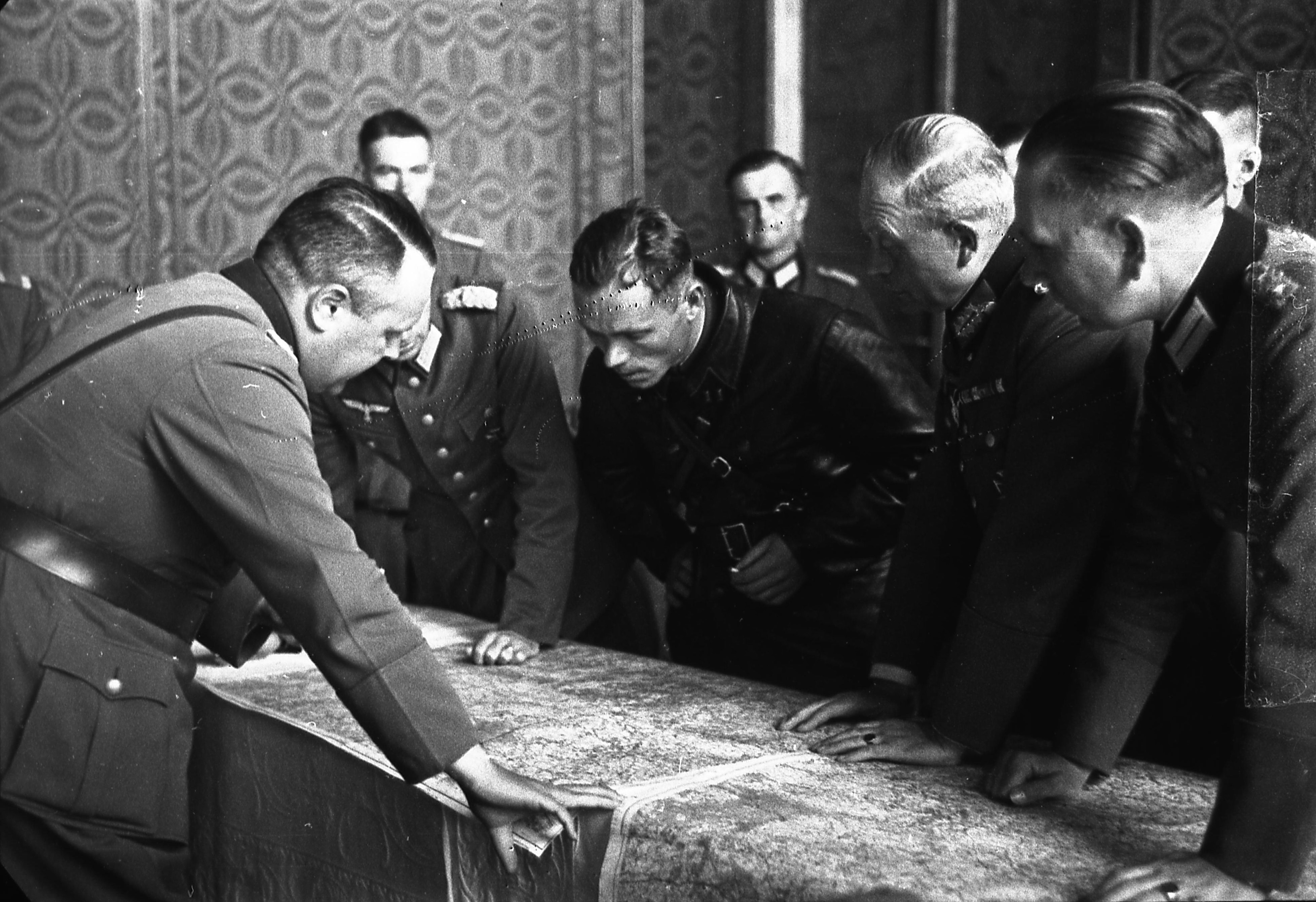
General der Panzertruppe Heinz Guderian (second from right), Kommandierender General XIX. Armeekorps (motorisiert), discussing with a representative from the Russian side (centre) for the German and Soviet demarcation lines/borders in occupied Poland. With Guderian at right is Oberst i.G. Walther Nehring (Chef des Generalstabes XIX. Armeekorps). This photo was taken in the vicinity of Brest-Litovsk in September 1939 by Kriegsberichter Max Ehlert and Heinz Boesig. Most written sources as well (as the internet) say that the Russian officer in this photo is General Vladimir Borovitsky who served as the NKVD Commissar for the 29th Tank Brigade. This was a little confusing because the Russian was clearly wearing a leather jacket with the epaulettes of Major or equivalent. The answer was obtained from the information from the Belorussian Front staff, which stated that on September 20, 1939 a group of Soviet vanguard troops led by NKVD Major Filipp Filippovich Borovensky came to visit the German troops' headquarters in Siemiatycze, northwest of Brest, where the host then showed a map of the demarcation lines. Is it possible that the name Borovensky has been misspelled as Borovitsky because of the resemblance? Not known for sure. What is clear is that the name Filipp Borovensky - who would later be killed in 1941 - matches the identification of the Russian officer in this photo much better, based on the similarity of rank and the corroboration of the original source.


Full of curiosity, German soldiers inspecting Soviet BA-10A armored vehicle in Lublin, Poland, September 1939. They also took the time to have a chats with the Russian soldiers guarding it. BA-10 became the most widely produced Soviet armored vehicle in World War II, with a total output of 3,377 units from 1938-1941. The armored, with the main weapon of 45mm cannon, was also used by the Finnish and German Armed Forces. In fact, so many BA-10s were captured by the Wehrmacht that the High Command created a new official name for this armored vehicle: Panzerspahwagen BA-203(r)! Photo by Kriegsberichter Höllenthal from PK (Propaganda-Kompanie) 637 Ost.


German and Russian soldiers exchange conversation during negotiations on the demarcation line in Lublin, Poland, September 1939. Visible in the background is the 45mm cannon of a BA-10A armored vehicle commonly used by Soviet reconnaissance troops. Photo by Kriegsberichter Höllenthal from PK (Propaganda-Kompanie) 637 Ost.


Meeting of German and Russian troops in Lublin, Poland, September 1939. A German soldier boards a Soviet BA-20 that will take part in the victory parade in Brest-Litovsk on 22 September. BA-20 (Broneavtomobil 20) is an armored vehicle whose main task is to reconnaissance. In 1941 its production was discontinued by the Soviets because it was considered outdated. Photo by Kriegsberichter Höllenthal from PK (Propaganda-Kompanie) 637 Ost.


German and Russian officers shaking hands during a meeting between the two sides in Lublin, Poland, September 1939. Photo by Kriegsberichter Höllenthal of PK (Propaganda-Kompanie) 637 Ost.


Standing on the platform, General der Panzertruppe Heinz Guderian, Kommandierender General XIX. Armeekorps (motorisiert), watching the victory parade of German troops - together with their temporary Soviet allies - in Brest-Litovsk on September 22, 1939. From left to right: Generalleutnant Mauritz von Wiktorin (Kommandeur 20. Infanterie-Division), Heinz Guderian, and Komandir Brigady Semyon M. Krivoshein (Commander of the 29th Soviet Light Tank Brigade). Ironically, Krivoshein himself is of Jewish descent! Photo by Kriegsberichter Gutjahr of PK (Propaganda-Kompanie) 689.


Wehrmacht victory parade at Brest-Litovsk, Poland, 22 September 1939. Standing on the podium, from left to right: General der Panzertruppe Heinz Guderian (Kommandierender General XIX. Armeekorps), Generalleutnant Mauritz von Wiktorin (Kommandeur 20. Infanterie-Division), and Komandir Brigady Semyon M. Krivoshein (Commander of the 29th Soviet Light Tank Brigade). Standing nearest to the camera below the podium is Oberst im Generalstab Walther Nehring (Chef des Generalstabes XIX. Armeekorps). Photo by Kriegsberichter Gutjahr of PK (Propaganda-Kompanie) 689.


Wehrmacht victory parade at Brest-Litovsk, Poland, 22 September 1939. Standing on the podium, from left to right: General der Panzertruppe Heinz Guderian (Kommandierender General XIX. Armeekorps), Generalleutnant Mauritz von Wiktorin (Kommandeur 20. Infanterie-Division), and Komandir Brigady Semyon M. Krivoshein (Commander of the 29th Soviet Light Tank Brigade). Photo by Kriegsberichter Gutjahr of PK (Propaganda-Kompanie) 689.


Source :
https://audiovis.nac.gov.pl/obraz/9162/
https://en.wikipedia.org/wiki/German%E2%80%93Soviet_military_parade_in_Brest-Litovsk
https://forum.axishistory.com/viewtopic.php?t=231271
https://www.gettyimages.com/photos/brest-1939
http://riowang.blogspot.com/2009/09/brest-nazi-soviet-military-parade-23_25.html

Sunday, February 26, 2023

Ritterkreuz Ceremony for Harry Hoppe

The Ritterkreuz award ceremony of Oberst Harry Hoppe (Kommandeur Infanterie-Regiment 424), which held on 12 September 1941. The medal was pinned by Generalmajor Hans Zorn (Kommandeur 20. Infanterie-Division [motorisiert]). This is a bit unique, since usually the division commander of the unit involved who awarded the medal (in this case, Generalleutnant Paul Laux, the Commander of 126. Infanterie-Division, in which the Infanterie-Regiment 424 subordinated). What is clear is that Hoppe got the prestigious medal for his brilliant performance in an attack on the city of Leningrad in early September 1941. At that ime he was appointed as Commander of Kampfgruppe Hoppe, which consisted of his own regiment with the addition of one battalion each of Infanterie-Regiment 76 and Panzer-Regiment 29. Especially for this attack, Kampfgruppe Hoppe was placed temporarily under the command of 20. Infanterie-Division (motorisiert), led by Zorn. So, that's why the medal was given by Zorn and not Laux. Hoppe himself is a veteran of the First World War with a myriad of medals (which is clearly visible in this video!).

Source :
https://www.youtube.com/watch?v=n-OVE-Vt8h8

Sunday, July 10, 2022

Ernst Busch and Erich Jaschke


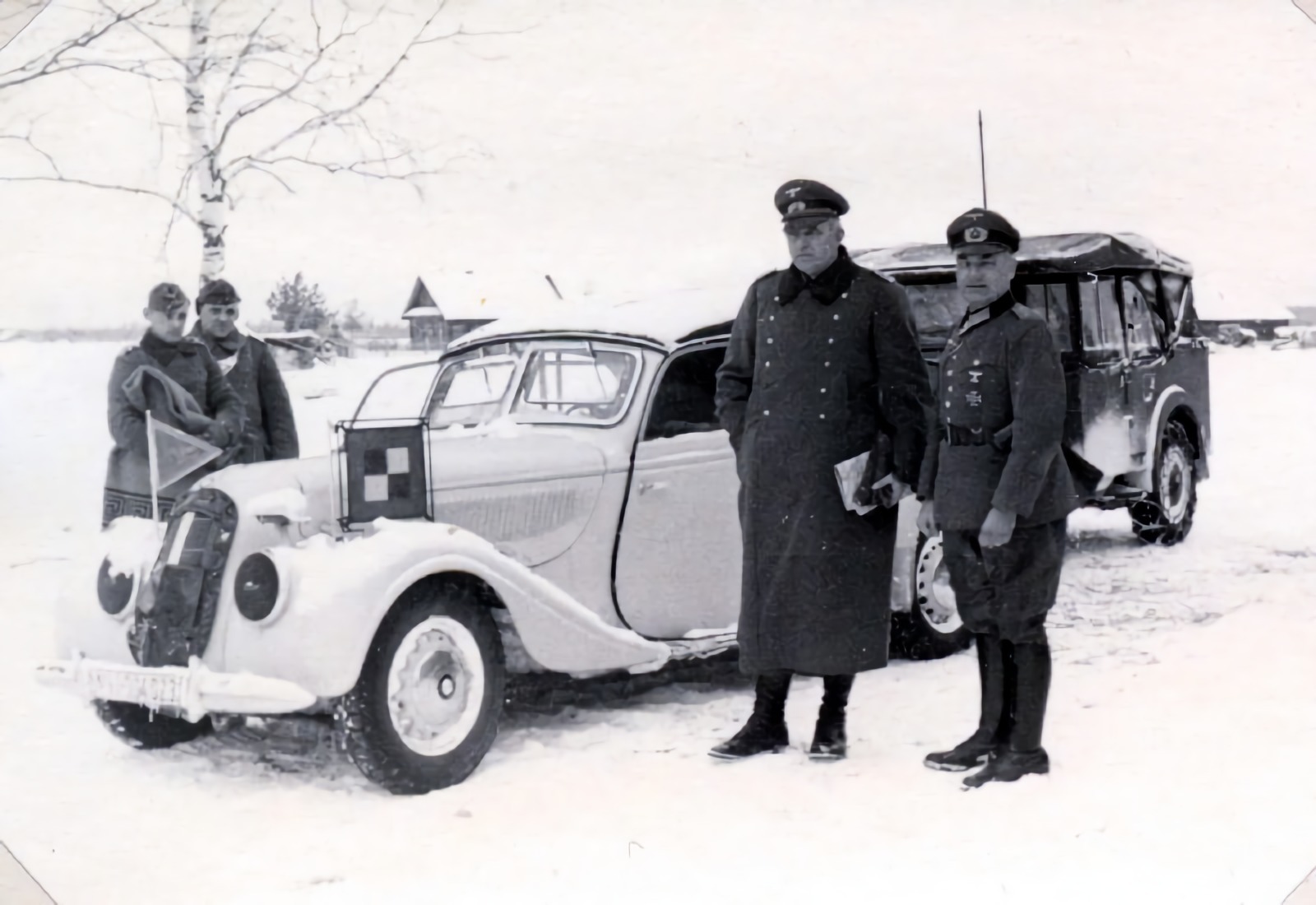
Generaloberst Ernst Busch (Oberbefehlshaber 16. Armee) poses with Oberst Erich Jaschke (right, Kommandeur Infanterie-Regiment 90 / 20.Infanterie-Division) in front of a BMW 335. This photo was most likely taken on the Volkhov front, northern sector of the Eastern Front, in the winter of 1941/42. At that time the Germans were not yet equipped with the winter white clothes and gear, so they wore the standard Wehrmacht coats or any other thick garment they could find in the field.

Source :
https://forum.axishistory.com/viewtopic.php?f=23&t=174130&hilit=k%C3%BCchler


Saturday, January 1, 2022

Bio of General der Infanterie Hans Zorn (1891-1943)

General der Infanterie Hans Wilhelm Karl Zorn
Born: 27.10.1891 in München / Bayern.
Killed in Action: 02.08.1943 near Krasnaja-Roschtscha, south of Orel, Eastern Front (in a Soviet air attack).

Promotions:
07.07.1911 Fähnrich
25.10.1913 Leutnant (ohne Patent)
14.12.1916 Patent vom 29.10.1912 erhalten
17.01.1917 Oberleutnant (ohne Patent)
01.10.1920 Patent vom 18.04.1916 erhalten
01.12.1922 Hauptmann
01.12.1931 Major (Patent vom 01.02.1931)
01.07.1934 Oberstleutnant
01.08.1936 Oberst
01.07.1940 Generalmajor
15.01.1942 Generalleutnant (mit RDA vom 01.03.1942)
01.06.1942 General der Infanterie

Career:
00.00.1905 - 07.07.1911 Member of the bayerische Kadettenkorps.
07.07.1911 - 00.00.1917 Entered service as Fähnrich, assigned to 2. bayerische Infanterie-Regiment Kronprinz. Assigned as Regiments-Adjutant, ca. 1914.
00.00.1918 - 00.00.1918 Assigned as Adjutant 1. bayer. Infanterie-Brigade on the Western Front.
00.00.1919 - 00.00.1919 Briefly employed in the bayerischen Kriegsministerium, München.
03.01.1920 (m.W.v. 01.10.1919) im Stab I./rw-Schützen-Regiment 41
01.10.1920 Assigned to Infanterie-Regiment 19.
01.10.1921 im Reiter-Regiment 17, kommandiert zur Führergehilfen-Ausbildung
01.10.1922 wieder im Infanterie-Regiment 19
01.10.1923 im Reichswehr-Ministerium, kommandiert zur Führergehilfen-Ausbildung
01.10.1925 im Infanterie-Regiment 20
01.10.1926 im Stab der 7. Division.
01.10.1929 Kompanie-Chef 4.(MG.)Kompanie im Infanterie-Regiment 19
01.10.1932 im Reichswehr-Ministerium, assigned as a Generalstabsoffizier to the Eisenbahn-Abteilung (Railways Department)
01.02.1933 im Reichswehrministerium; Leiter der Eisenbahn-Abteilung
01.10.1935 Abteilungschef Heerestransport-Abteilung / GenStdH
01.10.1937 bei der Wehrmacht-Akademie
01.04.1938 im Stab des Infanterie-Regiments 19
01.05.1938 - 01.09.1939 Kommandeur of Infanterie-Regiment 19.
01.09.1939 - 14.11.1940 Chef des Generalstabes of XXII.Armee-Korps.
14.11.1940 - 13.01.1942 Kommandeur of 20.Infanterie-Division (mot.).
15.01.1942 - 15.02.1942 Führer of XXXX.Panzer-Korps.
10.06.1942 - 00.06.1942 Führer of XXXII.Armee-Korps (mot.).
01.10.1942 - 21.11.1942 Kommandierender General of XXXXVI.Panzer-Korps. Succeeded by Hans-Karl Freiherr von Esebeck.
22.06.1943 - 02.08.1943 Kommandierender General of XXXXVI.Panzer-Korps. Succeeded by Hans Gollnick.

Decorations & Awards:
27.07.1941 Ritterkreuz des Eisernes Kreuzes as Generalmajor and Kdr. 20.Infanterie-Division (mot.) / XXXIX.Armee-Korps / 4.Panzer-Armee / Heeresgruppe Mitte, Eastern Front
03.09.1943 Eichenlaub zum Ritterkreuz des Eisernen Kreuzes (291., posthumously) as General der Infanterie and Kom. Gen. XXXXVI.Panzer-Korps / 9.Armee / Heeresgruppe Mitte, Eastern Front
14.06.1942 Deutsches Kreuz in Gold
00.00.191_ Ritterkreuz des Kgl. Preussische Hausordens von Hohenzollern mit Schwertern
26.05.1940 1939 Spange zum 1914 Eisernes Kreuz I. Klasse
14.05.1940 1939 Spange zum 1914 Eisernes Kreuz II. Klasse
29.06.1916 1914 Eisernes Kreuz I. Klasse
23.10.1914 1914 Eisernes Kreuz II. Klasse
00.00.191_ Kgl. Bayer. Prinz-Regent-Luitpold Jubiläums-Medaille
00.00.191_ Kgl. Bayer. Militär-Verdienstorden IV. Klasse mit Schwertern und mit der Krone
ca. 1918 Verwundetenabzeichen, 1918 in Schwarz
ca. 1943 Demjanskschild (?)
00.00.19__ Medaille zur Erinnerung an den 01.10.1938
00.00.19__ Medaille zur Erinnerung an den 13.03.1938
ca. 1934 Ehrenkreuz fur Frontkämpfer
00.00.193_ Wehrmacht-Dienstauszeichnung IV. bis I. Klasse


Source :
https://audiovis.nac.gov.pl/obraz/31051/
https://forum.axishistory.com/viewtopic.php?t=157063
http://www.geocities.ws/orion47.geo/WEHRMACHT/HEER/General2/ZORN_HANS.html

Tuesday, January 19, 2021

Hans Traut Leaving the Building

Hans Traut is seen leaving the building with other Wehrmacht officers. He is wearing the Ritterkreuz des Eisernen Kreuzes which he received on 5 August 1940 as Oberstleutnant und Kommandeur I.Bataillon / Infanterie-Regiment 90 / 20.Infanterie-Division. He would also added the Eichenlaub for his Ritterkreuz on 23 January 1942 as Oberst and Führer 10. Infanterie-Division (motorisiert).


Source :
Shawn Miller photo collection
https://www.facebook.com/photo/?fbid=739071026713639&set=gm.1034536447041794