Showing posts with label Nehring - Walther. Show all posts

Saturday, April 4, 2026

The Funeral of Hans-Valentin Hube


The death of Hans-Valentin Hube on 21 April 1944 came as a sudden and tragic blow to the German Wehrmacht at a moment when its armored forces on the Eastern Front were under increasing strain. Hube, a battle-hardened general who had lost his right arm during the First World War and earned the enduring nickname “Der Mensch” or “The Man” from his troops for his tough yet fair and courageous leadership, had just reached a pinnacle of recognition. On 20 April, he had been summoned to the Obersalzberg to join Adolf Hitler’s 55th birthday celebrations. There, in a personal audience, Hitler awarded him the rare Diamonds to the Knight’s Cross of the Iron Cross—one of only twenty-seven such distinctions granted during the entire war—and promoted him to the rank of Generaloberst. The honors were bestowed in acknowledgment of Hube’s masterful command of the 16th Panzer Division in the early campaigns against the Soviet Union, his leadership of XIV Panzer Corps during the defense of Sicily and the Salerno landings, and above all his skillful extrication of the 1st Panzer Army from the Kamenets-Podolsky Pocket earlier that spring, an operation that saved tens of thousands of German soldiers and their equipment from certain destruction. Rumors even circulated within the high command that Hitler had briefly considered elevating Hube to Commander-in-Chief of the Army itself, though that appointment was ultimately postponed. 

The following morning, 21 April, Hube boarded a Heinkel He 111 transport plane at Reichenhall-Berchtesgaden Airport in Ainring, near Salzburg, intending to fly back to his headquarters on the Eastern Front to resume command of the 1st Panzer Army. The aircraft lifted off normally but crashed shortly after takeoff into the mountainous terrain a few miles from Berchtesgaden. All aboard perished except for Walther Hewel, a senior diplomat traveling on the same flight, who survived with severe injuries. Hube’s adjutant, Major von Schwanenfeld, had been spared only because he was on personal leave and had not joined the flight. The wreckage yielded few intact remains; the sole clearly identifiable fragment of Hube’s body was his black metal prosthetic right arm, a grim reminder of the wound he had carried since 1916. Official reports classified the crash as an accident, yet the timing—mere hours after Hitler’s birthday festivities and amid growing paranoia within the Nazi leadership—prompted quiet speculation among some officers about possible sabotage, echoes later with the still-unexplained plane crash that would killed Generaloberst Eduard Dietl two months after. No concrete evidence ever emerged to support foul play, and the incident was accepted as one of the many wartime tragedies that claimed senior commanders without warning. Hitler himself was reportedly shaken by the news and, in the weeks before his own death in 1945, continued to lament the loss of “Der Mensch,” describing Hube as one of the three finest commanders produced by the Second World War and a general whose straightforward reliability could always be counted upon in the fiercest fighting. 

Hube’s passing was accorded the full solemnity of a state funeral, reflecting both his personal standing with Hitler and the regime’s desire to honor a figure whose battlefield record had become emblematic of determined resistance. On 26 April 1944, exactly five days after the crash, a grand ceremony took place in Berlin. Hube’s coffin, draped with a swastika flag, lay in state within the Reich Chancellery, where it was viewed by senior Nazi officials and military leaders. Adolf Hitler attended in person, a rare gesture by that stage of the war that underscored the depth of the Führer’s regard for the fallen general. Heinz Guderian, himself a legendary panzer commander and one of Hube’s closest comrades in the armored branch, delivered the eulogy, paying tribute to Hube’s tactical brilliance, his unyielding spirit, and the personal example he had set for the troops under his command. A guard of honor composed of four fellow generals—Walther Nehring, Hermann Breith, Heinrich Eberbach, and Hans Gollnick—stood vigil beside the coffin throughout the service, their presence a visible symbol of the respect Hube commanded within the officer corps. Following the formal rites, Hube was laid to rest with full military honors at the Invalidenfriedhof, the historic Invalids’ Cemetery in Berlin’s Mitte district. His grave lies near those of other prominent figures from the Nazi era, including the Luftwaffe aces Ernst Udet and Werner Mölders, Field Marshal Walther von Reichenau, Gestapo chief Reinhard Heydrich, and armaments minister Fritz Todt. 

The funeral marked the end of a remarkable military career that had spanned two world wars and seen Hube rise from a young infantry officer to one of the Wehrmacht’s most capable armored leaders. His death removed from the battlefield a commander whose innovative tactics and personal courage had repeatedly turned potential disasters into orderly withdrawals, most notably during the desperate fighting at Stalingrad and in the Ukraine. In the broader context of the collapsing German war effort, Hube’s loss was felt acutely by both the high command and the ordinary soldiers who had served under him; many recalled his habit of appearing at the front lines, directing operations with one hand while maintaining an almost superhuman calm amid chaos. Though the precise circumstances of the crash remain shrouded in the fog of wartime records, the state funeral and the public mourning that accompanied it ensured that Hans-Valentin Hube’s name would endure as a symbol of steadfast duty in the final, bitter phase of the conflict. 


The funeral ceremony of Generaloberst Hans-Valentin Hube which was held at the Neue Reichskanzlei in Berlin on 26 April 1944 (Hube himself died in a plane crash 5 days earlier). This photo was taken by Eitel Lange and shows Adolf Hitler (Führer und Oberster Befehlshaber der Wehrmacht) and Reichsmarschall Hermann Göring (Oberbefehlshaber der Luftwaffe) flanking the bereaved family, who are likely the widow or children of the deceased. In the front row, we can also see three Wehrmacht Marshals sitting at the left end: Generalfeldmarschall Erhard Milch (Generalinspekteur der Luftwaffe), Generalfeldmarschall Günther von Kluge (Führerreserve Oberkommando des Heeres), and Generalfeldmarschall Wilhelm Keitel (Chef Oberkommando der Wehrmacht). Meanwhile, sitting in the back row, from left to right: General der Flieger Günther Korten (Chef des Generalstabes der Luftwaffe), Generaloberst Friedrich Fromm (Chef der Heeresrüstung und Befehlshaber des Ersatzheeres), Konteradmiral Karl-Jesko von Puttkamer (Adjutant der Kriegsmarine beim Führer und Oberster Befehlshaber der Wehrmacht), SS-Obergruppenführer Julius Schaub (Chefadjutant der Führer), and Generalleutnant Rudolf Schmundt (Chefadjutant der Wehrmacht beim Führer und Oberster Befehlshaber der Wehrmacht).


The funeral ceremony of Generaloberst Hans-Valentin Hube which was held at the Neue Reichskanzlei in Berlin on 26 April 1944. Adolf Hitler (Führer und Oberster Befehlshaber der Wehrmacht) and Reichsmarschall Hermann Göring (Oberbefehlshaber der Luftwaffe) flanking the bereaved family, who are likely the widow or children of the deceased. In the background we can see Reichsminister Dr. Joseph Goebbels and Reichskommissar Dr. Arthur Seyss-Inquart.


The funeral ceremony of Generaloberst Hans-Valentin Hube which was held at the Neue Reichskanzlei in Berlin on 26 April 1944. Honored guests at the memorial service, front row from left to right: Generalfeldmarschall Hans-Günther von Kluge (Führerreserve), Reichsführer-SS Heinrich Himmler (Chef der SS und Polizei), Großadmiral Karl Dönitz (Oberbefehlshaber der Kriegsmarine), and Generalfeldmarschall Wilhelm Keitel (Chef Oberkommando der Wehrmacht). In the back row between Kluge and Himmler is General der Infanterie Joachim von Kortzfleisch (Kommandierenden General Stellvertretenden Generalkommando III. Armeekorps in Berlin und Befehlshaber vom Wehrkreis III), while the man with his head bowed between Dönitz and Keitel is Generaloberst Hermann Hoth (Führerreserve).


The funeral ceremony of Generaloberst Hans-Valentin Hube which was held at the Neue Reichskanzlei in Berlin on 26 April 1944. The military attachés of the foreign countries were honored guests at this state ceremony. The picture was taken by Ernst Schwahn.


The funeral ceremony of Generaloberst Hans-Valentin Hube which was held at the Neue Reichskanzlei in Berlin on 26 April 1944. The military attachés of the foreign countries were honored guests at this state ceremony.


The funeral ceremony of Generaloberst Hans-Valentin Hube which was held at the Neue Reichskanzlei in Berlin on 26 April 1944. Adolf Hitler (Führer und Oberster Befehlshaber der Wehrmacht) and Reichsmarschall Hermann Göring (Oberbefehlshaber der Luftwaffe) saluting the deceased. Hitler rarely attended a funeral (especially late in the war), unless the deceased was considered a really important person. So special was Hube's favor in Hitler's eyes that he made the time to attend this ceremony.


The funeral ceremony of Generaloberst Hans-Valentin Hube which was held at the Neue Reichskanzlei in Berlin on 26 April 1944. Reichsmarschall Hermann Göring (Oberbefehlshaber der Luftwaffe) delivered the eulogy, while generals and recipients of high and highest decorations for bravery escort the coffin. From left to right: General der Infanterie Hans Gollnick (Führerreserve), General der Panzertruppe Hermann Breith (Kommandierender General III. Panzerkorps), General der Panzertruppe Walther Nehring (Kommandierender General XXIV. Panzerkorps), and General der Panzertruppe Heinrich Eberbach (Inspekteur der Panzertruppe beim Befehlshaber des Ersatzheeres). The picture was taken by Eitel Lange and was first published on 3 May 1944.


The funeral ceremony of Generaloberst Hans-Valentin Hube which was held at the Neue Reichskanzlei in Berlin on 26 April 1944. Reichsmarschall Hermann Göring (Oberbefehlshaber der Luftwaffe) performing the marshall salute, while generals and recipients of high and highest decorations for bravery escort the coffin. From left to right: General der Panzertruppe Walther Nehring (Kommandierender General XXIV. Panzerkorps), General der Panzertruppe Heinrich Eberbach (Inspekteur der Panzertruppe beim Befehlshaber des Ersatzheeres), General der Infanterie Hans Gollnick (blocked by Eberbach, Führerreserve), and General der Panzertruppe Hermann Breith (Kommandierender General III. Panzerkorps). Two panzer officers are holding the ordenskissen (medal pillow).


The funeral ceremony of Generaloberst Hans-Valentin Hube which was held at the Neue Reichskanzlei in Berlin on 26 April 1944. Adolf Hitler (Führer und Oberster Befehlshaber der Wehrmacht) performing the Hitler salute at Hube's lying in state, while generals and recipients of high and highest decorations for bravery escort the coffin. From left to right: General der Panzertruppe Walther Nehring (Kommandierender General XXIV. Panzerkorps), General der Panzertruppe Heinrich Eberbach (Inspekteur der Panzertruppe beim Befehlshaber des Ersatzheeres), General der Infanterie Hans Gollnick (Führerreserve), and General der Panzertruppe Hermann Breith (Kommandierender General III. Panzerkorps). Two panzer officers are holding the ordenskissen (medal pillow). This picture was first published in "Das 12 Uhr Blatt", 27 April 1944 edition.


The funeral ceremony of Generaloberst Hans-Valentin Hube which was held at the Neue Reichskanzlei in Berlin on 26 April 1944. Adolf Hitler (Führer und Oberster Befehlshaber der Wehrmacht) performing the Hitler salute at Hube's lying in state, while generals and recipients of high and highest decorations for bravery escort the coffin. From left to right: General der Infanterie Hans Gollnick (Führerreserve), General der Panzertruppe Hermann Breith (Kommandierender General III. Panzerkorps), General der Panzertruppe Walther Nehring (Kommandierender General XXIV. Panzerkorps), and General der Panzertruppe Heinrich Eberbach (Inspekteur der Panzertruppe beim Befehlshaber des Ersatzheeres).


The funeral ceremony of Generaloberst Hans-Valentin Hube which was held in Berlin on 26 April 1944. Generals and recipients of high and highest decorations for bravery escort the coffin, carried by non-commissioned officers of the Panzertruppen, to the gun carriage after the state ceremony at the Neue Reichskanzlei. The two escort generals at left are General der Infanterie Hans Gollnick (Führerreserve) and General der Panzertruppe Walther Nehring (Kommandierender General XXIV. Panzerkorps), while the two escort generals at right are General der Panzertruppe Hermann Breith (Kommandierender General III. Panzerkorps) and General der Panzertruppe Heinrich Eberbach (Inspekteur der Panzertruppe beim Befehlshaber des Ersatzheeres). The picture was taken by Ernst Schwahn.


The funeral ceremony of Generaloberst Hans-Valentin Hube which was held in Berlin on 26 April 1944. Generals and recipients of high and highest decorations for bravery escort the coffin, carried by non-commissioned officers of the Panzertruppen, to the gun carriage after the state ceremony at the Neue Reichskanzlei. The two escort generals at left are General der Infanterie Hans Gollnick (Führerreserve) and General der Panzertruppe Walther Nehring (Kommandierender General XXIV. Panzerkorps), while the two escort generals at right are General der Panzertruppe Hermann Breith (Kommandierender General III. Panzerkorps) and General der Panzertruppe Heinrich Eberbach (Inspekteur der Panzertruppe beim Befehlshaber des Ersatzheeres).


The funeral ceremony of Generaloberst Hans-Valentin Hube which was held in Berlin on 26 April 1944. Generals and recipients of high and highest decorations for bravery escort the coffin, carried by non-commissioned officers of the Panzertruppen, to the gun carriage after the state ceremony at the Neue Reichskanzlei. The two escort generals at left are General der Infanterie Hans Gollnick (Führerreserve) and General der Panzertruppe Walther Nehring (Kommandierender General XXIV. Panzerkorps). In the center behind the coffin is Generalfeldmarschall Wilhelm Keitel (Chef Oberkommando der Wehrmacht), while at far right is Generalfeldmarschall Günther von Kluge (Führerreserve).


From left to right: Unknown Heer officer, General der Infanterie Wilhelm Wegener (Kommandierender General L. Armeekorps), Generalleutnant Rudolf Schmundt (Chefadjutant des Heeres beim Führer und Oberbefehlshaber der Wehrmacht), General der Infanterie Werner Kienitz (Kommandierenden General Stellvertretenden Generalkommando II. Armeekorps in Stettin und Befehlshaber vom Wehrkreis II), and General der Infanterie Joachim von Kortzfleisch (Kommandierenden General Stellvertretenden Generalkommando III. Armeekorps in Berlin und Befehlshaber vom Wehrkreis III). The picture was taken during the funeral of Generaloberst Hans-Valentin Hube in Berlin, 26 April 1944.


The grave of Hans-Valentin Hube at the Invalidenfriedhof, Berlin. The cemetery address is Scharnhorststraße 25 (or sometimes listed as 9 or 33 in sources), 10115 Berlin-Mitte, near the Berlin-Spandauer-Schifffahrtskanal. Coordinates for the cemetery: approx. 52.53194°N, 13.37111°E. It is open to the public and one of Berlin's oldest cemeteries (founded 1748), historically used for Prussian military veterans and later notable figures. Hube's grave still exists and can be visited. The original tombstone was replaced in 2000 (a simpler or restitution-style marker is now there), but the burial site remains undisturbed. Photos from 2007 and 2013 show the grave marker in the cemetery.

Source:
Die Deutsche Wochenschau Nr. 713 - 3 May 1944
David Stahel, Hitler’s Panzer Generals: Guderian, Hoepner, Reinhardt and Schmidt Unguarded (Cambridge: Cambridge University Press, 2023)
https://audiovis.nac.gov.pl/obraz/36625/dee40d08bd916e4c667770046a213080/
https://beeldbankwo2.nl/nl/beelden/?q=hans%20hube&mode=gallery&view=horizontal
https://www.bild.bundesarchiv.de/dba/de/search/?yearfrom=&yearto=&query=hans+hube#
https://www.bpk-bildagentur.de/shop
https://alifrafikkhan.blogspot.com/2011/10/album-foto-terbaik-hans-valentin-hube.html
www.en.wikipedia.org/wiki/Hans-Valentin_Hube 
www.findagrave.com/memorial/31534926/hans-valentin-hube
https://www.gettyimages.com/detail/news-photo/huber-hans-valentin-officer-colonel-general-germany29-10-news-photo/543888483
www.ww2gravestone.com/people/hube-hans-valentine-der-mensch/

Sunday, May 28, 2023

German-Soviet military parade in Brest-Litovsk (1939)


The German–Soviet military parade in Brest-Litovsk was an official ceremony held by the troops of Nazi Germany and the Soviet Union on September 22, 1939, during the invasion of Poland in the city of Brest-Litovsk (Polish: Brześć nad Bugiem or Brześć Litewski, then in the Second Polish Republic, now Brest in Belarus). It marked the withdrawal of German troops to the demarcation line secretly agreed to in the Molotov–Ribbentrop Pact, and the handover of the city and its fortress to the Soviet Red Army.

The secret protocol of the Molotov–Ribbentrop Pact, signed on August 23, 1939, defined the boundary between the German and Soviet "spheres of influence". However, during the invasion of Poland, some German forces, especially Heinz Guderian's XIX Corps, advanced beyond this line in pursuit of their tactical goals.

The XIX Corps approached Brest on September 13, 1939, and defeated the Polish resistance in the ensuing battle by September 17, establishing their base of operations in the city. During the following days, Guderian was informed, much to his chagrin, that the demarcation line between German and Soviet-controlled regions was drawn along the Bug River and that his forces were to withdraw behind this line by September 22.

On September 17, after Vasily Chuikov's 4th Army received the order to cross the Polish border, its 29th Tank Brigade, led by Kombrig Semyon Krivoshein, entered the town of Baranowicze. After taking the town and capturing a few thousand Polish soldiers, who were stationed there, his units kept on moving westward and reached the village of Prużany on 19 September.

On September 20, advance units of the 29th Tank Brigade encountered Guderian's forces at the village of Widomla, three days after the Soviet invasion of Poland and twenty days after the German invasion of Poland. The Soviet Brigade had seen little combat, as most of the fighting had already been over by this time.

According to Krivoshein, a reconnaissance unit returned with a group of 12 German officers, who identified themselves as part of Guderian's XIX Corps and explained that they too were moving in the direction of Brest. They were invited to Krivoshein's tent, who then proposed a toast to both commanders and invited the attending German officers to Moscow after they achieved a quick victory over "capitalist England". Through them, Krivoshein also sent warm greetings to the German general and made sure to approach the city from the opposite direction to that taken by the Wehrmacht.

Upon approaching the town on the morning of September 22, Krivoshein realized that Guderian had already established his headquarters there. Soon afterwards, Guderian's representatives arrived and greeted the "glorious Red Army" and its general. Following a short exchange of formalities, Krivoshein offered to visit Guderian and pay his respects to him personally. The offer was accepted, and Krivoshein was taken to the German headquarters to share breakfast with the German general.

During the meeting, Guderian proposed a joint parade of Soviet and German troops through the town, including a lineup of soldiers from both armies on the central square. Because the Soviet troops were tired after a long march, Krivoshein declined but promised to supply a military band and a few battalions and agreed to Guderian's request for both to stand and review the parade together.

According to the initial agreement, the procedure included German and Soviet troops marching before their commanding officers followed by changing the flag, accompanied by national anthems of Germany and the Soviet Union. However, the Soviet commanding officer, kombrig Semyon Krivoshein, wrote in his memoirs that he did not allow Soviet troops to pass alongside the German forces because he was afraid that Soviet troops, weary after a long march to Brest, would look inferior in comparison with the Germans, who had been in the city for several days. Instead, he suggested that the Soviet columns would enter the city separately and salute the leaving Germans whenever they meet.

The parade began at 16:00, and the "Victory Arches" were erected which the Soviet troops decorated with swastikas and red stars and through which German troops marched. The Soviets fielded the 4th Battalion of 29th Light Tank Brigade, which was the first unit of the Red Army to roll into the city. The Soviet and German generals paid homage to each other's armies and their respective victories over Polish forces.

After the parade, which Niall Ferguson described as amicable, the Germans withdrew to the western bank of the Bug, and the Soviets took control over the city, as well as the rest of Eastern Poland (Western Belarus and Western Ukraine).

Several historic works published in the 1980s and 1990s discuss joint military parades of the Red Army and German Wehrmacht in other cities of occupied Poland such as Białystok, Grodno, Lwow and others.

For example, Russian historian Mikhail Semiryaga writes in his 1992 work Secrets of Stalin's diplomacy without citing any sources: "Joint parades with militaries of both countries as participants took place In Grodno, Brest, Pinsk and several other cities (Germans called them 'victory parades'). The parade in Grodno was supervised by Kombrig Vasily Chuikov." Another author, Alexander Nekrich, made a similar claim, taking some "photographs" as evidence: "The conclusion of military operations against Poland was marked by joint parades of German and Soviet militaries in Brest and Lwow in the first days of October [1939]."

In later works, Russian historians such as Mikhail Meltyukhov and Oleg Vishlyov dismiss the parades in other cities as "a myth", pointing to the fact that virtually no evidence has been found to confirm that those parades actually took place. In Lwow, Vishlyov states, it was impossible to organize a joint parade, as the Soviet troops were ordered to move to a distance of 20 km (12 mi) from the Germans after an accidental exchange of fire between the two sides, and no German units were present there at the time when the city capitulated to the Soviets. Vishlyov also disputes that the events in Brest were a military parade and writes that what is often mistakenly regarded as a parade was in fact a "ceremonial departure of German forces under the supervision of Soviet representatives". That is, before leaving the city and handing it to the Soviet Union, the Germans marched through the streets greeted by their command and supervised by a Soviet military representative, whose role was to sign an agreement with the German command and monitor the implementation of that agreement. It was only after their withdrawal that the Soviet troops entered the city and held their own parade.


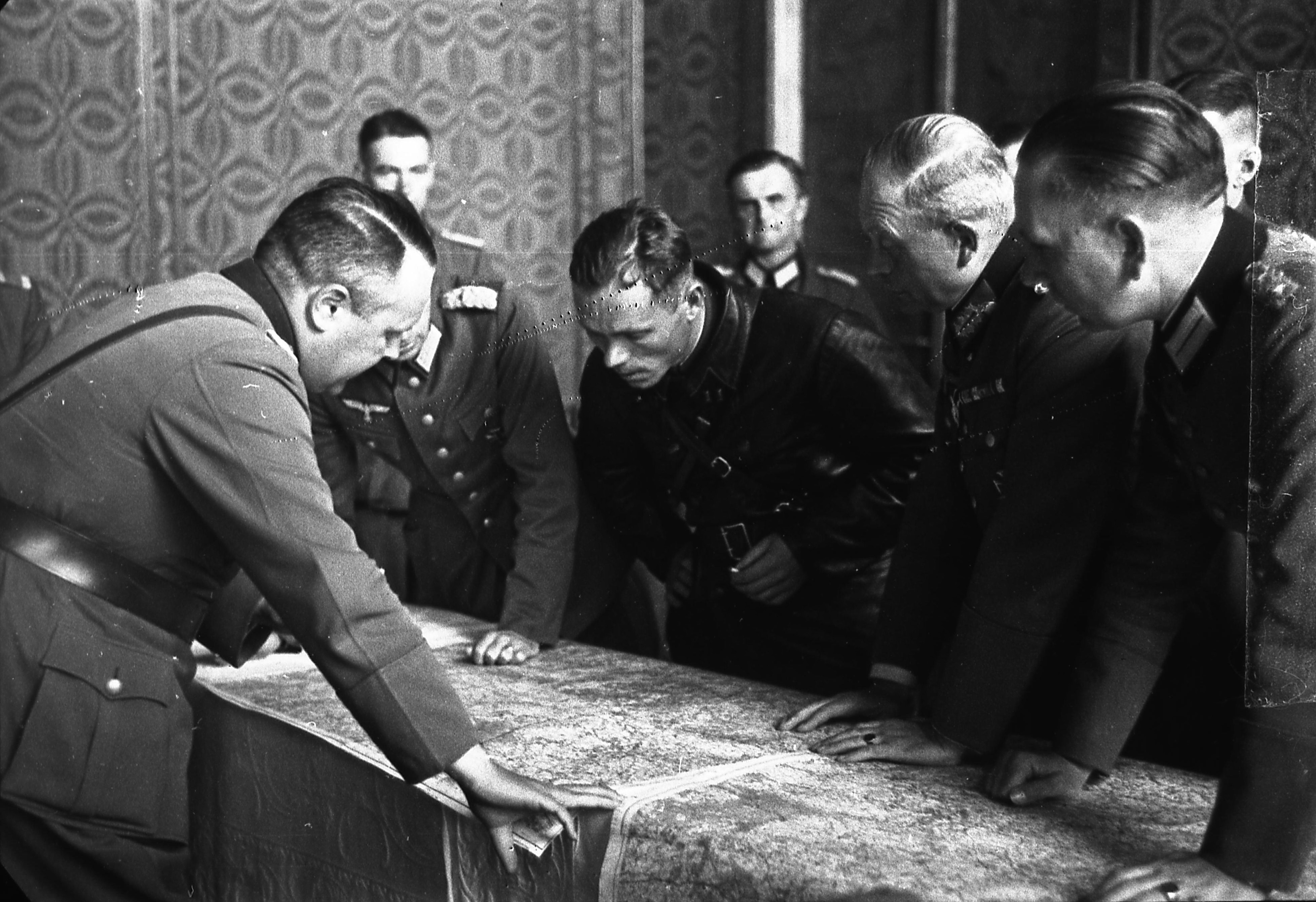
General der Panzertruppe Heinz Guderian (second from right), Kommandierender General XIX. Armeekorps (motorisiert), discussing with a representative from the Russian side (centre) for the German and Soviet demarcation lines/borders in occupied Poland. With Guderian at right is Oberst i.G. Walther Nehring (Chef des Generalstabes XIX. Armeekorps). This photo was taken in the vicinity of Brest-Litovsk in September 1939 by Kriegsberichter Max Ehlert and Heinz Boesig. Most written sources as well (as the internet) say that the Russian officer in this photo is General Vladimir Borovitsky who served as the NKVD Commissar for the 29th Tank Brigade. This was a little confusing because the Russian was clearly wearing a leather jacket with the epaulettes of Major or equivalent. The answer was obtained from the information from the Belorussian Front staff, which stated that on September 20, 1939 a group of Soviet vanguard troops led by NKVD Major Filipp Filippovich Borovensky came to visit the German troops' headquarters in Siemiatycze, northwest of Brest, where the host then showed a map of the demarcation lines. Is it possible that the name Borovensky has been misspelled as Borovitsky because of the resemblance? Not known for sure. What is clear is that the name Filipp Borovensky - who would later be killed in 1941 - matches the identification of the Russian officer in this photo much better, based on the similarity of rank and the corroboration of the original source.


Full of curiosity, German soldiers inspecting Soviet BA-10A armored vehicle in Lublin, Poland, September 1939. They also took the time to have a chats with the Russian soldiers guarding it. BA-10 became the most widely produced Soviet armored vehicle in World War II, with a total output of 3,377 units from 1938-1941. The armored, with the main weapon of 45mm cannon, was also used by the Finnish and German Armed Forces. In fact, so many BA-10s were captured by the Wehrmacht that the High Command created a new official name for this armored vehicle: Panzerspahwagen BA-203(r)! Photo by Kriegsberichter Höllenthal from PK (Propaganda-Kompanie) 637 Ost.


German and Russian soldiers exchange conversation during negotiations on the demarcation line in Lublin, Poland, September 1939. Visible in the background is the 45mm cannon of a BA-10A armored vehicle commonly used by Soviet reconnaissance troops. Photo by Kriegsberichter Höllenthal from PK (Propaganda-Kompanie) 637 Ost.


Meeting of German and Russian troops in Lublin, Poland, September 1939. A German soldier boards a Soviet BA-20 that will take part in the victory parade in Brest-Litovsk on 22 September. BA-20 (Broneavtomobil 20) is an armored vehicle whose main task is to reconnaissance. In 1941 its production was discontinued by the Soviets because it was considered outdated. Photo by Kriegsberichter Höllenthal from PK (Propaganda-Kompanie) 637 Ost.


German and Russian officers shaking hands during a meeting between the two sides in Lublin, Poland, September 1939. Photo by Kriegsberichter Höllenthal of PK (Propaganda-Kompanie) 637 Ost.


Standing on the platform, General der Panzertruppe Heinz Guderian, Kommandierender General XIX. Armeekorps (motorisiert), watching the victory parade of German troops - together with their temporary Soviet allies - in Brest-Litovsk on September 22, 1939. From left to right: Generalleutnant Mauritz von Wiktorin (Kommandeur 20. Infanterie-Division), Heinz Guderian, and Komandir Brigady Semyon M. Krivoshein (Commander of the 29th Soviet Light Tank Brigade). Ironically, Krivoshein himself is of Jewish descent! Photo by Kriegsberichter Gutjahr of PK (Propaganda-Kompanie) 689.


Wehrmacht victory parade at Brest-Litovsk, Poland, 22 September 1939. Standing on the podium, from left to right: General der Panzertruppe Heinz Guderian (Kommandierender General XIX. Armeekorps), Generalleutnant Mauritz von Wiktorin (Kommandeur 20. Infanterie-Division), and Komandir Brigady Semyon M. Krivoshein (Commander of the 29th Soviet Light Tank Brigade). Standing nearest to the camera below the podium is Oberst im Generalstab Walther Nehring (Chef des Generalstabes XIX. Armeekorps). Photo by Kriegsberichter Gutjahr of PK (Propaganda-Kompanie) 689.


Wehrmacht victory parade at Brest-Litovsk, Poland, 22 September 1939. Standing on the podium, from left to right: General der Panzertruppe Heinz Guderian (Kommandierender General XIX. Armeekorps), Generalleutnant Mauritz von Wiktorin (Kommandeur 20. Infanterie-Division), and Komandir Brigady Semyon M. Krivoshein (Commander of the 29th Soviet Light Tank Brigade). Photo by Kriegsberichter Gutjahr of PK (Propaganda-Kompanie) 689.


Source :
https://audiovis.nac.gov.pl/obraz/9162/
https://en.wikipedia.org/wiki/German%E2%80%93Soviet_military_parade_in_Brest-Litovsk
https://forum.axishistory.com/viewtopic.php?t=231271
https://www.gettyimages.com/photos/brest-1939
http://riowang.blogspot.com/2009/09/brest-nazi-soviet-military-parade-23_25.html

Saturday, March 18, 2023

Erwin Rommel and Afrikakorps (Jim Haley Photo Collection)


General der Panzertruppe Erwin Rommel.


Erwin Rommel with Italian officer.


Two Erwins: Erwin Rommel (2nd from left) and Erwin Menny (left).


Erwin Rommel briefs his officers.


Source:
Jim Haley photo collection

Saturday, December 25, 2021

Bio of General der Panzertruppe Walther Nehring (1892-1983)

Full name: Walther Kurt Josef Nehring
Nickname: No information

Date of birth: 15.08.1892 - Stretzin, Kreis Schlochau, Westpreußen (German Empire)
Date of death: 20.04.1983 - Düsseldorf, Nordrhein-Westfalen (West Germany)

Battles and Operations: Polish Campaign, Western Campaign, Operation Barbarossa, North Africa Campaign (including Battle of Alam Halfa), Tunisia Campaign, Eastern Front operations (including stabilization of the front near Kasatin and breakout from encirclement south of Lask in 1945)

Religion: No information
Parents: Emil Nehring (landowner, schoolteacher and reserve officer) and Martha Nehring née Weiß
Siblings: Edwin Nehring (half-brother from father's first marriage)
Spouse: Annemarie Rohrbeck (married autumn 1923)
Children: Annemarie (born September 1924), Christoph (born February 1930), Hubertus (born December 1935)

Promotions:
16.09.1914 Fahnenjunker
18.02.1914 Leutnant (mit Patent vom 22.02.1914)
06.06.1915 Oberleutnant
01.03.1923 Hauptmann
00.00.193_ Major
01.10.1934 Oberstleutnant
01.03.1937 Oberst
01.08.1940 Generalmajor
01.02.1942 Generalleutnant
01.07.1942 General der Panzertruppe

Career:
16.09.1911 entered the Königlich Preußische Armee as Fahnenjunker with the 8. Kompanie of Infanterie-Regiment 152 in Marienburg after Abitur
08.02.1913 commissioned Leutnant after Kriegsschule Anklam
1914-1918 served as Zugführer in the First World War, wounded in the East in 1914, Adjutant of Mobiles Ersatz-Bataillon 148 in November 1914, returned as Bataillonsadjutant to his regiment in December 1914, transferred to Fliegertruppe on own request in spring 1916 but crashed after 14 days of flight training on 23.06.1916 suffering broken jaw and concussion, later took command of 1. (MG) Kompanie of Infanterie-Regiment 22 on the Western Front, severely wounded by abdominal gunshot at Kemmelberg on 01.07.1918
November 1918 Adjutant to the Kommandeur der Maschinengewehrtruppen of XX. Armeekorps in Allenstein
1920 served with Freiwilligen 41. Division in Grenzschutz Ost
spring 1920 Ordonanzoffizier in Stab of Reichswehr-Brigade 20
1920-1921 served in 2. (Preuß.) Infanterie-Regiment, initially as Adjutant of II. Bataillon in Rastenburg
01.10.1922 transferred to 13. (Minenwerfer-) Kompanie of 2. (Preuß.) Infanterie-Regiment
01.10.1923 to 1925 attended Führergehilfenausbildung in Stab of 1. Division in Königsberg
01.10.1925 transferred to Reichswehrministerium in Berlin (Heeres-Statistische Abteilung T 3)
01.10.1926 back to Stab of II. Bataillon of 2. (Preuß.) Infanterie-Regiment in Rastenburg
01.03.1928 returned to Reichswehrministerium in Berlin (Heeres-Abteilung T 1 beim Truppenamt)
01.03.1929 transferred to 6. (Preuß.) Sanitäts-Abteilung in Münster
01.08.1929 Chef of 1. Kompanie of 6. (Preuß.) Kraftfahr-Abteilung in Münster where he established the first Kraftfahr-Kampfeinheit of the German Army
01.02.1932 returned to Reichswehrministerium as 1. Generalstabsoffizier (Ia) to Inspektion der Kraftfahrtruppen (In 6) under Generalmajor Oswald Lutz with Oberstleutnant Heinz Guderian as Chief of Staff
01.09.1934 promoted and continued work on the build-up of the German Panzerwaffe
06.10.1936 attended Kriegsakademie in Berlin
12.10.1937 Kommandeur of Panzer-Regiment 5
01.07.1939 Chef des Generalstabes of Generalkommando XIX. Armeekorps in Wien
summer 1939 participated in Polish Campaign as Chef des Generalstabes of XIX. Armeekorps (Gruppe Guderian)
spring 1940 participated in Western Campaign as Chef des Generalstabes of XIX. Armeekorps
26.10.1940 Kommandeur of 18. Panzer-Division
summer 1941 led 18. Panzer-Division in Operation Barbarossa with notable success at the Beresina River crossing near Borissow
25.01.1942 relieved of command of 18. Panzer-Division and placed in Führerreserve
end of February 1942 sent to North Africa
early March 1942 took temporary command of Deutsches Afrika-Korps
01.07.1942 appointed Kommandierender General of Deutsches Afrika-Korps
31.08.1942 severely wounded in air raid at Alam Halfa and evacuated to Germany on 10.09.1942
15.11.1942 appointed Befehlshaber Tunesien (Stab Nehring, later LXXXX. Armeekorps)
February 1943 took command of XXIV. Panzerkorps on the Eastern Front
21.04.1944 temporary command of 4. Panzerarmee
August 1944 command of XLVIII. Panzerkorps then returned to XXIV. Panzerkorps
19.03.1945 Kommandeur of 1. Panzerarmee until capitulation
09.05.1945 surrendered to American forces and held as prisoner of war until 1948

Awards and Decorations:
Eisernes Kreuz 2. Klasse (1914) - 27.01.1915
Eisernes Kreuz 1. Klasse (1914) - 25.11.1917
Verwundetenabzeichen 1918 in Silber - 1918
Ehrenkreuz für Frontkämpfer - 1934
Österreichisches Kriegs-Erinnerungs-Medaille mit Schwertern - 193_
War Commemorative Medal with Swords (Hungary) - 193_
War Commemorative Medal with Swords (Bulgaria) - 193_
Medaille zur Erinnerung an den 1. Oktober 1938 mit Spange "Prager Burg" - 1939
Dienstauszeichnung der Wehrmacht 1. Klasse (25 Jahre) and 2. Klasse (18 Jahre)
1939er Spange zum Eisernen Kreuz 2. Klasse - 11.09.1939
1939er Spange zum Eisernen Kreuz 1. Klasse - 29.09.1939
Ritterkreuz des Eisernen Kreuzes (24.07.1941) as Generalmajor and Kommandeur 18. Panzer-Division. Nehring received the award for the division’s decisive breakthrough and river crossing at Borissow on the Beresina River on 1-2 July 1941. The 18. Panzer-Division had already demonstrated exceptional mobility earlier in the campaign, including an audacious amphibious fording of the Bug River on 22 June using waterproofed tanks that plunged directly into the water under covering fire. By early July, however, the real test came at the Beresina. Soviet forces, desperate to halt the German advance toward Smolensk and Moscow, rushed elite troops freshly pulled from Moscow’s defenses along with massed tank formations to the riverbanks. They positioned themselves to destroy or deny every crossing point.
Under Nehring’s personal leadership from the front, the division launched a coordinated assault through dense forests and marshy terrain. Panzergrenadiers and engineers, supported by the division’s tanks, fought their way forward under heavy artillery and air attacks. Soviet counterattacks came in relentless waves—infantry charges backed by T-34s and heavy KV tanks slamming into the German spearheads. Despite intense defensive fire that turned the riverbanks into a killing ground of smoke, exploding shells, and burning vehicles, Nehring’s troops forced the crossing. They captured an intact bridge at Borissow before the Soviets could demolish it, then rapidly expanded a secure bridgehead on the far bank. The fighting was close-quarters and brutal: panzer crews dueling enemy armor at point-blank range while infantry cleared bunkers with grenades and bayonets amid the chaos of burning underbrush and drifting smoke. This success, achieved through Nehring’s skillful orchestration of combined-arms tactics and his insistence on maintaining momentum, opened the left wing of Panzergruppe 2 for a rapid exploitation eastward. Without it, the broader German advance into central Russia would have stalled dangerously. The award citation explicitly credited Nehring’s “well-honed skill as a commander” for turning a potential bottleneck into a decisive operational victory.
Panzerkampfabzeichen in Silber
Medaglia d'argento al Valore Militare - 00.06.1942
Medaille "Winterschlacht im Osten 1941/42" (Ostmedaille) - 1942
Ärmelband Afrika - 1943
Verwundetenabzeichen 1939 in Gold - 02.09.1943
Ritterkreuz des Eisernen Kreuzes mit Eichenlaub #383 (08.02.1944) as General der Panzertruppe and Kommandierender General XXIV. Panzerkorps. Nehring earned the award for his emergency stabilization of the collapsing front south of Kiev in late December 1943 and early January 1944, particularly in the Kasatin and Kanev sectors along the Dnepr River. On 24 December 1943, Soviet forces launched a massive surprise breakthrough against the neighboring XXXXII. Armeekorps at Kasatin, tearing open a gaping hole in the German lines near Kiev. The Red Army poured through with overwhelming infantry, tanks, and artillery, threatening to encircle large portions of the German southern front and cut off vital supply routes.
Nehring was urgently flown into the crisis zone by aircraft and given command of whatever fragmented forces could be scraped together—including badly mauled divisions from his own corps that had already suffered heavy losses in prior fighting. The situation was desperate: roads were choked with retreating troops and refugees, winter weather turned fields into quagmires of frozen mud and snow, and Soviet spearheads were advancing rapidly with fresh mechanized units. Nehring immediately organized ad-hoc battle groups, personally directing counterattacks with the few remaining panzers, assault guns, and infantry battalions. In the critical battles around the Soviet bridgeheads at Burkin and Kanev over the Dnepr, his forces conducted mobile defensive operations—rapid redeployments, spoiling attacks, and concentrated fire from artillery and surviving armor that blunted the Soviet momentum. Fighting raged through snow-covered villages and along icy riverbanks, with German panzergrenadiers holding ridges against human-wave assaults while Nehring’s headquarters coordinated desperate night marches to plug gaps. Despite being outnumbered and short on fuel and ammunition, the corps under his command halted the Soviet advance south of Kasatin, stabilized the line, and prevented a complete collapse of the sector. The award citation highlighted this rapid intervention with improvised forces as the decisive factor in restoring the front. Nehring’s leadership in these defensive battles around Kanev and the Dnepr bridgeheads exemplified his ability to improvise under extreme pressure during the brutal winter fighting of 1943-44.
Ritterkreuz des Eisernen Kreuzes mit Eichenlaub und Schwertern #124 (22.01.1945) as General der Panzertruppe and Kommandierender General XXIV. Panzerkorps (often referred to as “Gruppe Nehring” during this period). Nehring received the award for his masterful leadership of a mobile “wandering pocket” during the opening phase of the Soviet Vistula-Oder Offensive in January 1945. By this stage the corps had been repositioned in southern Poland near the Baranow bridgehead on the Vistula River. When the massive Soviet winter offensive erupted on 12 January, it smashed through German lines with overwhelming force, isolating large formations in encirclements across the front. Nehring’s corps became one of the few major units to avoid immediate destruction, but it was soon surrounded and forced into a fighting retreat across snow-bound terrain.
The “wandering pocket” maneuver involved Nehring directing a mixed force of panzers, panzergrenadiers, artillery, and stragglers in a continuous series of breakout attempts and delaying actions. They fought through blizzards and sub-zero temperatures, using the last reserves of fuel for hit-and-run attacks on Soviet blocking forces while protecting columns of wounded and supply trucks. Soviet tank armies repeatedly tried to seal the ring, launching night assaults and artillery barrages that lit up the frozen landscape with tracer fire and explosions. On 22 January 1945, south of Lask, Nehring personally orchestrated the final breakthrough: concentrated panzer thrusts punched through the Soviet encirclement line in fierce close combat, allowing the battered but intact corps to link up with German lines. The fighting was savage—tanks dueling at ranges of mere dozens of meters, infantry clearing roadblocks under machine-gun fire, and desperate rear-guard actions to cover the withdrawal. Immediately after breaking free, the corps was redeployed to bolster the defense along the Oder River. The award citation praised Nehring’s command of this “wandering pocket” as one of the rare successful large-unit survivals amid the initial Soviet onslaught, crediting his tactical skill with saving the formation for continued operations. This action came amid the broader retreat from the Baranow bridgehead and the desperate defense of Silesia.
Wehrmachtbericht mention
Westpreußen-Medaille - 1971
Verdienstkreuz 1. Klasse des Verdienstordens der Bundesrepublik Deutschland - 27.07.1973

-------------------------------------------------------------------------------

Walther Kurt Josef Nehring was a German general of the Panzertruppe in the Wehrmacht during the Second World War who commanded armored formations on the Eastern Front, in North Africa, and again in the East, earning high decorations for his leadership in mobile warfare and crisis situations. Born on 15 August 1892 in Stretzin, West Prussia, in the German Empire, he came from a family with military ties as the son of Emil Nehring, a landowner, schoolteacher, and reserve officer, and Martha Nehring, née Weiß. He had one half-brother, Edwin, from his father's first marriage. Nehring married Annemarie Rohrbeck in the autumn of 1923, and the couple had three children: a daughter Annemarie born in September 1924, and sons Christoph in February 1930 and Hubertus in December 1935. No specific details about his religious beliefs are recorded in available sources. After completing his Abitur, he entered the Prussian Army in September 1911 as a Fahnenjunker with Infantry Regiment 152 in Marienburg and was commissioned as a Leutnant in February 1913 following training at the war school in Anklam.

Nehring's early combat experience came during the First World War, where he served initially as a platoon leader on the Eastern Front and was wounded in 1914. By November of that year he had become adjutant of a mobile replacement battalion, later returning to his regiment as battalion adjutant. In the spring of 1916 he volunteered for the air service but suffered a severe crash after only two weeks of training, breaking his jaw and sustaining a concussion. He then commanded a machine-gun company on the Western Front and was gravely wounded again by abdominal gunshot fire at Kemmelberg in July 1918. After the armistice he held staff positions in the postwar Reichswehr, serving with border protection units in East Prussia, then as an ordnance officer and later in various infantry and motorized formations. During the 1920s and early 1930s he attended advanced staff training and worked in the Reichswehr Ministry, contributing to the secret development of motorized and armored units under General Oswald Lutz and Colonel Heinz Guderian. By 1929 he had established one of the first combat-ready motorized companies, and in the mid-1930s he helped shape the emerging Panzerwaffe while commanding Panzer Regiment 5 and serving as chief of staff of XIX Army Corps.

With the outbreak of the Second World War, Nehring participated in the Polish Campaign as chief of staff of XIX Corps under Guderian, then repeated the role during the Western Campaign in 1940. In October 1940 he took command of the newly formed 18th Panzer Division, which he led into Operation Barbarossa in June 1941 as part of Panzer Group 2. The division's advance began dramatically when its tanks, fitted with waterproof rubber skins originally intended for a planned invasion of Britain, plunged directly into the Bug River on 22 June, fording under fire in an amphibious assault that caught Soviet defenders off guard. By early July the formation had pushed deep into Belarus, reaching the Beresina River near Borissow where Soviet forces had massed elite troops and tanks to deny every crossing. On 1 and 2 July 1941 Nehring personally directed a combined-arms assault through dense forests and marshland under constant artillery and air bombardment. Panzergrenadiers and engineers battled forward amid exploding shells and burning vehicles while tank crews dueled T-34s and KV heavy tanks at close range. Despite fierce counterattacks that turned the riverbanks into a smoke-filled killing ground, the division seized intact bridges and established a secure bridgehead on the eastern bank through grenade-and-bayonet fighting in the underbrush. This breakthrough, achieved by Nehring's emphasis on speed and improvisation, opened the path for the wider German advance toward Smolensk and earned him the Knight's Cross of the Iron Cross on 24 July 1941.

In early 1942 Nehring was transferred to North Africa, where he briefly commanded the Deutsches Afrika Korps in March before being appointed its permanent leader in July. He directed operations during the final major Axis offensive at Alam Halfa in late August and early September 1942 but was severely wounded in an air raid on 31 August and evacuated to Germany. Recovering, he returned to command the German forces in Tunisia as head of LXXXX Army Corps from November 1942, organizing defenses against advancing Allied armies until the Axis collapse in May 1943. Sent back to the Eastern Front in February 1943, he assumed command of XXIV Panzer Corps under the Fourth Panzer Army. On 24 December 1943 Soviet forces launched a massive surprise offensive that shattered the neighboring corps near Kasatin south of Kiev, tearing open the German lines and threatening encirclement of much of Army Group South. Flown into the chaos, Nehring took charge of battered remnants from his own units and ad-hoc battle groups in freezing winter conditions of snow-covered fields and icy roads clogged with retreating troops. Through rapid redeployments, spoiling attacks, and concentrated fire from surviving armor and artillery, his forces halted the Soviet momentum around the Dnepr bridgeheads at Burkin and Kanev. Panzergrenadiers held ridges against repeated human-wave assaults while night marches plugged gaps in the line, ultimately stabilizing the front despite shortages of fuel and ammunition. For this emergency intervention Nehring received the Oak Leaves to his Knight's Cross on 8 February 1944.

By January 1945 Nehring's corps was positioned near the Baranow bridgehead on the Vistula when the massive Soviet Vistula-Oder Offensive erupted on 12 January, smashing through German positions and isolating large formations in snow-bound encirclements. His XXIV Panzer Corps became one of the few major units to avoid immediate destruction but was soon surrounded, forming what became known as the "wandering pocket." Under Nehring's direction the mixed force of panzers, grenadiers, artillery, and stragglers conducted a continuous fighting retreat across blizzards and sub-zero terrain, launching hit-and-run attacks on Soviet blocking positions while protecting columns of wounded and supplies. Soviet tank armies repeatedly attempted to seal the ring with night assaults and barrages that lit the frozen landscape with tracer fire and explosions. On 22 January south of Lask, Nehring orchestrated a final concentrated thrust that punched through the encirclement in savage close-quarters combat, with tanks dueling at point-blank range and infantry clearing roadblocks under machine-gun fire. The breakout allowed the battered but intact corps to link up with German lines and immediately redeploy to defend the Oder River. This skillful leadership of the mobile pocket, one of the rare successful large-unit survivals amid the offensive's opening chaos, earned him the Swords to his Knight's Cross on 22 January 1945.

In the final months of the war Nehring temporarily commanded the Fourth Panzer Army in April 1944 before returning to XXIV Panzer Corps and then assuming leadership of the First Panzer Army in March 1945 until the capitulation. He surrendered to American forces on 9 May 1945 and was held as a prisoner of war until his release in 1948. In the postwar years he lived quietly in West Germany and was awarded the Federal Cross of Merit First Class in 1973 for his contributions to veterans' affairs. Nehring died on 20 April 1983 in Düsseldorf at the age of ninety. His career exemplified the evolution of German armored doctrine from theoretical experiments in the Reichswehr through the high-mobility campaigns of 1939-1941 to the desperate defensive battles of the later war years, marked by consistent tactical skill in both offensive breakthroughs and improvised retreats under overwhelming pressure.


Major Walther Nehring.


General der Panzertruppe Heinz Guderian (second from right), Kommandierender General XIX. Armeekorps (motorisiert), discussing with a representative from the Russian side (centre) for the German and Soviet demarcation lines/borders in occupied Poland. With Guderian at right is Oberst i.G. Walther Nehring (Chef des Generalstabes XIX. Armeekorps). This photo was taken in the vicinity of Brest-Litovsk in September 1939 by Kriegsberichter Max Ehlert and Heinz Boesig. Most written sources as well (as the internet) say that the Russian officer in this photo is General Vladimir Borovitsky who served as the NKVD Commissar for the 29th Tank Brigade. This was a little confusing because the Russian was clearly wearing a leather jacket with the epaulettes of Major or equivalent. The answer was obtained from the information from the Belorussian Front staff, which stated that on September 20, 1939 a group of Soviet vanguard troops led by NKVD Major Filipp Filippovich Borovensky came to visit the German troops' headquarters in Siemiatycze, northwest of Brest, where the host then showed a map of the demarcation lines. Is it possible that the name Borovensky has been misspelled as Borovitsky because of the resemblance? Not known for sure. What is clear is that the name Filipp Borovensky - who would later be killed in 1941 - matches the identification of the Russian officer in this photo much better, based on the similarity of rank and the corroboration of the original source. Other pictures from this occasion can be seen HERE.


Generalmajor Walther Nehring.


The funeral ceremony of Generaloberst Hans-Valentin Hube which was held in Berlin on 26 April 1944. Generals and recipients of high and highest decorations for bravery escort the coffin, carried by non-commissioned officers of the Panzertruppen, to the gun carriage after the state ceremony at the Neue Reichskanzlei. The two escort generals at left are General der Infanterie Hans Gollnick (Führerreserve) and General der Panzertruppe Walther Nehring (Kommandierender General XXIV. Panzerkorps), while the two escort generals at right are General der Panzertruppe Hermann Breith (Kommandierender General III. Panzerkorps) and General der Panzertruppe Heinrich Eberbach (Inspekteur der Panzertruppe beim Befehlshaber des Ersatzheeres). Other pictures from this funeral ceremony can be seen HERE.


Source :
https://en.wikipedia.org/wiki/Walther_Nehring
http://www.geocities.ws/orion47.geo/WEHRMACHT/HEER/General2/NEHRING_WALTHER.html
https://waralbum.ru/336845/
https://www.lexikon-der-wehrmacht.de/
https://en.wikipedia.org/
https://www.tracesofwar.com/
https://grokipedia.com/
https://www.geni.com/
https://forum.axishistory.com/
https://rk.balsi.de/index.php?action=list&cat=300
https://www.unithistories.com/units_index/index.php?file=/officers/personsx.html
https://web.archive.org/web/20091027052912fw_/http://geocities.com/orion47.geo/index2.html
https://www.wehrmacht-awards.com/forums/
Additional websites used for verification:
https://warhistory.org/@msw/article/general-der-panzertruppe-walter-k-nehring
http://ww2colorfarbe.blogspot.com/2021/12/bio-of-general-der-panzertruppe-walther.html