Showing posts with label 8 Headgear Feldmütze M43. Show all posts

Sunday, June 21, 2026

Ritterkreuzträger with Feldmütze M43


The Feldmütze M43, also known as the Einheitsfeldmütze 1943, was the standardized field cap introduced by the German Wehrmacht in the second half of 1943 as a practical replacement for the earlier Schiffchen side cap, though the older model continued in limited use until the end of the Second World War. Evolving from the Bergmütze mountain cap worn by Gebirgsjäger units—which traced its roots to Austro-Hungarian ski cap designs of the First World War—the M43 featured a soft wool body in field-grey for Heer and Waffen-SS troops or black wool for Panzer forces, a short cloth-covered visor, and distinctive ear flaps that could be folded down for cold-weather protection or buttoned upward using two metal buttons (or later pressed cardboard versions). Its front typically bore the woven Hoheitssadler national eagle above the Reichskokarde cockade, while SS variants often placed a Totenkopf death’s-head badge at the front with the eagle on the left side; the cap’s teardrop-shaped crown and slightly sloped sides provided a comfortable, helmet-compatible design suited for field service, snipers, reconnaissance troops, and everyday wear. Manufactured in standard wool as well as later simplified HBT drillich and camouflage fabric versions using German or Italian patterns, it proved highly popular among soldiers for its versatility and durability across all fronts. The design’s influence extended well beyond 1945, serving as the basis for post-war headgear in the Bundesgrenzschutz and Bundeswehr mountain units, where similar Bergmütze-style caps remain in service today, and it continues to be widely reproduced for historical and collector purposes.

-----------------------------------------------------------------------------------------------------------

LUFTWAFFE

Oberstleutnant Heinrich "Pritzl" Bär (1913-1957), born on 25 May 1913 in Sommerfeld in the Kingdom of Saxony and died on 28 April 1957 in Braunschweig, was a highly successful Luftwaffe fighter pilot and flying ace who flew more than 1,000 combat sorties across the Western, Eastern, and Mediterranean theatres during World War II, claiming around 220 aerial victories (with German Federal Archives records confirming 208, including 16 in the Messerschmitt Me 262 jet fighter). A former mechanic and transport pilot who transitioned to fighters with I./JG 51, Bär achieved his first victory against a Curtiss P-36 Hawk on the French border in September 1939, adding further kills during the Battle of France and Battle of Britain before excelling dramatically on the Eastern Front in Operation Barbarossa with JG 51 under II. Fliegerkorps. His Ritterkreuz des Eisernen Kreuzes came on 2 July 1941 as Leutnant in 1./JG 51 after reaching 27 victories in the intense opening weeks, notably claiming multiple Tupolev SB bombers on 22 June and five more on 30 June amid JG 51's milestone 1,000th victory day. He received the 31st Eichenlaub on 14 August 1941 as Leutnant (soon promoted Oberleutnant) in 1./JG 51 upon attaining 60 victories, highlighted by an "ace-in-a-day" of six Soviet aircraft on 30 August before being shot down and wounded that same day near Novgorod-Seversky, evading capture by disguising himself as a peasant! Promoted to Hauptmann and appointed Staffelkapitän of 12./JG 51 (later Gruppenkommandeur of IV./JG 51), Bär earned the 7th Schwerter on 16 February 1942 for his 90th victory, continuing to amass kills in the Crimea with I./JG 77 and later in North Africa, the Defence of the Reich, and with JV 44, where his independent spirit often clashed with superiors like Hermann Göring, who denied him the Brillanten despite three recommendations; post-war he worked as a test pilot until his fatal crash in a LF-1 Zaunkönig.


Source :
https://alifrafikkhan.blogspot.com/2020/01/foto-tokoh-third-reich-yang-mengenakan.html
https://forum.axishistory.com/viewtopic.php?f=8&t=206833

Saturday, April 11, 2026

The Capitulation of Maximilian von Edelsheim and His Troops


General der Panzertruppe Maximilian Reichsfreiherr von Edelsheim and other officers leave in their command VW Schwimmwagen for the far side of the River Elbe to convey the terms of surrender to their subordinate commanders. They have just left the city hall of Stendal, Germany, where Major Frank Keating from the U.S. 102nd Infantry Division and Major General James Moore, Chief of Staff of the U.S. 9th Army, gave them the terms for the German XXXXVIII. Panzerkorps of which Edelsheim commanded at the time. 4 May 1945. The bulk of the retreating German forces, along with several thousand civilians fleeing the final Soviet advance, reached and crossed the Elbe using the partially destroyed bridge at Tangermünde between 4 May and 7 May 1945, surrendering to elements of the 102nd Infantry Division / 9th Army. The vehicle isn't a standard Type 166 VW Schwimmwagen, but the very rare limited production Type 128. Notice the high the body sides and the exhaust venting under the rear mudguard. The small badge on the side of the vehicle is the 48th Panzerkorps badge).

In the chaotic final days of the Second World War, as Soviet forces closed in from the east and American troops held the western bank of the Elbe River, General der Panzertruppe Maximilian Reichsfreiherr von Edelsheim played a pivotal role in one of the largest mass surrenders of the conflict. By late April 1945, the German 12th Army under General Walther Wenck, along with battered remnants of the 9th Army that had fought their way out of the Halbe pocket, had abandoned any hope of relieving Berlin. Instead, these exhausted formations turned westward in a desperate race to reach the Elbe and capitulate to the Western Allies rather than face the advancing Red Army. With tens of thousands of soldiers, wounded men, stragglers, and fleeing civilians pressing toward the river, Edelsheim—then commanding the XXXXVIII Panzer Corps—was selected by Wenck as the official negotiator, or Verhandlungsführer, to arrange the surrender of all German forces east of the Elbe.

On or about 3 May 1945, Edelsheim crossed the Elbe in a captured American amphibious Volkswagen Schwimmwagen under escort by U.S. officers. The journey itself was perilous; the river was swollen with spring melt, and the only viable crossing point near the historic town of Tangermünde featured a railroad bridge that German engineers had partially demolished weeks earlier to slow the Allied advance. Now, under a flag of truce, Edelsheim met representatives of the U.S. Ninth Army, including elements of the 102nd Infantry Division, near the western approaches to the damaged structure. Calm and resolute despite the surrounding chaos, he outlined the dire situation: his men were out of ammunition, fuel, and supplies, with Soviet artillery already audible in the distance. The negotiations were brief but pragmatic; the Americans agreed to accept the surrender of combat and non-combat personnel alike, providing medical aid for the wounded while forbidding further organized resistance or attempts to cross in strength once Soviet forces arrived at the eastern bank.

Word of the agreement spread rapidly through the German columns. Between 4 and 7 May 1945, a human tide converged on the Tangermünde bridge. Soldiers from panzer and infantry units, many still carrying their rifles or dragging exhausted horses, shuffled across the twisted girders and makeshift planking alongside thousands of civilians pushing carts laden with belongings. The partially destroyed span swayed under the weight of the desperate procession, yet it held long enough for an estimated 100,000 people to reach the western shore. On the American side, GIs watched in astonishment as disciplined German officers supervised the orderly stacking of weapons—rifles, machine guns, and Panzerfausts piled in neat heaps—while medical teams tended to the most severely injured. Edelsheim himself returned briefly to the eastern bank to ensure compliance, then formally surrendered with his staff and the last organized elements of his corps. Photographs from the scene capture the surreal calm: German generals in greatcoats being escorted in U.S. vehicles, weary troops handing over sidearms to sergeants, and long lines of prisoners forming under the watchful eyes of American sentries.

The capitulation at Tangermünde marked the effective end of the 12th Army as a fighting force and saved countless lives from potential Soviet captivity. For Edelsheim and his men, the crossing represented both defeat and deliverance; they had evaded the fate of units trapped farther east, where summary executions and forced marches awaited many. By 7 May, with Soviet troops reaching the eastern bridgehead and halting further movement, the bridge fell silent except for the occasional crack of small-arms fire as stragglers were rounded up. Edelsheim was taken into American custody on 8 May 1945, the day of Germany's unconditional surrender, and spent the next two years in U.S. prisoner-of-war camps before his release in March 1947.


General der Panzertruppe Maximilian Reichsfreiherr von Edelsheim (Kommandierender General XXXXVIII. Panzerkorps). Behind him is Oberstleutnant i.G. Seidel.


Source :
Photo courtesy of US Army Signal Corps. Colourised by Richard James Molloy
https://www.facebook.com/worldwarincolor/photos/general-der-panzertruppe-maximilian-von-edelsheim-and-other-officers-leave-in-th/1145807355549055/
https://www.vesteburg.com/begegnung/beg_geschichte.html
https://forum.axishistory.com/viewtopic.php?f=5&t=164870
https://www.zweiterweltkrieg.org/phpBB2/viewtopic.php?p=3001

Sunday, April 5, 2026

The 700th Mission of Stuka Ace Theodor Nordmann

Ritterkreuzträger Oberleutnant Theodor Nordmann (Gruppenkommandeur III.Gruppe / Sturzkampfgeschwader 1), serving as a dive-bomber pilot in the central sector of the front, recently returned safely from his 700th combat mission. The daring 24-year-old pilot has held the Ritterkreuz since August 1941. He has already flown in France, England, the Mediterranean, Crete, and Africa. The picture was taken on 12 February 1943 by Kriegsberichter Knittel.


On 12 February 1943, amid the frozen expanses of the Eastern Front, Hauptmann Theodor “Theo” Nordmann, commander of III./Sturzkampfgeschwader 1 (StG 1), touched down after a combat sortie that marked a rare milestone in Luftwaffe history. Ground crews and fellow airmen gathered at the airfield to celebrate his 700th operational mission (Feindflug). Bundesarchiv photographs from that exact date (notably Bild 183-B23442) capture the scene: a young but battle-hardened pilot stepping from his Junkers Ju 87 Stuka, greeted with the traditional Luftwaffe honors reserved for such achievements—bouquets of flowers, enthusiastic handshakes, and the camaraderie of men who understood the grim odds of dive-bombing survival.

This was no ordinary landing. By early 1943, Nordmann had already emerged as one of the Luftwaffe’s premier Stuka aces. His 700th mission came at a critical juncture in the war on the Eastern Front, just weeks after the fall of Stalingrad and during the intense fighting around Kharkov. The ceremony was both a morale booster for his unit and public recognition of one of the most demanding flying careers in aviation history.


Source :
https://www.bild.bundesarchiv.de/dba/en/search/?yearfrom=&yearto=&query=theodor+nordmann#

Tuesday, May 27, 2025

First Volkssturm Ritterkreuzträger Ernst Tiburzy

Ernst Tiburzy (1911-2004) was a battalion leader of the Volkssturm and the first Volkssturm soldier to be awarded with the Ritterkreuz des Eisernen Kreuzes. He destroyed 5 or 9 Soviet tanks (sources vary) during the Battle of Königsberg on February 10th, 1945, preventing a breakthrough into the city and was awarded for that. He was one of only four or five Volkssturm soldiers who received the Ritterkreuz.

The following newspaper excerpt (dated 3 March 1945) describes why Tiburzy was awarded the coveted medal:

“First Volkssturm Ritterkreuzträger:

The Bolsheviks had succeeded in achieving a penetration in the Königsberg area. In response a German Volkssturm Bataillon commander, SA-Hauptsturmführer Tiburzy (who had previously been badly wounded during the Eastern campaign), initiated a counterthrust at the head of a small shock troop. The Volkssturm managed to roll up the trench that had been occupied by the enemy with Panzerfausts and hand grenades. In the process Tiburzy destroyed 2 Soviet T-34s with Panzerfausts. Later, as the Soviets launched a new attack against the Volkssturm blocking position two days later with tanks and infantry, Tiburzy launched a counterattack with his Bataillon on his own initiative. In the fighting which followed he personally destroyed another 3 T-34s in close combat, and the situation was restored. For this reason the Hauptsturmführer was awarded the Ritterkreuz des Eisernen Kreuzes by the Führer.”


Source :
Die Deutsche Wochenschau No. 755 - 22 March 1945
https://www.youtube.com/watch?v=jWxWY4rFhTg
https://www.tracesofwar.com/persons/61903/Tiburzy-Ernst.htm

Sunday, July 7, 2024

SS-Gruppenführer Herbert Otto Gille


Herbert Otto Gille as SS-Gruppenführer und Generalleutnant der Waffen-SS. He was highly regarded for his leadership qualities and tactical abilities. He commanded Waffen-SS units at the regiment, division and corps level with distinction during the war. Gille was popular with his men and admired for his personal bravery. Despite being an early Nazi Party member, Gille was known for his apolitical views. The author Heinz Höhne in The Order under the Death Head characterized Gille as an enigma and "Nur-Soldat" (soldier – nothing else) who once threatened a newly assigned Weltanschauungsoffizier (political indoctrination officer) with a clean-out squad to gather his uniforms and other possessions and throw them and the officer out of the unit.

Source :
http://alifrafikkhan.blogspot.com/2014/03/album-foto-herbert-otto-gille.html
https://erenow.org/ww/warsaw-2-tank-battle-praga-july-september-1944/4.php
https://military-history.fandom.com/wiki/Herbert_Otto_Gille

Friday, July 5, 2024

Herbert Otto Gille with His Corps Adjutants


This picture was taken between July-November 1944. From left to right: SS-Gruppenführer und Generalleutnant der Waffen-SS Herbert Otto Gille (Kommandierender General IV. SS-Panzerkorps), SS-Untersturmführer Günther Lange (O5 Aide de Camp Kommandierender General IV. SS-Panzerkorps), and SS-Sturmbannführer Karl-Willy Schulze (Adjutant Kommandierender General IV. SS-Panzerkorps). Lange is holding a situation map for his corps commander. He had been serving as a platoon leader in the 2nd Battalion of SS Panzer Regiment 5 until he was selected to replace Hermann Kaufmann as Gille's O5. After the war, Lange returned to his art studio and earned a master's degree equivalent in art, while pursuing a career as an officer in the Bundeswehr, where he finally retired as a Lieutenant Colonel after 20 years of service. The picture was taken from the book "From the Realm of a Dying Sun (Volume 1): IV. SS-Panzerkorps and the Battles for Warsaw, July-November 1944" by Douglas E. Nash.

Source :
"From the Realm of a Dying Sun (Volume 1): IV. SS-Panzerkorps and the Battles for Warsaw, July-November 1944" by Douglas E. Nash

Léon Degrelle and Herbert Otto Gille in Cherkassy


SS-Hauptsturmführer der Reserve Léon Degrelle (left, Kommandeur 5. SS-Freiwilligen-Sturmbrigade "Wallonien") and SS-Gruppenführer und Generalleutnant der Waffen-SS Herbert Otto Gille (Kommandeur 5. SS-Panzer-Division "Wiking") during the Battle of Cherkassy Pocket (24 January – 16 February 1944). This picture was taken by SS-Kriegsberichter Briessa with the original press photo caption as follow: "Zu den Durchbruckskämpfen westlich Tscherkassy. Die für die erfolgreichen Durchbruchskämpfe westlich Tscherkassy Ausgezeichneten. Im Vordergrund der vom Führer mit den Schwertern zum Eichenlaub des Ritterkreuzes ausgezeichneten SS-Gruppenführer und Generalleutnant der Waffen-SS Herbert Gille und der mit dem Ritterkreuz ausgezeichnete SS-Hauptsturmführer Leon Degrelle." (On the breakthrough battles west of Cherkasy. Those awarded for the successful breakthrough battles west of Cherkasy. In the foreground, SS-Gruppenführer and Lieutenant General of the Waffen-SS Herbert Gille, who was awarded the Swords to the Oak Leaves of the Knight's Cross by the Führer, and SS-Hauptsturmführer Leon Degrelle, who was awarded the Knight's Cross).

Source :
https://beeldbankwo2.nl/nl/beelden/detail/cfe82f10-0259-11e7-904b-d89d6717b464/media/eecd18f7-1791-1002-347c-fb72791b3337?mode=detail&view=horizontal&q=gille&rows=1&page=5
https://dutchmilitaria.com/product/pressphoto-ss-gruppenfuhrer-ss-panzergrenadier-division-wiking-herbert-gille-ss-hauptsturmfuhrer-leon-degrelle-extremeley-rare/
http://www.mourningtheancient.com/truth4z3.htm

Herbert Otto Gille with Heer Soldier


SS-Gruppenführer und Generalleutnant der Waffen-SS Herbert Otto Gille (left, Kommandeur 5. SS-Panzer-Division "Wiking") in conversation with a grenadier from Heer (Army) who was wounded during the defensive fighting in Kovel, Ukraine. This picture was taken by SS-Kriegsberichter Alois Jarolim on 2 May 1944 and was first published on 18 May 1944.

Source :
https://beeldbankwo2.nl/nl/beelden/detail/bf8388e0-0259-11e7-904b-d89d6717b464/media/edac6deb-63da-39b8-7ba6-a04b6b266637?mode=detail&view=horizontal&q=gille&rows=1&page=4
https://www.ea-militaria.com/generalleutnant-der-waffen-ss-gille-press-photo.html
https://www.oorlogsbronnen.nl/bron/https%3A%2F%2Fbeeldbankwo2.nl%2Fnl%2Fbeelden%2Fdetail%2Fbf8388e0-0259-11e7-904b-d89d6717b464%2Fmedia%2Fedac6deb-63da-39b8-7ba6-a04b6b266637

Sunday, June 30, 2024

Karl Frewer Misidentified as Theodor Tolsdorff


In many sites and publications (for example, HERE), this man is said as Theodor Tolsdorff (3 November 1909 - 25 May 1978), a recipient of Brillanten zum Ritterkreuz des Eisernen Kreuzes with the last rank of Generalleutnant. In reality, he is actually Ritterkreuzträger Karl Frewer (21 July 1908 - 6 March 1945) who received the Ritterkreuz on 12 November 1943 as Major and Kommandeur I.Bataillon / Grenadier-Regiment 167 / 86.Infanterie-Division. The most obvious difference is that Frewer was alo a recipient of Nahkampfspange (visible in this picture), while Tolsdorff was never awarded the same medal.

Source :
http://alifrafikkhan.blogspot.com/2011/09/kumpulan-identifikasi-salah-yang.html

Theodor Tolsdorff and Gerhart Schirmer


Major Theodor Tolsdorff (left, Kommandeur I.Bataillon / Füsilier-Regiment 22 / 1.Infanterie-Division) chats with Major Gerhart Schirmer (Führer Fallschirmjäger-Regiment 5 / 2.Fallschirmjäger-Division). Bearded Tolsdorff sported the Eichenlaub on his uniform, which he received on 15 September 1943. original caption: "nach dem durchbruch seiner kampfgruppe durch die sowjetische umklammerung (after his combat group broke through the Soviet encirclement). The picture was taken by Kriegsberichter Rönicke.


Major Theodor Tolsdorff (left, Kommandeur I.Bataillon / Füsilier-Regiment 22 / 1.Infanterie-Division) sported the Eichenlaub on his uniform, which he received on 15 September 1943. original caption: "nach dem durchbruch seiner kampfgruppe durch die sowjetische umklammerung (after his combat group broke through the Soviet encirclement). The picture was taken by Kriegsberichter Rönicke.


Source :
http://www.1infanterie-division.de/divisionsgeschichte.htm
https://forum.axishistory.com/viewtopic.php?f=5&t=18435&hilit=theodor+tolsdorff&start=15
https://www.wehrmacht-awards.com/forums/forum/wehrmacht-era-militaria/order-of-battle-and-individual-research-forum/171463-eichenlaubtrager-obert-tolstorf#post2162393

Sunday, June 16, 2024

Bio of Oberst Heinz Wittchow von Brese-Winiary (1914-1995)

Heinz Leopold Wittchow von Brese-Winiary

Date of Birth: 13.01.1914 - Dresden, Sachsen (German Empire)
Date of Death: 03.12.1995 - Freiburg im Breisgau, Baden-Württemberg (Germany)

Parents: Wilhelm Wittchow von Brese-Winiary, official in Reichslandbund (died 30.12.1933) and Elsa Fischer

Promotions:
20.04.1936 Leutnant mit RDA vom 01.04.1936 (985)
01.04.1939 Oberleutnant (259)
01.03.1942 Hauptmann (207)
20.04.1942 neues RDA vom 01.12.1941 (8a) erhalten
30.01.1943 neues RDA vom 01.10.1940 (24b) erhalten
30.04.1943 Major mit RDA vom 01.04.1943 (16a)
01.04.1944 Oberstleutnant mit RDA vom 01.02.1944 (98)
01.09.1944 Oberst (58)

Career:
04.04.1934 Entered Infanterie-Regiment 10 (Löbau)
06.10.1936 Served in 7.Kompanie / Infanterie-Regiment 10 (Kamenz)
10.11.1938 Adjutant II.Bataillon / Infanterie-Regiment 10 (Kamenz)
29.01.1940 Chef 6.Kompanie / Infanterie-Regiment 10
15.08.1940 Chef 6.Kompanie / Schützen-Regiment 108
12.05.1942 Führer I.Bataillon / Schützen-Regiment 108
xx.xx.1942 Führer II.Bataillon / Schützen-Regiment 103
08.08.1942 Wounded, in hospital
14.12.1942 - 22.02.1943 Kommandeur Kampfgruppe Brese
23.02.1943 Wounded, in hospital
17.04.1943 Kommandeur II.Bataillon / Panzergrenadier-Regiment 108 / 14.Panzer-Division
06.11.1943 Führer Panzergrenadier-Regiment 108 / 14.Panzer-Division
17.02.1944 Führerreserve OKH (IV)
11.05.1944 - 07.06.1944 Moved to Panzertruppenschule Bergen
08.08.1944 13. Divisionsführerlehrgang
31.08.1944 - 02.09.1944 Kurzlehrgang für Panzeroffiziere
06.09.1944 Kommandeur Panzerfüsilier-Regiments "Großdeutschland"
08.02.1945 Führerreserve OKH (HGr Nord)

Awards and Decorations:
00.00.1938 Wehrmacht-Dienstauszeichnung IV.Klasse (4 jahre)
00.00.1939 Medaille zur Erinnerung an den 1. Oktober 1938 mit Spange "Prager Burg"
24.10.1939 Eisernes Kreuz II.Klasse
24.06.1940 Eisernes Kreuz I.Klasse
31.10.1940 Infanterie-Sturmabzeichen in Silber
10.11.1941 Verwundetenabzeichen in Schwarz
24.12.1941 Deutsches Kreuz in Gold
24.04.1942 Verwundetenabzeichen in Silber
18.09.1942 Verwundetenabzeichen in Gold
11.04.1943 Medaille "Winterschlacht im Osten 1941/42" (Ostmedaille)
15.05.1943 Ritterkreuz des Eisernen Kreuzes, as Major and Führer II.Bataillon / Panzergrenadier-Regiment 108 / 14.Panzer-Division. Awarded for his achievements during the critical winter of 1942-43 on the southern sector of the eastern front. He led a scratch regimental battlegroup with soldiers from various units in the following actions: 1) Fighting at the Chir river in the densely forested area east of Kustowskoj, 2) Serving as the ready reserve of Korpsgruppe Mieth, where it especially distinguished itself in a counterattack east of Kar Beljanski on the Bjelaja river, 3) Ejecting a group of Soviets that had infiltrated German positions at the end of January 1943, thus preventing an early abandonment of the Manytsch position.
02.03.1944 Nahkampfspange in Silber
06.04.1944 Ritterkreuz des Eisernen Kreuzes mit Eichenlaub #441, as Major and Führer II.Bataillon / Panzergrenadier-Regiment 108 / 14.Panzer-Division. Awarded for the leadership of his Kampfgruppe during the Cherkassy encirclement, where he and his men were separated from their parent division but managed to break out with other German forces encircled in the pocket.

------------------------------------------------------------------------------------------

Heinz Wittchow von Brese-Winiary was born on January 13, 1914 in Dresden. Brese-Winiary's name goes back to his great-great-grandfather, who, as a fortress inspector, built a new type of fortress on the Winiary hill near Posen in 1856, for which he received a noble title.

He joined the 10th Infantry Regiment in Dresden in April 1934 and was promoted to lieutenant on May 1, 1936. He initially belonged to the 7th and later to the 8th Company, and continued to be a communications officer in the 2nd Battalion.

Appointed battalion adjutant, he became battalion adjutant in May 1939 and took part in the Polish and French campaigns.

Having remained loyal to his regiment during the Russian campaign, he was promoted to captain in March 1942 and took over the 6th Company.

After becoming commander of the 2nd Company of the 108th Panzer Grenadier Regiment, he was commander of the "Kampfgruppe Brese" from December 14, 1942 to February 22, 1943 in the Chir-Donetsbogen combat area near Stalingrad. The combat group consisted of various units and had approximately the strength of a regiment. In the battles, critical situations were repeatedly resolved, enemies who had broken through were bypassed, thrown back and destroyed. In December 1942, the combat group was in the dense forest area east of Kostowskoj and then became the intervention reserve of the Mieth Corps Group. The combat group performed particularly well in the counterattack east of Kar Beljanski on the Bjelaja. At the end of January 1943, von Brese advanced from Nowotcherkassk on the Tusloff against the enemy who had broken into the Don lowlands, thus preventing the early evacuation of the Manych position. Captain von Brese, in his position as commander of the 1st Battalion of the 108th Panzer Grenadier Regiment, 14th Panzer Division, was awarded the Knight's Cross on May 15, 1943 for these battles.

Later promoted to major, von Brese's combat group (remnants of PzGren.Rgt. 108, PzAA 14, II./PzAR 4 and an anti-aircraft combat group) was pushed into the Cherkassy pocket on February 1, 1944, where it joined up with the 389th Infantry Division. The PzGrenRgt. 108 had repeatedly tried to open the pocket by flanking attacks west of Pissarimka. Von Brese's personal commitment also led to the nomination for the Oak Leaves to the Knight's Cross on March 23, 1944, which he received on April 6, 1944 as major and leader of the 108th Panzer Grenadier Regiment.

After being promoted to lieutenant colonel on April 1, 1944 and to colonel on September 1, 1944, he took command of the "Grossdeutschland" Panzer Fusilier Regiment, which he commanded until the capitulation on February 18, 1945 when he was wounded the last time.

Got excellent Beurteilungen in 1941-1944 and was rated as "fit for divisional command" by General Brennecke. The last Beurteilung by Lorenz says: "In absehbarer Zeit zum Divisionsführer nicht geeignet. Weitere Verwendung als Regimentskommandeur wird vorgeschlagen." No reasons, no comments from higher superiors. Wittchow von Brese-Winiary was wounded again in February 1945, and this would explain why he did not get a new command.

Oberst Heinz Wittchow von Brese-Winiary was dismissed by Generalmajor Karl Lorenz from command of Panzer-Füsilier-Regiment Grossdeutschland approximately on 13 February 1945.

The rumour is that Karl Lorenz had been with Panzer-Grenadier-Regiment Grossdeutschland for a long time and had a lot of loyalty and feelings for that Regiment.However he never bothered with Panzer-Füsilier-Regiment Grossdeutschland and treated the Regiment like a an poor stepsister.In fact he never once visited the Regiment while Divisional Commander.Von Brese was dismissed for protesting about the misuse of his II Batallion. Von Brese was an Oakleaf winner (As was Lorenz) and it interesting that Lorenz would dismiss such a highly decorated soldier no matter what disagreements'especially as February 1945 and how desperate the situation was.

During his imprisonment, his name was shortened to von Brese, which made it difficult to send him mail.

After his release, von Brese changed his name in 1956 and from then on called himself Heinz von Brese.
|
He died on December 3, 1995 in Freiburg im Breisgau.


Major Heinz Wittchow von Brese-Winiary (Führer II.Bataillon / Panzergrenadier-Regiment 108 / 14.Panzer-Division) with the Ritterkreuz.


Major Heinz Wittchow von Brese-Winiary (Führer II.Bataillon / Panzergrenadier-Regiment 108 / 14.Panzer-Division) with the Ritterkreuz.


Major Heinz Wittchow von Brese-Winiary (Führer II.Bataillon / Panzergrenadier-Regiment 108 / 14.Panzer-Division) with the Ritterkreuz.


Major Heinz Wittchow von Brese-Winiary (Führer II.Bataillon / Panzergrenadier-Regiment 108 / 14.Panzer-Division) with the Ritterkreuz.


Major Heinz Wittchow von Brese-Winiary (Führer II.Bataillon / Panzergrenadier-Regiment 108 / 14.Panzer-Division) with the Ritterkreuz.


Adolf Hitler (Führer und Oberster Befehlshaber der Wehrmacht) shaking hands and congratulates Major d.R. Hogrebe for his newly awarded Eichenlaub. On 25 May 1944 Hitler welcomes nine Wehrmacht officers - who just recently receives the higher grade of Ritterkreuz - in his retreat in Berghof Obersalzberg. They were, from left to right: Generalleutnant Dietrich von Saucken (Kommandeur 4. Panzer-Division. Schwerter #46 on 31 January 1944), Generalleutnant Georg-Wilhelm Postel (Kommandeur 320. Infanterie-Division. Schwerter #57 on 26 March 1944), Oberst Franz Griesbach (Kommandeur Grenadier-Regiment 399 / 170.Infanterie-Division. Schwerter #53 on 6 March 1944), General der Artillerie Maximilian Fretter-Pico (Kommandierender General XXX. Armeekorps. Eichenlaub #368 on 16 January 1944), General der Infanterie Friedrich Schulz (Kommandierender General III. Panzerkorps. Eichenlaub #428 on 20 March 1944), Generalmajor Ernst-Günther Baade (Kommandeur 90. Panzergrenadier-Division. Eichenlaub #402 on 22 February 1944), Oberst Herbert Schwender (Kommandeur Grenadier-Regiment 45 / 21.Infanterie-Division. Eichenlaub #442 on 6 April 1944), Oberstleutnant Heinz Wittchow von Brese-Winiary (Kommandeur II.Bataillon / Panzergrenadier-Regiment 108 / 14.Panzer-Division. Eichenlaub #441 on 6 April 1944), and Major der Reserve Heinrich Hogrebe (Kommandeur II.Bataillon / Grenadier-Regiment 422 / 126.Infanterie-Division. Eichenlaub #454 on 13 April 1944). The signature is belong to Von Brese-Winiary. Other pictures from this ceremony can be seen HERE.


Oberstleutnant Heinz Wittchow von Brese-Winiary (Kommandeur II.Bataillon / Panzergrenadier-Regiment 108 / 14.Panzer-Division) photographed by Walter Frentz at the Berghof Obersalzberg after the Eichenlaub award ceremony with Hitler on 25 May 1944. The medal was formally awarded on 6 April 1944 for the leadership of his Kampfgruppe during the Cherkassy encirclement, where he and his men were separated from their parent division but managed to break out with other German forces encircled in the pocket.


Oberstleutnant Heinz Wittchow von Brese-Winiary with the Eichenlaub.


Oberstleutnant Heinz Wittchow von Brese-Winiary with the Eichenlaub.


From left to right: Oberst Heinz Wittchow von Brese-Winiary (Kommandeur Panzer-Füsilier-Regiment "Grossdeutschland") and Generalmajor Karl Lorenz (Kommandeur Panzergrenadier-Division "Grossdeutschland"). The picture was taken in 1944 or 1945. Other pictures from this sequence can be seen HERE.


Two Ritterkreuzträger after the war, possibly in the 1980s : Remi Schrijnen (left) and Heinz von Brese. Remi Schrijnen (24 December 1921 - 27 July 2006) received the Ritterkreuz des Eisernen Kreuzes on 21 September 1944 as SS-Sturmmann and Richtschütze in 5.Panzerjäger-Kompanie / I.Bataillon / 6.SS-Freiwilligen-Sturmbrigade "Langemarck", while Heinz Wittchow von Brese-Winiary (13 January 1914 - 3 December 1995) received the Ritterkreuz on 15 May 1943 and Eichenlaub on 6 April 1944, both as Major and Führer II.Bataillon / Panzergrenadier-Regiment 108 / 14.Panzer-Division.


Personalakte (Personnel File) of Heinz-Wittchow von Brese-Winiary in the Bundesarchiv. Complete pages of this Personalakte can be seen HERE.


Source :
Nick Hessen photo collection
"Panzergrenadier-Division Großdeutschland" by Horst Scheibert
https://www.alamy.com/stock-photo/brese-winiary.html?blackwhite=1&sortBy=relevant
https://de.metapedia.org/wiki/Brese-Winiary,_Heinz_Wittchow_von
https://www.ebay.com/itm/382879506615?_ul=IL
https://www.facebook.com/100071774722426/posts/1537705133219724/
https://forum.axishistory.com/search.php?keywords=brese&terms=all&author=&sc=1&sf=all&sr=topics&sk=t&sd=d&st=0&ch=300&t=0&submit=Search
https://forum.axishistory.com/viewtopic.php?t=136373
https://www.tracesofwar.com/persons/20972/Wittchow-von-Brese-Winiary-Heinz-PGR-108.htm
https://www.warrelics.eu/forum/german-photographs-postcards/show-your-signed-photos-284539-53/
https://web.archive.org/web/20111228130133fw_/http://www.ritterkreuztraeger-1939-45.de/Infanterie/W/Wittchow-von-Brese-Winiary-Heinz.htm

Saturday, June 8, 2024

Hasso von Manteuffel and Siegfried von Waldenburg


General der Panzertruppe Hasso von Manteuffel (Oberbefehlshaber 5. Panzerarmee) in the center with his son, Gert, and Generalmajor Siegfried von Waldenburg (Kommandeur 116. Panzer-Division) at right. The picture was taken in the end of 1944 or early 1945 during the Battle of the Bulge.


General der Panzertruppe Hasso von Manteuffel (Oberbefehlshaber 5. Panzerarmee) in the center with his son, Gert, and Generalmajor Siegfried von Waldenburg (Kommandeur 116. Panzer-Division) at right. The picture was taken in the end of 1944 or early 1945 during the Battle of the Bulge.


Source :
https://forum.axishistory.com/viewforum.php?f=5

Saturday, November 18, 2023

Bio of Oberstleutnant Wilhelm Drewes (1907-1982)

Wilhelm Heinrich Friedrich Drewes

Date of Birth: 26.05.1907 - Ilster, Hannover (German Empire)
Date of Death: 14.07.1982 - Bremen, Freie Hansestadt Bremen (West Germany)

Battles and Operations: Invasion of Poland (1939), Battle of France (1940), Invasion of Yugoslavia (1941), Battle of Greece (1941), Operation Barbarossa (1941), Battle of Białystok–Minsk (1941), Battle of Smolensk (1941), Battle of Moscow (1941-1942), Battle of Kursk (1943), Operation Bagration (1944), and Upper Silesian Offensive (1945)

Promotions:
00.00.1929 Polizei-Unterwachtmeister
00.00.1931 Polizei-Wachtmeister
00.00.1935 Oberwachtmeister der LP
00.00.1936 Feldwebel
00.00.1939 Oberfeldwebel
00.00.1939 ROA
15.05.1940 Leutnant. mit RDA vom 01.11.1934 (25)
12.11.1940 Oberleutnant. mit RDA vom 01.10.1937 (488)
01.08.1942 Hauptmann (413)
01.11.1943 Major. mit RDA vom 01.02.1944 (3g)
00.00.1945 Oberstleutnant

Career:
00.00.191_ Volksschule Munster
00.00.1921 - 00.00.1928 Carpenter
00.00.1928 - 00.00.1935 Polizei Bremen
00.00.1935 III.Bataillon / Infanterie-Regiment 65
22.11.1938 Truppführer in 6.Kompanie / II.Bataillon / Schützen-Regiment 14 in Oppeln
00.00.1940 Zugführer in 6.Kompanie / II.Bataillon / Schützen-Regiment 14
00.00.1941 Divisions-Nachschubführer 85
00.09.1942 Kommandeur Kradschützen-Bataillon 55
00.11.1942 Chef 4.Kompanie / I.Bataillon / Panzergrenadier-Regiment 13
00.01.1943 Führer Feld-Ersatz-Bataillon 85
12.03.1943 Führer I.Bataillon / Panzergrenadier-Regiment 13
00.07.1944 Kommandeur Feldersatz-Bataillon 85
06.02.1945 Kommandeur Panzergrenadier-Regiment 73
18.03.1945 Seriously wounded in Silesia
00.00.1945 - 00.00.1946 US prisoner of war

Awards and Decorations:
00.00.193_ Dienstauszeichnung der Wehrmacht IV.Klasse (4 jahre)
01.07.1939 Medaille zur Erinnerung an den 1. Oktober 1938 (Sudetenland-Medaille)
05.10.1939 Eisernes Kreuz II.Klasse
14.06.1940 Eisernes Kreuz I.Klasse
24.11.1940 Panzerkampfabzeichen in Bronze
13.08.1942 Medaille "Winterschlacht im Osten 1941/42" (Ostmedaille)
27.10.1943 Nahkampfspange in Bronze
27.10.1943 Ritterkreuz des Eisernen Kreuzes, as Hauptmann and Führer I.Bataillon / Panzergrenadier-Regiment 13 / 5.Panzer-Division. During the heavy defensive battles along the Dnieper Drewes and his Bataillon held off a Soviet onslaught along a broad front. He and his Kampfgruppe defended the crossing point north of Joltscha on the 28.09.1943, and by attacking into the enemy’s left flank Drewes was able to prevent the Soviets from thrusting in a westerly direction.
05.12.1943 Verwundetenabzeichen in Schwarz
20.04.1944 Ritterkreuz des Eisernen Kreuzes mit Eichenlaub #458, as Major and Kommandeur I.Bataillon / Panzergrenadier-Regiment 13 / 5.Panzer-Division. During the relief of Kowel in early 1944 Drewes and his Bataillon attacked the chain of hills west of Smidyn on the 31.03.1944. He and his men then captured the western part of Smidyn in accordance with their orders. However when he saw that the bridges between the two parts of the village were undamaged, he continued attacking into the eastern part of Smidyn on his own initiative. He stormed this place with only 2 Kompanien and 2 Panzers, and in doing so created an important bridgehead. By this action the conditions were established for the 4. and 5. Panzer-Divisionen to continue their relief efforts on the other side of the large ring of swampy land around Kowel, which eventually led to the relief of the city itself.
28.04.1944 Mentioned in Wehrmachtbericht
03.05.1944 Nahkampfspange in Silber

-------------------------------------------------------------------------------------------------------

Wilhelm Drewes came from the police to III.Bataillon / Infanterie-Regiment 65 in 1935 as a Unterfeldwebel. On November 22, 1938, he was transferred to the 6th Company of the Schützen-Regiment 14 as a Oberfeldwebel. As a company troop and platoon leader, he took part in the Polish and Western campaigns and was promoted to Leutnant on May 15, 1940. He was then transferred to Divisions-Nachschubführer 85 and took part in the Balkan campaign. From June 1941 he fought in Russia, where he was promoted to Hauptmann on August 1, 1942. From September 1942 he led the Kradschützen-Bataillon 55, and from November 1942 he was chief of the 4th company of the Panzergrenadier-Regiment 13. In January 1943 he became leader of the Feld-Ersatz-Bataillon 85 and on March 12, 1943 commander of the I. Battalion of the Panzergrenadier-Regiment 13. For his leadership achievements in the Chernigov area in September 1943, he was awarded the Ritterkreuz as a Hauptmann on October 27, 1943. On November 1, 1943 he was promoted to major. For his decisive contribution to the liberation of Kovel at the beginning of April 1944, he was awarded the Eichenlaub on April 20, 1944. From July 1944 he was commander of the Feldersatz-Bataillon 85, and from February 6, 1945, after a regimental commander's course, he led the Panzergrenadier-Regiment 73. On March 18, 1945, he was seriously wounded in Silesia. At the end of the war he was in the hospital in Prague.

After 1945, Wilhelm Drewes served as Polizeihauptkommissar in Bremen.


Wilhelm Drewes in winter camo.


Wilhelm Drewes in winter camo.


Wilhelm Drewes (left) and unknown Luftwaffe soldier.


Group photo of 5. Panzer-Division Officers and Ritterkreuzträger after the fightings at Kovel in April 1944, possibly in preparation for the Eichenlaub award ceremony for Bataillonskommandeur Wilhelm Drewes. From left to right: Major der Reserve Hans-Georg Herzog (Kommandeur II.Bataillon / Panzergrenadier-Regiment 14. Ritterkreuz on 6 April 1944 and Eichenlaub on 23 March 1945), Generalmajor Karl Decker (Kommandeur 5. Panzer-Division. Ritterkreuz on 13 June 1941, Eichenlaub on 4 May 1944 and Schwerter on 26 April 1945), Major Wilhelm Drewes (Kommandeur I.Bataillon / Panzergrenadier-Regiment 13. Ritterkreuz on 27 October 1943 and Eichenlaub on 20 April 1944); and Major Gerhard Friedrich (Führer Panzergrenadier-Regiment 13. Ritterkreuz on 6 April 1943 and Eichenlaub on 3 November 1944).


Major Wilhelm Drewes (Kommandeur I.Bataillon / Panzergrenadier-Regiment 13 / 5.Panzer-Division) photographed by Walter Frentz after the Eichenlaub award ceremony with Hitler at Berghof, Obersalzberg, on 31 May 1944. Drewes formally received the Eichenlaub #458 for his Ritterkreuz on Hitler's birthday, 20 April 1944.


Major Wilhelm Drewes.


Major Wilhelm Drewes.


Source :
ECPAD archives (LWEK F7096 L02)
https://alchetron.com/Wilhelm-Drewes
http://alifrafikkhan.blogspot.com/2016/08/foto-5-panzer-division.html
https://www.ca-collecting.com/shop/de/autographen-1933-1945-heer/drewes-44156.html
https://forum.axishistory.com/viewtopic.php?p=565650#p565650
https://www.google.com/url?sa=t&rct=j&q=&esrc=s&source=web&cd=&cad=rja&uact=8&ved=2ahUKEwinwqHFpsuCAxWPbGwGHQKFC4wQFnoECCMQAQ&url=http%3A%2F%2Fwww.ritterkreuztraeger.info%2Frkel%2Fd%2FEL458Drewes.pdf&usg=AOvVaw3kjwe70Lq_Kza9xfLYInqB&opi=89978449
https://imagesdefense.gouv.fr/fr/catalogsearch/result/?avec_visuel=1&q=lwek
https://www.lexikon-der-wehrmacht.de/Personenregister/D/DrewesW.htm
https://military-history.fandom.com/wiki/Wilhelm_Drewes
https://www.ratisbons.com/autographs-photos/drewes-wilhelm-2-photos-with-autographs.html
https://www.tracesofwar.com/persons/29125/Drewes-Wilhelm.htm

Ritterkreuzträger of 5. Panzer-Division


Group photo of 5. Panzer-Division Officers and Ritterkreuzträger after the fightings at Kovel in April 1944, possibly in preparation for the Eichenlaub award ceremony for Bataillonskommandeur Wilhelm Drewes. From left to right: Major der Reserve Hans-Georg Herzog (Kommandeur II.Bataillon / Panzergrenadier-Regiment 14. Ritterkreuz on 6 April 1944 and Eichenlaub on 23 March 1945), Generalmajor Karl Decker (Kommandeur 5. Panzer-Division. Ritterkreuz on 13 June 1941, Eichenlaub on 4 May 1944 and Schwerter on 26 April 1945), Major Wilhelm Drewes (Kommandeur I.Bataillon / Panzergrenadier-Regiment 13. Ritterkreuz on 27 October 1943 and Eichenlaub on 20 April 1944); and Major Gerhard Friedrich (Führer Panzergrenadier-Regiment 13. Ritterkreuz on 6 April 1943 and Eichenlaub on 3 November 1944).
 

Source :
http://alifrafikkhan.blogspot.com/2016/08/foto-5-panzer-division.html
https://forum.axishistory.com/viewtopic.php?p=565650#p565650

Saturday, November 4, 2023

Ritterkreuzträger in the Courland Pocket


Ritterkreuzträger of German units in Courland pocket (Latvia) with their Commander-in-Chief von Vietinghoff, February-March 1945. From left to right: unknown Wehrmacht officer (not Ritterkreuzträger), Oberfeldwebel Ludwig Bellof (Flugzeugführer in 1.Staffel / Nachtschlachtgruppe 3. Ritterkreuz on 28 January 1945), Major Franz Dutter (Führer Grenadier-Regiment 2 / 11.Infanterie-Division. Ritterkreuz on 20 March 1944), Generaloberst Heinrich von Vietinghoff (Oberbefehlshaber Heeresgruppe Kurland. Ritterkreuz on 24 June 1940 and Eichenlaub on 16 April 1944), Oberfeldwebel der Reserve Walter Süß (Zugführer in Stabskompanie / Grenadier-Regiment 273 / 93.Infanterie-Division. Ritterkreuz on 9 June 1944 and Eichenlaub on 24 January 1945), unknown Kriegsmarine officer (hidden), and Stabsgefreiter Adolf Teuwsen (Machinengewehr Schütze 1 in 3.Kompanie / I.Bataillon / Luftwaffen-Jäger-Regiment 25 / 13.Luftwaffen-Feld-Division. Ritterkreuz on 14 May 1944).

Source :
https://forum.axishistory.com/viewtopic.php?p=2051803#p2051803

Saturday, October 14, 2023

Léon Degrelle with Subordinates in the Cherkassy Pocket


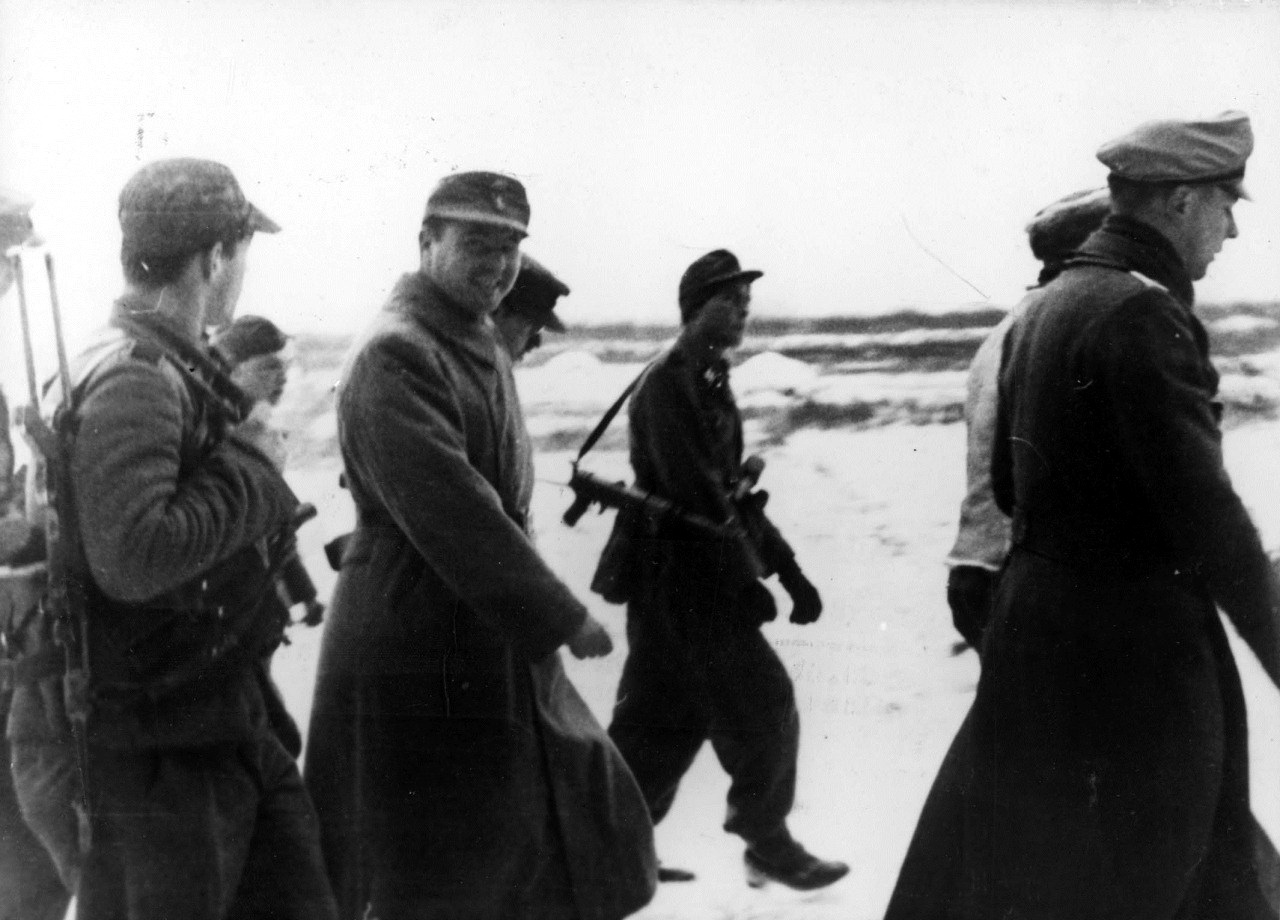
SS-Hauptsturmführer der Reserve Léon Degrelle (smiles to the camera, Kommandeur 5. SS-Freiwilligen-Sturmbrigade "Wallonien") with a group of subordinates in the Cherkassy pocket, Ukraine, February 1944. For the 56,000 Wehrmacht soldiers trapped there at the end of January 1944, this siege was perhaps the most brutal, incredibly tiring and mentally draining struggle they had ever experienced. The battle that raged centered on the joint efforts of Heer and Waffen-SS units attempting to free their comrades from other Heer and Waffen-SS units trapped in the Russian rear lines.

Source :
http://alifrafikkhan.blogspot.com/2010/10/album-foto-leon-degrelle.html
https://stabswache-de-euros.blogspot.com/2011/07/copyright-and-license-text-articles-on.html
https://waralbum.ru/236483/

Thursday, October 5, 2023

Incorporation of Legion Wallonie to the Waffen-SS


In May 1943, Himmler ordered the incorporation of the Volunteer Legion " Wallonia” into the Waffen-SS. Léon Degrelle's proactive and demanding attitude is an essential characteristic of German-Walloon military collaboration. Although the German authorities usually positioned themselves skeptically and dismissively from their position of strength, Degrelle's impulsiveness and charisma often put them under pressure.

The Walloon legionnaires spent the winter of 1942/43 recovering at home. During the previous battles in 1942 in the Caucasus, the “Légion Wallonie” was under the command of SS Division "Wiking" (Felix Steiner) for a few weeks. Steiner, who commanded the unit made up of Scandinavians, Dutch and Flemings, paid his respects to the enthusiasm of the Walloon volunteers and asked for the permanent transfer of the Legion to the SS-Division "Wiking" in a letter to the Reichsführer-SS in September 1942. Degrelle was very impressed by the material equipment and ideological orientation of the Wiking. Conversely, at the beginning of January 1943 Degrelle took the initiative and approached the German representative for the Flemish SS, the SS-Brigadeführer Richard Jungclaus, about founding a “Walloon SS”. The head of the SS Main Office, Gottlob Berger, immediately turned to Himmler because the request seemed premature to him: “I would like to ask you to decide whether this question can be addressed today or whether we should put Degrelle off until the spring or summer of 1943.”

Himmler initially left the letter unanswered. Only after Degrelle had formulated his thesis of the “Germanic affiliation” of the Walloons in a media-effective manner at a large rally in the Brussels Sports Palace on January 17, 1943 - on the occasion of the legionnaires' return to the front - did Himmler respond to Berger's request: “About your letter for the establishment of a Walloon SS I thought about it for a long time. At the same time I am sending you the text of the speech given by the clever De Grelle [sic!]. It is very interesting [sic!] that the Walloons are now suddenly remembering that they are Germans.” Himmler expressed reservations about the founding of a “Walloon SS” because he feared that he would dupe the Flemings who were already organized in the SS, but Degrelle's programmatic speech on January 17, 1943 made waves. Although the “Chef de Rex” had already declared the Walloons to be “French-speaking Germans” in August 1941, he was only able to make his voice heard under the changed war conditions in 1943. In the same way, he modified the “Greater Burgundy idea” as a voluntary return to the “Germanic community”:

“Our small fatherland is the West, but our great fatherland is the Germanic community in which our comrades died. We will never again forget the glorious uniform we wear. A German soldier is forever a comrade and brother for us. We comes from the same race […]. In the heart of the resurrected empire we will labor worthily in our western sector.”

From now on, the Reichsführer-SS followed the political change of the “Chef de Rex” closely, and although he could only raise objections to the SS's protection of Degrelle, Himmler recommended Degrelle in a letter to the head of the SS main office, Gottlob Berger, in principle to reinforce his concerns. At the beginning of February 1943, a skeptical Reichsführer-SS gave the head of the SS main office instructions to treat the Degrelle case in a dilatory manner:

“Although it should be taken into account that Degrelles [sic!] has already gone through many changes so far and it should also be taken into account that […] we might be able to gain this small following [Degrelles] if we make the wrong approach, but with that one If we can offend and lose a large Flemish following, I think it would be appropriate for Degrelles [sic!] to be supported in his Germanic ideas so that we can continue to check whether he is serious about his findings.”

In contrast, the head of military administration in occupied Belgium and northern France, Eggert Reeder, reacted quite angrily to Degrelle's “Germanic speech” at the end of January with a nine-page memorandum to the Army High Command (OKH). He warned the German authorities involved not to interfere in the occupation policy matters of the military administration by favoring Degrelle because of their lack of an overview on domestic politics. Although his military achievements should definitely be appreciated, this does not legitimize promoting him as a Rexist leader in domestic political matters:

“For the military administration, one principle must be made clear: As an officer of the Walloon Legion, Leon [sic!] Degrelle must be given every recognition and support that is conceivable. As the leader of the Rex movement, however, he can only be given support to the extent that other currently important interests are not endangered.”

In short, the military administration saw its policy of “peace and order” now seriously disturbed by Degrelle's action. Reeder noted:

“The difficult decisions that the military administration is currently increasingly faced with every day, H.H., [...] make it necessary that the tried and tested political course is steered calmly and without sudden changes right now. […] That is why it is not justifiable if individual Reich German authorities, who cannot possibly have this overall overview, do not have to bear any direct responsibility, through agreements with individual representatives of the local political groups, in this case with the leader of the Rex movement, Leon [ sic!] Have a disgruntled, disruptive influence on political developments in the local area.”

The representative of the Foreign Office in Brussels, Werner von Bargen, also felt compelled to intervene and a few days later wrote a memorandum to his employer in Berlin in a similar style. Von Bargen, who closely observed Degrelle's development and saw him “well on the way” to “becoming a real SS man,” also emphasized his merits within the Legion. However, he expressly recommended refraining from “political experiments” with Degrelle. Here too, the assessment of Degrelle as a domestic troublemaker and an insecure cantonist dominated. However, alarming words from Reeder and Bargen did not achieve the desired effect. Referring to von Bargen's telegram, Hitler ordered at the end of January 1943 to support the “Chef de Rex” “by all means”, because he was “the only really useful Belgian”. Reich Foreign Minister von Ribbentrop immediately commissioned the envoy von Bargen to maintain connection with Degrelle. Under the auspices of Hitler's directive, Degrelle's desire to be accepted into the SS took on new urgency. It was Gottlob Berger who suggested to Himmler that the Walloons be incorporated into an SS unit in February 1943:

“After, as the Foreign Office informs me, the Führer has ordered support for Degrelle, a takeover of the Walloon Legion may be discussed. In addition, the establishment of a French SS regiment would also justify the inclusion of the Walloons in a Waffen-SS association.”

Finally, in the course of March 1943, the question had also been clarified for Himmler to what extent Degrelle was serious about his “Germanic confession” or whether the “Chef de Rex” had just made a tactical about-face. In a letter to the head of the Reich Chancellery, Hans Heinrich Lammers, he told that Degrelle must have undergone an internal change due to his shared front-line experience with other Germanic volunteers from the SS “Wiking” division. Degrelle recognized out of personal conviction "that French-speaking Walloonism must be returned to popular Germanicism." At the same time, the Reichsführer-SS initiated a research project on the "Germanic" descent of the Walloons, so that the head of the expert group appointed - SS-Hauptsturmführer Sommer – had already determined in June 1943 that Wallonia was essentially “Germanic” and that the Walloons, as “descendants of the old Franconians with almost 80% Nordic-Fallic [sic!] blood, were even above the national average.”

While Hitler's maxim of Degrelle as the "only really useful Belgian" had paved the way for the Walloon Legion to become the Waffen-SS and the ideological superstructure was poised with all its might to take it over, a dispute over honor overshadowed the negotiations over the transfer in March and April 1943 : Degrelle's wife Marie had become romantically involved with a special officer in the German Air Force while her husband was at the front. Since she was expecting a child from him, which Degrelle did not want to acknowledge, the affair caused greater waves. The German officer sought to “carry out the bargain of honor,” but Degrelle initially refused a duel, citing a ban on duels ordered by Hitler. The betrayed husband turned to the Reichsführer-SS to obtain support for a duel of satisfaction or – If this is not possible - to obtain a “severe punishment” for the Luftwaffe officer. The head of the SS main office, Berger, immediately took up the case and asked Himmler to take a position: “I […] am now bringing the matter to the attention of the Reichsführer-SS, because Degrelle will certainly come up with the matter at the meeting and Reichsführer [sic !] as the man to whom he joined politically feels imputed and asks to help him.” Even before taking over the Legion, Degrelle relied on the power of the SS in private matters, which naturally took care of the problem of her future protégé. A short time later, Berger reported to Himmler that the Sonderführer had "shot himself" in Brussels and that the problem was solved.

Gottlob Berger and the Flemish fascist politician Jef van der Wiele attended Hochwald in the afternoon of 21 May 1943 for a 3 p.m. meeting when the formation of a Waffen-SS unit of Flemish volunteers was discussed. It was also decided that the Walloon Battalion under the Belgian Rexist leader Léon Degrelle should transfer to the Waffen-SS, culminating in its transfer to SS command in June 1943. Immediately after this meeting, Himmler had an appointment with Admiral Canaris to discuss Abwehr and other intelligence matters. Berger and van der Wiele returned the next day for lunch and a further appointment where details were finalised for the transfer of the Walloon unit. They were joined by Hans Prützmann and then SS-Brigadeführer Karl Cerff after van der Wiele had departed.

On the 23rd/24th In May 1943, the planned meeting between the Reichsführer-SS and Degrelle finally took place in the military training camp near Meseritz, at which the modalities of transferring the Walloon Legion to the Waffen-SS were discussed. Himmler left Hochwald at 10 p.m. by train accompanied by Leon Degrelle and Berger. In a three hour meeting the men ironed out the practical details of forming a new Waffen-SS Walloon volunteer unit, the finer points being decided by the time the train reached Meseritz where he conducted an inspection visit of the Walloon troops. In a secret communiqué, Degrelle confirmed his promise for the Reichsführer-SS. The aim is to return the “Walloons (French-speaking Germans) to the Germanic community and the Reich”. Far from advocating an immediate annexation of the “Germania Inferior” to the Reich, Degrelle set a time period of “25 or 50 years” and demanded that “the increasingly strong desire for a total return to the empire [...] must come spontaneously from the Walloon and Flemish population”. The position paper avoided statements about a concrete roadmap for political reorganization, and the Reichsführer-SS also postponed the "soft-handed integration" of Belgium for an indefinite period of time. However, on the occasion of the takeover of the Legion, Himmler subsequently provided a reason why the Walloons were not transferred into the ranks of the Waffen-SS in the summer of 1941. Accordingly, the Germanization intentions of the Reichsführer-SS with Degrelle would only have resulted in domestic political disadvantages:

“Over the past few years, I have been careful not to get in touch with Degrelle and his party as the Reichsleiter of the NSDAP, who was labeled as 'Pangermanian' and also had such an internal attitude. I would only have harmed the man's movement, which was not yet so advanced at the time. That’s why I refused their request to be accepted into the Waffen-SS when the Legion was set up in 1941.”

On May 24, 1943, Himmler ordered the transfer of around 1,600 Walloon legionnaires into the ranks of the Waffen-SS effective on June 1, 1943 and planned a future expansion of the “SS-Freiwilligen-Brigade-Wallonien” into an “SS-Freiwilligen-Gebirgs-Division”. Command of the brigade was taken over by the Legion’s previous Belgian commander, Hauptmann Lucien Lippert. The uniforms eventually received the SS rank insignia instead of the Wehrmacht one, with the right collar patch showing the Burgundy cross. Contrary to the usual SS guidelines, the Catholic chaplain remained in the unit. Although Himmler had already issued a general order on December 11, 1941, prohibiting the employment of military chaplains in the volunteer units, in the case of the Walloons he “expressly” approved that “the Catholic chaplain remains with the troops.”

In July 1943, the "SS-Sturmbrigade Wallonien'" was relocated to the Wildflecken military training area in the Hohen Rhön for reorganization and, shortly before the start of the Soviet winter offensive in December 1943 ("Dnieper-Carpathian Operation"), to the Ukrainian front to combat partisans. The assault brigade was assigned to the 5. SS-Panzer-Division “Wiking” under the command of SS-Brigadeführer Herbert Gille and managed to break out of the Cherkassy/Korsun pocket in February 1944 with great losses: only 632 of around 1,600 Walloon soldiers survived the operation! Nazi propaganda celebrated the escape of the completely exhausted troops as a historic success. Degrelle received the Ritterkreuz des Eisernen Kreuzes on February 20th, 1944 and the Sturmbrigade paraded through Brussels on April 2nd in front of mostly Rexist party supporters. In the summer of 1944, the SS-Sturmbrigade 'Wallonien'" fought on until it was reorganized as the 8. SS-Freiwilligen-Grenadier-Division "Wallonien‘“ in Estonia. As part of the defensive battles for the city of Dorpat, Degrelle acquired the Eichenlaub to his Ritterkreuz on August 27, 1944.


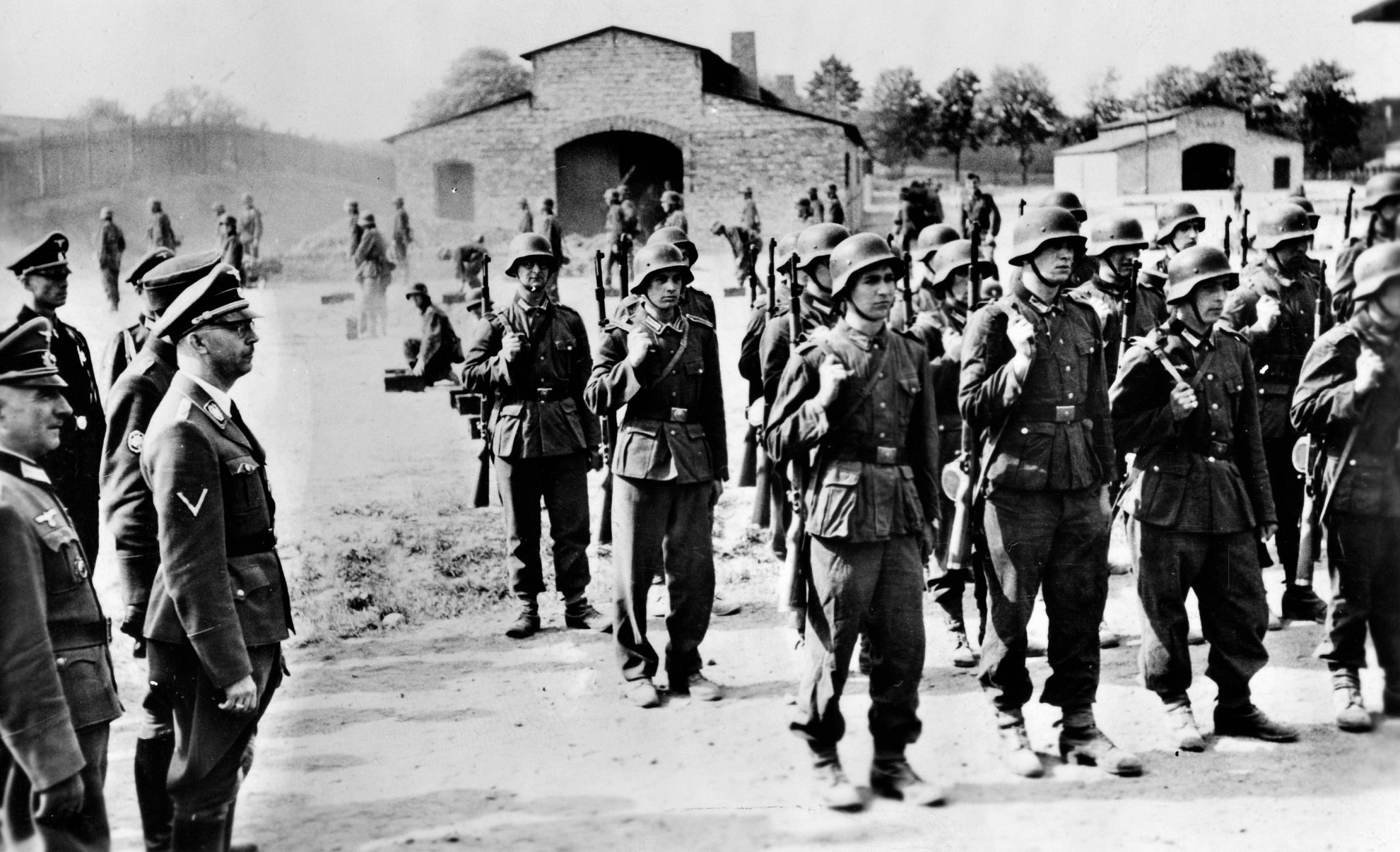
Meseritz, 24 May 1943: Reichsfuhrer-SS Heinrich Himmler (second from right, Chef der SS und deutschen Polizei) in conversation with Oberleutnant der Reserve Léon Degrelle (third from right, Stellvertretender Kommandeur Wallonische Infanterie-Bataillon 373) during Himmler's inspection to the Legion Wallonie headquarters before their transfer from Heer to the Waffen-SS. In the night before Himmler and Degrelle had met for the first time at the Reichsführer-SS's private train called "Sonderzug Heinrich", which was on its way to Meseritz, Pomerania. A private meeting to discuss the fate of the Walloon volunteers took place from 11:00 PM on 23 May 1943 until 01:00 AM of 24 May 1943.


Reichsfuhrer-SS Heinrich Himmler (Chef der SS und deutschen Polizei) inspecting the Walloon volunteers in Pieske barracks, 8 km from Meseritz, before their transfer from Heer to the Waffen-SS. Beside him - face not seen - is Oberleutnant der Reserve Léon Degrelle (Stellvertretender Kommandeur Wallonische Infanterie-Bataillon 373). The picture was taken on 24 May 1943, while most of the sources wrongfully dated this occasion as happened on 24-26 June 1943, when in reality the Walloon volunteers already changed their uniforms to the SS one!


Reichsfuhrer-SS Heinrich Himmler (second from right, Chef der SS und deutschen Polizei) talking with one of the Walloon volunteer during the visit to their barracks at Pieske, 8 km from Meseritz, Germany. Watching second from left is Oberleutnant der Reserve Léon Degrelle (Stellvertretender Kommandeur Wallonische Infanterie-Bataillon 373). The picture was taken on 24 May 1943, while most of the sources wrongfully dated this occasion as happened on 24-26 June 1943, when in reality the Walloon volunteers already changed their uniforms to the SS one!


Source :
"Heinrich Himmler: A Photo History of the Reichsführer-SS" by Max Williams
"Im übrigen scheinen mir aber politische Erwägungen für seine Schwenkung zur SS bestimmend gewesen zu sein: Léon Degrelle und die Politik der militärischen Kollaboration" by Stephan Horn
http://alifrafikkhan.blogspot.com/2010/10/album-foto-leon-degrelle.html
https://audiovis.nac.gov.pl/obraz/51883/
https://www.gettyimages.com/photos/wallonie-himmler?assettype=image&family=editorial&phrase=wallonie%20himmler&sort=best
https://www.mdr.de/geschichte/ns-zeit/waffen-ss-100_page-2_zc-ad1768d3.html