Showing posts with label 6 Workdesk. Show all posts

Tuesday, July 2, 2024

Herbert Otto Gille in His Workdesk


SS-Gruppenführer and Generalleutnant der Waffen-SS Herbert Otto Gille (Kommandeur 5. SS-Panzer-Division "Wiking") photographed by Kriegsberichter Etzhold (Propaganda-Kompanie 670) in his office in the Eastern Front, 21 March 1944. In his neck is the Schwerter zum Ritterkreuz des Eisernen Kreuzes mit Eichenlaub which he received on 20 February 1944, while in his uniform is Deutsches Kreuz in Gold which he received on 28 February 1942.

Source :
https://commons.wikimedia.org/wiki/File:Bundesarchiv_Bild_101I-090-3916-14,_Russland,_Herbert_Gille.jpg

Saturday, November 25, 2023

Heinz Harmel in His Command Post in Normandy


This picture was taken in July 1944 during the Battle of Normandy, and it shows SS-Oberführer Heinz Harmel (Kommandeur 10. SS-Panzer-Division "Frundsberg") in his command post near the town of Avrecy, around 12 km southwest of Caen. At this point, the "Frunsbergers" were subordinate to the II. SS-Panzerkorps and had the task of preventing the Allies from breaking out of the landing area to the east.

Source :
https://www.facebook.com/frontsoldaten/photos/a.173823269673098/1609023089486435/
https://www.reddit.com/r/GermanWW2photos/comments/awgyy7/1944_venoix_normandy_brigadef%C3%BChrer_fritz_witt/
https://waralbum.ru/178440/

Wednesday, November 1, 2023

Hans Eikmeier in the Command Post


The command post of II.Abteilung / Reiter-Regiment 32 / 3.Kavallerie-Brigade in 1944/1945. Of course, the unknown officer on the field telephone catches your eyes immediately. Five Tank Destruction Badge (Panzervernichtungsabzeichen) on his sleeve meaning that he had single-handedly destroyed 5 enemy tanks using a hand-held weapon. Sitting in the middle is the only 26 year old Abteilungsführer (Detachment Leader), Rittmeister Johannes "Hans" Eikmeier, who was born on the 3rd December 1918 in Wiesbaden. Éikmeier, awarded with the Deutsches Kreuz in Gold, Ehrenblattspange and the Ritterkreuz des Eisernen Kreuzes, survived the war and later studied veterinary medicine. From 1964 to 1987 he worked as a professor of internal and forensic veterinary medicine at the University of Gießen. He died in 2012.


Source :
Ingo Möbius photo collection
https://www.facebook.com/permalink.php?story_fbid=pfbid02BywZL6fNePLWjNHV3YUoViq3cu1Wq5XTx9mqXPk3DrwWA2an33jqXhMhQjYwonNdl&id=100013095840106

Sunday, October 29, 2023

Map Discussion of XIII. Armeekorps

General der Panzertruppe Heinrich von Vietinghoff (center, Kommandierender General XIII. Armeekorps) with his two staff officers during map discussion in 1940. At left is Oberst i.G. Rudolf Hofmann (Chef des Generalstabes XIII. Armeekorps), while at right is Oberstleutnant i.G. Anton Glasl (Ia Erster Generalstabsoffizier XIII. Armeekorps). These three people would later become Ritterkreuzträger (recipients of the Ritterkreuz des Eisernen Kreuzes): Vietinghoff on 24 June 1940 and 16 April 1944 (Eichenlaub), Hofmann on 7 May 1945, and Glasl on 11 October 1943.


Source :
http://alifrafikkhan.blogspot.com/2011/09/album-foto-merundingkan-strategi-dan.html

Thursday, August 3, 2023

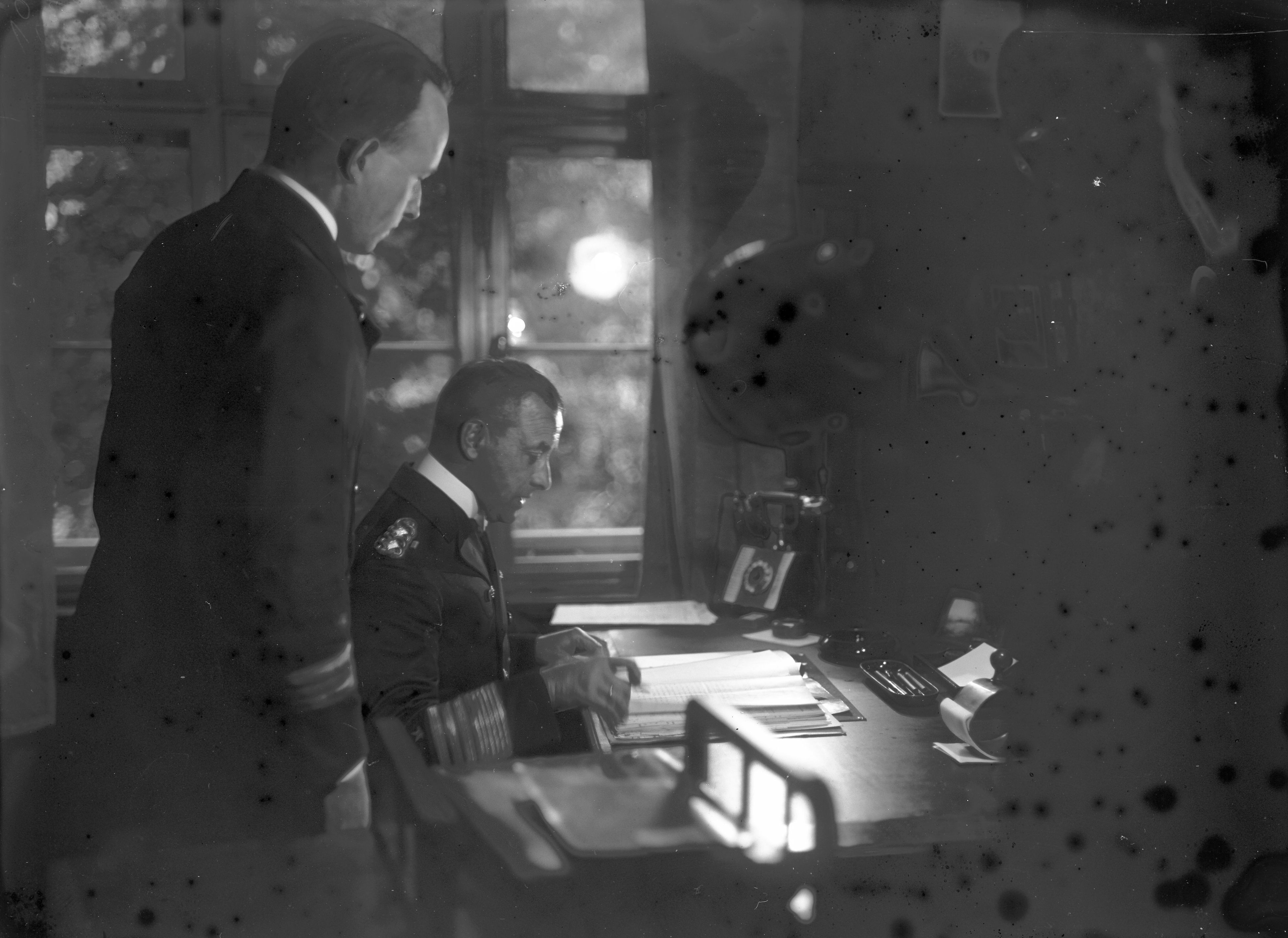
Erich Raeder and His Adjutant


The new Chef der Reichsmarine (Chief of the Navy), Admiral Erich Raeder, signing the protocols in the office of the Reichswehrministerium (Reichswehr Ministry) after taking office. Next to him is his personal adjutant, Kapitänleutnant Norbert von Baumbach. The picture was taken in October 1928 by Georg Pahl.

Source :
https://commons.wikimedia.org/wiki/File:Bundesarchiv_Bild_102-12391,_Erich_Raeder_mit_pers%C3%B6nlichem_Adjudanten.jpg

Wednesday, March 29, 2023

Bio of General der Gebirgstruppe Ludwig Kübler (1889-1947)

Ludwig Kübler

Date of Birth: 02.09.1889 - Hopferau, Münich (German Empire)
Date of Death: 18.08.1947 - executed at Ljubljana Miklasicera (Yugoslavia)

Nickname: Limping Nurmi
Parents: Wilhelm Kübler and Rosa Braun
Siblings: Six brothers and two sisters

Promotions:
16.10.1908 Fahnenjunker-Unteroffizier
20.02.1909 Fähnrich
23.10.1910 Leutnant
09.07.1915 Oberleutnant
18.08.1918 Hauptmann
01.08.1928 Major
01.04.1932 Oberstleutnant
01.07.1934 Oberst
01.01.1938 Generalmajor
01.12.1939 Generalleutnant
01.08.1940 General der Infanterie
24.11.1941 General der Gebirgstruppe

Career:
20.07.1918 Entered Army Service
20.07.1908 - 01.04.1913 Fahnenjunker in the 15. Königlich Bayerisches Infanterie-Regiment "König Friedrich August von Sachsen" in Neuburg an der Donau
01.10.1909 - 14.10.1910 Detached to the Kriegsschule Münich
15.01.1913 - 04.02.1913 Detached to the Machinegun Company of the Bavarian 3. Infanterie-Regiment Prinz Karl von Bayern and for riding training with the Bavarian 4. Chevaulegers [Light Cavalry]-Regiment König.
05.02.1913 - 18.03.1913 Detached for machinegun training at the Camp Lechfeld Troop Training Area.
01.04.1913 Detached to the Machinegun Company of the Bavarian 15th Infantry Regiment.
01.10.1913 Transferred to the Machinegun Company of the Bavarian 15th Infantry Regiment.
21.09.1914 Regimental Adjutant of the Bavarian 15th Infantry Regiment.
24.09.1914 Severely wounded in the face and jaw by a grenade during the engagement at Lassigny on the Western Front.
01.10.1917 - 31.10.1917 Detached to the Bavarian 2nd Infantry Division for the purpose of training in General Staff service.
25.01.1918 Relieved from the position of Regimental Adjutant and Leader of the Machinegun Company of the Bavarian 15th Infantry Regiment.
31.03.1918 Deputy Leader of the Bavarian Machinegun Sharp Shooting Battalion 2.
11.04.1918 - 25.06.1918 Deputy Leader of the II. Battalion of the Bavarian 15th Infantry Regiment.
03.05.1918 Wounded in the right shoulder and right knee by artillery fire south of Villers aux Erables on the Western Front/treated at the front and remained with the troops.
09.07.1918 - 10.08.1918 Deputy Leader of the II. Battalion of the Bavarian 15th Infantry Regiment.
10.08.1918 Sick with respiratory and heart trouble.
15.08.1918 Operation at the Surgical Clinic in München and the Erlangen Reserve Hospital School and again on 15 February 1919.
16.02.1919 Leader of the Home Defense Company of the Bavarian 15th Infantry Regiment.
01.06.1919 Adjutant of Bavarian Infantry Leader 22.
01.10.1919 Ordnance Officer of Infantry Leader 21.
15.10.1919 Company Leader in Reichswehr Schützen [Rifle]-Regiment 42.
01.10.1920 Transferred to the 19th (Bavarian) Infantry Regiment.
01.10.1921 Transferred to the Reich Defense Ministry – 1923-1925 in the Army Department (T 1) of the Troop Office.
01.10.1925 Transferred to the General Staff of Group Command 1.
01.10.1927 Transferred to the staff of the 1st Division.
01.07.1930 - 23.07.1930 At the same time, sent to the XXV Course for Physical Education in Wünsdorf.
01.06.1931 Commander of the I. Battalion of the 19th (Bavarian) Infantry Regiment.
05.10.1931 - 23.10.1931 Detached to Firing Course A for Heavy Infantry Weapons at Döberitz.
01.10.1933 Transferred to the staff of the 7th Division carrying the Uniform of a Leadership Staff Officer.
01.11.1933 Chief of Staff of the 7th Division.
01.10.1934 Chief of Staff of Wehrkreis Command VII.
01.06.1935 Commander of the Mountain Brigade, München carrying the Uniform of the 19th (Bavarian) Infantry Regiment.
01.04.1938 - 24.10.1940 Kommandeur 1. Gebirgs-Division
17.10.1940 - 21.10.1940 Detached to the Army High Command (Army General Staff).
25.10.1940 - 20.01.1942 Kommandierender General XXXXIX. Gebirgskorps
17.12.1941 - 20.01.1942 Commander-in-Chief of the 4th Army (other documents state with immediate effect from 19 December 1941).
21.01.1942 - 21.07.1943 Army High Command Leader Reserve – Duties determined by the Deputy Commanding General of the VII Army Corps and Commander of Wehrkreis VII.
22.07.1943 - 04.09.1943 Delegated with the post of Commanding General of Security Troops and Commander of Army Area Center.
05.09.1943 - 30.09.1943 Commanding General of Security Troops and Commander of Army Area Center.
01.10.1943 Commander of Security Area, then Operations Zone Adriatic Coastland.
28.09.1944 Commanding General of the LXXXXVII Army Corps for Special Employment (through renaming) (also seen as 5 October 1944).
08.05.1945 Prisoner of war in Yugoslavian captivity; war crimes trial.
18.08.1947 Died in Ljubljana (per WASt) (other sources state he was tried and shot for war crimes against the Yugoslavian people).
00.11.1964 The Pioneer Barracks in Mittenwald was named “General Kübler-Kaserne” in his honor.

Awards and Decorations:
03.03.1911 Königlich Bayerische Prinz-Regent-Luitpold Jubiläums-Medaille
16.09.1914 1914 Eisernes Kreuz II.Klasse
05.11.1911 Königlich Bayerische Militär-Verdienstorden IV.Klasse mit Schwertern
17.11.1914 1914 Eisernes Kreuz I.Klasse
12.05.1916 Ritterkreuz II.Klasse des Königlich Sächsische Albrechts-Ordens mit Schwertern
23.07.1917 Königlich Bayerische Militär-Verdienstorden IV.Klasse mit Schwertern und mit der Krone
07.06.1918 Verwundetenabzeichen 1918 in Schwarz
15.12.1934 Ehrenkreuz für Frontkämpfer 1914-1918
02.10.1936 Dienstauszeichnung der Wehrmacht IV.Klasse 4 Jahre
02.10.1936 Dienstauszeichnung der Wehrmacht III.Klasse 12 Jahre
02.10.1936 Dienstauszeichnung der Wehrmacht II.Klasse 18 Jahre
02.10.1936 Dienstauszeichnung der Wehrmacht I.Klasse 25 Jahre
30.11.1936 Deutsches Olympia Ehrenzeichen Erster Klasse
21.11.1938 Medaille zur Erinnerung an den 13. März 1938
00.00.19__ Heeresbergführer-Abzeichen
15.09.1939 1939 spange zum 1914 Eisernes Kreuz II.Klasse
20.09.1939 1939 spange zum 1914 Eisernes Kreuz I.Klasse
27.10.1939 Ritterkreuz des Eisernen Kreuzes, as Generalmajor and Kommandeur 1. Gebirgs-Division
23.08.1942 Medaille "Winterschlacht im Osten 1941/42" (Ostmedaille)
00.00.194_ Slovenský vojenný víťazný kríž (Slovakian Order of the War Victory Cross), 3rd Class

----------------------------------------------------------------------------

Ludwig Kübler (2 September 1889 – 18 August 1947) was born on 2 September 1889 in the village of Hopferau near Munich in the Kingdom of Bavaria. His father was the physician Wilhelm Kübler and he had six brothers and two sisters. In 1895 he enrolled in elementary school in Forstenried which he left after three years, he then attended the Gymnasium in Rosenheim and the humanist Ludwig Gymnasium in Munich. He graduated in 1908 with top grades and turned down a place at the prestigious Maximilianeum for a career in the military. On 20 July 1908, he joined the 15th Royal Bavarian Infantry Regiment "King Friedrich August of Saxony" as a cadet. At the time, the regiment was garrisoned at Neuburg an der Donau. On 26 October of that year, he was appointed as a Fahnenjunker-Unteroffizier (cadet non-commissioned officer). From 1 October 1909 until 14 October 1910 he attended the War School (German: Kriegsschule) in Munich, at which he was placed fifth out of 166 students in his year. On 23 October 1910, he was commissioned as a Leutnant. On 15 January 1913 he was posted to the machine gun company of the 3rd Royal Bavarian Infantry Regiment "Prince Karl of Bavaria", then conducted riding training with the 4th Royal Bavarian Chevaulegers Regiment. He spent February and March 1913 conducting machine gun training courses in the field, before taking command of the machine gun company of the 15th Royal Bavarian Infantry Regiment on 1 April.

At the beginning of World War I, Kübler was serving with 15th Bavarian Infantry Regiment, on the Western Front. He was involved in September 1914 fighting in Lorraine and around St Quentin as commander of a machine gun platoon. On 16 September he was awarded the Iron Cross 2nd class. On 21 September he was appointed as the regimental adjutant. On 24 September a serious injury from shell splinters left a conspicuous large scar on his face. Although the injury had not completely healed he returned on 13 January 1915 to his regiment, which took part in the Battle of the Somme. While recuperating, on 17 November he was awarded the Iron Cross 1st class. On 9 July 1915 he was promoted to Oberleutnant, and on 18 August 1918 he was promoted to the rank of Hauptmann.

After the war he was retained in the Reichswehr. He was then a staff officer in the Army Department (T1) of Truppenamt for a few years. From 1925–1926 he was at the General Staff of Group Command 1 in Berlin. He was promoted to the rank of Major on 1 August 1928, and Oberstleutnant on 1 April 1932. On 1 November 1933 he was appointed as the chief of staff of the 7th Division based in Munich, and after transferring to the newly created Wehrmacht, he was promoted to the rank of Oberst on 1 July 1934. This was followed by his appointment on 1 October 1934 as the chief of staff of Wehrkreis VII, the Bavarian military district centred on Munich. He was promoted to Generalmajor on 1 January 1938, and exactly three months later was appointed to command the 1st Mountain Division. The 1st Mountain Division was raised from Wehrkreis VII, with its garrison centred on Garmisch-Partenkirchen. It was recruited from Bavarians, with some Austrians included, and was formed on 9 April 1938. Considerably stronger than most German divisions, it had three mountain infantry regiments rather than two.

At the start of World War II, Kübler's division was involved in the invasion of Poland as part of the 14th Army, commencing on 1 September 1939. It fought in the Carpathian Mountains, distinguishing itself during the capture of the Dukla Pass. On 27 October, Kübler was awarded the Knight's Cross of the Iron Cross for his role in the Polish campaign. Then on 1 December 1939 he was promoted to Generalleutnant. During the invasion of France and the Low Countries in May 1940, Kübler's division was not heavily committed, fighting on the Franco-Belgian border and crossing the Maas on 15 May. The division was stationed around Arras after the fall of France, as it had been selected to form part of the invasion force for Operation Sealion, the invasion of the United Kingdom. After that operation was postponed, on 25 October 1940 Kübler was appointed to command the XXXXIX Mountain Corps, which included the 1st Mountain Division. His corps was earmarked for Operation Felix, the planned capture of Gibraltar, but that operation was also called off. Due to the disfigurement caused by the wounds he suffered during World War I, Kübler became known to his troops as "Limping Nurmi", a reference to the Finnish long-distance runner Paavo Nurmi.

In April 1941, Kübler's XXXXIX Mountain Corps was allocated to the 2nd Army for the German-led Axis invasion of Yugoslavia, and assembled near Klagenfurt prior to the commencement of the invasion on 6 April. By this time, Kübler had been promoted to General der Infanterie. For the Axis attack on the Soviet Union that commenced in 22 June 1941, Kübler's corps was allocated to the 17th Army, itself part of Army Group South. Kübler's rank was redesignated from General der Infanterie to General der Gebirgstruppe. On 19 December 1941, Kübler was appointed commander of the 4th Army. This occurred during the desperate winter defensive fighting when Adolf Hitler would not countenance any withdrawals. Kübler found Hitler's approach "intolerable" and sought relief. On 20 January 1942 he was transferred to the Army Führerreserve (senior officer reserve pool).

From 22 July and 1 October 1943, Kübler was acting commander of the Army Group Centre Rear Area, responsible for security warfare in the territories behind Army Group Centre. On 1 October he was appointed to command the Operational Zone of the Adriatic Littoral (OZAK), based in Trieste on the northern Adriatic coast. On 28 August 1944, LXXXXVII Army Corps was formed to command all German Army elements in OZAK, and Kübler was appointed as its commander. Shortly before the end of the war he was wounded and captured in Yugoslavia, tried for war crimes and executed after the war. Along with his successor Generalleutant Hans von Hößlin he was sentenced to death in 1947 by a Yugoslav court. He was hanged in Ljubljana on 18 August 1947, like his younger brother, Generalleutnant Josef Kübler, who was hanged in Belgrade on 26 February 1947.

Kübler was considered a "superb soldier" but a hard taskmaster. In 1964, the German Army barracks in Mittenwald, Bavaria were named after Kübler. In November 1995, Volker Rühe, then the German Minister of Defence, changed the name of the barracks from "General-Kübler-Kaserne" to "Karwendel-Kaserne".


Source :
Jim Haley photo collection
https://en.wikipedia.org/wiki/Ludwig_K%C3%BCbler
https://www.kometmilitaria.com/product-page/press-picture-general-k%C3%BCbler-with-olympia-ehrenzeichen-erster-klasse
https://www.lexikon-der-wehrmacht.de/Personenregister/K/KueblerLudwig.htm
https://www.tracesofwar.com/persons/12422/K%C3%BCbler-Ludwig.htm
https://web.archive.org/web/20091027112558fw_/http://www.geocities.com/~orion47/WEHRMACHT/HEER/General2/KUEBLER_LUDWIG.html

Friday, March 17, 2023

Ritterkreuz Actions of Heinz Greiner

Heinrich "Heinz" Greiner (12 August 1895 - 19 November 1977) received the Ritterkreuz des Eisernen Kreuzes on 22 September 1941 as Oberst and Kommandeur Infanterie-Regiment 499 / 268.Infanterie-Division. The medal was awarded for distinguishing himself during the defensive battles in the Yelnya pocket in 1941. The regiment he led were responsible for preventing a complete Soviet encirclement in the Yelnya Offensive, during which Greiner, for his stiff, hold-out defense of Wehrmacht forces evacuating the salient, earned the nickname the "Lion of Yelnya" from his soldiers.

Greiner received the Eichenlaub #572 for his Ritterkreuz on 5 September 1944 as Generalleutnant and Kommandeur 362. Infanterie-Division. The medal was awarded for his outstanding command of a Kampfgruppe composed of Heer and Fallschirmjäger troops in the area Velletri—Valmontone (on the Anzio front). His unit repelled a total of 38 Allied attacks on both sides of Velletri through either a successful initial defense or via immediate counterthrusts against hostile penetrations. The Wehrmachtbericht aired on 2 June 1944 mentioned his name as follows: "In diesem Frontabschnitt haben sich die 65. Infanteriedivison unter Generalleutnant Pfeiffer, die durch Teile der 4. Fallschirmjägerdivision verstärkte 3. Panzergrenadierdivision unter Generalmajor Hecker und eine aus Einheiten des Heeres und der Fallschirmtruppe zusammengestellte Kampfgruppe unter Generalleutnant Greiner, hervorragend unterstützt durch Artillerie und durch Flakartillerie der Luftwaffe, besonders ausgezeichnet." (In this section of the front have the 65th Infantry Division under Lieutenant General Pfeiffer, augmented by parts of the 4th Airborne Division which reinforced the 3rd Mechanized Infantry Division under Major General Hecker and units from the Army and the parachute troops assembled combat group under Lieutenant General Greiner, well supported by artillery and anti-aircraft artillery of the Luftwaffe, particularly distinguished themselves)


Source :
https://www.alexautographs.com/auction-lot/heinz-greiner_CD04AECA6C
https://military-history.fandom.com/wiki/Heinz_Greiner
https://www.tracesofwar.com/persons/35945/Greiner-Heinrich-Heinz.htm

Bio of Generalleutnant Heinz Greiner (1895-1977)

Heinrich "Heinz" Greiner

Date of Birth: 12.08.1895 - Amberg, Oberpfalz, Bayern (German Empire)
Date of Death: 19.11.1977 - Rottach-Egern, Bayern (West Germany)

Nickname: Heinz "The Lion of Yelnya"
Battles/wars: World War I, Siege of Antwerp, First Battle of Ypres, Second Battle of Ypres, Second Battle of the Aisne, Battle of Arras, German Revolution of 1918-1919, World War II, Invasion of Poland, Battle of France, Operation Barbarossa, Battle of Bialystok–Minsk, Battle of Smolensk (1941), Yelnya Offensive, Battle of Moscow, Battle of Smolensk (1943), Italian Campaign, Operation Diadem, Battle of Monte Cassino, Battle of Garfagnana, Gothic Line Offensive, Operation Grapeshot.

Promotions:
20.10.1914 Fahnenjunker-Unteroffizier
15.02.1915 Fähnrich
12.06.1915 Leutnant
01.10.1923 Oberleutnant
01.06.1928 Hauptmann
01.03.1935 Major
01.01.1938 Oberstleutnant
01.11.1940 Oberst
01.03.1942 Generalmajor
01.01.1943 Generalleutnant

Career:
Entered Army Service (03 Aug 1914)
Fahnenjunker in the 13th Bavarian Infantry-Regiment (03 Aug 1914-06 Oct 1914)
With the Regiment in the Field (06 Oct 1914-11 Dec 1916)
Detached to the Gun Factory in Amberg (11 Dec 1916-01 Feb 1917)
Transferred to the I. Replacement-Battalion of the 13th Bavarian Infantry-Regiment (01 Feb 1917-06 Aug 1917)
Detached to the 4th Replacement-MG-Company (05 Feb 1917-30 Apr 1917)
Detached to Training-Course for Weapons-Officers in Stettin (30 Apr 1917-10 Jun 1917)
Detached to MG-Training-Course in Camp Hammelburg (10 Jun 1917-06 Aug 1917)
Transferred to the 13th Bavarian Infantry-Regiment in the Field (06 Aug 1917-08 Sep 1917)
Leader of the 1st MG-Company of the 13th Bavarian Infantry-Regiment (08 Sep 1917-04 Oct 1917)
Wounded, in Hospital (04 Oct 1917-16 Jun 1918)
Temporary-MG-Officer with the Staff of the 13th Bavarian Infantry-Regiment (16 Jun 1918-13 Nov 1918)
Leader of the 2nd MG-Company of the 13th Bavarian Infantry-Regiment (13 Nov 1918-07 Feb 1919)
Adjutant of the I. Battalion of the 13th Bavarian Infantry-Regiment (07 Feb 1919-14 Apr 1919)
Regiments-Adjutant of the 13th Bavarian Infantry-Regiment (14 Apr 1919-26 Aug 1919)
Auxiliary-Officer with the Staff of the 42nd Reichswehr-Rifle-Regiment (26 Aug 1919-10 Oct 1919)
MG-Platoon-Leader in the 8th Company of the 42nd Reichswehr-Rifle-Regiment (10 Oct 1919-01 Oct 1920)
MG-Platoon-Leader in the 19th Infantry-Regiment (01 Oct 1920-01 Oct 1926)
Detached to Weapons School Course on the Troop-Exercise-Grounds Ohrdruf (01 May 1924-15 Aug 1924)
Detached to Subsidiary-Leadership-Course with the Staff of the 7th Division (01 Oct 1924-01 Jul 1926)
Detached to the 2nd Pioneer-Battalion (01 Jul 1926-31 Jul 1926)
Detached to the 2nd Motor-Transport-Battalion (01 Aug 1926-31 Aug 1926)
Detached to the 2nd Signals-Battalion (01 Sep 1926-30 Sep 1926)
Transferred into the 7th Company of the 19th Infantry-Regiment (01 Oct 1926-01 Apr 1928)
Chief of the 14th Company of the 19th Infantry-Regiment (01 Apr 1928-01 Apr 1932)
Transferred into the 17th Mounted-Regiment and Detached as Instructor to the Infantry-School in Munich (01 Apr 1932-01 Oct 1934)
Transferred as Instructor to the Infantry-School in Munich (01 Oct 1934-01 Jan 1935)
Instructor at the War School in Munich (01 Jan 1935-10 Nov 1938)
Commander of the III. Battalion of the 63rd Infantry-Regiment (10 Nov 1938-06 Feb 1940)
Detached to Staff-Officers-Course of the 7th and 27th Divisions (10 Nov 1938-14 Dec 1938)
Commander of the 63rd Infantry-Regiment (06 Feb 1940-25 Sep 1940)
Leader of the MIA-Office with the Staff of the General Of Infantry with the Commander-in-Chief of the Army (25 Sep 1940-20 Apr 1941)
Commander of the 499th Infantry-Regiment (20 Apr 1941-06 Jan 1942)
Delegated with the Leadership of the 268th Infantry-Division (06 Jan 1942-20 Apr 1942)
Commander of the 268th Infantry-Division (20 Apr 1942-08 Sep 1943)
Commander of the 362nd Infantry-Division (20 Nov 1943-01 Jan 1945)
Führer-Reserve OKH, Detached to Course for Commanding Generals (01 Jan 1945-12 Apr 1945)
Commanding General of the Replacement VII. Army-Corps and Commander in Military-District VII (12 Apr 1945-06 May 1945)
In US Captivity (06 May 1945-27 Jun 1947)
Released (27 Jun 1947)


Awards and Decorations:
04.12.1914 1914 Eisernes Kreuz II.Klasse
00.00.191_ Königlich Bayerische Militär-Verdienstorden IV.Klasse mit Schwertern
00.00.191_ Königlich und Kaiserlich Österreischische Militär-Verdienstkreuz III.Klasse mit der Kriegsdekoration
00.00.1918 Verwundetenabzeichen 1918 in Schwarz
25.11.1918 1914 Eisernes Kreuz I.Klasse
00.00.193_ Ehrenkreuz für Frontkämpfer 1914-1918
00.00.19__ Dienstauszeichnung der Wehrmacht 1.Klasse, 25 Jahre
04.10.1939 1939 spange zum 1914 Eisernes Kreuz II.Klasse
20.10.1939 1939 spange zum 1914 Eisernes Kreuz I.Klasse
22.09.1941 Ritterkreuz des Eisernen Kreuzes, as Oberst and Kommandeur Infanterie-Regiment 499 / 268.Infanterie-Division. Awarded for distinguishing himself during the defensive battles in the Yelnya pocket in 1941
00.00.1942 Medaille "Winterschlacht im Osten 1941/42" (Ostmedaille)
02.06.1944 Mentioned in the Wehrmachtbericht: "In diesem Frontabschnitt haben sich die 65. Infanteriedivison unter Generalleutnant Pfeiffer, die durch Teile der 4. Fallschirmjägerdivision verstärkte 3. Panzergrenadierdivision unter Generalmajor Hecker und eine aus Einheiten des Heeres und der Fallschirmtruppe zusammengestellte Kampfgruppe unter Generalleutnant Greiner, hervorragend unterstützt durch Artillerie und durch Flakartillerie der Luftwaffe, besonders ausgezeichnet." (In this section of the front have the 65th Infantry Division under Lieutenant General Pfeiffer, augmented by parts of the 4th Airborne Division which reinforced the 3rd Mechanized Infantry Division under Major General Hecker and units from the Army and the parachute troops assembled combat group under Lieutenant General Greiner, well supported by artillery and anti-aircraft artillery of the Luftwaffe, particularly distinguished themselves)
05.09.1944 Ritterkreuz des Eisernen Kreuzes mit Eichenlaub #572, as Generalleutnant and Kommandeur 362. Infanterie-Division. Awarded for his outstanding command of a Kampfgruppe composed of Heer and Fallschirmjäger troops in the area Velletri—Valmontone (on the Anzio front). His unit repelled a total of 38 Allied attacks on both sides of Velletri through either a successful initial defense or via immediate counterthrusts against hostile penetrations

---------------------------------------------------------------------------------

Greiner was born 12 August 1895 in Amberg, Bavaria. Upon graduating from Amberg Gymnasium, Greiner joined the Bavarian Army as an Officer Cadet and was assigned to the 13th Infantry Regiment in March 1914. Less than five months later Greiner's unit was mobilized and the young officer saw action with the German Army on the Western Front. Eventually taking command of a Machine Gun Company he saw fierce combat in Belgium and was wounded outside Flanders leading to a brief period of convalescence before returning to his unit for the remainder of the War.

With the conclusion of the First World War Greiner returned to Bavaria and served in the 19th Infantry Regiment. He later became a respected instructor and tactical theorist at the Military Academy of Munich, saw assignments to both Augsburg and Landshut and served as an adviser in the suppression of the Bavarian Spartacist uprising.

At the opening of the Second World War, Heinrich Greiner had reached the rank of Oberst and was Commander of the 268th Infantry Regiment. His unit, leaning heavily upon its engineer elements, was one of the first German Army units to see action in Poland. He went on to a short staff position during the Battle of France and returned to the Eastern Front just prior to Operation Barbarossa and led the 499th Regiment. Greiner and the 499th were responsible for preventing a complete Soviet encirclement in the Yelnya Offensive, during which Greiner, for his stiff, hold-out defense of Wehrmacht forces evacuating the salient, earned the nickname the "Lion of Yelnya" from his soldiers. His leadership qualities were swiftly recognized and he was subsequently awarded command of the 268th Infantry Division. That command was to last until 1944 when the Division, along with much of Army Group Centre was nearly obliterated by the Soviet Army as the tide of the war began to turn. Greiner was then transferred to Italy where he took command of the 362nd Infantry Division in the defense of the peninsula against invading Allied forces. He led a series of decisive counterattacks on Allied forces outside of Rome that slowed enemy progress up the peninsula and earned Greiner his final promotion to Generalleutnant in addition to a lengthy stay in a Bavarian Hospital due to wounds sustained in combat.

Greiner was released from medical care in early April 1945 and finding the war all but lost began preparations for an orderly surrender of German forces throughout Italy and Southern Germany. In his final action as a Wehrmacht General, Greiner deposed Nazi officials who stubbornly attempted a final defense of Munich. Following his capitulation Greiner was held as an Allied Prisoner of War until his release and subsequent retirement in 1947.

Greiner died 19 November 1977.

---------------------------------------------------------------------------------

* During Operation Barbarossa Greiner reached divisional level command. The division was destroyed in the Soviet Operation Bagration in the summer of 1944, along with much of Army Group Centre. Greiner was transferred to Italy where he took command of the 362nd Infantry Division. Losses were so heavy in the division in Italy that a bit of doggerel made the rounds:
The division of Greiner
Gets chopped ever finer
Until roll call's a one liner
That simply says: Greiner.


Source :
Jim Haley photo collection
https://alchetron.com/Heinz-Greiner#heinz-greiner-3a1100b2-ba5d-4af1-8907-6c76b8d61d4-resize-750.jpeg
https://www.alexautographs.com/auction-lot/heinz-greiner_CD04AECA6C
https://www.ebay.de/sch/i.html?_from=R40&_trksid=p2499334.m570.l1313&_nkw=heinz+greiner&_sacat=15504
https://en.wikipedia.org/wiki/Heinz_Greiner
https://forum.axishistory.com/viewtopic.php?p=2463202#p2463202
https://www.invaluable.com/auction-lot/heinz-greiner-107-c-c214de49d9
https://jp-militaria.de/epages/c8160b69-739a-486c-b016-ca431d292e5b.sf/de_DE/?ObjectPath=/Shops/c8160b69-739a-486c-b016-ca431d292e5b/Products/31905
https://military-history.fandom.com/wiki/Heinz_Greiner
http://www.sjsmilitaria.com/photos-autographs/generalleut-heinz-greiner-autograph/
https://www.tracesofwar.com/persons/35945/Greiner-Heinrich-Heinz.htm
https://web.archive.org/web/20091027112745fw_/http://www.geocities.com/~orion47/WEHRMACHT/HEER/Generalleutnant/GREINER_HEINRICH.html

Sunday, August 28, 2022

Dietrich von Saucken in His Office

Generalleutnant Dietrich von Saucken (Kommandeur 4. Panzer-Division) at his command post on the Eastern Front in 1944. In his neck hangs the Schwerter zum Ritterkreuz which he won on January 30, 1944. This photo is one of the few that shows a Wehrmacht general wearing black panzer uniform!
 
Source :
https://www.ebay.de/itm/295156672669?hash=item44b8b5689d:g:Z9gAAOSwDpFi-N3J

Saturday, February 12, 2022

Bio of General der Flakartillerie Richard Reimann (1892-1970)

General der Flakartillerie Richard Reimann
Born: 02 Nov 1892 in Minden, Westphalia (Westfalen)
Died: 28 Oct 1970 in Rottach-Egern

Promotions:
Fahnenjunker-Unteroffizier (27 Jan 1912); Fähnrich (18 Aug 1912); Oberleutnant (16 Jun 1913); Hauptmann (01 Feb 1927); Major (01 Oct 1934); Oberstleutnant (20 Apr 1937); Oberst (01 Apr 1939); Generalmajor (20 Apr 1941); Generalleutnant (15 Mar 1943); General der Flakartillerie (02 Aug 1944)

Career:
Entered Army Service as a Fahnenjunker and Battery-Officer in the 43rd Field-Artillery-Regiment (04 Dec 1911-01 Aug 1914)
Detached to War-School in Metz (1912-07 May 1913)
Platoon-Leader in the 43rd Field-Artillery-Regiment (02 Aug 1914-14 Sep 1914)
Wounded, in Hospital (14 Sep 1914-15 Sep 1914)
With the II. Replacement-Battalion of the 43rd Field-Artillery-Regiment (15 Sep 1914-05 Sep 1915)
Transferred for Training on Motor-Vehicle-Guns of the Inspection of Motor-Transport-Troops and Detached to the Motor-Transport-Battalion Schöneberg (06 Sep 1915-27 Sep 1915)
With the Motor-Vehicle-Gun 37 of Army-Detachment Gaede and Detached to Balloon-Defence-Cannon-School Ostend (28 Sep 1915-18 Oct 1915)
With the Motor-Vehicle-Gun 21 (19 Oct 1915-31 May 1916)
Leader of Cannon-Flak 89 (01 Jun 1936-31 Aug 1916)
Assistant with the Artillery-Tests-Commission (01 Sep 1916-00 Jan 1919)
Volunteer in the Guards-Cavalry-Rifle-Division (00 Jan 1919-00 Mar 1919)
With the Brigade Reinhard (00 Mar 1919-13 Mar 1919)
Detached to the Artillery-Tests-Commission (14 Mar 1919-30 Sep 1919)
Detached to the Inspection for Weapons and Equipment, RWM (01 Oct 1919-11 Dec 1919)
Transferred into the 7th Light Motor-Vehicle-Battalion (12 Dec 1919-02 Jan 1920)
Battery-Officer in the 7th Artillery-Regiment (03 Jan 1920-08 Jun 1920)
In Freikorps Severin (09 Jun 1920-30 Sep 1920)
Auxiliary-Officer with the Staff of the 7th Division and Detached to the Inspection for Weapons and Equipment, RWM (01 Oct 1920-14 Apr 1921)
Transferred into the 7th Artillery-Regiment while retaining position with the Inspection for Weapons and Equipment (15 Apr 1921-30 Sep 1921)
Battery-Chief in the III. Battalion of the 3rd Artillery-Regiment, while retaining position with the Inspection for Weapons and Equipment (01 Oct 1921-31 Jan 1923)
Advisor of the Inspection for Weapons and Equipment in the RWM (01 Feb 1923-31 May 1928)
Transferred into the 1st Artillery-Regiment, while retaining position with the Inspection for Weapons and Equipment (01 Jun 1928-31 May 1929)
At the same time, Delegated with the Leadership of the 4th Squadron of the 1st Transport-Battalion (10 Nov 1928-15 Mar 1929)
Battery-Chief in the 1st Artillery-Regiment (01 Jun 1929-31 Mar 1932)
At the same time, Instructor with Flak-Course in Königsberg (23 Sep 1929-09 Nov 1929)
At the same time, Instructor with the 1st Motor-Vehicle-Course in Königsberg-Pillau (28 Apr 1930-05 Jun 1930)
At the same time, Battery-Leader and Instructor with the 2nd Motor-Vehicle-Course in Königsberg-Pillau (22 Aug 1930-29 Sep 1930)
At the same time, Leader of the Training-Battery with the Motor-Vehicle-Course in Pillau (07 Sep 1931-27 Sep 1931)
Detached as Advisor for Flak-Development in Weapons-Tests 1, RWM (01 Apr 1932-30 Jun 1932)
Auxiliary-Officer in the Ballistic and Munitions Department, Army Weapons Office, RWM (01 Jul 1932-31 Mar 1935)
Transferred into Luftwaffe Service as Advisor in Wa Prw. 10 in the RLM (01 Apr 1935-10 Jun 1935)
Group-Leader in Wa Prw. 10 in the RLM (11 Jun 1935-30 Sep 1936)
Commander of the Instruction-Battalion of the Flak-Artillery-School Wustrow (01 Oct 1936-30 Sep 1937)
Commander of the Training-Staff of the Flak-Artillery-School Wustrow (01 Oct 1937-31 Jan 1938)
Commander of the Flak-Artillery-School Wustrow (01 Feb 1938-14 Oct 1939)
Commander of the 8th Flak-Regiment (15 Oct 1939-02 Jun 1940)
Higher Commander of Flak-Artillery-Schools (03 Jun 1940-19 Dec 1941)
Delegated with the Leadership of the I. Flak-Corps (20 Dec 1941-11 Jan 1942)
Commanding General of the I. Flak-Corps (12 Jan 1942-19 Apr 1942)
Commander of the 18th Flak-Division (20 Apr 1942-09 Mar 1943)
Inspector of Flak-Artillery East (10 Mar 1943-08 Sep 1943)
Detached for Briefing with Air-Fleet-Command 4 (09 Sep 1943-30 Sep 1943)
Commanding General of the I. Flak-Corps (01 Oct 1943-08 May 1945)
In US, later Soviet Captivity (08 May 1945-10 Oct 1955)
Released (10 Oct 1955)

Decorations & Awards:
- Ritterkreuz: am 03.04.1943 als Generalleutnant und Kommandeur der 18. Flak-Division
- Deutsches Kreuz in Gold: am 01.08.1942 als Generalmajor und Kommandeur der 18. Flak-Division
- 1914 EK I
- 1914 EK II
- Kgl. Preuss. Rettungsmedaille am Bande
- Verwundetenabzeichen, 1918 in Schwarz
- Ehrenkreuz für Frontkämpfer
- Wehrmacht-Dienstauszeichnung IV. bis I. Klasse
- Spange zum EK I
- Spange zum EK II
- Flakkampfabzeichen
- Medaille "Winterschlacht im Osten 1941/1942"


Source :
http://alifrafikkhan.blogspot.com/2010/06/daftar-general-der-flakartillerie.html
https://forum.axishistory.com/viewtopic.php?p=2393491#p2393491
https://www.oocities.org/~orion47/WEHRMACHT/LUFTWAFFE/General/REIMANN_RICHARD.html

Sunday, December 19, 2021

Bio of Generaloberst Walter Heitz (1878-1944)

Generaloberst Walter Heitz
Born: 08 Dec 1878 in Berlin
Died: 09 Feb 1944 in Moscow (Buried in Krassnogorsk)

Promotions:
Leutnant (18 Aug 1899); Oberleutnant (17 Sep 1909); Hauptmann (01 Oct 1913); Major (01 Apr 1922); Oberstleutnant (01 Nov 1927); Oberst (01 Feb 1930); Generalmajor (01 Feb 1933); Generalleutnant (01 Oct 1934); General der Artillerie (01 Apr 1937); Generaloberst (30 Jan 1943)

Career:
Entered Army Service (07 Mar 1898)
Fahnenjunker in the 2nd West Prussian 36th Field-Artillery-Regiment (07 Mar 1898-01 Oct 1899)
Transferred into the 72nd Field-Artillery-Regiment Hochmeister (01 Oct 1899-01 Oct 1901)
Detached to the Artillery & Engineer School (01 Oct 1901-01 Oct 1903)
Adjutant of II. Battalion of the 72nd Field-Artillery-Regiment (01 Oct 1903-01 Feb 1908)
Regiments-Adjutant of the 72nd Field-Artillery-Regiment, Marienwerder (01 Feb 1908-02 Aug 1914)
Battery-Chief in the IV. Battalion of the 72nd Field-Artillery-Regiment (02 Aug 1914-00 Dec 1916)
Leader of III. Battalion of the 36th Field-Artillery-Regiment (00 Dec 1916-18 Dec 1918)
Battalion-Leader in the 72nd Field-Artillery-Regiment (18 Dec 1918-01 Oct 1919)
Instructor at the Artillery-School Jüterbog (01 Oct 1919-01 Mar 1922)
Training-Advisor with the Inspection of Artillery, RWM (In 4) (01 Mar 1922-01 Feb 1927)
Commander of I. Battalion of Artillery-Regiment Halberstadt (01 Feb 1927-1929)
Commander of the Artillery Firing School (1929-1930)
With the Regiments-Staff of the 1st Artillery-Regiment, Königsberg (01 Feb 1931-01 Oct 1931)
Commandant of Fortress Königsberg (01 Oct 1931-01 Aug 1936)
President of the Reichs War Court (01 Aug 1936-11 Sep 1939)
Commander Danzig-West Prussia (11 Sep 1939-23 Oct 1939)
Commanding General of VIII. Army-Corps (25 Oct 1939-31 Jan 1943)
At the same time, Delegated with the Leadership of 15th Army (00 Jan 1942)
Captured by the Red Army as Stalingrad (31 Jan 1943)
In Soviet Captivity (31 Jan 1943-09 Feb 1944)
Died (09 Feb 1944)

Decorations & Awards:
- Ritterkreuz (208): am 04.09.1940 als General der Artillerie und Kommandierender General des VIII. Armee-Korps
- Eichenlaub (156): am 21.12.1942 als General der Artillerie und Kommandierender General des VIII. Armee-Korps
- Deutsches Kreuz in Gold: am 22.04.1942 als General der Artillerie und Kommandierender General des VIII. Armee-Korps
- RK des Kgl. Preuss. Hausordens von Hohenzollern mit Schwertern
- 1914 EK I
- 1914 EK II
- Hamburgisches Hanseatenkreuz
- Verwundetenabzeichen, 1918 in Schwarz
- Kgl. Preuss. Dienstauszeichnungskreuz
- Ehrenkreuz für Frontkämpfer
- Wehrmacht-Dienstauszeichnung IV. bis I. Klasse
- Spange zum EK I: 19.05.1940
- Spange zum EK II: 10.10.1939

------------------------------------------------------------------------------------------------------

Walter Heitz was born in Berlin on December 8, 1878, Heitz joined the Prussian army on August 18, 1899. Commissioned as a second lieutenant, he became battalion adjutant in 1909 and was promoted to captain in 1913. At the outbreak of World War I, he was regimental adjutant of the 36th (2nd West Prussian) Field Artillery Regiment “Hochmeister”. He remained with his regiment during World War I, where he became a battery commander and battalion commander, and fought in East Prussia (1914), on the Russian Front (1914–1915), and on the Western Front from the fall of 1915 until the end of the war.[1] During the war, he awarded the House Order of Hohenzollern with swords.

Selected for the reduced Reichswehr, he served on the staff of the Artillery School at Jueterbog (1919–1922) and in the Artillery Inspectorate in the Defense Ministry (1922–1927). He then commanded the 4th (Saxon) Artillery Regiment at Dresden (1927–1929), the Troop Maneuver Area at Jueterbog (1929–1930), and the Artillery School itself (1930–1931). Heitz eventually became the commander of Fortress Koenigsberg in late 1931 and achieved the rank of Colonel.

Described by historian Samuel W. Mitcham as a "harsh, right-wing career officer", Heitz was a staunch supporter of Nazism and Hitler. This played a partial role in his appointment as the President of the Reichskriegsgericht (Reich Military Court) on 1 August 1936, Nazi Germany's highest military court. On 1 April 1937 Heitz was promoted to General of the Artillery (General der Artillerie).

On 17 August 1938, during Heitz's appointment as president of the Reichskriegsgericht, Wehrkraftzersetzung (undermining military force) was established as a sedition offence in German military law, which criminalized all criticism, dissent and behavior opposed to Nazi political and military leadership, particularly within the Wehrmacht's military justice. The Wehrkraftzersetzung consolidated and redefined paragraphs already in the military penal code to punish "seditious" acts such as conscientious objection, defeatist statements, self-mutilation, and questioning the Endsieg. Convictions were punishable by the death penalty, heavy sentences in military prisons, concentration camps, and forced mobilization in combat or penal units. In 1939, a second decree was issued extending the law to civilians.

At the outbreak of the Second World War in 1939, Heitz was already 60 years old and would have gone into retirement. Nevertheless, he requested to be sent into the frontlines. On September 14, 1939, during the invasion of Poland Heitz was appointed as the commander of the armed forces in Danzig-West Prussia, partially because of his hatred for the Poles. On September 10, 1939, he wrote enthusiastically that he would “rule the area with a mailed fist” and that the combat troops under his command were "over inclined towards a false sense of chivalry." However, his command in Danzig-West Prussia only lasted four weeks.

On October 25, 1939, Heitz was appointed as the commanding general of the VIII Army Corps despite his advanced age. He led the Corps in the Invasion of France and on 4 September 1940 he was awarded the Knight's Cross of the Iron Cross for personally scouting for river crossings and leading his troops across the Oise river under enemy fire.

Heitz continued to command the VIII Army Corps during the German invasion of the Soviet Union Operation Barbarossa. The Corps was sent into central Russia, and took part in the Battle of Białystok–Minsk and the First Battle of Smolensk. After an interlude in the fall of 1941 when the VIII Corps was sent into Paris for occupation duty, the Corps was sent back to the Eastern Front. In the summer of 1942, the Corps was sent towards Southern Russia to participate in the main German strategic summer offensive of the year, Case Blue. In the offensive, Army Group B which included Heitz's Corps was to attack towards the Volga river and Stalingrad.

In August of 1942, the VIII Army Corps was sent along with the rest of the 6th Army, commanded by General der Panzertruppe Friedrich Paulus into Stalingrad. The Germans managed to capture 90% of the ruined city, splitting the remaining Soviet forces in the city into two narrow pockets. On 19 November the Soviet forces launched Operation Uranus, a massive counteroffensive that involved over 1 million Soviet military personnel, aimed against Hungarian and Romanian units defending the 6th Army's flanks. The outnumbered and under-equipped Romanian 3rd Army at the northern flank and Romanian 4th Army Corps at the southern flank were overrun and by 23 November, the VIII Army Corps along with the rest of the German 6th Army was encircled and threatened with destruction.

As the situation worsened for the Germans in Stalingrad, he ordered defeatists and every man who attempted surrender to be shot and coined the slogan: "We fight to the last bullet but one!" Meanwhile, other generals such as General der Artillerie Walther von Seydlitz-Kurzbach, had already given their regimental and battalion commanders permission to act and surrender independently according to local conditions. When Seydlitz released his divisional commanders on 25 January to decide for themselves whether or not to surrender, Paulus relieved him of his command and placed all of Seydlitz's divisions under Heitz. A few days later when Seydlitz and over a dozen other officers fled the German lines to surrender, bursts of machine-gun fire were aimed at them from German lines, Seydlitz later claimed that 2 German officers were mortally wounded because of Heitz's 'apocalyptic order'. On 29 January 1943, Heitz ordered that "Whoever surrenders, will be shot! Whoever displays the white flag, will be shot! Whoever does not immediately deliver bread or sausages dropped by our pilots, will be shot!" As late as the 31 of January, German soldiers who attempted surrender were shot in the back on the basis of Heitz's orders.

On 26 January 1943, the German forces inside Stalingrad were split into two pockets north and south of Mamayev Kurgan. The northern pocket consisted of the XI Corps, and the VIII Corps, under Heitz. On 28 January, the two pockets were split into three. The northern pocket consisted of the XI Corps, the central with the VIII and LI Corps, and the southern with the XIV Panzer Corps and IV Corps "without units". The sick and wounded reached 40,000 to 50,000. On 29 January, Heitz had stated that he would seek the death of a soldier while defending his command post. He later attempted suicide but was stopped by his chief of staff. On 31 January 1943, Heitz surrendered the central pocket of German forces.

At the time of his arrest, Heitz was the second-highest ranking German officer taken prisoner by the Allies, behind Paulus. In prison, he vehemently refused to cooperate with the anti-Nazi National Committee for a Free Germany that operated out of the Soviet Union, despite being pressured by the Soviets, who beat him and threatened his family. He died on 9 February 1944 while in Soviet captivity.


Source :
https://beeldbankwo2.nl/nl/beelden/?mode=gallery&view=horizontal&rows=45&page=1&fq%5B%5D=search_s_keywords_poolparty:%22Duitse%20strijdkrachten%22&filterAction&q=heitz&reverse=0
https://www.bild.bundesarchiv.de/dba/de/search/?yearfrom=&yearto=&query=walter+heitz#
https://en.wikipedia.org/wiki/Walter_Heitz
http://www.geocities.ws/orion47.geo/WEHRMACHT/HEER/Generaloberst/HEITZ_WALTER.html
https://www.szukajwarchiwach.gov.pl/en/jednostka/-/jednostka/6270959/obiekty/473175

Sunday, August 1, 2021

Regimentskommandeur Richard Koll in 1940

 
Oberstleutnant Richard Koll (Kommandeur Panzer-Regiment 11 / 6.Panzer-Division) in his office, 1940. He would receive the Ritterkreuz des Eisernen Kreuzes on 15 July 1941 as Oberst in the same Regimentskommandeur position.

Source :
https://www.ebay.de/itm/224522157506?hash=item3446903dc2:g:-AoAAOSwKMhg4sHs

Saturday, June 19, 2021

Bio of Generaladmiral Alfred Saalwächter

Promotions:
10.04.1901: Seekadett
22.04.1902: Fähnrich zur See
29.09.1904: Leutnant zur See
30.03.1906: Oberleutnant zur See
10.04.1911: Kapitänleutnant
21.01.1920: Korvettenkapitän
01.10.1925: Fregattenkapitän
01.01.1928: Kapitän zur See
01.10.1932: Konteradmiral
01.04.1935: Vizeadmiral
01.06.1937: Admiral
01.01.1940: Generaladmiral

Career:
Alfred Saalwächter (10 January 1883 – 6 December 1945) entered the Kaiserliche Marine as a Seekadett on 10 April 1901, and was trained on SMS Moltke and Hertha. Saalwächter then served with Bordkommando units, first with the 2. Matrosen-Division, then on Hessen with the 2. Werft-Division. Until 1908, he served with the 2. Torpedo-Division as adjutant to the I. Abteilung. Saalwächter also served on Gneisenau.

Saalwächter served on Hannover in 1910 and later on Westfalen as Flaggleutnant to Vice Admiral Hugo von Pohl, commander of the I. Marine-Geschwader then he joined the admiralty in Berlin and remained in the admiralty until 1915, with his last position there being head of the signal section in the operations department.

On 1 April 1915, Saalwächter became Flaggleutnant on Friedrich der Grosse, the flagship of the High Seas Fleet. In February 1916 he transferred to the U-boat service. After graduating from submarine school, he commanded U-25, U-46, and U-94 from September 1916 to March 1918.

In 1920, Saalwächter served on Braunschweig as an admiralty officer. After a leave of absence, Saalwächter joined the Marineleitung in the Personnel Department on 17 May 1920. From 15 October 1923 till 31 March 1925 he served as 1. Asto in the staff of the Commander of Naval Forces. On 24 September 1926 he took command of the light cruiser Amazone, and, a year later, of the battleship Schlesien. On 2 October 1933 Saalwächter was named inspector for naval instruction. During the following five years he had a strong influence on the development of the young officer corps. Saalwächter was named Commanding Admiral of Naval Station North Sea at Wilhelmshaven, one of the highest positions in the Kriegsmarine at the time, on 28 October 1938.

On 2 March 1939, Saalwächter sent a report to the Naval High Command in which he openly discussed the acquisition of bases in Norway. The report stressed both the dangers to Germany of British dominance in Norwegian waters and the favourable change in the geo-strategic position that a German occupation of Norway would bring about.

With the outbreak of World War II in September 1939, Saalwächter received command of Marine-Gruppenkommando West and was responsible for operations in the North Sea, which led to disputes between himself and the fleet commanders, Vice Admirals Hermann Boehm, Wilhelm Marschall, and Günther Lütjens.

Along with Admiral Rolf Carls, Saalwächter had tactical command of Operation Weserübung, the invasion of Norway. Beginning of summer 1940, Saalwächter led German surface operations in the North Atlantic and the English Channel. In 1940, he directed E-Boat forces against British shipping during the Kanalkampf phase of the Battle of Britain in support of the Luftwaffe. Later, he oversaw naval movements such as Operation Cerberus in February 1942. On 20 September of that year, he was replaced as head of Navy Group West by Marschall, who was himself replaced by Theodor Krancke in April 1944. Saalwächter resigned from active service on 30 November 1942.

Saalwächter was imprisoned by the Soviet Union on 21 June 1945. He was convicted by a Soviet military tribunal of war crimes on 17 October and executed by firing squad in Moscow on 6 December. In 1994, after the dissolution of the Soviet Union, Saalwächter was formally exonerated by a Russian court.


Source :
https://www.alexautographs.com/auction-lot/alfred-saalwachter_390493B989
https://www.alexautographs.com/auction-lot/alfred-saalwachter_F6044DBBFE
https://ar.pinterest.com/pin/190628996713113502/
https://www.bild.bundesarchiv.de/dba/en/search/?yearfrom=&yearto=&query=alfred+Saalw%C3%A4chter#
https://ms.wikipedia.org/wiki/Alfred_Saalw%C3%A4chter
https://www.tracesofwar.com/persons/15183/Saalw%C3%A4chter-Alfred-Kriegsmarine.htm

Thursday, June 3, 2021

Bio of Generalleutnant Johann "Hans" von Ravenstein

Johann "Hans" Theodor von Ravenstein was born in Strehlen, near Breslau, on 1 January 1889 into a family with a military tradition. His father was an officer in the Silesian Hussars and an ancestor was an adjutant to Generalfeldmarschall Blücher during the Napoleonic Wars. He had a harsh upbringing; his father had a major head injury while Johann was young and this affected his interactions with his children. Eventually his mother left his father, later obtaining a divorce in 1893, and raised Ravenstein and his sister on her own.

Despite an early interest in becoming a pastor in the Lutheran Church, Ravenstein began a military education in 1899 when he entered Wahlstatt Cadet School. He went onto the Cadet Academy in Berlin in 1903. During his time there, he made the acquaintance of Kaiser Wilhelm II while occasionally serving as a page at the Neues Palais (New Palace) at Potsdam. Following graduation from the Cadet Academy in 1909 he was posted to the King's Grenadier Regiment, stationed at Liegnitz, as a leutnant (second lieutenant). The same year he met his future wife, Elisabeth von Oriola, who was from an aristocratic Silesian family of Portuguese descent.

After two years at Liegnitz, Ravenstein transferred to the 155th Infantry Regiment as a battalion adjutant officer. On the outbreak of World War I, his regiment marched into Belgium and he fought in the Battle of Longwy on 22 August 1914. He subsequently saw action in the Battle of Verdun. In 1915 he was promoted to oberleutnant and was soon commanding a company in his regiment. Apart for periods of leave, he served continuously on the Western Front throughout the war. He proposed to Elisabeth in 1917 and married her early the following year while on leave.

Ravenstein was selected for a training course in general staff duties and, after completion, joined the General Staff of the Imperial German Army. He soon sought a return to the frontlines and rejoined the 155th Infantry Regiment which was to soon be involved in the third phase of the German spring offensive. In the Third Battle of the Aisne in May 1918, Ravenstein was given command of his regiment's 1st Battalion and led it through the opposing line. Shortly afterwards, with only a small squad of men, he captured a bridge over the Aisne near Chemin des Dames. Later in the battle, he was in charge of a patrol which executed an ambush of a French battalion, routing it completely. Pushing on with his battalion towards the Marne, his troops eventually took 1,500 prisoners and captured in excess of 30 field guns and machine guns. For his accomplishments, Ravenstein received the Pour le Mérite on 9 June.

Promoted to hauptmann (captain), Ravenstein was posted to the Imperial Guard as a battalion commander. He was serving at the Kaiser's headquarters when the war ended. Attached to the Freikorps from 1919, he was engaged in defending against Polish incursions along the border in the east of Germany. When the border disputes settled, he decided to leave the military rather than stay in the newly formed Reichsheer. He was discharged on 31 March 1920 having received an honorary promotion to the rank of major.

Entering a university at Essen, he graduated in 1921 with a degree in administration. He secured employment with a large electrical company and was soon transferred to Duisburg. He made the acquaintance of the city's mayor, Dr. Karl Jarres, who, in 1926, offered him a role as the manager of the Duisburg tramway system. He was a success in the role and Jarres soon moved Ravenstein to his mayoral office as director of public relations. By this stage of his career, he had adopted his sister's daughter.

Ravenstein lost his job when Jarres lost his mayoralty in 1933. As an anti-Nazi, he found it hard to secure employment so in 1934 he rejoined the army as a major attached to the 2nd Battalion of the 60th Infantry Regiment. On 1 October 1936 he was promoted to oberstleutnant (lieutenant colonel) and shortly afterwards was given command of the 4th Rifle Regiment, 1st Light Division, based at Iserlohn. He led the regiment when it was involved in the occupation of Sudetenland, having been promoted oberst (colonel) in August 1938. The following year the regiment was part of the occupation force that marched into Czechoslovakia.

The 1st Light Division was involved in the Polish campaign as part of the 10th Army. After the end of the fighting in Poland, the division's structure was considered inadequate and it was re-organised as the 6th Panzer Division. Ravenstein remained in command of his regiment and led it through the Battle of France. At one stage, having crossed the Meuse and Oise Rivers and accompanied by several panzers, his regiment captured the headquarters of the French 9th Army although its commander, General Henri Giraud, was away at the front at the time. As a result of his regiment's endeavours, Ravenstein was awarded the Ritterkreuz des Eisernen Kreuzes.

The campaign in France concluded, Ravenstein was appointed commander of 16th Rifle Brigade, 16th Panzer Division, and was sent to the Balkans. During his time there he was briefly part of the German Military Mission to Romania and later, after the Battle of Greece, was a liaison officer at the court of King Boris III of Bulgaria. On 20 May 1941, he was promoted to Generalmajor and appointed commander of the 5th Light Division, which was serving in Libya as part of Generalleutnant Erwin Rommel's Afrika Korps.

Ravenstein arrived in North Africa a few days later to take up command of the 5th Light Division and was almost immediately brought into action when the British commenced Operation Battleaxe. Ordered by Rommel to attack the flank of the British advance, his division performed well, inflicting severe damage to the 7th Armoured Brigade, and threatening encirclement of the 7th Armoured Division and the Indian 4th Infantry Division.

After the battle, Ravenstein's division was redesignated the 21st Panzer Division although it did not receive any additional units to its order of battle. For the next few months, the Afrika Korps built up its stores in preparation for offensive operations against Tobruk and during this period Ravenstein went on leave to Rome.

In the evening of 18 November 1941, the British Eighth Army commenced Operation Crusader, intended to relieve the Siege of Tobruk. Ravenstein's division, located to the west of Bardia, was soon engaged in counterattacks during which his command vehicle was struck by gunfire. By 26 November his command was reduced to 22 tanks. While traveling in a staff car on 28 November 1941 to visit the headquarters of the neighbouring 15th Panzer Division with an orderly and driver, Ravenstein was ambushed by soldiers of 21st Battalion, 2nd New Zealand Division, near Point 175. One of his companions was wounded when the New Zealanders opened fire and the trio surrendered. Taken back to battalion headquarters, it was discovered that one of their captives was a general. Ravenstein was promptly taken into Tobruk and maps he was carrying were helpful in preparing against forthcoming attacks by the 21st Panzer Division. He was the first German general to be made a prisoner of war by Allied forces in the war!

Ravenstein was transported by ship from Tobruk but it was sunk by an Italian torpedo bomber and was rescued by a British corvette after spending two hours in the sea. Taken to Alexandria, he was held in a series of prisoner of war camps, firstly in Egypt, then South Africa and later in Ontario, where he spent the majority of the war. While a POW, he was promoted to Generalleutnant on 1 October 1943. After the war, he was transferred to a POW camp in Bridgend, Wales, which was designated for senior German officers. He soon developed heart problems and was medically repatriated to Germany in November 1947.

Settling back in Iserlohn with his wife Elisabeth, Ravenstein secured a job with the Düsseldorf Corporation. In 1951, he and his wife moved to Duisburg, where he took up employment again with the city's administration. He eventually retired in 1954. Soon afterwards he declined an offer from King Farouk of Egypt to command his country's army. An active Christian throughout his life, he was involved in the Lutheran Church in addition to other civic and charitable organisations. While attending church in Duisburg, he died on 26 March 1962 of a heart attack.


Source :
Docarchiv photo collection
https://en.wikipedia.org/wiki/Johann_von_Ravenstein
https://forum.axishistory.com/viewtopic.php?p=2343573#p2343573

Sunday, April 25, 2021

Heinz Hellmich in His Office

Generalleutnant Heinz Hellmich in his office. He received the Ritterkreuz des Eisernen Kreuzes posthumously on 2 September 1944 as Kommandeur 243. Infanterie-Division. Hellmich was killed by 20-millimeter cannon shells during an Allied air attack on 17 June 1944 previously.

Source :
https://forum.axishistory.com/viewforum.php?f=5

Tuesday, April 20, 2021

Bio of General der Infanterie Friedrich Gollwitzer (1889-1977)

 
Archives ECPAD (PK697 F1000 L07)

General der Infanterie Friedrich Gollwitzer
Born: 27 Apr 1889 in Bullenheim, District Kitzingen, Lower Franconia (Unterfranken)
Died: 25 Mar 1977 in Amberg

Promotions:
Fahnenjunker-Unteroffizier (01 Nov 1908); Fähnrich (12 Mar 1909); Leutnant (23 Oct 1910); Oberleutnant (01 Jun 1915); Hauptmann (18 Aug 1918); Major (01 Mar 1930); Oberstleutnant (01 Apr 1934); Oberst (01 Jan 1936); Generalmajor (01 Oct 1939); Generalleutnant (01 Oct 1941); General der Infanterie (20 Jan 1944)

Career:
Entered Army Service (01 Aug 1908)
Fahnenjunker in the 13th Bavarian Infantry-Regiment (01 Aug 1908-28 May 1913)
Detached to the War School in Munich (01 Oct 1909-31 Aug 1910)
Detached to the Military Firing School (01 Sep 1910-14 Oct 1910)
Transferred into the 3rd Bavarian Pioneer-Battalion (28 May 1913-02 Aug 1914)
Adjutant of the Replacement-Battalion of the 3rd Bavarian Pioneer-Battalion (02 Aug 1914-18 Jan 1915)
In the Field as Adjutant of the 2nd Bavarian Reserve-Pioneer-Battalion (18 Jan 1915-27 Dec 1915)
Transferred into the Bavarian Mortar-Replacement-Detachment (27 Dec 1915-01 Mar 1916)
Detached to Officer-Training-Course at the Mortar-School in Munich (27 Dec 1915-25 Jan 1916)
In the Field as Leader of the 100th Light Bavarian Mortar-Company (01 Mar 1916-26 Apr 1917)
Detached as Instructor to the 4th Officer-Aspirant-Course with the Replacement-Battalion of the 1st Bavarian Pioneer-Battalion (05 Oct 1916-03 Dec 1916)
Transferred into the Light Bavarian Mortar-Replacement-Battalion and Detached as Advisor for Mortar Affairs to the Deputy Bavarian Pioneer Inspection (26 Apr 1917-07 May 1917)
Adjutant of the Bavarian Inspection of Mortar-Replacement-Troops (07 May 1917-08 Jun 1918)
Transferred to the Staff of the Bavarian General Of Pioneers 6 (08 Jun 1918-14 Nov 1918)
Detached as Ordinance-Officer to the Senior-Quartermaster-Staff of Army-High-Command 6 (14 Nov 1918-22 Dec 1918)
Transferred to the 1st Bavarian Pioneer-Replacement-Battalion (22 Dec 1918-23 Dec 1918)
Company-Leader in the 3rd Bavarian Pioneer-Battalion (23 Dec 1918-07 Mar 1919)
Advisor for Security-Service with the Staff of Fortress-Commander Ingolstadt (07 Mar 1919-03 Jun 1919)
Battery-Leader of the 24th Reichswehr-Mortar-Battery (03 Jun 1919-14 May 1920)
Detached as Firing-Instructor to Sniper-Training of the 47th and 48th Mortar-Companies on the Troop-Exercise-Grounds at Grafenwöhr (01 Nov 1919-12 Nov 1919)
Detached to Training-Course for Company-Chiefs in Mortar-Service on the Troop-Exercise-Grounds at Königsbrück (14 Jan 1920-03 Feb 1920)
Detached as a Member of the Regulations-Committee for Mortar-Service on the Troop-Exercise-Grounds at Königsbrück (25 Feb 1920-28 Feb 1920)
Chief of the Mortar-Company of the 48th Reichswehr-Infantry-Regiment (14 May 1920-01 Jan 1921)
Detached as Company-Chief to the Watch-Regiment Berlin (01 Dec 1920-28 Feb 1921)
Chief of the Mortar-Company of the 20th Infantry-Regiment (01 Jan 1921-01 Jan 1926)
Was Detached with his Company to Detachment Leupold for the suppression of unrests in Central Germany (28 Mar 1921-11 Apr 1921)
Detached to Training-Course for Company Chiefs for Mortar and MG on the Troop-Exercise-Grounds at Döberitz (27 Sep 1921-12 Nov 1921)
Detached to Transport and Equipment Course with the 7th Transport-Battalion (22 Sep 1924-04 Nov 1924)
Transferred into the 19th Infantry-Regiment – Service with Infantry-Leader VII (01 Jan 1926-01 Oct 1928)
Detached to Battle-School-Course in Döberitz (01 Oct 1926-16 Nov 1926)
Detached to Gas-Protection-Course in Berlin (27 Mar 1927-03 Apr 1927)
Transferred into the Staff of Infantry-Leader VII (01 Oct 1928-15 Mar 1929)
Detached to Battle-School-Course in Döberitz (07 Oct 1928-01 Nov 1928)
Detached to the Command-Office Berlin, Assigned with the Training-Staff of Infantry with the Inspection of Infantry, RWM (15 Mar 1929-01 Feb 1932)
Commander of the Training-Battalion of the 20th Infantry-Regiment (01 Feb 1932-01 Oct 1934)
Commander of the I. Battalion of the Infantry-Regiment Amberg (01 Oct 1934-15 Oct 1935)
Commander of the 41st Infantry-Regiment (15 Oct 1935-29 Nov 1939)
Commander of Division 193 (29 Nov 1939-21 Dec 1939)
Commander of Division 193 (21 Dec 1939-02 Feb 1940)
Commander of the 88th Infantry-Division (02 Feb 1940-19 Oct 1942)
Granted Leave (19 Oct 1942-13 Dec 1942)
Commander of the 88th Infantry-Division (13 Dec 1942-10 Mar 1943)
Führer-Reserve OKH (10 Mar 1943-22 Jun 1943)
Delegated with the Temporary-Leadership of LIII. Army-Corps (22 Jun 1943-05 Aug 1943)
Delegated with the Leadership of LIII. Army-Corps (05 Aug 1943-01 Dec 1943)
Commanding General of LIII. Army-Corps (01 Dec 1943-28 Jun 1944)
Captured by Soviets near Vitebsk, in Soviet captivity (26 Jun 1944-06 Oct 1955)
Released (06 Oct 1955)

Awards & Decorations:
- Ritterkreuz: am 08.02.1943 als Generalleutnant und Kommandeur der 88. Infanterie-Division
- Deutches Kreuz in Gold: am 25.01.1943 als Generalleutnant und Kommandeur der 88. Infanterie-Division
- 1914 EK I: 17.10.1916
- 1914 EK II: 12.03.1915
- k.u.k. Österr Bronzene Inhaber-Jubiläums-Medaille für Ausländer: 02.12.1908
- Kgl. Bayer. Prinz-Regent-Luitpold Jubiläums-Medaille: 03.03.1911
- Kgl. Bayer. Militär-Verdienstorden IV. Klasse mit Schwertern: 29.04.1915
- Ehrenkreuz für Frontkämpfer: 01.02.1935
- Wehrmacht-Dienstauszeichnung IV. bis I. Klass: 21.10.1936
- Medaille zur Erinnerung an den 13.03.1938
- Spange zum EK I
- Spange zum EK II
- Medaille “Winterschlacht im Osten 1941/1942”


Archives ECPAD (PK697 F1000 L04)


Archives ECPAD (PK697 F1000 L09)


Archives ECPAD (PK697 F1000 L10)


Archives ECPAD (PK697 F1000 L15)


Archives ECPAD (PK697 F1001 L02)


Source :
http://alifrafikkhan.blogspot.com/2020/03/foto-tokoh-third-reich-di-ruang-kerja.html
https://www.ebay.de/sch/i.html?_from=R40&_trksid=p2499334.m570.l1313&_nkw=gollwitzer&_sacat=15504
http://www.oocities.org/~orion47/WEHRMACHT/HEER/General/GOLLWITZER_FRIEDRICH.html