Showing posts with label 6 On Parade. Show all posts

Sunday, September 27, 2026

The Fall of Paris and the German Victory Parade of 14 June 1940


On the morning of 14 June 1940, the capital of France, declared an open city to spare it from destruction, fell without resistance to the advancing forces of the Wehrmacht. The French government and military authorities had withdrawn southward in the preceding days, leaving the streets largely empty of regular troops. The first German units entered the city in the early hours, establishing control over key points including the Place de la Concorde and the area around the Arc de Triomphe. What followed was a series of formal marches and parades intended to mark the historic occupation of the city that had eluded German arms in 1914 and had been the scene of French triumph in 1918.

Among the formations that moved into the heart of Paris that day was the 30. Infanterie-Division, commanded by Generalleutnant Kurt von Briesen. The division had been advancing from the north as part of the broader pursuit by the 6. Armee. Originally intended to bypass the capital and continue southward after the French forces, the formation altered its route once it became clear that Paris offered no opposition. Patrols confirmed the absence of defending troops, and Generalleutnant von Briesen ordered elements of his division into the city center.

By mid-morning the 30. Infanterie-Division was formed for a ceremonial march along the broad Avenue Foch, one of the grand approaches leading toward the Place de l’Étoile and the Arc de Triomphe. Generalleutnant Kurt von Briesen, mounted on horseback and wearing the Ritterkreuz des Eisernen Kreuzes awarded for his earlier actions in Poland, took up a position to review his troops. Columns of infantry, accompanied by a military band, advanced in disciplined ranks past their commander. The soldiers marched with rifles at the shoulder, steel helmets gleaming in the summer sun, their step measured and precise. Photographic records captured the long files of Feldgrau uniforms stretching along the avenue, with the Arc de Triomphe visible in the background and the German war flag already flying from the monument.

The parade of the 30. Infanterie-Division was both a divisional ceremony and part of the larger demonstration of German presence in the city. Generalleutnant von Briesen saluted each unit as it passed, the men responding with the prescribed military greeting. The event was filmed and photographed extensively by Kriegsberichter of the Propagandakompanien, images that would soon circulate widely in the German press as symbols of the rapid victory in the West. After the march, elements of the division continued through the city and resumed the advance southward, their temporary diversion through Paris complete.

While the 30. Infanterie-Division conducted its review on the Avenue Foch, other formations moved along the principal axes of the capital. Columns advanced down the Champs-Élysées toward the Place de la Concorde, the vast square dominated by the Luxor Obelisk and framed by the classical façades of the Hôtel de la Marine and the Hôtel Crillon. German military vehicles had reached the Place de la Concorde as early as 06:30 that morning, and a command post was quickly established nearby. By late morning the square had become the focal point for a larger formal parade.

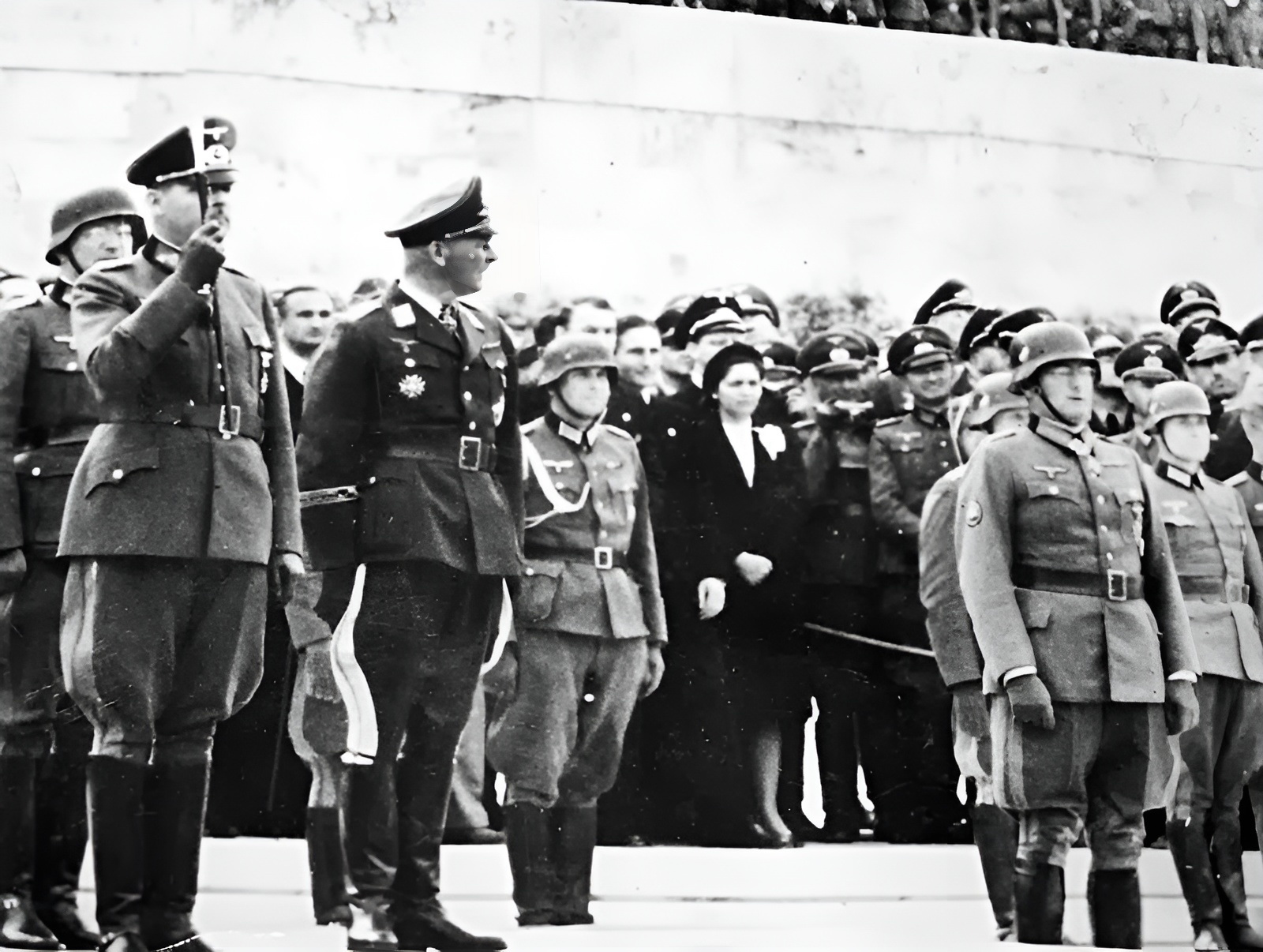
At the Place de la Concorde, senior commanders of Heeresgruppe B assembled to take the salute. Generaloberst Fedor von Bock, Oberbefehlshaber of Heeresgruppe B, arrived to review the passing troops. Beside him stood General der Artillerie Georg von Küchler, commanding the 18. Armee, whose formations had played a significant role in the advance on the capital. Other officers present included Generalmajor Bogislav von Studnitz, who would serve as the first German Stadtkommandant of Paris, as well as additional generals from the Heer and Luftwaffe. The assembled commanders watched as infantry, motorized units, and supporting elements marched past the obelisk, the sound of boots and the music of military bands echoing across the square.

The route of the main columns linked the two principal sites of the day’s ceremonies. Troops moved between the Place de l’Étoile, where the 30. Infanterie-Division had been reviewed by Generalleutnant von Briesen, and the Place de la Concorde, where Generaloberst von Bock and his subordinates received the march-past. German sentries were posted at the Tomb of the Unknown Soldier beneath the Arc de Triomphe, and the eternal flame continued to burn as soldiers of the Wehrmacht paid their respects according to military custom. Swastika banners appeared on public buildings, and loudspeakers announced the new regulations, including a curfew, to the remaining civilian population.

The events of 14 June 1940 were carefully staged for both immediate effect and later propaganda use. The presence of Generalleutnant Kurt von Briesen at the head of the 30. Infanterie-Division on the Avenue Foch provided striking visual images of a divisional commander reviewing his men in the heart of the captured capital. The subsequent or concurrent arrival of Generaloberst Fedor von Bock and the higher command at the Place de la Concorde underscored the strategic significance of the occupation, placing the leadership of Heeresgruppe B at the symbolic center of the city. Together these ceremonies marked the formal assertion of German control over Paris, eight days before the armistice negotiations at Compiègne would bring the campaign in France to its official close.

The streets of the capital, emptied by the mass exodus of civilians in the preceding week, offered a stark stage for the marches. What remained of the population watched largely in silence from sidewalks and windows. For the German soldiers who participated, the day represented the culmination of the Blitzkrieg campaign that had begun less than five weeks earlier. For the history of the Second World War, the parades of 14 June 1940—beginning with the 30. Infanterie-Division under Generalleutnant Kurt von Briesen on the Avenue Foch and extending to the review by Generaloberst Fedor von Bock and other generals at the Place de la Concorde—stood as the most visible expression of the Wehrmacht’s triumph in the West.


Generaloberst Fedor von Bock (Oberbefehlshaber Heeresgruppe B) speaks with French General Henri-Fernand Dentz at Place de la Concorde on the day Paris fell into German hands, June 14, 1940. To the right of Von Bock is Generalleutnant Hans von Salmuth (Chef des Generalstabes Heeresgruppe B).


The German victory parade at Place de la Concorde, Paris, on June 14, 1940. Front row from left to right: General der Kavallerie Georg Stumme (Kommandierender General XXXX.Panzer-Korps), General der Artillerie Georg von Küchler (Oberbefehlshaber 18.Armee), and Generaloberst Fedor von Bock (Oberbefehlshaber Heeresgruppe B). On the far left is Generalmajor Erich Marcks (Chef des Generalstabes 18.Armee), while closest to the camera is Generalleutnant Hans von Salmuth (Chef des Generalstabes Heeresgruppe B).


The German victory parade at Place de la Concorde, Paris, on June 14, 1940. From left to right: General der Kavallerie Georg Stumme (Kommandierender General XXXX.Panzer-Korps), Generaloberst Fedor von Bock (Oberbefehlshaber Heeresgruppe B), and Oberleutnant der Reserve Heinrich Graf von Lehndorff-Steinort (Adjutant Oberbefehlshaber Heeresgruppe B).


Source :
https://artsandculture.google.com/search?q=hugo+jaeger&hl=en
https://alifrafikkhan.blogspot.com/2010/10/koleksi-ratusan-foto-berwarna-dari-life.html

Sunday, July 12, 2026

Johannes Blaskowitz in the German Victory Parade in Warsaw (1939)


Victory Parade of the German 8th Army in Warsaw, held on 5 October 1939. From left to right: Adolf Hitler (Führer und Oberster Befehlshaber der Wehrmacht), Generalmajor Friedrich-Carl Cranz (Commander of the 18th Infantry Division), General der Artillerie Emil Leeb (Commanding General of XI Army Corps), Generaloberst Wilhelm Keitel (Chief of the Oberkommando der Wehrmacht), General der Kavallerie Maximilian Reichsfreiherr von Weichs (wearing glasses, partially obscured by Blaskowitz, Commanding General of XIII Army Corps), Generaloberst Johannes Blaskowitz (Commander-in-Chief of the 8th Army), Generaloberst Walther von Reichenau (behind Blaskowitz, only his cap is visible; Commander-in-Chief of the 10th Army), and General der Flieger Albert Kesselring (Chief of Luftflotte 1). BTW, standing directly below Hitler is Erwin Rommel, who at that time was still a Generalmajor and served as commander of the Führer-Begleit-Bataillon (Führer’s Escort Battalion). Photo by Hugo Jaeger, one of Hitler’s personal photographers.


Generaloberst Johannes Blaskowitz (Oberbefehlshaber 8. Armee).


Source :
https://alifrafikkhan.blogspot.com/2010/10/koleksi-ratusan-foto-berwarna-dari-life.html
https://artsandculture.google.com/entity/hugo-jaeger/m064km4b?categoryid=artist

Saturday, May 23, 2026

Otto Ernst Remer Speaks in front of Grossdeutschland Soldiers


This famous video - taken from 'Die Deutsche Wochenschau Nr. 726, 3 August 1944 - shows Otto Ernst Remer (then Major, later promoted straight to Oberst!) giving a propaganda speech to troops of the Wachbataillon Großdeutschland (Greater German Guard Battalion) in Berlin, late July 1944. He stands in front of a Nazi flag, addresses the soldiers, and they march past him. This was a propaganda piece filmed to celebrate the failure of the 20 July 1944 plot and emphasize the unity between the Wehrmacht and the Nazi Party (NSDAP). In his speech, Remer, addressing his troops and emphasizing loyalty to Hitler and the state after the failed plot.


Oberst Otto Ernst Remer (Kommandeur "Wachbataillon Großdeutschland"). This is a screenshot taken from 'Die Deutsche Wochenschau' Nr. 726 (3 August 1944) which was taken shortly after the failed 20 July 1944 Plot.


From left to right: Oberleutnant Rudolf Schlee (Chef 5.Kompanie / Wachbataillon "Großdeutschland") and Oberleutnant Karl Hausmann. This is a screenshot taken from 'Die Deutsche Wochenschau' Nr. 726 (3 August 1944) which shows the speech of the commander of Wachbataillon "Großdeutschland", Oberst Otto Ernst Remer, shortly after the failed 20 July 1944 Plot.


Source :
https://www.youtube.com/watch?v=hX0_CfJdatQ

Sunday, June 23, 2024

The Occupation of Sudetenland (1-8 October 1938)


Einmarsch in Sudetenland: German victory parade at Vimperk, Czechoslovakia, 8 October 1938. On the podium, from left to right: Char. General der Infanterie Franz Ritter von Epp (Reichsstatthalter in Bayern und Chef des Infanterie-Regiment 61), Oberst Rudolf Sintzenich (Kommandeur Infanterie-Regiment 61 / 7.Infanterie-Division), General der Infanterie Eugen Ritter von Schobert (Kommandierender General VII. Armeekorps), Generalleutnant Otto Hartmann (Kommandeur 7. Infanterie-Division), and Oberst Kurt Brennecke (Chef des Generalstabes VII. Armeekorps).


On Saturday, October 8, 1938, at 2 p.m., units of the German armed forces entered Vimperk in the direction of Horní Vltavice. The following historical facts describe what preceded this moment..


Munich Agreement

The Munich Agreement was signed on September 29, 1938. Representatives of four countries - Neville Chamberlain (Great Britain), Edouard Daladier (France), Adolf Hitler (Germany) and Benito Mussolini (Italy) - agreed that Czechoslovakia must withdraw from the border with germany in Sudetenland by October 10. Representatives of the Czechoslovak party were present, but were not invited to the meeting itself. The Czechoslovak government, among other things, under pressure from France and Britain, finally accepted the Munich dictate.

Germany was thus ceded a territory with an area of ​​28,680 km, where there were a total of 3,751 municipalities, in which 3,653,292 inhabitants lived. Of these, 3,576,719 were Czechoslovak nationals, by nationality : 2,822,899 Germans, 738,502 Czechoslovaks, and 6,659 Jews.

As a result of this agreement, Czechoslovakia lost the system of border fortresses, which it had already begun to build in 1934. A general mobilization was announced in Czechoslovakia shortly before the signing of the Munich Agreement. It was announced by the head of the caretaker government, General Jan Syrový, who was appointed after the government of Milan Hodži resigned. Czechoslovakia managed to gather 1,500,000 troops within five days and was ready to defend itself.


Occupation of Sudetenland by German Nazis

October 1, 1938 became a black day for Czechoslovakia, when the German army entered Vimperk territory and began to occupy the Sudetenland. The occupation of the borderlands became a prelude to the seizure of the entire territory of Bohemia, Moravia and Czech Silesia, the creation of the protectorate of Bohemia and Moravia and the separation of Slovakia and Subcarpathian Rus from the common state.

The Sudetendeutschen Partei (SdP), led by the leader of the Sudeten Nazis, Konrád Henlein, with the help of the Freikorps units, already before the entry of the German army into the Sudetenland, began large-scale arrests of anti-Nazi-minded Czechoslovak Germans, especially among social democrats. Immediately after the occupation of the Sudetenland, the Germans banned all political parties except Henlein's Sudetendeutschen Partei. Many Czechs and all Jews were forced to leave the Sudetenland, it was - de facto - the first ethnic cleansing in this area in the 20th century. Even this could not satisfy Hitler's ambitions for lebensraum (expanding "living space" for Germans). It was clear in advance that the Nazi army would occupy the entire territory of Bohemia, Moravia and Czech Silesia, which happened later on March 15, 1939.


The occupation of the first zone begins

Saturday, October 1, 1938. At 2:00 p.m., the occupation of the first zone of the Czech Republic begins. When the German Army entered the borders, they were welcomed by the majority of Sudeten Germans as a liberator. In the same time, the Czechoslovak government also accepts Poland's ultimate demands.

Sunday, October 2, 1938 . A strong fight is taking place between the Czechoslovak security authorities and SdFK around Český Krumlov. The occupation of Těšín and other areas, including the Frýdlant and Šluknovské salients, is also underway.


The fight for Český Krumlov

The heaviest fighting from the beginning of October took place in Český Krumlov, through which the SOS units and incendiary patrols of Czechoslovak engineers retreated after the withdrawal of the border guards of the army. Already on the night of September 30, the convoy was ambushed here by the Henleins, while engineers belonging to one of the incendiary patrols were also captured. Then, when German forces attacked the district office building, the battle for the city in the truest sense of the word flared up. The defenders and employees of the district office were freed from the encirclement only by a concentrated attack by the gendarmerie emergency unit.

Already after midnight, three infantry platoons of the Czechoslovak Army arrived and occupied the city center, but later they were forced to withdraw again. When two SOS squads were then captured in the morning and another squad was forced to fight their way towards the line of light fortifications, the city found itself completely in German hands. On the evening of October 1, a strike group was formed in České Budějovice under the command of Captain Stejskal, consisting of engineers from the 23rd Engineer Company, two infantry platoons from the 9th Company of the 1st Infantry Regiment and a platoon of three light tanks of Lieutenant Vladimír Němeček, belonging to the 1st Tank Company VII . light tank battalion. These units, additionally supported by the armored train of Infantry Regiment 1, had the task of removing explosives from mined bridges and freeing prisoners from previous battles, as well as imprisoned Krumlov Czechs.

On October 2, Captain Stejskal's column passed through the suburbs of Český Krumlov to engage in fierce fighting with the insurgents at the Budějovická gate, which was barricaded, and also in the vicinity of the gate. In particular, the guns of three light tanks were crushed by the Henlein resistance, but eventually the promisingly developing attack was weakened by a senseless order from the reserve officers to withdraw the mounted infantry. Captain Stejskal, who was left with only tanks supported by engineers, was forced to give the order to retreat. At least partially, however, the task was fulfilled, because from all sides the Czech population flocked to the soldiers, who then left with the column in the direction of České Budějovice. As a result of the action, three engineers were wounded on the Czech side and the city was greatly scarred by the battle. On the same day, the captives were also released and the whole city began to depopulate. By October 8, when the city was occupied by the German army, the Czechoslovak state sovereignty was not restored in Český Krumlov.

Monday, October 3, 1938 . Hitler visits the Sudetenland for the first time. In the House of Commons, Duff Cooper explains in detail why he resigned as First Lord of the Admiralty. Chamberlain then justifies his action and emphasizes that he has nothing to be ashamed of. He further informs that the Czechoslovak government has asked the British government for a loan of 30 million poundsterling.

Tuesday, October 4, 1938. A new official government is elected, headed by General Jan Syrový. The newspaper reports that it is made up of soldiers and experts, with no politicians at all. Hitler makes another triumphant trip to the Sudetenland. In Těšín, the Polish army begins to occupy other regions and cities, for example Třinec or Jablunkov.

Wednesday, October 5, 1938. President Edvard Beneš resigns from his position. A major incident occurs south of Rimavská Sobota in Slovakia, when four companies of the Hungarian Honvéd undertake an organized raid on the Czechoslovak Republic. area. The international committee decides on the size of the fifth evacuation zone, which also includes a number of territories with a majority Czech population. Winston Churchill: “It's all over. Silent, sad, abandoned and broken, Czechoslovakia sinks into darkness. In any case, it had to pay tribute to its alliance with France, whose leadership and policies it had long been influenced by opportunists. The British people should know that the balance has been broken and that an ominous shadow has now fallen on Western democracy. It is only the first sip from the chalice that will be served to us year after year!”

Thursday, October 6, 1938 . According to the Žilina Agreement, the autonomy of Slovakia is declared. Among other things, Hitler visits Frýdlant in Bohemia, where he delivers a speech and also inspects several LO objects. The boundary of the 5th withdrawal zone is determined based on the nationality status according to the 1910 census.

Friday, October 7, 1938. Hitler's next visit to the Sudetenland, the 1st Slovak autonomous government headed by Jozef Tis is established in Slovakia. In the hinterland, for example near Poděbrady, Kolín, Kutná Hora and other cities, large numbers of refugees from the occupied territory are accumulating, of both Czech, German and Jewish nationality. None of them wants to voluntarily return to their former places of residence, as they are threatened with persecution there.

Saturday, October 8, 1938. The occupation of the ceded territory by the German and Polish armies continues, several serious incidents occur during the withdrawal of SOS units and on the demarcation line, when these units are attacked by the Sudeten German Freikorps despite the development of the political situation.


Einmarsch in Sudetenland: Char. General der Infanterie Franz Ritter von Epp (saluting, Reichsstatthalter in Bayern und Chef des Infanterie-Regiment 61) inspecting German honorary guards from Infanterie-Regiment 61 after the German troops entered Vimperk in Czechoslovakia, 8 October 1938. At left is General der Infanterie Eugen Ritter von Schobert (Kommandierender General VII. Armeekorps), while at right is Oberst Rudolf Sintzenich (Kommandeur Infanterie-Regiment 61 / 7.Infanterie-Division).


Einmarsch in Sudetenland: Char. General der Infanterie Franz Ritter von Epp (saluting, Reichsstatthalter in Bayern und Chef des Infanterie-Regiment 61) inspecting German honorary guards from Infanterie-Regiment 61 after the German troops entered Vimperk in Czechoslovakia, 8 October 1938. At left is General der Infanterie Eugen Ritter von Schobert (Kommandierender General VII. Armeekorps), while at right is Oberst Rudolf Sintzenich (Kommandeur Infanterie-Regiment 61 / 7.Infanterie-Division).


Char. General der Infanterie Franz Ritter von Epp (Reichsstatthalter in Bayern und Chef des Infanterie-Regiment 61) chats with one member of Infanterie-Regiment 61 who was also a veteran of the First World War. This picture was taken during victory parade at Vimperk, 8 October 1938, after the Germans occupied the Sudetenland region, Czechoslovakia. Watching behind Von Epp at left is General der Infanterie Eugen Ritter von Schobert (Kommandierender General VII. Armeekorps), while the officer with the stahlhelm accompanying Von Epp  is Oberst Rudolf Sintzenich (Kommandeur Infanterie-Regiment 61 / 7.Infanterie-Division).


Source :
https://forum.axishistory.com/viewtopic.php?f=5&t=14230&hilit=otto+hartmann&start=10680
https://www.kohoutikriz.org/autor.html?id=anony17&t=p
https://zakrasnejsivimperk.cz/?p=77903

Sunday, May 12, 2024

Hasso von Manteuffel and Kradschützen-Bataillon 2


As the Kradschützen-Bataillon 2 parades at the Luitpold park on 1 June 1937 during the opening ceremony for their new barracks, an unknown photographer takes a few images of the assembled dignitaries. Major Hasso von Manteuffel (ex-Kompaniechef in Kradschützen-Bataillon 2) is caught in the scene, standing with an unidentified general, second officer from the right.


In the mid 1930s, while still stationed in Eisenach, during the first years following conversion of the Kradschützen-Bataillon 2 to a motorcycle infantry unit, Hauptmann Hasso von Manteuffel had been both a company commander and, following promotion to major, the senior staff officer with the unit. Manteuffel’s early career had been as a horse cavalry officer, he was an expert rider and had previously commanded horse cavalry “squadrons“ (company size units in the old Reichsheer).

As select cavalry units were motorized during the modernization of the Heer after Hitler came to power, top officers were assigned to the “fast troop“ units to command, learn and study first hand, the new equipment and tactics. This brought Manteuffel to Eisenach and the 2 Krad.

As the new barracks was being built in Bad Kissingen and Oberst von Apell, commander of the 2 Krad, visited the construction site, Hasso von Manteuffel was at work with the unit staff and missed movement with the battalion to Bad Kissingen by less than a year. 2 Panzer Division commander Guderian had recognized Manteuffel as an exceptional officer and moved him from the 2 Krad to the division staff in 1937. His new position was to oversee training and school assignments of all officer cadets and junior officers within the division. Guderian saw this as a very important task, handed the job to a key subordinate and in all probability, Manteuffel moved from Eisenach to the division HQ in Wurzburg.

Some months later, as Guderian left the division for higher command and supervision of the entire Panzer personnel training system, he brought Manteuffel to Berlin and the Panzer Troops School. Despite these rapid moves, Manteuffel did not forget his connection to the 2nd Panzer Division and the last company he commanded.

On 1 June 1937, as the 2nd Kradschutzen Battalion held the formal parade and opening ceremony for their new barracks, Major Hasso von Mauteuffel traveled from Berlin to watch the proceedings. He stood not on the formal reviewing stand but off to the side, in the crowd of visiting officers and dignitaries. He was captured on film by a local photographer and the image surfaced in a collection purchased by Norbert Ruckel. Manteuffel would have recognized most of the men of the unit as they paraded, there may have been cadets and junior officers present that held his personal interest and perhaps, he felt that had duty and Guderian not called him to Berlin, he would have stood in the lead field car as the battalion commander or senior staff officer of the motorcycle infantry unit as it occupied the barracks on the hill that honored his family name.

Source :
Norbert Ruckel photo collection
http://www.eaglehorse.org/home_station/hidden_stories/60s/iron_crosses/iron_crosses.htm

Tuesday, January 16, 2024

Italian Military Parade in Greece


Italian military parade in front of German and Italian officials in Greece, spring 1941. Standing in the podium are General der Gebirgstruppe Franz Böhme (saluting, Kommandierender General XVIII. Gebirgskorps) and Generalmajor Ferdinand Schörner (Kommandeur 6. Gebirgs-Division). Italian officer in the helmet is Generale di divisione Paolo Berardi (21 June 1885 - 13 December 1953). In 1941 he was the divisional commander of the "Brennero" division in Greece, while in 1942 he took command of the "Sassari" in Yugoslavia. In this picture, he is wearing the collar patch of "Brennero" (the vertically separated yellow/red as in the photo below).


Generale di divisione Paolo Berardi (21 June 1885 – 13 December 1953). In September 1940 he was given command of the 11th Infantry Division Brennero, which he led during the Greco-Italian War. After the Armistice of Cassibile (1943) he served the new Allied-aligned Badoglio Government as the Chief of Staff of what remained of the Royal Italian Army, now fighting alongside the Allies.


Italian and German troops deployed on the Acropolis of Athens in spring 1941.


Italian and German troops lined up on the Acropolis of Athens in the spring 1941.


Flag-raising ceremony for the Italian troops on the Acropolis of Athens in the spring 1941.


The Italian and Reich flags fly on the Acropolis of Athens in the spring 1941.


Troops at the Italian flag raising ceremony on the Acropolis of Athens in the spring 1941.


German and Italian military officials during the Italian flag-raising ceremony on the Acropolis in Athens, spring 1941. In the center is General der Infanterie Franz Böhme (Kommandierender General XVIII. Gebirgskorps), while saluting at right is Generalmajor Ferdinand Schörner (Kommandeur 6. Gebirgs-Division). The Italian officer with helmet at left is Generale di divisione Paolo Berardi (Commander of the 11th Infantry Division "Brennero").


German and Italian military officials during the Italian flag-raising ceremony on the Acropolis in Athens, spring 1941. The two Wehrmacht officers at left are, from left to right: General der Infanterie Franz Böhme (Kommandierender General XVIII. Gebirgskorps) and Generalmajor Ferdinand Schörner (Kommandeur 6. Gebirgs-Division).


General der Infanterie Franz Böhme (saluting, Kommandierender General XVIII. Gebirgskorps) inspecting German troops in Athens in spring 1941, accompanied by Generale di divisione Paolo Berardi (center) from Italian Brennero Division. Other German officer at left of Berardi is Generalmajor Ferdinand Schörner (Kommandeur 6. Gebirgs-Division).


German and Italian military officials inspecting the ruins of Acropolis in Athens, spring 1941. Walking at front, from left to right: Generalmajor Ferdinand Schörner (Kommandeur 6. Gebirgs-Division), General der Infanterie Franz Böhme (Kommandierender General XVIII. Gebirgskorps), and Generale di divisione Paolo Berardi (Commander of the Italian 11th Infantry Division "Brennero").


German and Italian military officials inspecting the ruins of Acropolis in Athens, spring 1941. Walking at front, from left to right: Generalmajor Ferdinand Schörner (Kommandeur 6. Gebirgs-Division), General der Infanterie Franz Böhme (Kommandierender General XVIII. Gebirgskorps), and Generale di divisione Paolo Berardi (Commander of the Italian 11th Infantry Division "Brennero").


German and Italian military officials inspecting the ruins of Acropolis in Athens, spring 1941. Walking at front, from left to right: Generale di divisione Paolo Berardi (Commander of the Italian 11th Infantry Division "Brennero"), General der Infanterie Franz Böhme (Kommandierender General XVIII. Gebirgskorps), and Generalmajor Ferdinand Schörner (Kommandeur 6. Gebirgs-Division).


Parade of Italian troops through the streets of Athens in the spring 1941.


Parade of Italian troops through the streets of Athens in the spring 1941. In the background is Hotel Grande Bretagne.


Italian military officers paying homage to the Tomb of the Greek Unknown Soldier in Syntagma Square, Athens, after the fall of Greece, spring of 1941.


Italian military officers paying homage to the Tomb of the Greek Unknown Soldier in Syntagma Square, Athens, after the fall of Greece, spring of 1941.


Italian military parade in front of German and Italian officials in Greece, spring 1941. Three officers standing on the podium flanked by men in whites are, from left to right: Generale di divisione Paolo Berardi (Commander of the Italian 11th Infantry Division "Brennero"), General der Gebirgstruppe Franz Böhme (Kommandierender General XVIII. Gebirgskorps), and Generalmajor Ferdinand Schörner (Kommandeur 6. Gebirgs-Division). The tractor is a Pavesi type P4/100, an Italian wheeled artillery tractor from the interwar period and World War II. The first military examples of this vehicle appeared in the late 1920s, and serial production continued in 1927-1942. The drive was provided by a single 4.7 liter engine and a power of 57 HP.


Italian military parade in front of German and Italian officials in Greece, spring 1941. Three officers standing on the podium flanked by men in whites are, from left to right: Generale di divisione Paolo Berardi (Commander of the Italian 11th Infantry Division "Brennero"), General der Gebirgstruppe Franz Böhme (Kommandierender General XVIII. Gebirgskorps), and Generalmajor Ferdinand Schörner (Kommandeur 6. Gebirgs-Division).


Italian military parade in front of German and Italian officials in Greece, spring 1941. Three officers standing on the podium flanked by men in whites are, from left to right: Generale di divisione Paolo Berardi (Commander of the Italian 11th Infantry Division "Brennero"), General der Gebirgstruppe Franz Böhme (Kommandierender General XVIII. Gebirgskorps), and Generalmajor Ferdinand Schörner (Kommandeur 6. Gebirgs-Division).


Italian military parade in front of German and Italian officials in Greece, spring 1941. The tractor is a Pavesi type P4/100, an Italian wheeled artillery tractor from the interwar period and World War II. Pavesi P4 / 100 was originally produced by La Mottomecanica Brevetti, but in 1926 it was taken over by Fiat based in Turin. The originator of this vehicle was the Italian engineer Ugo Pavesi, who also developed its plans and put it into production. The tractor was built of de facto two articulated but independent parts of the hull, built on two separate frames, which allowed it to turn not only horizontally, but also vertically - along the axis of the vehicle. Very large diameter cast rubber wheels were also used, which were often equipped with special spurs for driving on difficult terrain. Thanks to such design solutions, the vehicle was characterized by great off-road characteristics and was very well suited, for example, for service in mountainous conditions. Vehicles of this type were used as artillery tractors primarily in the Italian armed forces. However, they also served in the Greek, German and Hungarian armies.


Italian military parade in front of German and Italian officials in Greece, spring 1941. The vehicle is a Bianchi Miles type, a medium truck with an optional electric start, with or without battery and starter. The Bianchi Miles saw a lot of action in WW2, with a total of 20,000 estimated being produced between Italy and German which shared manufacturing. It was mostly used on the eastern front, precisely because of its batter-powered starter well suited for winter conditions.


Italian military parade in front of German and Italian officials in Greece, spring 1941.

Source :
Bayerische Staatsbibliothek (Image-No.: 50108893)
https://9gag.com/gag/aV0W4r2
https://www.elgrancapitan.org/foro/viewtopic.php?t=23504&start=30
https://forum.axishistory.com/viewtopic.php?f=75&t=238546&sid=9f38ef4150e09ff5bc202a644306480f&start=60
https://www.reddit.com/r/HistoryPorn/comments/g8as48/italian_officers_paying_homage_to_the_tomb_of_the/
https://www.super-hobby.com/products/Gun-tractor-Pavesi-P4-100-model-30A.html
https://www.televignole.it/foto-storie-guerra-43/

Saturday, January 13, 2024

Ferdinand Schörner Leading His Company (1920)


Handwritten postcard to Johann Schörner, dated 14 April 1920. With his own signature: "Ferdinand". Front photo of the parade march of the 11th Company on 10 April 1920 in Dortmund with Oberleutnant Ferdinand Schörner (Führer 11. Kompanie / 1.Bayerischen Reichswehr-Schützen-Regiment 41 / Schützen-Brigade "Epp") at the head.


Source :
https://www.andreas-thies.de/auctions/49-749225

Wednesday, January 10, 2024

German Victory Parade in Athens (1941)


The Wehrmacht victory parade through the streets of Athens on 3 May 1941 marked a formal public celebration of the rapid German success in the Balkans during Operation Marita. It came just six days after advance German units entered the Greek capital on 27 April 1941, symbolizing the effective end of organized resistance on the Greek mainland and the beginning of Axis occupation.

The German 12. Armee, commanded by Generalfeldmarschall Wilhelm List, had spearheaded the invasion of Greece (and Yugoslavia) starting on 6 April 1941. By late April, German forces had outflanked Allied and Greek defenses. On the morning of 27 April 1941, vanguard elements reached Athens from the north. These included troops of the 6. Gebirgs-Division and the 2. Panzer-Division, advancing in armored vehicles, tanks, cars, and motorcycles.

Greek police continued patrolling the streets as thousands of civilians watched the columns move into the city center. Later that morning, German troops reached the Acropolis and raised the Reichskriegsflagge, replacing the Greek national flag. At approximately 10:45 a.m., the city was formally handed over during a meeting between the mayor of Athens and Generalleutnant Georg Stumme, commander of the XXXX. Panzerkorps.

On 3 May 1941, the Wehrmacht staged its victory parade, reviewed by Generalfeldmarschall Wilhelm List. The event featured selected German units marching and driving through central Athens, likely passing areas near the Royal Palace or Syntagma Square. Contemporary accounts describe a two-hour procession that included infantry, artillery, motorized elements, and armored vehicles.

Participating German formations included elements of the 6. Gebirgs-Division and Detachement Süßmann. Armored and motorized units featured prominently, with Panzer III tanks and columns of Sd.Kfz. 251 half-tracks parading past the reviewing stand. Some soldiers wore parade uniforms, while others appeared in standard field dress.

Photographs from the event show disciplined columns of troops and vehicles moving through the city, with German flags and swastika banners displayed on buildings. Crowds of Greek civilians watched from streets, balconies, and rooftops. Berlin radio reported that German troops were joined by Italian detachments, reflecting the joint Axis nature of the campaign, although the review and primary participation remained German.

Hitler had initially been reluctant to stage a grand entry into Athens to avoid wounding Greek national pride, but pressure from Mussolini led to Italian participation in the broader celebrations. The parade on 3 May stood in contrast to the more subdued or somber mood among many Athenian civilians, who had already witnessed the raising of the German flag on the Acropolis days earlier.

In the immediate aftermath, Greece was divided into occupation zones: Germany controlled key areas including Athens, Thessaloniki, and parts of Macedonia and Crete; Italy took most of the mainland and islands; and Bulgaria occupied northeastern territories. A puppet Greek government under General Georgios Tsolakoglou was soon installed. The occupation brought severe repression, food shortages, and eventual famine, claiming hundreds of thousands of Greek lives over the following years.

Key German Units and Formations Mentioned:
12. Armee (commanded by Generalfeldmarschall Wilhelm List)  
XXXX. Panzerkorps (commanded by Generalleutnant Georg Stumme)  
6. Gebirgs-Division  
2. Panzer-Division  
Detachement Süßmann  
Armored elements with Panzer III tanks and Sd.Kfz. 251 half-tracks


German victory parade in Athens, 1941. After the end of the southeastern campaign, a large parade of contingents from the Heer and Luftwaffe regiments took place in Athens in front of Generalfeldmarschall Wilhelm List on Sunday, 4 May 1941. Italian combat troops also took part in the parade, which were held in front of the old Royal Palace in Syntagma Square. This picture shows Mountain Troops from 6. Gebirgs-Division during the march past Field Marshal List. For the identification, from left to right: 1.Generalfeldmarschall Wilhelm List (Oberbefehlshaber 12. Armee), 2.General der Infanterie Franz Böhme (Kommandierender General XVIII. Gebirgskorps), 3.General der Flieger Wolfram Freiherr von Richthofen (Kommandierender General VIII. Fliegerkorps), 4.Generalmajor Ferdinand Schörner (Kommandeur 6. Gebirgs-Division), and 5.Generalmajor Rudolf Schubert (Armee-Nachrichtenführer der 12. Armee). The picture was taken by Kriegsberichter Röder.


German victory parade in Athens, 1941. After the end of the southeastern campaign, a large parade of contingents from the Heer and Luftwaffe regiments took place in Athens in front of Generalfeldmarschall Wilhelm List on Sunday, 4 May 1941. Italian combat troops also took part in the parade, which were held in front of the old Royal Palace in Syntagma Square. This picture shows Mountain Troops from 6. Gebirgs-Division during the march past Field Marshal List. For the identification, from left to right: 1.General der Infanterie Franz Böhme (Kommandierender General XVIII. Gebirgskorps), 2.Generalfeldmarschall Wilhelm List (Oberbefehlshaber 12. Armee), 3.General der Flieger Wolfram Freiherr von Richthofen (Kommandierender General VIII. Fliegerkorps), and 4.Generalmajor Ferdinand Schörner (Kommandeur 6. Gebirgs-Division).


Following the rapid German conquest of Greece in Operation Marita, Wehrmacht forces under Generalfeldmarschall Wilhelm List entered Athens on 27 April 1941 after a series of decisive victories that forced the evacuation of remaining Greek and British Commonwealth troops, and a formal victory parade was staged in the Greek capital on 3 May 1941 to mark the triumph, with troops marching through central squares and streets under the gaze of senior Axis commanders. Among the units participating in this display of strength were elite elements of the Fallschirmjäger from Detachement Süßmann, drawn from the 7. Flieger-Division commanded by Generalleutnant Wilhelm Süssmann; these paratroopers had played a key role just one week earlier during the airborne assault on the Corinth Canal bridge on 26 April, when glider-borne engineers and parachute infantry from the Fallschirmjäger-Regiment 2 seized both ends of the vital crossing in a surprise operation intended to cut off Allied lines of retreat and open the way for pursuing panzer columns, although fierce fighting and the eventual destruction of the bridge by Allied action resulted in significant casualties on both sides. Marching with precision in their distinctive Fallschirmjäger attire—including the characteristic jump smock, Stahlhelm helmets, and full combat equipment—these highly trained airborne troops exemplified the innovative vertical envelopment tactics that had accelerated the German advance across the Balkans, parading as a symbol of Luftwaffe prowess just prior to their major commitment in the upcoming Battle of Crete. The event featured a combined German and Italian procession in line with Axis agreements, with the Fallschirmjäger contingent standing out for their specialized role and elite status amid the broader Wehrmacht formations, while the historic backdrop of Athens, including views toward the Acropolis, underscored the propaganda value of the parade in consolidating the occupation.


Among the units participating in the German victory parade in Athens on 3 May 1941 were elite elements of the Fallschirmjäger from Detachement Süßmann, drawn from the 7. Flieger-Division commanded by Generalleutnant Wilhelm Süssmann; these paratroopers had played a key role just one week earlier during the airborne assault on the Corinth Canal bridge on 26 April, when glider-borne engineers and parachute infantry from the Fallschirmjäger-Regiment 2 seized both ends of the vital crossing in a surprise operation intended to cut off Allied lines of retreat and open the way for pursuing panzer columns, although fierce fighting and the eventual destruction of the bridge by Allied action resulted in significant casualties on both sides. Marching with precision in their distinctive Fallschirmjäger attire—including the characteristic jump smock, Stahlhelm helmets, and full combat equipment—these highly trained airborne troops exemplified the innovative vertical envelopment tactics that had accelerated the German advance across the Balkans, parading as a symbol of Luftwaffe prowess just prior to their major commitment in the upcoming Battle of Crete.


In the wake of the swift German conquest of mainland Greece during Operation Marita in April 1941, the elite Gebirgsjäger of the 6. Gebirgs-Division (6th Mountain Division) formed a prominent contingent in the Axis victory parade staged in Athens on 3 May 1941, reviewed by Generalfeldmarschall Wilhelm List of the 12. Armee. This mountain infantry division, commanded within the XVIII. Gebirgs-Korps by General der Gebirgstruppen Franz Böhme and comprising regiments such as the Gebirgsjäger-Regiment 141 and Gebirgsjäger-Regiment 143, had played a decisive role in breaching the heavily fortified Metaxas Line and advancing through rugged, snow-covered passes around Mount Olympus before its vanguard elements—alongside motorcycle units of the 2. Panzer-Division—first entered the Greek capital from the north on the morning of 27 April 1941, raising the swastika flag over the Acropolis while Greek civilians largely remained indoors behind shuttered windows. During the formal parade, columns of Gebirgsjäger in their distinctive mountain uniforms adorned with the Edelweiss insignia marched in precise formation through central Athens streets past landmarks including the Parliament building and in view of the ancient Acropolis, showcasing German military discipline and prowess alongside panzer elements and Italian detachments (included at Mussolini’s insistence despite Hitler’s initial reluctance to stage a grand spectacle that might offend Greek pride); the event, witnessed by subdued onlookers and captured in contemporary photographs, underscored the rapid collapse of Greek and Allied resistance that culminated in the occupation of the country and the subsequent transfer of the 6. Gebirgs-Division to other theaters.


Following the swift German triumph in Operation Marita, the April 1941 invasion of Greece and Yugoslavia, advance elements of the Wehrmacht, including units of the 2. Panzer-Division, entered Athens on 27 April and raised the Reichskriegsflagge on the Acropolis. In May 1941 a formal victory parade was held through the streets of the occupied capital, reviewed by Generalfeldmarschall Wilhelm List, commander of the 12. Armee, who inspected the columns of troops and vehicles assembled to celebrate the rapid conquest. Among the mechanized forces on display were the Sd.Kfz. 251 Schützenpanzerwagen, the Hanomag-designed armored half-tracked personnel carriers that formed the backbone of the armoured battalions in panzer-grenadier regiments, allowing Panzergrenadiere to keep pace with tanks across the rugged Balkan terrain. A complete platoon of four early-model Sd.Kfz. 251 half-tracks from a motorisierte Infanterie-Kompanie, each fitted with a pintle-mounted MG 34 machine gun protected by a small shield, passed in review before the Generalfeldmarschall, vividly demonstrating the combined-arms tactics that had overwhelmed Greek and Allied defenses; German censors later altered photographs of the event by painting out registration numbers and overpainting the rectangular tactical signs denoting the motorized infantry company. These versatile Sonderkraftfahrzeuge, together with lighter half-tracks such as the Sd.Kfz. 10 used for towing artillery, underscored the technological and organizational superiority of the Wehrmacht during the Balkans campaign, contrasting with the more traditional marching infantry also present in the parade.


Elements of Sturmgeschütz-Abteilung 191, which had already distinguished itself earlier in the operation near Katerini, were among the mechanized forces prominently featured in the German victory parade in Athens, 3 May 1941. Their low-profile assault guns highlighting the effectiveness of the Sturmartillerie concept in providing close infantry support against fortified positions and rearguards in the Balkan theater.


German victory parade in Athens, 1941. After the end of the southeastern campaign, a large parade of contingents from the Heer and Luftwaffe regiments took place in Athens in front of Generalfeldmarschall Wilhelm List on Sunday, 4 May 1941. Italian combat troops also took part in the parade, which were held in front of the old Royal Palace in Syntagma Square. The picture was taken by Kriegsberichter Theodor Scheerer from PK (Propaganda-Kompanie) 690.


German victory parade in Athens, 1941. After the end of the southeastern campaign, a large parade of contingents from the Heer and Luftwaffe regiments took place in Athens in front of Generalfeldmarschall Wilhelm List on Sunday, 4 May 1941. Italian combat troops also took part in the parade, which were held in front of the old Royal Palace in Syntagma Square. The picture was taken by Kriegsberichter Theodor Scheerer from PK (Propaganda-Kompanie) 690.


Ritterkreuzträger Hauptmann Wilhelm Walther (Führer I.Bataillon / Lehr-Regiment "Brandenburg" z.b.V. 800) watching the Wehrmacht victory parade in Athens, Greece, on 3 May 1941. During Operation Marita, the German invasion of Yugoslavia and Greece that began on 6 April 1941, the Lehr-Regiment "Brandenburg" z.b.V. 800, an elite Abwehr special forces formation composed of linguistically gifted volunteers trained for sabotage, reconnaissance and the surprise seizure of vital objectives while often operating in disguise or enemy uniforms, played a decisive role in paving the way for the rapid advance of conventional Wehrmacht formations. On 5 April, one day before the main assault, a 54-man detachment from the II. Bataillon secured the strategically important docks at Orsova on the Danube River at the Iron Gates gorge, preventing their demolition by Yugoslav forces and ensuring the river remained open for German supply traffic. During the subsequent drive through northern Greece, Leutnant Siegfried Grabert led a small Brandenburg team that, on 12 April 1941, prevented the destruction of the vital 400-metre road bridge over the Vardar River east of Axiupolis by surprising and capturing a British demolition party at the last moment; he personally took the enemy soldiers prisoner and then held the bridge with his limited forces for approximately ninety minutes until reinforcements arrived, an action that enabled the immediate pursuit of retreating Allied troops and for which Grabert was awarded the Ritterkreuz des Eisernen Kreuzes. Elements of the regiment also secured a key bridge over the Vardar in the opening phase of the campaign, while shortly afterwards other units captured the island of Euböa, demonstrating the Lehr-Regiment "Brandenburg" z.b.V. 800’s effectiveness in conducting high-risk commando operations ahead of the main forces to disrupt enemy defences and seize critical infrastructure throughout the Balkans campaign.


Source :
Bundesarchiv photo archive
"Brandenburger: Wartime Photographs of Wilhelm Walther" by Anthony Rogers
https://www.alamy.com/stock-photo/german-parade-athens-1941.html?sortBy=relevant
https://www.gettyimages.co.uk/search/2/image?family=editorial&phrase=parade%20athens%201941
https://trove.nla.gov.au/newspaper/article/41952152