Showing posts with label 9 HJ-Abzeichen. Show all posts

Sunday, June 2, 2024

Hasso von Manteuffel and Oldwig von Natzmer


From left to right: General der Panzertruppe Hasso von Manteuffel (Oberbefehlshaber 5. Panzerarmee) and Generalmajor Oldwig von Natzmer (Chef des Generalstabes Heeresgruppe Nord). Previously, from January to July 1944, they were both served in the same unit: Panzergrenadier-Division "Grossdeutschland": Von Manteuffel as the Divisionskommandeur while Von Natzmer as his Chief of Operations.

Source :
https://www.lexikon-der-wehrmacht.de/Personenregister/N/NatzmerOldwigOttov.htm

Saturday, May 11, 2024

Hasso von Manteuffel and Horst Niemack


Two Schwerterträger from Grossdeutschland Division: General der Panzertruppe Hasso von Manteuffel (pointing, Kommandeur Panzergrenadier-Division "Grossdeutschland") and Oberst Horst Niemack (Kommandeur Panzer-Füsilier-Regiment "Grossdeutschland"). The picture was taken by Kriegsberichter Bauer on 5 August 1944 during the battle for Vilkovishken, Reichskommissariat Ostland (today Vilkaviškis in Lithuania).

Source :
Bayerische Staatsbibliothek photo archive (Image-No.: 50135161)
http://alifrafikkhan.blogspot.com/2010/10/album-foto-general-der-panzertruppe.html
https://commons.wikimedia.org/wiki/File:Bundesarchiv_Bild_101I-732-0132-43A,_Hasso_von_Manteuffel_mit_Oberst_Niemack.jpg

Wednesday, May 1, 2024

Hasso von Manteuffel during the Battle of Lorraine


General der Panzertruppe Hasso von Manteuffel (Oberbefehlshaber 5. Panzerarmee) inspects members of Panzer-Brigade 113 - one of whom is a recipient of Deutsches Kreuz in Gold and Panzervernichtungsabzeichen in Silber - in the village of Abreschviller, Moselle, in the Sarrebourg sector (France) in the midst of the Battle of Arracourt/Lorraine, 20 September 1944. It was only 11 days earlier when Manteuffel was appointed as a Commander-in-Chief of the Fifth Panzer Army after previously being the commander of the elite Panzergrenadier-Division "Grossdeutschland". Please note that the officer at far left is wearing civilian boots sometimes worn by Wehrmacht Heer Offiziere, boots with closure strap on the upper part of the shaft (but with a soft shaft).


The same place as above right now.


General der Panzertruppe Hasso von Manteuffel (Oberbefehlshaber 5. Panzerarmee) inspects members of Panzer-Brigade 113 - one of whom is a recipient of Panzervernichtungsabzeichen in Silber - in the village of Abreschviller, Moselle, in the Sarrebourg sector (France) in the midst of the Battle of Arracourt/Lorraine, 20 September 1944. It was only 11 days earlier when Manteuffel was appointed as a Commander-in-Chief of the Fifth Panzer Army after previously being the commander of the elite Panzergrenadier-Division "Grossdeutschland". In this photo we can clearly see the Panzerkampfabzeichen in Silber and Goldenes Hitlerjugend Ehrenabzeichen medals pinned to his black Panzer uniform.


The same place as above right now.


General der Panzertruppe Hasso von Manteuffel (Oberbefehlshaber 5. Panzerarmee) inspects members of Panzer-Brigade 113 - one of whom is a recipient of Deutsches Kreuz in Gold and Panzervernichtungsabzeichen in Silber - in the village of Abreschviller, Moselle, in the Sarrebourg sector (France) in the midst of the Battle of Arracourt/Lorraine, 20 September 1944. It was only 11 days earlier when Manteuffel was appointed as a Commander-in-Chief of the Fifth Panzer Army after previously being the commander of the elite Panzergrenadier-Division "Grossdeutschland".


The same place as above right now.


General der Panzertruppe Hasso von Manteuffel (Oberbefehlshaber 5. Panzerarmee) inspects members of Panzer-Brigade 113 - one of whom is a recipient of Deutsches Kreuz in Gold and Panzervernichtungsabzeichen in Silber - in the village of Abreschviller, Moselle, in the Sarrebourg sector (France) in the midst of the Battle of Arracourt/Lorraine, 20 September 1944. It was only 11 days earlier when Manteuffel was appointed as a Commander-in-Chief of the Fifth Panzer Army after previously being the commander of the elite Panzergrenadier-Division "Grossdeutschland".


The same place as above right now.


General der Panzertruppe Hasso von Manteuffel (Oberbefehlshaber 5. Panzerarmee) inspects members of Panzer-Brigade 113 - one of whom is a recipient of Deutsches Kreuz in Gold and Panzervernichtungsabzeichen in Silber - in the village of Abreschviller, Moselle, in the Sarrebourg sector (France) in the midst of the Battle of Arracourt/Lorraine, 20 September 1944. It was only 11 days earlier when Manteuffel was appointed as a Commander-in-Chief of the Fifth Panzer Army after previously being the commander of the elite Panzergrenadier-Division "Grossdeutschland".


The same place as above right now.


General der Panzertruppe Hasso von Manteuffel (Oberbefehlshaber 5. Panzerarmee) inspects members of Panzer-Brigade 113 in the village of Abreschviller, Moselle, in the Sarrebourg sector (France) in the midst of the Battle of Arracourt/Lorraine, 20 September 1944. It was only 11 days earlier when Manteuffel was appointed as a Commander-in-Chief of the Fifth Panzer Army after previously being the commander of the elite Panzergrenadier-Division "Grossdeutschland".


The same place as above right now.


General der Panzertruppe Hasso von Manteuffel (Oberbefehlshaber 5. Panzerarmee) inspects members of Panzer-Brigade 113 in the village of Abreschviller, Moselle, in the Sarrebourg sector (France) in the midst of the Battle of Arracourt/Lorraine, 20 September 1944. It was only 11 days earlier when Manteuffel was appointed as a Commander-in-Chief of the Fifth Panzer Army after previously being the commander of the elite Panzergrenadier-Division "Grossdeutschland".


The same place as above right now.


Source :
http://alifrafikkhan.blogspot.com/2014/06/album-foto-dulu-dan-sekarang.html
https://forum.axishistory.com/viewtopic.php?p=2009211#p2009211
https://www.materielsterrestres39-45.fr/fr/index.php/tout-guerre-terrestre/137-france-guerre-terrestre/alsace/1105-abreschviller
https://souvenir.xooit.be/t465-Abreschviller-de-1944-a-Aujourd-hui.htm
https://www.warrelics.eu/forum/field-equipment-accessories-third-reich/ww2-german-riding-boots-670742/

Friday, December 8, 2023

Rudolf von Ribbentrop as a Student of Westminster School


The fifteen-year old Rudolf von Ribbentrop's first day at Westminster School, 12 October 1936. Original caption: "Rudi, the eldest son of the German ambassador in London, Joachim von Ribbentrop, began his first day of school today as a new student at the famous Westminster School in London. Rudolf von Ribbentrop in the traditional school uniform of the Westminster students leaving his London home in Eaton Square on the way to the Westminister School."


Unlike many of his fellow boarding students, Rudolf "Rudi" von Ribbentrop was an outside student. He would arrive first thing every day, attend his morning classes, eat at school, and return home at the end of each day.

As he confesses in his memoirs, and despite his years of belonging to the Hitlerjugend, nothing in Nazi Germany had prepared him at 15 years of age, for the culture shock that he was going to suffer at Westminster School: Spartan life, frozen rooms, food unbearable. The daily dinner at the ambassador's residence with dishes of German cuisine was, hands down, the highlight of the day for the young student.

Of course, nothing is perfect in life, because from Monday to Friday every night at every dinner, his father would question him about his impressions of opinions and comments from his classmates and teachers.

Von Ribbentrop saw his son as a primary source of information about the thinking of the children of the British elites and, therefore, of them. With his commission to strike a pact with Great Britain, the ambassador was anxious to know whether the British would be willing to strike some kind of agreement to help Hitler fight the threat of communism or if they were really a group of "decadent manners. As described by Nazi propaganda.

We suppose that after dinner there would still be time for homework.

Rudi was a somewhat lanky boy who wore glasses, who - according to his memoirs - found it very strange to have to go to and from school every day with a top hat, frack, gloves and an umbrella ...

In his memoirs he recalls how surprised he was that there was an Officers Training Corps at the school, which he wanted to join at the time. And how a "nice and young teacher, in a captain's uniform, asked me if he wanted to sign me up."

Surprised by the existence of such a pre-military formation, von Ribbentrop authorized his son to join, but on the condition that he should wear a German uniform. Very politely the school rejected the proposal. However, the ambassador informed Berlin that the British were preparing their schoolchildren for war.

Rudi was initially teased by his classmates. And he also remembers the cold and huge house, where to warm himself he went to the library which, apparently, was the warmest room in the school.

The British diplomat Brian Urquhart, a student at the same school during Ribbentrop's time there, in his autobiography "A Life in Peace and War (1987)" describes the latter as being "doltish, surly and arrogant". Urquhart recalls that Ribbentrop, much to the dismay of his schoolmates, "arrived each morning in one of two plum-colored Mercedes-Benz limousines". Urquhart further recalls, "On arrival in Dean's Yard, both chauffeurs would spring out, give the Nazi salute, and shout "Heil Hitler!"

Peter Ustinov, tone of his classmates, states in his memoirs that von Ribbentrop would drive to school every day in the embassy's Mercedes and that the chauffeur would bump his heels shouting "Heil Hitler!"

When Rudolf is reminded of this, he smiles and denies it in amusement. Every day on his way to and from school walking to the residence in Eaton Square - he says - he, in addition to the fact that the driver was English.

Rudi's father did not exactly win sympathy among embassy staff. The animosity between Ustinov and Rudi has its origin in that von Ribbentrop dismissed, among many others, the German press attaché in London, who was precisely the father of Peter Ustinov.

Two more anecdotes from Rudi von Ribbentrop's London school days:

On the occasion of a school debate on the hypothetical return of the German colonies, the vote was in favor of the return to Germany. This show of impartiality was transmitted to Berlin by the ambassador, interpreted as a British predisposition to make concessions to the Reich.

On another occasion a member of Parliament visited the school to give a lecture on the League of Nations established by the Treaty of Versailles, criticizing Hitler for his intervention. Young von Ribbentrop got up to contradict the speaker and was slapped by a teacher who said to him: - "We don't want to hear speeches, we want to hear questions."

Behind him, he heard the noise of the chairs: all the students had left the room in silence to protest the treatment given to their German companion.

This anecdote was also wrongly interpreted by the German ambassador, who deduced and informed Berlin about a "British sympathy towards German policies".

Upon completing that course in the summer of 1937, Rudi returned to Germany.

In 2010, when interviewed by The Times, Rudolf von Ribbentrop stated: "I look back and happily remember those days."


Source :
https://beeldbankwo2.nl/nl/beelden/detail/dfd84cb6-0259-11e7-904b-d89d6717b464/media/4bbf0d95-3c83-539a-2f80-990fe91a44ba?mode=detail&view=horizontal&q=rudolf%20ribbentrop&rows=1&page=1
https://forum.axishistory.com/viewtopic.php?f=38&t=134272&hilit=rudolf+ribbentrop
https://www.gettyimages.com/detail/news-photo/rudolf-von-ribbentrop-fils-de-lambassadeur-joachim-von-news-photo/690506992
https://www.warrelics.eu/forum/cloth-headgear/rudolf-von-ribbentrop-783266-2/

Sunday, September 3, 2023

Bio of SS-Obersturmführer Ernst Stäudle (1913-1946)

Ernst Stäudle

Date of Birth: 06.06.1913 - Heidenheim an der Brenz, Württemberg (German Empire)
Date of Death: 11.07.1946 - POW-camp Jaworzno, Silesia (Poland)

NSDAP Number: 3 289 807 (Joined 00.00.1933)
SS Number: 226 097 (Joined 00.00.193_)
Spouse: Margareta Hugo from Würzburg

Promotions:
00.00.1935/1936 Gefreiter
00.00.194_ SS-Unterscharführer der Reserve
10.04.1942 SS-Oberscharführer der Reserve
01.09.1943 SS-Untersturmführer der Reserve
21.06.1944 SS-Obersturmführer der Reserve

Career:
00.02.1942 Vorgeschobene Beobachter (V.B.) in 8.Batterie / SS-Artillerie-Regiment "Totenkopf"
00.09.1943 instructor in SS-Artillerie-Schule II (Beneschau)
30.04.1945 Kompaniechef / SS-Artillerie-Schule II - fightings around Prag
00.05.1945 soviet POW
11.07.1946 died of hunger and mistreatment in harsh labour in a coal mine near camp Jaworzno, south of Katowice, Silesia in Poland

Awards and Decorations:
00.00.193_ SS-Zivilabzeichen
00.00.1934 Ehrenwinkel der Alten Kämpfer
00.00.193_ SA-Sportabzeichen in Bronze
00.00.193_ Deutsche Lebens-Rettungs-Gesellschaft Abzeichen in Bronze
00.00.193_ Ehrendegen des Reichsführers-SS
00.00.193_ SS-Ehrenring
00.00.193_ Julleuchter der SS
23.09.1941 Eisernes Kreuz II.Klasse
00.00.1941 Allgemeines-Sturmabzeichen in Silber
00.02.1942 Verwundetenabzeichen in Schwarz (WIA 27.02.1942 to the leg and arm)
17.02.1942 Eisernes Kreuz I.Klasse
10.04.1942 Ritterkreuz des Eisernen Kreuzes, as SS-Oberscharführer der Reserve and Vorgeschobene Beobachter (V.B.) in 8.Batterie / II.Abteilung / SS-Artillerie-Regiment "Totenkopf" / SS-Totenkopf-Division, based on a recommendation dated 01.03.1942 and approved by Div. Kdr. Theodor Eicke (read HERE for his action that got him the Ritterkreuz)
00.00.1942 Medaille "Winterschlacht im Osten 1941/42" (Ostmedaille)
00.00.1943 Demjanskchild
00.00.194_ Goldenes Hitlerjugend Ehrenzeichen
00.00.194_ Goldenes Hitlerjugend Ehrenzeichen mit Eichenlaub

--------------------------------------------------------------------------------

Ernst Stäudle was born 6. Juni. 1913, in Heidenheim, Germany. He married Margareta Hugo of Würzburg, although not much else is known about his life before WWII, aside from his service in the Hitlerjugend.

He joined the SS, and was assigned to the SS-Division "Totenkopf", and served with the Artillerie Regiment within the Division.

He was awarded the Knight’s Cross for outstanding deeds during the night battles of 26/27 Feb. 1942. Thanks to their overwhelming numbers, the Soviets came within 50 meters of the German positions in Schumilkino which were manned by just a few defenders. A German construction battalion, which had been sent in as a reinforcement, fled when attacked by the Russian soldier. In those dramatic conditions, despite a severe wound, Stäudle gathered the last survivors of the German garrison and, with only a 3.7cm-Pak 36 available, managed to keep the enemy at bay, at time firing close range. His actions prevented a Soviet breakthrough behind the German positions at Salutschje.

He survived the war, and surrendered to the Soviets. Like so many members of the Waffen-SS who were “lucky” not to be murdered or tortured to death immediately after their capture by the Red Army, Stäudle also had to perform slave labor for the enemy as a German forced laborer. Most died from mistreatment or hunger, often both, including Ernst Stäudle. He fell ill in the coal mines in Silesia, starved to death and ultimately died on July 11, 1946 in the Jaworzno central labor camp south of Polish-occupied Katowice.

Ernst Stäudle, who was a Hitler Youth leader and an early member of the SS and was registered in his parents' “Spielwaren Stäudle” at Olgastraße 3 in Heidenheim in 1935, left behind his wife Margareta, née Hugo from Würzburg. It can be assumed that children were born of the marriage, but it could not be determined.

After the war, the Jaworzno labor camp was run first by the NKVD, then by the Polish Ministry of Public Security, MBP (also known as Urząd Bezpieczeństwa or UB), which committed unimaginable atrocities against “enemies of the people”. One of the worst of the criminal commanders was the Polish Jew Schlomo Morel (1919-2007), a member of the Stalinist secret police Urząd Bezpieczeństwa, who was already considered a mass murderer of thousands of German civilians in various labor camps who could not get out of their Upper Silesian wanted to have their homeland expelled. The prisoners included all kinds of political prisoners, ethnic Germans, Silesian civilians (among them many women and children), from 1947 also victims of the forced resettlement operation Vistula, but also "Polish resistance fighters" who refused to become members of the communist party and German prisoners of war, The members of the Waffen-SS were housed separately and their suffering was even more cruel than that of the other inmates.

In 1993, the Polish government released the names of 6,987 people, mostly Germans, who died in the Jaworzno labor camp between 1945 and 1956, but estimates put the actual number many times higher.


Ernst Stäudle as SS-Unterscharfuhrer.


Ernst Stäudle as SS-Oberscharfuhrer.


Ernst Stäudle is photographed shortly after his promotion to SS-Untersturmführer.


Ernst Stäudle as SS-Obersturmführer.


Ernst Stäudle as SS-Obersturmführer.


There is no information whether in this picture Stäudle is dead or just sleeping.


Letter - signed by Ernst Stäudle - to a certain “Karl-Heinz”, thanking him for the congratulations on the occasion of his birthday, 18 June 1942.


Source :
"Knight's Cross Holders of the SS & German Police, 1940-1945" by Michael D. Miller
http://www.2kompanie.org/ernst-staudle.html
https://www.alexautographs.com/auction-lot/ernst-staudle-current-bid-usd160.00_64A586443B
https://de.metapedia.org/wiki/St%C3%A4udle,_Ernst
https://forum.axishistory.com/viewtopic.php?p=1538859#p1538859
https://www.forum-der-wehrmacht.de/index.php?thread/16473-totenkopf-div/
https://militariarelics.com/german/rk-autographs/war-time-signed/6360
https://military-history.fandom.com/wiki/Ernst_St%C3%A4udle
https://www.tracesofwar.com/persons/44787/St%C3%A4udle-Ernst.htm
https://www.tumblr.com/fallschirmjager/11099142780/ernst-st%C3%A4udle-is-photographed-shortly-after-his

Friday, July 14, 2023

Bio of SS-Gruppenführer Karl-Heinrich Brenner (1895-1954)

Karl Jakob Heinrich Brenner

Date of Birth: 19.05.1895 - Mannheim, Baden (German Empire)
Date of Death: 15.02.1954 - Karlsruhe, Baden-Württemberg (West Germany), heart failure

NSDAP-Nr.: 3 460 685 (Joined 01.05.1933)
SS-Nr.: 307 786 (Joined 11.09.1938 [with seniority from 01.07.1938])

Promotions:
18.01.1917 Leutnant (mit Patent vom 01.09.1915)
01.04.1923 Polizei-Oberleutnant (mit RDA vom 01.04.1925)
01.04.1932 Polizei-Hauptmann (mit RDA vom 01.02.1930)
01.11.1935 Polizei-Major (mit RDA vom 09.11.1935)
01.09.1936 Charakter als Oberstleutnant der Landespolizei
20.04.1937 Oberstleutnant der Landespolizei (mit Wirkung vom 01.04.1937 & RDA vom 20.04.1937)
01.07.1938 SS-Mann
11.09.1938 SS-Obersturmbannführer (mit Wirkung vom 01.07.1938)
20.04.1939 Oberst der Schutzpolizei
15.08.1939 SS-Standartenführer
09.11.1941 SS-Oberführer
09.11.1941 Charakter als Generalmajor der Polizei
30.01.1942 SS-Brigadeführer
30.01.1942 Generalmajor der Polizei (mit RDA vom 21.10.1941)
15.03.1944 Generalleutnant der Polizei (mit Wirkung vom 01.01.1944 & RDA vom 01.03.1944)
16.03.1944 SS-Gruppenführer (mit Wirkung vom 15.03.1944)
[17.11.1944] Generalleutnant der Waffen-SS und der Polizei (precise date of promotion unknown)

Career:
ca. 1900 – ca. 1904 Attended Volksschule.
00.00.1904 – 00.00.19__ Attended a Handelshochsschule (trade high school). Graduated Untersekunda..
03.08.1914 – 17.10.1914 Entered service as Kriegsfreiwilliger, assigned to Ersatz-Abteilung / Feldartillerie-Regiment 30 (Base: Rastatt).
17.10.1914 – 00.11.1918 Frontline service with Feldartillerie-Regiment “von Scharnhorst” (1.Hannoversches) Nr. 10, assigned from 1917 to 1918 as Zugführer, Batterieführer, and Regiments-Adjutant. Wounded four times in World War I, on one of these occasions losing his left eye.
15.01.1919 – 01.04.1920 Führer of Badische Freiwilligen-Batterie Ost in Badischen Freiwilligen-Bataillon Ost. Participated in the Kapp Putsch, Berlin, 03.1920.
01.09.1919 – 01.04.1920 Service with Reichswehr-Infanterie-Regiment 17, then Infanterie-Begleit-Batterie 61.
01.04.1920 – 00.00.1935 Entered the Sicherheitspolizei in Baden, assigned as Zugführer and Hundertschaftsführer, then for several years as a Sportoffizier (Sports Officer); later transferred to the Baden Landespolizei. He excelled in sports, being a Landesmeister in the 10km road race and a Polizei-Meister in ski racing.
00.00.1926 – 01.03.1935 Hitler-Jugend service in Baden (rising to rank of HJ-Bannführer assigned to HJ-Gebiet 21, Baden). Left the HJ but retained his rank in that organization.
01.05.1933 Joined the NSDAP.
00.00.1935 – 00.00.1935 Attended an instructional course at the Landespolizei-Führerschule in Berlin.
00.02.1935 – 00.09.1936 Leiter of the Zentralabteilung (Central Department) of the “Reichsstab der Preussischen Landespolizei” and Adjutant to the “Befehlshaber der Preussischen Landespolizei” (Kurt Daluege), Berlin.
01.05.1935 – 01.06.1935 Attended an instructional course at the Artillerie-Schießschule Jüterbog.
00.09.1935 – 00.09.1935 Training with Artillerie-Regiment 41 (Base: Ulm).
00.10.1936 – 01.08.1939 Transferred from the Landespolizei to the Schutzpolizei, assigned as Amtsleiter K/R (Reit- und Fahrwesen / Riding and Driving Matters) in Stab Chef der Ordnungspolizei.
12.03.1938 – 22.03.1938 Assigned to the Berittenen (Mounted) Schutzpolizei-Gruppe in the annexation of Austria.
13.04.1938 Submitted application for membership in the SS.
01.07.1938 – 20.04.1939 Joined the SS, attached to the Stab SS-Hauptamt.
20.04.1939 – 01.09.1944 Attached to the Stab Reichsführer-SS.
00.01.1939 – 01.08.1939 Leiter of Amtsgruppe Sport (Office Group for Sports) in the “Kommandoamt des Hauptamtes Ordnungspolizei.”
00.00.1939 – 00.00.1945 Member of the Lebensborn Society.
01.08.1939 – 04.11.1939 Kommandeur of the “Sportschule der Polizei” in Berlin-Spandau. Succeeded by Major Niemann.
04.11.1939 – 12.03.1940 Kommandeur of Polizei-Regiment 3 (redesignated Polizei-Regiment “Warschau” on 19.10.1939) and “Kommandeur der Ordnungspolizei in Distrikt Warschau. First holder of these posts. Succeeded in both by Max Montua.
00.01.1940 – 00.03.1940 Chef des Stabes to the “Befehlshaber der Ordnungspolizei im Generalgouvernement” (Krakau).
12.03.1940 – 04.05.1940 Kommandeur (temporary) of Artillerie-Standarte / SS-Totenkopf-Division. First commander of this newly established unit. Succeeded by Fritz Allihn.
04.05.1940 – 01.11.1941 Kommandeur of SS-Polizei-Artillerie-Regiment / SS-Polizei-Division. First to hold this post. Succeeded by Fritz Schmedes.
00.10.1941 Wounded in the right thigh by a landmine explosion near Leningrad.
28.10.1941 – ca. 00.12.1941 Hospitalized at the “SS- und Polizei-Lazarett Berlin-Lichterfelde.”
09.11.1941 – 08.05.1945 Attached to the Stab Reichsführer-SS.
01.12.1941 – 06.02.1942 “Befehlshaber der Waffen-SS beim Höherer SS- und Polizeiführer in die Niederlanden” (Short title: “Befehlshaber der Waffen-SS Nordwest.” HQ: Den Haag). Succeeded Kurt Knoblauch. Succeeded by Alfred Karrasch.
01.12.1941 – 06.02.1942 Kommandeur of the Ersatz-Einheiten (Replacement Units) / SS-Polizei-Division
06.02.1942 – 01.07.1942 “Inspekteur der Ordnungspolizei beim Höheren SS- und Polizeiführer Alpenland im Wehrkreis XVIII” in Salzburg (subordinate to the HSSPF Alpenland, Erwin Rösener). Succeeded Helmut Mascus. Succeeded by Oskar Knofe. He actually left the post in 06.1942 to assist in forming the SS-Generalkommando.
00.06.1942 – 07.10.1942 Assigned to the Aufstellungsstab (Formation Staff) of the SS-Generalkommando (SS Army Corps HQ).
07.10.1942 – 01.02.1943 Artillerie-Kommandeur (Arko) of the SS-Generalkommando (redesignated Generalkommando SS-Panzerkorps on 14.09.1942). Succeeded Curt Brasack. Relieved of this command by the Reichsführer-SS based on telex from Paul Hausser documenting Brenner’s lack of fitness for the post (see text in notes, below).
25.11.1942 – 00.12.1942 Kommandeur of SS-Kampfgruppe “Brenner” (also known as Kampfgruppe Hafen Toulon). One of 4 battle groups operating under the SS-Panzer-Korps used in “Operation Lila”, the attempt to take over the French fleet at Toulon. The particular task of Brenner’s Kampfgruppe was to follow Kampfgruppe A under Army Oberst Edgar Feuchtinger and occupy the Sanary area of Toulon.
01.02.1943 – 07.03.1943 Assigned as an Amtsleiter in Hauptamt Ordnungspolizei, Berlin.
07.03.1943 – 30.09.1943 “Befehlshaber der Ordnungspolizei beim Höheren SS- und Polizeiführer Alpenland im Wehrkreis XVII” in Salzburg and “militärischer Einsatzführer der Bandenkampf in Oberkrain-Untersteiermark” (Military Operations leader for combating partisans in Upper Carniola and Upper Styria, subordinated to HSSPF “Alpenland” [Erwin Rösener]). Succeeded Oskar Knofe. Succeeded by Walter Griep.
15.12.1943 – 01.06.1944 “Befehlshaber der Ordnungspolizei im Reichskommissariat Ukraine” (HQ:
Rowno). Succeeded Werner Lorge. Succeeded by the same officer, who, by that time was head of the winding-up staff based in Breslau.
10.02.1944 – 27.03.1944 “Stellvertreter-Kommandeur und militärischer Führer” (Deputy Commander and Military Leader) of Kampfgruppe “Prützmann” (under Hans-Adolf Prützmann), attached to Panzer-Armeeoberkommando 4.
27.03.1944 – 29.03.1944 Führer of Polizei-Kampfgruppe “Brenner.”
17.04.1944 – 26.04.1944 Führer of Gruppe “Brenner”, subordinated to XIII.Armee-Korps / 4.Panzer-
Armee / Heeresgruppe Nord.
06.06.1944 – 23.07.1944 “militärischer-Führer der Bandenkampfaktionen” (Military Leader of Anti-Partisan Actions) attached to the HSSPF “Russland-Mitte und Weissruthenien” (Curt von Gottberg).
02.07.1944 – 23.07.1944 Führer of Gruppe “von Gottberg.”
00.07.1944 – 26.08.1944 “Vertreter des Chefs der Bandenkampfverbände” (Deputy to the Chief of Anti-Partisan Forces), Erich von dem Bach.
23.07.1944 – 01.09.1944 Führer of Korpsgruppe “von Gottberg” (also known as Gruppe “Brenner” from 02.08.1944 – 05.08.1944). Succeeded Curt von Gottberg.
01.09.1944 – 10.03.1945 Kommandeur of 6.SS-Gebirgs-Division “Nord.” Succeeded Friedrich-Wilhelm Krüger. Succeeded by Franz Schreiber.
02.04.1945 Surendered to U.S. Army troops. After his release from a U.S. internment camp, he lived in Karlsruhe. In 1953, Brenner was a candidate for election to the Bundestag (representing the “Nationalen Sammlung” in Wahlkreis 175 [City of Karlsruhe]).

Awards and Decorations:
00.00.191_ 1914 Eisernes Kreuz II.Klasse
00.00.191_ 1914 Eisernes Kreuz I.Klasse
00.00.191_ Ehrenkreuz II.Klasse der Haus und Verdienstorden von Herzog Peter Friedrich Ludwig
00.00.191_ Ehrenkreuz I.Klasse der Haus und Verdienstorden von Herzog Peter Friedrich Ludwig
31.01.1917 Militär Karl-Friedrich-Silberne Verdienstmedaille
10.11.1917 Ritter II.Klasse zu dem Orden der Löwen von Zähringen mit Schwertern
00.00.191_ Ehrenkreuz II.Klasse des Königlicher Preussischer Hausordens von Hohenzollern
00.00.191_ Ehrenkreuz I.Klasse des Königlicher Preussischer Hausordens von Hohenzollern
00.00.191_ Friedrich-August Kreuz II.Klasse
00.00.191_ Friedrich-August Kreuz I.Klasse
00.00.19__ Kriegverdienstkreuz 1914-1918 für Kämpfer II.Klasse
00.00.19__ Kriegverdienstkreuz 1914-1918 für Kämpfer I.Klasse
00.00.1918 Verwundetenabzeichen 1918 in Schwarz
00.00.1918 Verwundetenabzeichen 1918 in Silber
00.02.1934 Ehrenwinkel der Alten Kämpfer
00.00.1934 Ehrenkreuz für Frontkämpfer
00.00.1936 Goldenes Hitlerjugend Ehrenabzeichen #12410
00.00.1936 Deutsches Olympia Ehrenzeichen II.Klasse
00.00.1937 Kriegserinnerungsmedaille mit Schwertern
00.00.1937 Magyar Haborus Emlékérem kardokkal és sisakkal (Hungary)
00.00.1937 Za Uchastie V Evropeĭskata Voĭna (Bulgarian Royal WW1 Veteran Medal)
00.00.1937 Deutsches Reiterabzeichen in Silber
00.00.1937 Deutsche Lebens-Rettungs-Gesellschaft Abzeichen in Bronze
01.12.1937 DRL Sportabzeichen in Gold
00.00.1938 SS-Zivilabzeichen #164277
01.08.1938 Polizei Dienstauszeichnung 2.Stufe (with effect from 14.05.1938)
01.12.1938 Julleuchter der SS
01.12.1938 SS-Ehrenring
30.01.1939 Ehrendegen des Reichsführers-SS
01.08.1939 Dienstauszeichnung der NSDAP 10 Jahre
00.00.1939 Medaille zur Erinnerung an den 13. März 1938
05.07.1939 Medaille zur Erinnerung an den 1. Oktober 1938
24.07.1940 Kriegsverdienstkreuz II.Klasse mit Schwertern
04.08.1941 1939 spange zum 1914 Eisernes Kreuz II.Klasse
17.08.1941 1939 spange zum 1914 Eisernes Kreuz I.Klasse
27.09.1941 Verwundetenabzeichen in Gold
00.00.1942 SS-Dienstauszeichnung 4.Stufe (4 Jahre)
00.00.1942 Medaille "Winterschlacht im Osten 1941/42" (Ostmedaille)
01.09.1942 Kriegsverdienstkreuz I.Klasse mit Schwertern
16.05.1944 Infanterie-Sturmabzeichen in Silber (other sources indicates 28.05.1944)
16.06.1944 Deutsches Kreuz in Gold, as SS-Gruppenführer und Generalleutnant der Polizei (for his part in anti-partisan operations in Byelorussia; award recommendation written and submitted by Heinrich Himmler on 10.06.1944)
27.12.1944 Ritterkreuz des Eisernen Kreuzes, as SS-Gruppenführer und Generalleutnant der Waffen-SS und Polizei and Kommandeur 6. SS-Gebirgs-Division "Nord". Award based on recommendation by General der Infanterie Friedrich Hochbaum dated 17.11.1944; approved by Oberbefehlshaber 20.(Gebirgs-)Armee, Generaloberst Dr. Lothar Rendulic on 25.11.1944). Brenner’s Ritterkreuz recommendation reads as follows: “Within the context of the XVIII. (Geb.) Armee-Korps’ withdrawal movements from its previous positions in Karelia, the subordinated 6. SS-Geb.Div. Nord had the mission of defending against an early Bolshevik pursuit thrust towards Kuusamo from its own position at Kiestinki. By defending its position here it would also enable the evacuation of the supplies stored at Kuusamo. On the 19.09.1944 the Bolsheviks succeeded in getting one of their Regiments to block the retreat path of the Division’s rearguard (consisting of two reinforced Jäger-Bataillonen and an Artillerie-Abteilung) while it was still tied down in heavy frontal battles near the Finnish-Russian border. The Ia of the Division became a casualty at 09:10 on the 19.09.1944 while conducting a reconnaissance probe from the west against these encircling forces. At this time the bulk of the Division was currently in the process of withdrawing and setting up the Kuusamo static position about 70 km to the west. Although SS-Gruppenführer Brenner had only taken over command of the Division just 14 days before, his prudence and energy ensured that there was no disruption of the issuing of orders caused by the sudden falling out of the Ia. Sparing himself no quarter, he immediately rushed forward to his hard-pressed rearguard in order to personally lead the fight to break open the encirclement ring (see attachment - clipping from map 1:100000 Bl. Q 36 X West). Fighting his way through the Bolshevik troops sent out ahead along the main road, Brenner and his small escort arrived at the Finnish border right along the perimeter of the encirclement ring. There he recognized that it was necessary for the Division to enable the encircled friendly elements to break out westwards and simultaneously prevent the Bolsheviks from advancing against the not yet ready Kuusamo static position. He therefore decided to create a new defensive front along both sides of the road and establish contact with the encircled friendly elements through an attack (16:00, 19.09.1944). By assembling all stragglers, drivers and co-drivers he created a Kompanie sized unit that was immediately assigned to the new defensive position. Gruppenführer Brenner called up an additional Bataillon and sent it eastwards to fight its way through to the trapped rearguard. He led this unit personally with ruthlessness and spirit, and by doing this he laid the groundwork for the success of the breakout. This success was first and foremost thanks to SS-Gruppenführer Brenner. Although his previously sustained injuries (namely the loss of an eye) continued to hinder him, his personal example and bravery were nonetheless outstanding. His swift and independent initiative mastered the challenging situation. The enemy ring around the two Jäger-Bataillone and the Artillerie-Abteilung was broken. The conditions were also created for the orderly occupation of the Kuusamo static position. This guaranteed the continued smooth withdrawal by the Division. The evacuation of all the important supplies for the Korps from the Kuusamo depots was likewise secured. On the grounds of his outstanding devotion to duty and successes, I recommend SS-Gruppenführer Brenner for the Ritterkreuz des Eisernen Kreuzes.”

---------------------------------------------------------------------------------------------

* Son of the salesman Georg Jakob Brenner and his wife Anna Elisabeth, née Leucht.
* Religion: Protestant until 1940, then declared himself “gottgläubig.”
* 30% disabled in World War I.
* Married on 11.04.1935 to Ursula Moninger (born 26.03.1915 / died 1983); divorced 01.12.1941 (his first wife had an affair- and a son out of wedlock- with “Sepp” Dietrich, marrying him on 19.01.1942; despite this, Brenner and Dietrich remained friends). Remarried on 19.01.1943 to Ursula (Ursel) Spielhagen, née Bueb, born 05.08.1905 in Berlin, member of NSV). One son (Bolko [?], born 16.02.1939) and three daughters (born 11.08.1932; 01.02.1934; and 24.02.1944).
* Height: 5 ft., 11 in (181 cm).
* The following is the telex from Paul Hausser, commander of the SS-Panzer-Korps, to Himmler concerning the need to relieve Brenner of his Artillery Commander assignment with that formation (followed by Himmler’s reply)(translations courtesy of Guenter Thalhaeuser):

Telex 30.1.43

to
Reichsführer-SS

Repeat recommendation to disband the Stab – Artillerie-Kommandeur of the Generalkommando. Remainder of staff to be utilized as Generalkommando - artillery staff officers. Brenner not transferred from Generalkommando. (I have) no previous knowledge of service history. After transfer (Brenner) agitated to commence duties.
Assessment: Brenner is unsuited for position. No overview skills [poor situational awareness]
Not able to think for himself, inadequate practical and theoretical knowledge of the leadership requirements for larger artillery forces. This last absolutely necessary in the East.
Acting (position) as subordinate to an artillery commander requested and approved by Army Group.
Request consideration be given for recall of Brenner. Not suited for divisional commander.

SS-Generalkommando
[signed] Hausser
SS-Obergruppenführer


T e l e x

To the
SS-Führungshauptamt
Berlin


Disbanding of Stab – Artillerie-Kommandeur for Generalkommando SS-Panzer-Korps as per request by SS-Obergruppenführer Hausser is hereby granted.
Recall of SS-Brigadeführer B r e n n e r due to urgent requirement within the Provincial Police. His reassignment as Inspekteur der Ordnungspolizei for Oberabschnitte Alpenland, Steiermark, and Kärnten is necessary given the current situation within these areas.

SS-Obergruppenführer Hausser is formally requested, in my name, to notify Brenner of the unsuitability and lack of qualifications which have resulted in his departure. This to avoid a situation whereby Brenner may be convinced that he is being unjustly demoted despite exemplary performance of his duties.

[signed] H. H i m m l e r

1.2.43


* The following character assessment was submitted by Brenner’s superior SS-Obergruppenführer und General der Polizei Erwin Rösener from Laibach (Ljubljana, Slovenia) on 09.11.1943:

“Generalmajor Brenner served again from 7.03.1943 until 30.09.1943 as Befehlshaber der Ordnungspolizei Alpenland and acted as military task force leader for anti-partisan activities in Oberkrain-Untersteiermark.

“Generalmajor Brenner carried out his assignments with great passion and care and is a man who possesses great feelings of camaraderie. In the last half-year, General Brenner’s overall manner has changed greatly to his credit and I can only award him praise. He enjoys a glass or two without losing his composure.”


Karl-Heinrich Brenner as Polizei-Oberleutnant in Baden, 1927.


Establishment of the Polizei-Artillerie-Regiment for the newly created Polizei-Division at Dahme/Mark Brandenburg, June 1940. On the right is the Regimentskommandeur, Oberst der Schutzpolizei Karl-Heinrich Brenner. Brenner was the first First to hold this post, before succeeded by Fritz Schmedes in November 1941.


Establishment of the Polizei-Artillerie-Regiment for the newly created Polizei-Division at Dahme/Mark Brandenburg, June 1940. On the right is the Regimentskommandeur, Oberst der Schutzpolizei Karl-Heinrich Brenner. Brenner was the first First to hold this post, before succeeded by Fritz Schmedes in November 1941.


Karl-Heinrich Brenner (right) and General der Artillerie Kurt Jahn (2nd from right).


Karl-Heinrich Brenner "mit Zigarettenspitze und Augenklappe".


SS-Gruppenführer und Generalleutnant der Waffen-SS und Polizei Karl-Heinrich Brenner in Lyck, Ostpreußen, August 1944. The picture was taken by Kriegsberichter Hoffmann of PK (Propaganda-Kompanie) 689.


SS-Gruppenführer und Generalleutnant der Waffen-SS und Polizei Karl-Heinrich Brenner in Lyck, Ostpreußen, August 1944. The picture was taken by Kriegsberichter Hoffmann of PK (Propaganda-Kompanie) 689.


Source :
Bundesarchiv photo collection
Dr. Dieter Zinke photo collection
"Leaders of the SS and German Police, volume 1" by Michael D. Miller
https://en.wikipedia.org/wiki/Karl-Heinrich_Brenner
https://forum.axishistory.com/viewtopic.php?f=38&t=130916&hilit=karl+brenner
https://www.tracesofwar.com/persons/28695/Brenner-Karl-Heinrich-Waffen-SS.htm

Saturday, July 8, 2023

Ritterkreuz Action of Adolf Vogt


Adolf Vogt (31 August 1915 - 21 September 1992) received the Ritterkreuz des Eisernen Kreuzes on 16 October 1944 as Oberleutnant and Chef 12.Kompanie / III.Bataillon / Grenadier-regiment 1054 / 85.Infanterie-Division. Vogt's company was involved in the German retreat across France in mid-1944. Shortly after he had received an order to retreat, an Oberst from a Panzer Regiment asked that he hold his positions for two more days until his tanks had been evacuated across the Seine. He held his positions as requested and with his men was also able to destroy two tanks in close combat. But on the second day of fighting he was shot through the elbow and was paralyzed in the arm. That night he and his men also retreated across the Seine and Vogt was transferred to hospital. For his successful stand during this engagement he would shortly thereafter be awarded the Ritterkreuz.


Source :
Jim Haley photo collection
https://www.tracesofwar.com/persons/20025/Vogt-Adolf.htm

Wednesday, July 5, 2023

Bio of Hauptmann Adolf Vogt (1915-1992)

Adolf Vogt

Date of Birth: 31.08.1915 - Sindolsheim, Baden-Württemberg (German Empire)
Date of Death: 21.09.1992 - Sindolsheim, Baden-Württemberg (Germany)

Campaigns: Occupation of the Rhineland (1936), Battle of France (1940), Battle of Greece (1941), Operation Barbarossa (1941), Crimean Campaign (1941-1942), Operation Overlord (1944), Falaise pocket (1944)

Promotions:
00.00.1935 Gefreiter
00.00.193_ Unteroffizier
00.00.19__ Feldwebel
00.00.1940 Oberfeldwebel
00.00.1943 Leutnant
00.00.1944 Oberleutnant
01.01.1945 Hauptmann

Career:
00.00.1934 Entered the military in MG-Kompanie (schwere) / Infanterie-Regiment 15 in Gießen
00.00.1936 Soldat in 8.MG-Kompanie / Infanterie-Regiment 105
00.00.1940 Zugführer in 12.Kompanie / Infanterie-Regiment 105
00.01.1941 Mittelgebirgsausbildung in Colmar
00.02.1944 Chef 12.Kompanie / Grenadier-regiment 1054 / 85.Infanterie-Division
00.03.1945 Infanterie-Division Ulrich von Hutten

Awards and Decorations:
00.00.193_ HJ-Abzeichen
00.00.1938 Wehrmacht-Dienstauszeichnung IV. klasse (4 jahre)
00.05.1940 Eisernes Kreuz II.Klasse
00.00.1940 Infanterie-Sturmabzeichen in Silber
00.06.1941 Eisernes Kreuz I.Klasse
00.00.1942 Verwundetenabzeichen in Schwarz
05.05.1942 Deutsches Kreuz in Gold
00.00.194_ Bulgarische "Soldatenkreuz des Tapferkeitsordens" II.Klasse
16.10.1944 Ritterkreuz des Eisernen Kreuzes, as Oberleutnant and Chef 12.Kompanie / III.Bataillon / Grenadier-regiment 1054 / 85.Infanterie-Division. Vogt's company was involved in the German retreat across France in mid-1944. Shortly after he had received an order to retreat, an Oberst from a Panzer Regiment asked that he hold his positions for two more days until his tanks had been evacuated across the Seine. He held his positions as requested and with his men was also able to destroy two tanks in close combat. But on the second day of fighting he was shot through the elbow and was paralyzed in the arm. That night he and his men also retreated across the Seine and Vogt was transferred to hospital. For his successful stand during this engagement he would shortly thereafter be awarded the Ritterkreuz.

----------------------------------------------------------------------------------

Adolf Vogt was born on August 31, 1915 in Sindolsheim and joined the Wehrmacht in 1934 in the heavy machine gun company of the 15th Infantry Regiment in Giessen. In the course of the occupation of the Rhineland, the regiment was sent to Worms in 1936, where Vogt was promoted to corporal and relocated to Trier together with the regiment.

The 72nd Infantry Division was set up there, to which Vogt was transferred as a soldier in the 8th MG Company in the 105th Infantry Regiment. Trier remained the regiment's peacetime garrison until 1940, where Vogt was promoted to sergeant.

On May 10th, 1940, the attack in the west begins for him via Luxembourg, Belgium and France. On the Marne, his sMG platoon succeeded in taking or eliminating an important French bunker and enabling the infantry to cross over. His train was the first to cross the river. That same evening, the regiment commander awarded the Iron Cross, Second Class, to all the soldiers in his platoon.

The regiment then advanced further across the Seine to the Atlantic at Michel-Chef-Chef. Initially used for three weeks in coastal protection, the division was transferred to Paris as a guard troop as a distinction, where Vogt was promoted to Oberfeldwebel and set up the 12th company of the 105th Infantry Regiment together with Lieutenant Damm.

At the beginning of 1941 he was transferred to the Colmar area for low mountain training and was then transferred to Romania as part of the division as part of the training force, in order to protect the oil fields there, which were important to the war effort.

Then came the march through Bulgaria and the attack on Greece. On the heavily fortified Metaxas Line, a rifle company and Vogt's sMG platoon then managed to wade through a swamp that the Greeks considered impassable and conquer a 1,200m high mountain. On this were all the observation points of the Greek artillery. The enemy attacked continuously for the next three days. When the ammunition was almost gone, the Greek army surrendered. The Greek regiment commander provided the German soldiers with bread and tinned meat, since they had not received any supplies for three days. The opposing regiment rallied with weapons and marched to the nearest town. There the weapons were handed in and the soldiers released to go home.

The commander of the III. Battalion Captain Heinrich Nietsche received the Knight's Cross on June 13, 1941 and Vogt the Iron Cross 1st Class in Salonika.

Vogt continued the advance in Greece to Larissa before Athens. The return march took place through Romania, where they prepared themselves for the eastern campaign.

He followed the regiment through Bessarabia, where they took the city of Kishinev, broke through the Stalin Line, crossed the Dnieper and reached the Isthmus of Perekop in the Crimea. There he took part in the heavy fighting to take Crimea. During the first few months in Russia, Vogt distinguished himself repeatedly. For example, during a small shock troop operation, he managed to bring in two enemy field kitchens that were still warm, two supply vans and 10 prisoners. He was also used one day to secure the divisional command post. He observed movements in the nearby village. Vogt manned a Russian truck with two SMGs and advanced with the truck, covered by the other comrades. When entering the village, they were met by Russian soldiers. When one of the Germans indicated that at least 1,000 German soldiers would soon follow, the Russian soldiers surrendered and Vogt returned to the division's command post with 60 prisoners!

The regiment continued to advance to Simferopol, where he was badly wounded by a MG burst. He suffered a shot in the neck and lung fragments from explosive projectiles and lost three fingers on his right hand. For four weeks he lay, unable to be transported, in an old school near Perekop and was then transported across the Black Sea to Bucharest in a Ju-52. He spent almost a year in various military hospitals, then came to a convalescent home and then received a command at the infantry school.

In February 1944, the 85th Infantry Division was formed at the Döberitz military training area. Vogt was transferred to Grenadier Regiment 1054 as commander of the 12th company and then promoted to lieutenant.

The division is then transferred to the Calais area to repel the invasion, followed by heavy fighting in the Caen-Falaise-Rouen area.

For example, after Vogt had received an order to withdraw, a colonel of a tank regiment asked him to hold his positions for another two days until his tanks had crossed the Seine. Vogt held out and, together with his fellow, destroyed two more enemy tanks in close combat. On the second day, Vogt was wounded by a shot through his elbow and continued to suffer from radial paralysis. That night the company withdrew across the Seine and Vogt was transferred to a military hospital in Münster in Westphalia and then to a special clinic in Jena. For his service on the invasion front, Vogt received the Knight's Cross on October 16, 1944 as a lieutenant and commander of the 12th company in Grenadier Regiment 1054.

Towards the end of 1944, the "Ullrich von Hutten" division was set up in Potsdam, to which Vogt was transferred and promoted to captain. It is used primarily in the Harz mountains. After he was quickly surrounded by American formations there, he reported with his battle group to the divisional command post on the Brocken. The commander informed the soldiers about the end of the war and everyone could now fend for themselves. Vogt wanted to make his way to the hospital in Jena in seven night marches. It was successful and Vogt reached the doctor he knew at the Bismarck School, who was still able to accommodate the soldiers. When the Americans cleared Thuringia and handed it over to the Russians, all soldiers who could be transported were dismissed.

Not a day in captivity, Vogt reached his homeland in July 1945, where he volunteered in a car workshop. In 1950 he opened a rental car company with just one car. Two years later he bought his first bus. Up until his 70th birthday he drove another 3,000,000 kilometers.

Adolf Vogt died on September 21, 1992 in his native town of Sindolsheim.


Source :
Jim Haley photo collection
http://www.ritterkreuztraeger.info/rk/v.html
https://www.tracesofwar.com/persons/20025/Vogt-Adolf.htm
https://web.archive.org/web/20111228125041fw_/http://www.ritterkreuztraeger-1939-45.de/Infanterie/V/Vo/Vogt-Adolf.htm

Saturday, December 3, 2022

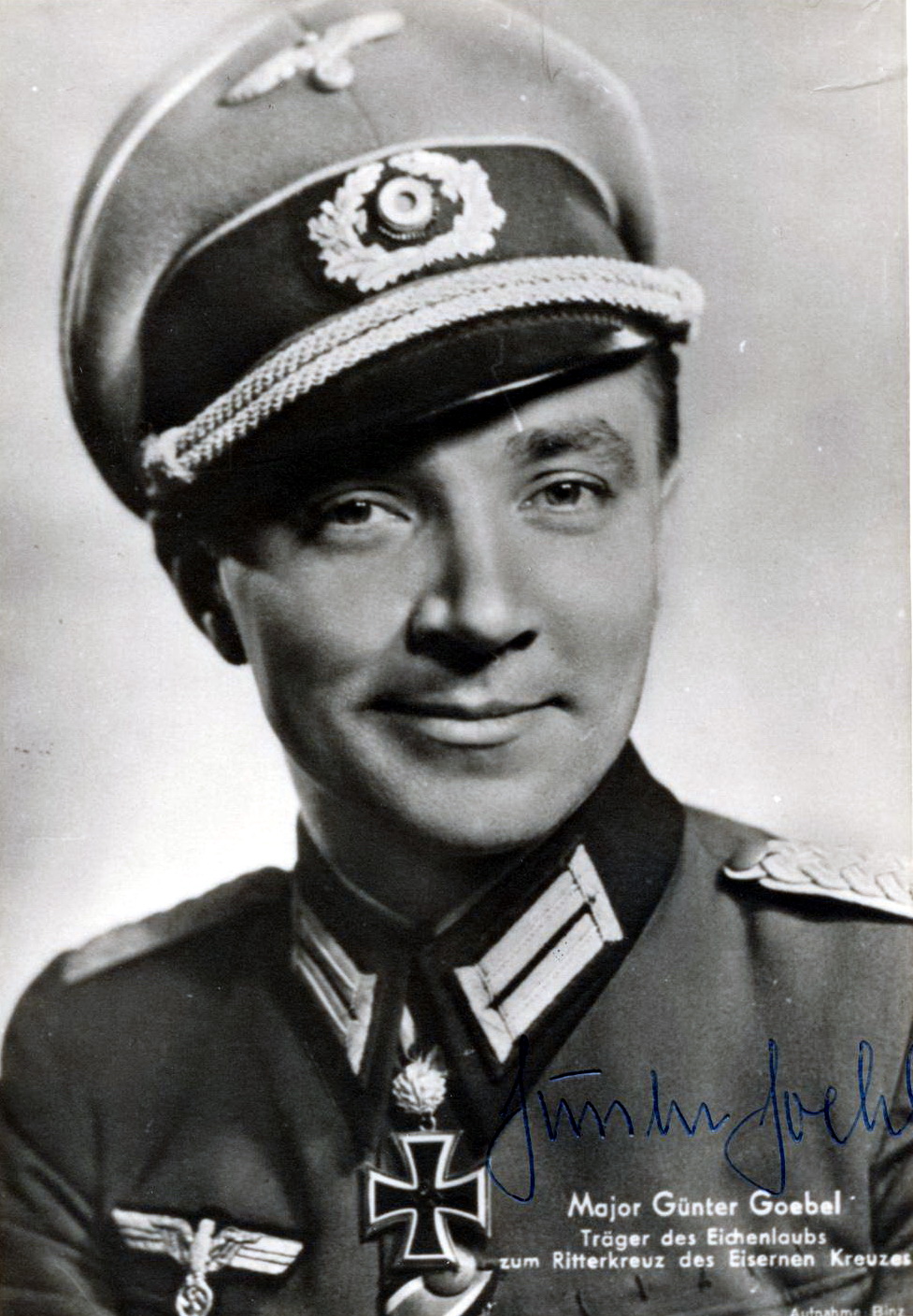
Bio of Oberstleutnant Günter Goebel (1917-1993)


Günter Goebel

Date of birth : 14 November 1917 at Hagen-Haspe, Westfalen (German Empire)
Date of death : 4 September 1993 at Hagen, Westfalen (Germany)

Promotions:
00.00.1938 Leutnant
01.06.1940 Oberleutnant
01.02.1942 Hauptmann
01.02.1943 Major
01.03.1945 Oberstleutnant

Career:
00.00.1936 Joined Infanterie-Regiment 18
00.00.1939 Adjutant III.Bataillon / Infanterie-Regiment 208
00.00.1942 Attended Generalstabsausbildung
00.00.1943 Attended Kriegsakademie Hirschberg in Silesia
01.04.1944 Posted in the Generalstab des Heeres
00.00.1944 Ib 61. Infanterie-Division
00.00.1944 Stellvertretender Quartiermeister XXXXIII. Armeekorps
00.00.1944 Ia L. Armeekorps
00.00.1944 Ia 218. Infanterie-Division
00.00.1945 Ia 215. Infanterie-Division
00.00.1945 Kommandeur Grenadier-Regiment 189
11.05.1945 Taken prisoner by the Russians
00.10.1955 Released from the POW camp

Awards and Decorations:
04.11.1939 Eisernes Kreuz II.Klasse
18.06.1940 Eisernes Kreuz I.Klasse
00.00.194_ Infanterie-Sturmabzeichen in Silber
18.10.1941 Ritterkreuz des Eisernen Kreuzes, as Oberleutnant and Adjutant Infanterie-Regiment 208 / 79.Infanterie-Division
06.11.1941 Ehrenblattspange des Heeres und Waffen-SS
00.00.1942 Medaille "Winterschlacht im Osten 1941/42" (Ostmedaille)
00.00.194_ Verwundetenabzeichen in Schwarz
00.00.194_ Goldenes HJ-Ehrenzeichen
18.01.1943 Ritterkreuz des Eisernen Kreuzes mit Eichenlaub #180, as Hauptmann and Führer Kampfgruppe Goebel / 79.Infanterie-Division
00.04.1944 Nahkampfspange in Silber


Source :
https://www.alexautographs.com/auction-lot/gunter-goebel_2E347D696E
https://de.metapedia.org/wiki/Goebel,_G%C3%BCnter
https://forum.axishistory.com/viewtopic.php?p=2444035#p2444035
http://www.specialcamp11.co.uk/Oberstleutnant%20Gunter%20Goebel.htm
https://www.tracesofwar.com/persons/29961/Goebel-G%C3%BCnter.htm

Thursday, November 3, 2022

Bio of Hauptmann d.R. Erich Röseke (1921-1994)

Erich Röseke

Date of birth: January 24th, 1921 (Stuttgart/Württemberg, Germany)
Date of death: May 2nd, 1994 (Leinfelden/Baden-Württemberg, Germany)

Promotions:
1939: Pionier der Reserve;
1940: Gefreiter der Reserve;
1941: Unteroffizier der Reserve;
1942: Feldwebel der Reserve;
1943 Leutnant der Reserve;
1944: Oberleutnant der Reserve;
1945: Hauptmann der Reserve.

Career:
May 1939 Convocation to the Gebirgsjäger. conscription
October 1939 voluntary registration as a pioneer for the first German Commando, the 'Company z.b.V. 800', set up by OKW Office Foreign Defense II (Admiral Canaris) in Brandenburg. This force, later battalion, regiment and division, was famous as 'The Brandenburgers'. - From winter 44/45 as tank grenadier division in the Panzerkorps 'Grossdeutschland'
1940 Gefreiter and MG-Schütze 1. - Fallschirms-Ausbildung.
1941 Unteroffizier and Pioniergruppenführer. Führer of Sturmboots-staffel (Ziel: Nil, Suezkanal).
1942 Feldwebel and Kompanietruppführer. Führer Cossack Platoon (In use on the Caspian Sea, furthest east of the entire German army)
1943 Leutnant und Zugführer.
1944 Oberleutnant und Kompanie-Chef.
1945 Hauptmann und Bataillons- bzw. Kampfgruppenführer. (as a 24 years old, the youngest captain in the division!).
1945 to 1948 in American captivity. As a 'sabotage specialist - dangerous prisoner' in different camps, prisons and in penitentiary. Beaten during interrogations by CIC officials, despite unhealed wounds. cynicism and sadism.
Fought in the western campaign (1940), in Greece/Africa (1941) as a member of Sonderverband 288 'Orientkorps' targeting Arabs and Persian). Russia (1942), Greece (1943/44), Albania, Yugoslavia, Hungary, in East Prussia (1945), Wertheland, Silesia.

Awards:
HJ-Leistungsabzeichen
Deutsches Reichssportabzeichen in Bronze
Führer-Sportabzeichen der Hitlerjugend
Eisernes Kreuz (1939) 2. und 1. Klasse
Goldenes HJ-Ehrenzeichen
Pionier-Steuermannabzeichen des Heeres
Infanterie-Sturmabzeichen in Silber
Allgemeines Sturmabzeichen
Two Panzervernichtungsabzeichen (8 February 1945)
Nahkampfspange in Bronze und Silber
Verwundetenabzeichen (1939) in Schwarz, Silber und Gold
Tapferkeits- und Verdienstauszeichnung für Angehörige der Ostvölker, II. und I. Klasse in Gold mit Schwertern
Kroasian Kolajnu Poglavnika Ante Pavelica za Hrabost 1st Class (10 Mei 1944)
Bandenkampfabzeichen I. Stufe (Bronze)
Deutsches Kreuz in Gold on 22 March 1945 as Oberleutnant der Reserve in 9.Kompanie / Jäger-Regiment 1 "Brandenburg“
Ritterkreuz des Eisernen Kreuzes on 14 April 1945 as Oberleutnant der Reserve and Führer 9.Kompanie / Jäger-Regiment 1 "Brandenburg" / Panzerkorps "Großdeutschland"


Source :
"Panzerkorps Grossdeutschland - A Pictoral History" by Helmuth Spaeter
https://de.metapedia.org/wiki/R%C3%B6seke,_Erich
https://www.feldgrau.net/forum/viewtopic.php?t=13141
https://www.tracesofwar.com/persons/16854/R%C3%B6seke-Erich.htm
https://www.wehrmacht-awards.com/forums/forum/wehrmacht-era-militaria/photos-and-paper-items-forum/13414665-many-unknown-knight-s-cross-bearers