Showing posts with label 6 Funeral. Show all posts

Sunday, May 10, 2026

Funeral of Ritterkreuzträger

 1944


Taken from 'Die Deutsche Wochenschau' Nr. 722 -5 July 1944: Black 4-door sedan drives up to group of German officers, doors opened by German soldier, Generaloberst Eduard Dietl wearing black leather coat steps out and is greeted by German Naval Officers. Dietl inspecting troops. Image and sound of German military snare drums, German Nazi flag waves in the breeze. Hitler arrives at state funeral for Generaloberst Dietl. Hitler shakes hands with widow, three young German girls and touches face of young German boy. Hitler delivers eulogy (no audio of Hitler). Hitler helps place large wreath at casket and gives Hitler or Nazi salute. All in attendance gives Hitler salute. Casket carried by German soldiers outside and placed on gun carriage. View of Nazi flag. Other pictures from Eduard Dietl's funeral ceremony can be seen HERE.


Source :
Die Deutsche Wochenschau Nr. 722 - 5 July 1944

Saturday, April 4, 2026

The Funeral of Hans-Valentin Hube


The death of Hans-Valentin Hube on 21 April 1944 came as a sudden and tragic blow to the German Wehrmacht at a moment when its armored forces on the Eastern Front were under increasing strain. Hube, a battle-hardened general who had lost his right arm during the First World War and earned the enduring nickname “Der Mensch” or “The Man” from his troops for his tough yet fair and courageous leadership, had just reached a pinnacle of recognition. On 20 April, he had been summoned to the Obersalzberg to join Adolf Hitler’s 55th birthday celebrations. There, in a personal audience, Hitler awarded him the rare Diamonds to the Knight’s Cross of the Iron Cross—one of only twenty-seven such distinctions granted during the entire war—and promoted him to the rank of Generaloberst. The honors were bestowed in acknowledgment of Hube’s masterful command of the 16th Panzer Division in the early campaigns against the Soviet Union, his leadership of XIV Panzer Corps during the defense of Sicily and the Salerno landings, and above all his skillful extrication of the 1st Panzer Army from the Kamenets-Podolsky Pocket earlier that spring, an operation that saved tens of thousands of German soldiers and their equipment from certain destruction. Rumors even circulated within the high command that Hitler had briefly considered elevating Hube to Commander-in-Chief of the Army itself, though that appointment was ultimately postponed. 

The following morning, 21 April, Hube boarded a Heinkel He 111 transport plane at Reichenhall-Berchtesgaden Airport in Ainring, near Salzburg, intending to fly back to his headquarters on the Eastern Front to resume command of the 1st Panzer Army. The aircraft lifted off normally but crashed shortly after takeoff into the mountainous terrain a few miles from Berchtesgaden. All aboard perished except for Walther Hewel, a senior diplomat traveling on the same flight, who survived with severe injuries. Hube’s adjutant, Major von Schwanenfeld, had been spared only because he was on personal leave and had not joined the flight. The wreckage yielded few intact remains; the sole clearly identifiable fragment of Hube’s body was his black metal prosthetic right arm, a grim reminder of the wound he had carried since 1916. Official reports classified the crash as an accident, yet the timing—mere hours after Hitler’s birthday festivities and amid growing paranoia within the Nazi leadership—prompted quiet speculation among some officers about possible sabotage, echoes later with the still-unexplained plane crash that would killed Generaloberst Eduard Dietl two months after. No concrete evidence ever emerged to support foul play, and the incident was accepted as one of the many wartime tragedies that claimed senior commanders without warning. Hitler himself was reportedly shaken by the news and, in the weeks before his own death in 1945, continued to lament the loss of “Der Mensch,” describing Hube as one of the three finest commanders produced by the Second World War and a general whose straightforward reliability could always be counted upon in the fiercest fighting. 

Hube’s passing was accorded the full solemnity of a state funeral, reflecting both his personal standing with Hitler and the regime’s desire to honor a figure whose battlefield record had become emblematic of determined resistance. On 26 April 1944, exactly five days after the crash, a grand ceremony took place in Berlin. Hube’s coffin, draped with a swastika flag, lay in state within the Reich Chancellery, where it was viewed by senior Nazi officials and military leaders. Adolf Hitler attended in person, a rare gesture by that stage of the war that underscored the depth of the Führer’s regard for the fallen general. Heinz Guderian, himself a legendary panzer commander and one of Hube’s closest comrades in the armored branch, delivered the eulogy, paying tribute to Hube’s tactical brilliance, his unyielding spirit, and the personal example he had set for the troops under his command. A guard of honor composed of four fellow generals—Walther Nehring, Hermann Breith, Heinrich Eberbach, and Hans Gollnick—stood vigil beside the coffin throughout the service, their presence a visible symbol of the respect Hube commanded within the officer corps. Following the formal rites, Hube was laid to rest with full military honors at the Invalidenfriedhof, the historic Invalids’ Cemetery in Berlin’s Mitte district. His grave lies near those of other prominent figures from the Nazi era, including the Luftwaffe aces Ernst Udet and Werner Mölders, Field Marshal Walther von Reichenau, Gestapo chief Reinhard Heydrich, and armaments minister Fritz Todt. 

The funeral marked the end of a remarkable military career that had spanned two world wars and seen Hube rise from a young infantry officer to one of the Wehrmacht’s most capable armored leaders. His death removed from the battlefield a commander whose innovative tactics and personal courage had repeatedly turned potential disasters into orderly withdrawals, most notably during the desperate fighting at Stalingrad and in the Ukraine. In the broader context of the collapsing German war effort, Hube’s loss was felt acutely by both the high command and the ordinary soldiers who had served under him; many recalled his habit of appearing at the front lines, directing operations with one hand while maintaining an almost superhuman calm amid chaos. Though the precise circumstances of the crash remain shrouded in the fog of wartime records, the state funeral and the public mourning that accompanied it ensured that Hans-Valentin Hube’s name would endure as a symbol of steadfast duty in the final, bitter phase of the conflict. 


The funeral ceremony of Generaloberst Hans-Valentin Hube which was held at the Neue Reichskanzlei in Berlin on 26 April 1944 (Hube himself died in a plane crash 5 days earlier). This photo was taken by Eitel Lange and shows Adolf Hitler (Führer und Oberster Befehlshaber der Wehrmacht) and Reichsmarschall Hermann Göring (Oberbefehlshaber der Luftwaffe) flanking the bereaved family, who are likely the widow or children of the deceased. In the front row, we can also see three Wehrmacht Marshals sitting at the left end: Generalfeldmarschall Erhard Milch (Generalinspekteur der Luftwaffe), Generalfeldmarschall Günther von Kluge (Führerreserve Oberkommando des Heeres), and Generalfeldmarschall Wilhelm Keitel (Chef Oberkommando der Wehrmacht). Meanwhile, sitting in the back row, from left to right: General der Flieger Günther Korten (Chef des Generalstabes der Luftwaffe), Generaloberst Friedrich Fromm (Chef der Heeresrüstung und Befehlshaber des Ersatzheeres), Konteradmiral Karl-Jesko von Puttkamer (Adjutant der Kriegsmarine beim Führer und Oberster Befehlshaber der Wehrmacht), SS-Obergruppenführer Julius Schaub (Chefadjutant der Führer), and Generalleutnant Rudolf Schmundt (Chefadjutant der Wehrmacht beim Führer und Oberster Befehlshaber der Wehrmacht).


The funeral ceremony of Generaloberst Hans-Valentin Hube which was held at the Neue Reichskanzlei in Berlin on 26 April 1944. Adolf Hitler (Führer und Oberster Befehlshaber der Wehrmacht) and Reichsmarschall Hermann Göring (Oberbefehlshaber der Luftwaffe) flanking the bereaved family, who are likely the widow or children of the deceased. In the background we can see Reichsminister Dr. Joseph Goebbels and Reichskommissar Dr. Arthur Seyss-Inquart.


The funeral ceremony of Generaloberst Hans-Valentin Hube which was held at the Neue Reichskanzlei in Berlin on 26 April 1944. Honored guests at the memorial service, front row from left to right: Generalfeldmarschall Hans-Günther von Kluge (Führerreserve), Reichsführer-SS Heinrich Himmler (Chef der SS und Polizei), Großadmiral Karl Dönitz (Oberbefehlshaber der Kriegsmarine), and Generalfeldmarschall Wilhelm Keitel (Chef Oberkommando der Wehrmacht). In the back row between Kluge and Himmler is General der Infanterie Joachim von Kortzfleisch (Kommandierenden General Stellvertretenden Generalkommando III. Armeekorps in Berlin und Befehlshaber vom Wehrkreis III), while the man with his head bowed between Dönitz and Keitel is Generaloberst Hermann Hoth (Führerreserve).


The funeral ceremony of Generaloberst Hans-Valentin Hube which was held at the Neue Reichskanzlei in Berlin on 26 April 1944. The military attachés of the foreign countries were honored guests at this state ceremony. The picture was taken by Ernst Schwahn.


The funeral ceremony of Generaloberst Hans-Valentin Hube which was held at the Neue Reichskanzlei in Berlin on 26 April 1944. The military attachés of the foreign countries were honored guests at this state ceremony.


The funeral ceremony of Generaloberst Hans-Valentin Hube which was held at the Neue Reichskanzlei in Berlin on 26 April 1944. Adolf Hitler (Führer und Oberster Befehlshaber der Wehrmacht) and Reichsmarschall Hermann Göring (Oberbefehlshaber der Luftwaffe) saluting the deceased. Hitler rarely attended a funeral (especially late in the war), unless the deceased was considered a really important person. So special was Hube's favor in Hitler's eyes that he made the time to attend this ceremony.


The funeral ceremony of Generaloberst Hans-Valentin Hube which was held at the Neue Reichskanzlei in Berlin on 26 April 1944. Reichsmarschall Hermann Göring (Oberbefehlshaber der Luftwaffe) delivered the eulogy, while generals and recipients of high and highest decorations for bravery escort the coffin. From left to right: General der Infanterie Hans Gollnick (Führerreserve), General der Panzertruppe Hermann Breith (Kommandierender General III. Panzerkorps), General der Panzertruppe Walther Nehring (Kommandierender General XXIV. Panzerkorps), and General der Panzertruppe Heinrich Eberbach (Inspekteur der Panzertruppe beim Befehlshaber des Ersatzheeres). The picture was taken by Eitel Lange and was first published on 3 May 1944.


The funeral ceremony of Generaloberst Hans-Valentin Hube which was held at the Neue Reichskanzlei in Berlin on 26 April 1944. Reichsmarschall Hermann Göring (Oberbefehlshaber der Luftwaffe) performing the marshall salute, while generals and recipients of high and highest decorations for bravery escort the coffin. From left to right: General der Panzertruppe Walther Nehring (Kommandierender General XXIV. Panzerkorps), General der Panzertruppe Heinrich Eberbach (Inspekteur der Panzertruppe beim Befehlshaber des Ersatzheeres), General der Infanterie Hans Gollnick (blocked by Eberbach, Führerreserve), and General der Panzertruppe Hermann Breith (Kommandierender General III. Panzerkorps). Two panzer officers are holding the ordenskissen (medal pillow).


The funeral ceremony of Generaloberst Hans-Valentin Hube which was held at the Neue Reichskanzlei in Berlin on 26 April 1944. Adolf Hitler (Führer und Oberster Befehlshaber der Wehrmacht) performing the Hitler salute at Hube's lying in state, while generals and recipients of high and highest decorations for bravery escort the coffin. From left to right: General der Panzertruppe Walther Nehring (Kommandierender General XXIV. Panzerkorps), General der Panzertruppe Heinrich Eberbach (Inspekteur der Panzertruppe beim Befehlshaber des Ersatzheeres), General der Infanterie Hans Gollnick (Führerreserve), and General der Panzertruppe Hermann Breith (Kommandierender General III. Panzerkorps). Two panzer officers are holding the ordenskissen (medal pillow). This picture was first published in "Das 12 Uhr Blatt", 27 April 1944 edition.


The funeral ceremony of Generaloberst Hans-Valentin Hube which was held at the Neue Reichskanzlei in Berlin on 26 April 1944. Adolf Hitler (Führer und Oberster Befehlshaber der Wehrmacht) performing the Hitler salute at Hube's lying in state, while generals and recipients of high and highest decorations for bravery escort the coffin. From left to right: General der Infanterie Hans Gollnick (Führerreserve), General der Panzertruppe Hermann Breith (Kommandierender General III. Panzerkorps), General der Panzertruppe Walther Nehring (Kommandierender General XXIV. Panzerkorps), and General der Panzertruppe Heinrich Eberbach (Inspekteur der Panzertruppe beim Befehlshaber des Ersatzheeres).


The funeral ceremony of Generaloberst Hans-Valentin Hube which was held in Berlin on 26 April 1944. Generals and recipients of high and highest decorations for bravery escort the coffin, carried by non-commissioned officers of the Panzertruppen, to the gun carriage after the state ceremony at the Neue Reichskanzlei. The two escort generals at left are General der Infanterie Hans Gollnick (Führerreserve) and General der Panzertruppe Walther Nehring (Kommandierender General XXIV. Panzerkorps), while the two escort generals at right are General der Panzertruppe Hermann Breith (Kommandierender General III. Panzerkorps) and General der Panzertruppe Heinrich Eberbach (Inspekteur der Panzertruppe beim Befehlshaber des Ersatzheeres). The picture was taken by Ernst Schwahn.


The funeral ceremony of Generaloberst Hans-Valentin Hube which was held in Berlin on 26 April 1944. Generals and recipients of high and highest decorations for bravery escort the coffin, carried by non-commissioned officers of the Panzertruppen, to the gun carriage after the state ceremony at the Neue Reichskanzlei. The two escort generals at left are General der Infanterie Hans Gollnick (Führerreserve) and General der Panzertruppe Walther Nehring (Kommandierender General XXIV. Panzerkorps), while the two escort generals at right are General der Panzertruppe Hermann Breith (Kommandierender General III. Panzerkorps) and General der Panzertruppe Heinrich Eberbach (Inspekteur der Panzertruppe beim Befehlshaber des Ersatzheeres).


The funeral ceremony of Generaloberst Hans-Valentin Hube which was held in Berlin on 26 April 1944. Generals and recipients of high and highest decorations for bravery escort the coffin, carried by non-commissioned officers of the Panzertruppen, to the gun carriage after the state ceremony at the Neue Reichskanzlei. The two escort generals at left are General der Infanterie Hans Gollnick (Führerreserve) and General der Panzertruppe Walther Nehring (Kommandierender General XXIV. Panzerkorps). In the center behind the coffin is Generalfeldmarschall Wilhelm Keitel (Chef Oberkommando der Wehrmacht), while at far right is Generalfeldmarschall Günther von Kluge (Führerreserve).


From left to right: Unknown Heer officer, General der Infanterie Wilhelm Wegener (Kommandierender General L. Armeekorps), Generalleutnant Rudolf Schmundt (Chefadjutant des Heeres beim Führer und Oberbefehlshaber der Wehrmacht), General der Infanterie Werner Kienitz (Kommandierenden General Stellvertretenden Generalkommando II. Armeekorps in Stettin und Befehlshaber vom Wehrkreis II), and General der Infanterie Joachim von Kortzfleisch (Kommandierenden General Stellvertretenden Generalkommando III. Armeekorps in Berlin und Befehlshaber vom Wehrkreis III). The picture was taken during the funeral of Generaloberst Hans-Valentin Hube in Berlin, 26 April 1944.


The grave of Hans-Valentin Hube at the Invalidenfriedhof, Berlin. The cemetery address is Scharnhorststraße 25 (or sometimes listed as 9 or 33 in sources), 10115 Berlin-Mitte, near the Berlin-Spandauer-Schifffahrtskanal. Coordinates for the cemetery: approx. 52.53194°N, 13.37111°E. It is open to the public and one of Berlin's oldest cemeteries (founded 1748), historically used for Prussian military veterans and later notable figures. Hube's grave still exists and can be visited. The original tombstone was replaced in 2000 (a simpler or restitution-style marker is now there), but the burial site remains undisturbed. Photos from 2007 and 2013 show the grave marker in the cemetery.

Source:
Die Deutsche Wochenschau Nr. 713 - 3 May 1944
David Stahel, Hitler’s Panzer Generals: Guderian, Hoepner, Reinhardt and Schmidt Unguarded (Cambridge: Cambridge University Press, 2023)
https://audiovis.nac.gov.pl/obraz/36625/dee40d08bd916e4c667770046a213080/
https://beeldbankwo2.nl/nl/beelden/?q=hans%20hube&mode=gallery&view=horizontal
https://www.bild.bundesarchiv.de/dba/de/search/?yearfrom=&yearto=&query=hans+hube#
https://www.bpk-bildagentur.de/shop
https://alifrafikkhan.blogspot.com/2011/10/album-foto-terbaik-hans-valentin-hube.html
www.en.wikipedia.org/wiki/Hans-Valentin_Hube 
www.findagrave.com/memorial/31534926/hans-valentin-hube
https://www.gettyimages.com/detail/news-photo/huber-hans-valentin-officer-colonel-general-germany29-10-news-photo/543888483
www.ww2gravestone.com/people/hube-hans-valentine-der-mensch/

Tuesday, March 31, 2026

The Death of Fallschirmjäger Walter Koch (1943)


On 23 October 1943, Oberstleutnant Walter Koch, one of the most celebrated commanders of the German Fallschirmjäger, died at the age of thirty-three in a Berlin hospital from injuries sustained in a road accident while convalescing from earlier wounds received in combat. Koch had risen rapidly through the ranks of the Luftwaffe’s airborne forces, earning the Knight’s Cross of the Iron Cross for his audacious leadership of the glider-borne assault on Fort Eben-Emael and the Albert Canal bridges during the 1940 invasion of Belgium. By 1941 he commanded the first battalion of the Luftlande-Sturm-Regiment during the airborne invasion of Crete, where he was wounded in the head while fighting for Hill 107 near Maleme airfield. Promoted to Oberstleutnant in April 1942, he took command of Fallschirmjäger-Regiment 5 and led it into the Tunisian campaign in late 1942. There, in the fighting around Depienne airfield, his troops captured British paratroopers of the 2nd Parachute Battalion. Koch personally intervened to prevent their summary execution under Hitler’s infamous Commando Order, ordering medics to treat the wounded prisoners, providing them with food, water, and cigarettes, and ensuring they were sent to a prisoner-of-war camp rather than shot. His open criticism of the order, combined with his refusal to carry it out, reportedly led to his placement in the Führerreserve upon his return to Germany.

While recovering from a head wound—accounts differ on whether it stemmed from the earlier Crete fighting or from a subsequent incident during the Tunisian operations—Koch was involved in a motor-vehicle collision. He was rushed to a hospital in Berlin, where, despite medical efforts, he succumbed to his injuries on 23 October 1943. Official reports described the death as the result of the traffic accident, yet within his regiment the circumstances quickly became the subject of suspicion. Many of his men believed the “accident” was staged by the SS-Reichssicherheitshauptamt as retribution for his outspoken denunciation of the Commando Order and his defiance of Hitler’s directives. No formal investigation ever confirmed foul play, and the precise details of the collision were never publicly clarified, leaving the episode shrouded in the wartime atmosphere of paranoia and reprisal that marked the later years of the Nazi regime. Some contemporary accounts even suggested the injuries may have originated from a plane crash in Tunisia, but the predominant narrative, supported by postwar historical research, centers on the car accident during his convalescence.

Details of Koch’s funeral itself remain sparse in surviving records, as was often the case for officers who died under ambiguous circumstances amid the escalating pressures of total war. No large-scale public ceremony or detailed contemporary press accounts have been preserved, likely because the regime preferred to avoid drawing attention to internal dissent or the suspicious deaths of decorated heroes. What is known is that his body was transported from Berlin to his hometown of Bonn, where he was laid to rest with military honors befitting a Knight’s Cross recipient and a pioneer of airborne warfare. He was interred at the Nordfriedhof (North Cemetery) in Bonn, in the designated war-graves section, specifically Section 16, Graves 7/8. The grave was later shared with his wife Marie (sometimes referred to in records as Berta Koch-Bucholz, whom he had married in 1937), who survived him by nearly three decades and was buried beside him upon her death on 14 November 1972 at the age of eighty-seven. Nearby in the same war-graves area lies the grave of General der Infanterie Kurt Kühme. Postwar, the site became a quiet place of remembrance; one documented gesture came from a former Allied opponent—referred to in some accounts simply as “Beachy”—who, years after the conflict, arranged for remembrance crosses to be placed on Koch’s grave as a mark of respect between former adversaries.

Koch’s death marked the end of a remarkable but tragically brief career that had helped define the early successes and brutal realities of German airborne operations. From the daring glider assaults of 1940 to the desperate fighting in North Africa, he embodied the aggressive spirit of the Fallschirmjäger while also demonstrating a measure of humanity that set him apart from the regime he served. The lingering questions surrounding his final days—whether accident or assassination—have ensured that his story continues to intrigue historians and veterans alike, even as his final resting place in Bonn remains a modest testament to a soldier whose life was cut short in the shadow of suspicion and secrecy.


Walter Koch's funeral in October 1943. A former member of Sonderverband 288 is holding the ordenskissen (medal pillow).


Walter Koch's funeral in October 1943. Ritterkreuzträger Leutnant Wilhelm Kempke is holding the ordenskissen (medal pillow).


Walter Koch's funeral in October 1943. Ritterkreuzträger Leutnant Wilhelm Kempke is holding the ordenskissen (medal pillow).


Walter Koch's funeral in October 1943. Ritterkreuzträger Leutnant Wilhelm Kempke is holding the ordenskissen (medal pillow).


Source:  
https://ww2gravestone.com/people/koch-walter/
https://en.wikipedia.org/wiki/Walter_Koch_(paratrooper)
https://www.tracesofwar.com/persons/23975/Koch-Walter.htm
https://tellthemofus.uk/oberstleutnant-walter-koch-kommandeur-fllschirmjaeger-regiment-5.  
https://www.wehrmacht-awards.com/forums/forum/wehrmacht-era-militaria/order-of-battle-and-individual-research-forum/14174987-whose-medals-are-these
Quarrie, Bruce. *German Airborne Troops 1939–45*. Osprey Publishing, 1983 (cited in relation to Koch’s career and death circumstances)
Quarrie, Bruce. *Fallschirmjäger: German Paratrooper 1935–45*. Osprey Warrior Series 38, Osprey Publishing, 2001
Kurowski, Franz. *Deutsche Fallschirmjäger 1939–1945* (various editions; referenced in secondary sources discussing Koch’s North African actions and subsequent fate)

Wednesday, August 14, 2024

Eduard Dietl Funeral


Taken from 'Die Deutsche Wochenschau' Nr. 722 -5 July 1944: Black 4-door sedan drives up to group of German officers, doors opened by German soldier, Generaloberst Eduard Dietl wearing black leather coat steps out and is greeted by German Naval Officers. Dietl inspecting troops. Image and sound of German military snare drums, German Nazi flag waves in the breeze. Hitler arrives at state funeral for Generaloberst Dietl. Hitler shakes hands with widow, three young German girls and touches face of young German boy. Hitler delivers eulogy (no audio of Hitler). Hitler helps place large wreath at casket and gives Hitler or Nazi salute. All in attendance gives Hitler salute. Casket carried by German soldiers outside and placed on gun carriage. View of Nazi flag.


On Friday, 23 June 1944, exactly at 7:42 a.m., a Junkers Ju 52/3mg11 "A2+AA" (Werknummer 7596) transport aircraft belonging to the Wehrmacht crashed near the small village of Rettenegg, Styria (Austria). At the time of the incident, the aircraft was occupied by nine passengers, seven of whom died at the scene. Among those who lost their lives in the crash were leading Heer generals: Generaloberst Eduard Dietl (Oberbefehlshaber 20. Gebirgsarmee), General der Infanterie Thomas-Emil von Wickede (Kommandierender General X. Armeekorps), General der Gebirgstruppe Karl Eglseer (Kommandierender General XVIII. Gebirgskorps), and Generalleutnant Franz Rossi (Kommandeur Divisionsgruppe Rossi). Dietl last words were to the pilot shortly before take-off:  “No, we are not going to fly over the plain.  The clouds are six hundred meters above the ground.  I know the area and am glad to finally be back in my mountains.  I want to see them from above once more.  In Finland, everything is flat.  We will fly from Graz along the valley that goes to Judenberg.  From there we will follow the Semmering trace that goes to Mürzuschlag and from there to Vienna.”

The "Staatsbegräbnis" (State Funeral) was held on 3 July 1944. The honor guards were high-ranking Wehrmacht officers who were also Ritterkreuzträger (recipients of the Ritterkreuz des Eisernen Kreuzes): General der Gebirgstruppe Rudolf Konrad (Führerreserve) and General der Gebirgstruppe Georg Ritter von Hengl (Chef Nationalsozialistische-Führungsstabes im Oberkommando des Heeres).


Wehrmacht Honor guards during "Staatsbegräbnis" (State Funeral) of Generaloberst Eduard Dietl, 3 July 1944. At front left is General der Gebirgstruppe Rudolf Konrad (Führerreserve), while at front right is General der Gebirgstruppe Georg Ritter von Hengl (Chef Nationalsozialistische-Führungsstabes im Oberkommando des Heeres).


General der Gebirgstruppe Rudolf Konrad. Received the Ritterkreuz des Eisernen Kreuzes on 1 August 1942 as General der Gebirgstruppe and Kommandierender General XXXXIX. Gebirgskorps.


Major Wilhelm von Goriany. Received the Ritterkreuz des Eisernen Kreuzes on 18 July 1943 as Major and Kommandeur II.Abteilung / Gebirgs-Artillerie-Regiment 85 / 101.Jäger-Division.


Feldwebel Ulrich Karg. Received the Ritterkreuz des Eisernen Kreuzes on 5 July 1943 as Oberjäger and Zugführer in Radfahrzug 17 / Gebirgsjäger-Regiment 91 / 4.Gebirgs-Division.


Feldwebel Josef Ehinger. Received the Ritterkreuz des Eisernen Kreuzes on 22 August 1943 as Oberjäger and Gruppenführer in 6.Kompanie / II.Bataillon / Gebirgsjäger-Regiment 10 / 5.Gebirgs-Division.


From left to right: Generalfeldmarschall Erhard Milch (Generalinspekteur der Luftwaffe) and Generalfeldmarschall Günther von Kluge (Oberbefehlshaber West und Oberbefehlshaber Heeresgruppe D).


Source :
http://alifrafikkhan.blogspot.com/2010/11/album-foto-eduard-dietl.html
https://www.buyoutfootage.com/pages/titles/pd_dc_502a.php
https://www.thefifthfield.com/2000-quotes/state-funeral-for-general-dietl/
https://www.youtube.com/watch?v=dHL8cxpPj1w

Tuesday, August 6, 2024

Felix Steiner Funeral


The funeral of former Waffen-SS general Felix Steiner which were held on 25 May 1966. His funeral was attended by hundreds of his men who came from all over Europe to pay their last respects, including Ritterkreuzträger Otto Weidinger and Wilhelm Bittrich. Steiner died on 12 May 1966 in Münich, 11 days before his 70th birthday, and was buried in Friedhof Perlacher Forst (Plot 201, Reihe A, Grab 16).


The funeral of former Waffen-SS general Felix Steiner which were held on 25 May 1966. His funeral was attended by hundreds of his men who came from all over Europe to pay their last respects. Steiner died on 12 May 1966 in Münich, 11 days before his 70th birthday, and was buried in Friedhof Perlacher Forst (Plot 201, Reihe A, Grab 16).


Herbert Otto Gille gives the eulogy during the funeral of former Waffen-SS general Felix Steiner which were held on 25 May 1966. His funeral was attended by hundreds of his men who came from all over Europe to pay their last respects. Steiner died on 12 May 1966 in Münich, 11 days before his 70th birthday, and was buried in Friedhof Perlacher Forst (Plot 201, Reihe A, Grab 16).


The casket during the funeral of former Waffen-SS general Felix Steiner which were held on 25 May 1966. His funeral was attended by hundreds of his men who came from all over Europe to pay their last respects. Steiner died on 12 May 1966 in Münich, 11 days before his 70th birthday, and was buried in Friedhof Perlacher Forst (Plot 201, Reihe A, Grab 16).


Source :
Agustin Vazquez photo collection
https://en.wikipedia.org/wiki/Felix_Steiner
https://warfarehistorynetwork.com/article/waffen-ss-general-felix-steiners-wwii-legacy/
https://www.wehrmacht-awards.com/forums/forum/wehrmacht-era-militaria/-1957-medals-orders-and-decorations/646561-vets-wearing-their-57ers/page279#post14377794

Thursday, July 4, 2024

Herbert Otto Gille Funeral


26 December 1966: The funeral of fomer SS general Herbert Otto Gille in his house in Stemmen über Hannover, Niedersachsen, West Germany. On 26 December 1966 Gille passed away after suffering a heart attack in Stemmen, age 68. He was buried at the local cemetery in the city. Unfortunately, for some reason, now the grave is no longer there!


The funeral of former Waffen-SS general Herbert Otto Gille which were held on 28 December 1966. His funeral was attended by hundreds of his men who came from all over Europe to pay their last respects. Gille died on 26 December 1966 in Stemmen, near Hannover, and was buried at Stemmen Friedhof.

Source :
Agustin Vazquez photo collection
Bayerische Staatsbibliothek (Image-No.: 50077487)
http://alifrafikkhan.blogspot.com/2014/03/album-foto-herbert-otto-gille.html
https://www.wehrmacht-awards.com/forums/forum/wehrmacht-era-militaria/crosses-of-the-wehrmacht/624871-the-fate-of-the-diamonds/page28#post7270390
https://ww2gravestone.com/people/gille-herbert-otto/

Sunday, March 31, 2024

Hans-Ulrich Rudel Funeral


22 December 1982: The funeral of Hans-Ulrich Rudel, the only Ritterkreuzträger (Knight's Cross winner) with Goldenem Eichenlaub (golden oak leaves) and a member of the right-wing radical DRP, took place amidst a group of old and young fans of Adolf Hitler. Several of his mourners saluted with the "Heil Hitler". Photo by Klaus Rose.


Gunzenhausen, West Germany -- Mourners at the funeral of Nazi Germany's most honored bomber pilot Wednesday (22 December 1982) sang Nazi songs and raised their arms in the Nazi salute as he was buried.

Hans-Ulrich Rudel, who died Monday (18 December 1982) at the age of 66, was awarded Nazi Germany's highest military honor, a special form of the Iron Cross created specifically for him.

He later won notoriety after World War II for his pro-Nazi writings and speeches and praise of Adolf Hitler.

Some 2,000 people attended his funeral, many of them joining in the banned, pro-Nazi verses of the German national anthem 'Deutschland Uber Alles' and raising their outstretched right arms in the Nazi salute, witnesses said.

World War II veterans and women were among those who joined in the song and raised their arms.

The West German air force refused to send a representative to the funeral near Gunzenhausen south of Nuremberg, but West German Phantom fighter planes swooped low over the cemetery before and during the burial service making the shape of a cross in the sky, witnesses said.

Known as the 'Eagle of the Russian Front,' Rudel made 2,530 raids against the Soviet Union in his Stuka dive-bomber.

He is credited with destroying 519 Soviet tanks and 800 combat vehicles, and sinking or damaging three Russian warships and 70 landing vessels.

He escaped serious injury until 1945, when he lost a leg in combat. He spent a year as a prisoner of the American and British armies.

Rudel went to Argentina after the war where he reportedly played a role in building up the Argentine air force.

When he returned to West Germany he provoked criticism by his writings and speeches extolling Hitler and the war. One of his books was banned for sale to young people because authorities considered it dangerous.


The funeral of Rudel took place amidst a group of old and young fans of Adolf Hitler. Hans-Ulrich Rudel was the only bearer of the Knight's Cross with golden oak leaves and supporter of the right-wing DRP. Several of his mourners saluted with the "Heil Hitler". Photo by Klaus Rose.


The funeral of Rudel took place amidst a group of old and young fans of Adolf Hitler. Hans-Ulrich Rudel was the only bearer of the Knight's Cross with golden oak leaves and supporter of the right-wing DRP. Several of his mourners saluted with the "Heil Hitler". Photo by Klaus Rose.


The funeral of Rudel took place amidst a group of old and young fans of Adolf Hitler. Hans-Ulrich Rudel was the only bearer of the Knight's Cross with golden oak leaves and supporter of the right-wing DRP. Several of his mourners saluted with the "Heil Hitler". Photo by Klaus Rose.


The funeral of Rudel took place amidst a group of old and young fans of Adolf Hitler. Hans-Ulrich Rudel was the only bearer of the Knight's Cross with golden oak leaves and supporter of the right-wing DRP. Several of his mourners saluted with the "Heil Hitler". Photo by Klaus Rose.


The funeral of Rudel took place amidst a group of old and young fans of Adolf Hitler. Hans-Ulrich Rudel was the only bearer of the Knight's Cross with golden oak leaves and supporter of the right-wing DRP. Several of his mourners saluted with the "Heil Hitler". Photo by Klaus Rose.


The funeral of Rudel took place amidst a group of old and young fans of Adolf Hitler. Hans-Ulrich Rudel was the only bearer of the Knight's Cross with golden oak leaves and supporter of the right-wing DRP. Several of his mourners saluted with the "Heil Hitler". Photo by Klaus Rose.


The funeral of Rudel took place amidst a group of old and young fans of Adolf Hitler. Hans-Ulrich Rudel was the only bearer of the Knight's Cross with golden oak leaves and supporter of the right-wing DRP. Several of his mourners saluted with the "Heil Hitler". Photo by Klaus Rose.


The funeral of Rudel took place amidst a group of old and young fans of Adolf Hitler. Hans-Ulrich Rudel was the only bearer of the Knight's Cross with golden oak leaves and supporter of the right-wing DRP. Several of his mourners saluted with the "Heil Hitler". Photo by Klaus Rose.


The funeral of Rudel took place amidst a group of old and young fans of Adolf Hitler. Hans-Ulrich Rudel was the only bearer of the Knight's Cross with golden oak leaves and supporter of the right-wing DRP. Several of his mourners saluted with the "Heil Hitler". Photo by Klaus Rose.


The funeral of Rudel took place amidst a group of old and young fans of Adolf Hitler. Hans-Ulrich Rudel was the only bearer of the Knight's Cross with golden oak leaves and supporter of the right-wing DRP. Several of his mourners saluted with the "Heil Hitler". Photo by Klaus Rose.


The funeral of Rudel took place amidst a group of old and young fans of Adolf Hitler. Hans-Ulrich Rudel was the only bearer of the Knight's Cross with golden oak leaves and supporter of the right-wing DRP. Several of his mourners saluted with the "Heil Hitler". Photo by Klaus Rose.


The funeral of Rudel took place amidst a group of old and young fans of Adolf Hitler. Hans-Ulrich Rudel was the only bearer of the Knight's Cross with golden oak leaves and supporter of the right-wing DRP. Several of his mourners saluted with the "Heil Hitler". Photo by Klaus Rose.


The funeral of Rudel took place amidst a group of old and young fans of Adolf Hitler. Hans-Ulrich Rudel was the only bearer of the Knight's Cross with golden oak leaves and supporter of the right-wing DRP. Several of his mourners saluted with the "Heil Hitler". Photo by Klaus Rose.


The funeral of Rudel took place amidst a group of old and young fans of Adolf Hitler. Hans-Ulrich Rudel was the only bearer of the Knight's Cross with golden oak leaves and supporter of the right-wing DRP. Several of his mourners saluted with the "Heil Hitler". Photo by Klaus Rose.


The funeral of Rudel took place amidst a group of old and young fans of Adolf Hitler. Hans-Ulrich Rudel was the only bearer of the Knight's Cross with golden oak leaves and supporter of the right-wing DRP. Several of his mourners saluted with the "Heil Hitler". Photo by Klaus Rose.


The funeral of Rudel took place amidst a group of old and young fans of Adolf Hitler. Hans-Ulrich Rudel was the only bearer of the Knight's Cross with golden oak leaves and supporter of the right-wing DRP. Several of his mourners saluted with the "Heil Hitler". Photo by Klaus Rose.


The funeral of Rudel took place amidst a group of old and young fans of Adolf Hitler. Hans-Ulrich Rudel was the only bearer of the Knight's Cross with golden oak leaves and supporter of the right-wing DRP. Several of his mourners saluted with the "Heil Hitler". Photo by Klaus Rose.


The funeral of Rudel took place amidst a group of old and young fans of Adolf Hitler. Hans-Ulrich Rudel was the only bearer of the Knight's Cross with golden oak leaves and supporter of the right-wing DRP. Several of his mourners saluted with the "Heil Hitler". Photo by Klaus Rose.


The funeral of Rudel took place amidst a group of old and young fans of Adolf Hitler. Hans-Ulrich Rudel was the only bearer of the Knight's Cross with golden oak leaves and supporter of the right-wing DRP. Several of his mourners saluted with the "Heil Hitler". Photo by Klaus Rose.


The funeral of Rudel took place amidst a group of old and young fans of Adolf Hitler. Hans-Ulrich Rudel was the only bearer of the Knight's Cross with golden oak leaves and supporter of the right-wing DRP. Several of his mourners saluted with the "Heil Hitler". Photo by Klaus Rose.


The funeral of Rudel took place amidst a group of old and young fans of Adolf Hitler. Hans-Ulrich Rudel was the only bearer of the Knight's Cross with golden oak leaves and supporter of the right-wing DRP. Several of his mourners saluted with the "Heil Hitler". Photo by Klaus Rose.


The funeral of Rudel took place amidst a group of old and young fans of Adolf Hitler. Hans-Ulrich Rudel was the only bearer of the Knight's Cross with golden oak leaves and supporter of the right-wing DRP. Several of his mourners saluted with the "Heil Hitler". Photo by Klaus Rose.


The funeral of Rudel took place amidst a group of old and young fans of Adolf Hitler. Hans-Ulrich Rudel was the only bearer of the Knight's Cross with golden oak leaves and supporter of the right-wing DRP. Several of his mourners saluted with the "Heil Hitler". Photo by Klaus Rose.


The funeral of Rudel took place amidst a group of old and young fans of Adolf Hitler. Hans-Ulrich Rudel was the only bearer of the Knight's Cross with golden oak leaves and supporter of the right-wing DRP. Several of his mourners saluted with the "Heil Hitler". Photo by Klaus Rose.


The funeral of Rudel took place amidst a group of old and young fans of Adolf Hitler. Hans-Ulrich Rudel was the only bearer of the Knight's Cross with golden oak leaves and supporter of the right-wing DRP. Several of his mourners saluted with the "Heil Hitler". Photo by Klaus Rose.


The funeral of Rudel took place amidst a group of old and young fans of Adolf Hitler. Hans-Ulrich Rudel was the only bearer of the Knight's Cross with golden oak leaves and supporter of the right-wing DRP. Several of his mourners saluted with the "Heil Hitler". Photo by Klaus Rose.


The funeral of Rudel took place amidst a group of old and young fans of Adolf Hitler. Hans-Ulrich Rudel was the only bearer of the Knight's Cross with golden oak leaves and supporter of the right-wing DRP. Several of his mourners saluted with the "Heil Hitler". Photo by Klaus Rose.


The funeral of Rudel took place amidst a group of old and young fans of Adolf Hitler. Hans-Ulrich Rudel was the only bearer of the Knight's Cross with golden oak leaves and supporter of the right-wing DRP. Several of his mourners saluted with the "Heil Hitler". Photo by Klaus Rose.


The funeral of Rudel took place amidst a group of old and young fans of Adolf Hitler. Hans-Ulrich Rudel was the only bearer of the Knight's Cross with golden oak leaves and supporter of the right-wing DRP. Several of his mourners saluted with the "Heil Hitler". Photo by Klaus Rose.


The funeral of Rudel took place amidst a group of old and young fans of Adolf Hitler. Hans-Ulrich Rudel was the only bearer of the Knight's Cross with golden oak leaves and supporter of the right-wing DRP. Several of his mourners saluted with the "Heil Hitler". Photo by Klaus Rose.
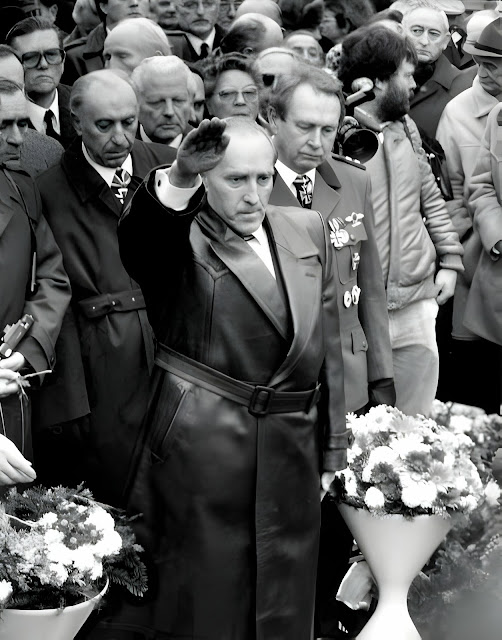


Several mourners, like this man in the leather coat, said goodbye at the grave with the Hitler salute. On December 22, 1982, former Luftwaffe Oberst Hans-Ulrich Rudel, the most decorated soldier in the Wehrmacht, was buried in the Dornhausen cemetery near Gunzenhausen. Among the approximately 2,000 mourners were delegations from right-wing extremist groups and parties from Germany, Holland and Belgium. Photo by Karl Staedele.


Source :
https://www.alamy.com/the-funeral-of-hans-ullrich-rudel-the-only-knights-cross-winner-with-golden-oak-leaves-and-a-member-of-the-right-wing-radical-drp-turned-into-a-image490194980.html
https://www.album-online.com/detail/en/NDYwODkxMA/funeral-hans-ullrich-rudel-only-knight-s-cross-winner-golden-alb9209216
https://www.gettyimages.co.uk/search/2/image?family=editorial&phrase=hans%20ulrich%20rudel
https://www.shutterstock.com/pl/editorial/image-editorial/funeral-hans-ullrich-rudel-only-knight's-cross-winner-13612202ow
https://www.upi.com/Archives/1982/12/22/Nazi-sympathizers-at-funeral-of-German-ace/5492409381200/