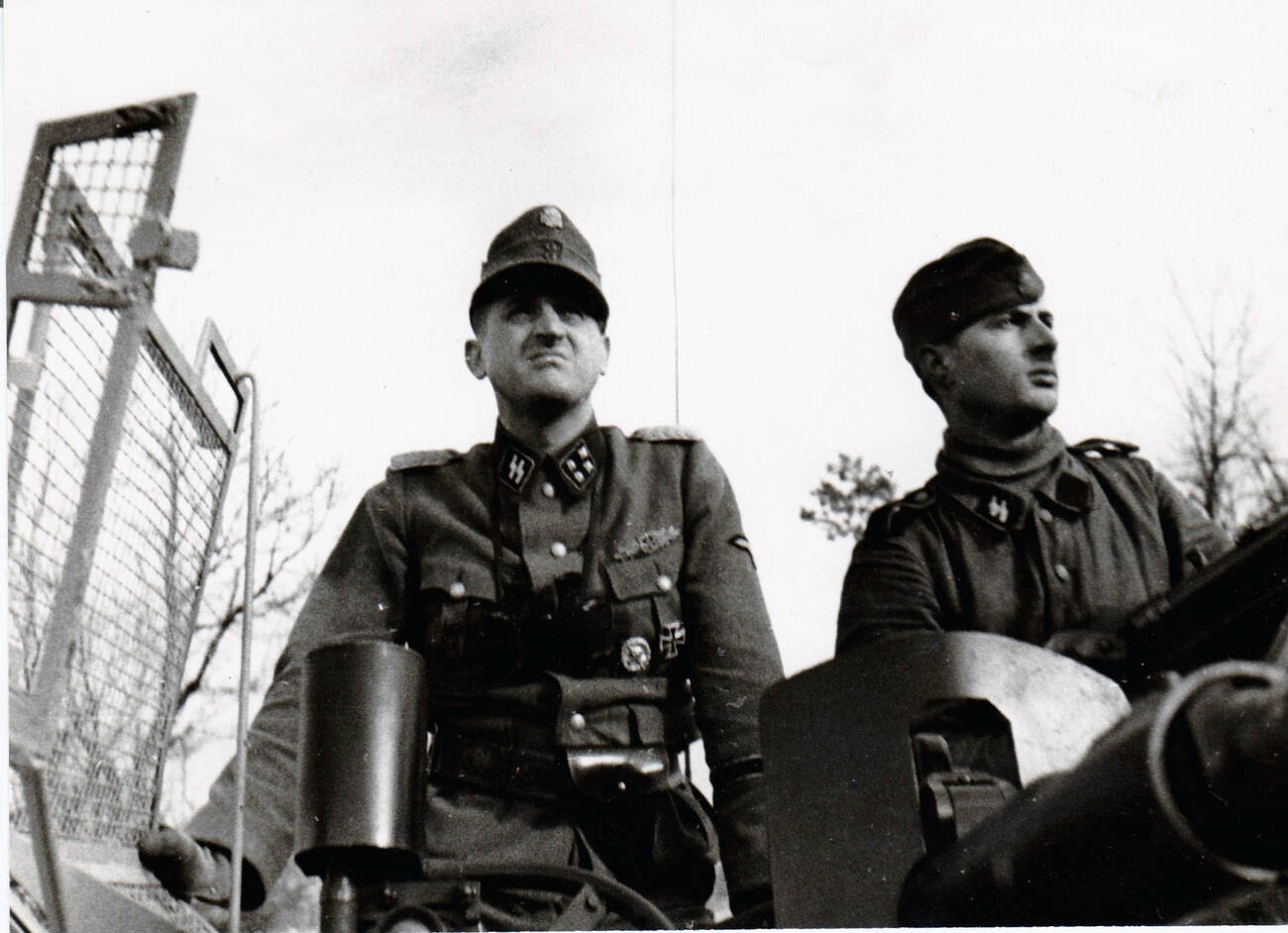
SS-Sturmbannführer Franz Hack (Kommandeur III.Bataillon / SS-Panzergrenadier-Regiment 9 "Germania" / 5.SS-Panzer-Division "Wiking") in an Sd.Kfz.250/9 Armoured Reconnaisance vehicle belong to 2.Kompanie / SS-Panzer-Aufklärungs-Abteilung 11 “Nordland”. The picture was taken by Ernst Baumann in the vicinity of Topolovac (near Sisak), Croatia, November 1943, when Hack visiting a Panzerspäh-Kompanie of SS-Panzer-Aufklärungs-Abteilung 11, which was in the Balkan area during the autumn of 1943.
These photos were taken by Ernst Baumann, who is commonly considered an SS war correspondent, but who may not actually have been one. They represent the fielding of SS-Panzer-Aufklärungs-Abteilung 11 “Nordland” with the Sd.Kfz. 250/9, Ausführung A (the Cäsar) for the 2nd Company, which was a Type “C” armored scout company. 16 of these vehicles were issued to the unit in Croatia on 4 November 1943, when the company was undergoing its final training prior to commitment in the northern part of the eastern front the following January. The field-grade officer seen here is SS-Sturmbannführer Franz Hack (Kommandeur III.Bataillon / SS-Panzergrenadier-Regiment 9 "Germania" / 5.SS-Panzer-Division "Wiking"), who was in Croatia at the same time supervising the train-up for the newly established SS-Panzer-Regiment 5 headquarters and its 2nd Battalion, as well as SS-Panzer-Regiment 11, which eventually became SS-Panzer-Abteilung 11 and schwere SS-Panzer-Abteilung 103/503. Hack apparently took an interest in the training of what would become the 2./SS-Panzer-Aufklärungs-Abteilung 11 “Nordland”, and used the opportunity to familiarize himself with the vehicle. This knowledge was most likely put to good use when Hack commanded SS-Panzer- Aufklärungs-Abteilung 5 “Wiking” from June through August 1944.

This picture was taken by Ernst Baumann in the vicinity of Topolovac (near Sisak), Croatia, November 1943, during the final training of 2.Kompanie / SS-Panzer-Aufklärungs-Abteilung 11 “Nordland” prior to commitment in the northern part of the eastern front the following January.

SS-Sturmbannführer Franz Hack (Kommandeur III.Bataillon / SS-Panzergrenadier-Regiment 9 "Germania" / 5.SS-Panzer-Division "Wiking") in an Sd.Kfz.250/9 Armoured Reconnaisance vehicle. This picture was taken by Ernst Baumann in the vicinity of Topolovac (near Sisak), Croatia, November 1943, during the final training of 2.Kompanie / SS-Panzer-Aufklärungs-Abteilung 11 “Nordland” prior to commitment in the northern part of the eastern front the following January.

SS-Sturmbannführer Franz Hack (Kommandeur III.Bataillon / SS-Panzergrenadier-Regiment 9 "Germania" / 5.SS-Panzer-Division "Wiking") in an Sd.Kfz.250/9 Armoured Reconnaisance vehicle. This picture was taken by Ernst Baumann in the vicinity of Topolovac (near Sisak), Croatia, November 1943, during the final training of 2.Kompanie / SS-Panzer-Aufklärungs-Abteilung 11 “Nordland” prior to commitment in the northern part of the eastern front the following January.

SS-Sturmbannführer Franz Hack (Kommandeur III.Bataillon / SS-Panzergrenadier-Regiment 9 "Germania" / 5.SS-Panzer-Division "Wiking") in an Sd.Kfz.250/9 Armoured Reconnaisance vehicle. This picture was taken by Ernst Baumann in the vicinity of Topolovac (near Sisak), Croatia, November 1943, during the final training of 2.Kompanie / SS-Panzer-Aufklärungs-Abteilung 11 “Nordland” prior to commitment in the northern part of the eastern front the following January.

SS-Sturmbannführer Franz Hack (Kommandeur III.Bataillon / SS-Panzergrenadier-Regiment 9 "Germania" / 5.SS-Panzer-Division "Wiking") in an Sd.Kfz.250/9 Armoured Reconnaisance vehicle. This picture was taken by Ernst Baumann in the vicinity of Topolovac (near Sisak), Croatia, November 1943, during the final training of 2.Kompanie / SS-Panzer-Aufklärungs-Abteilung 11 “Nordland” prior to commitment in the northern part of the eastern front the following January.

SS-Sturmbannführer Franz Hack (Kommandeur III.Bataillon / SS-Panzergrenadier-Regiment 9 "Germania" / 5.SS-Panzer-Division "Wiking") in an Sd.Kfz.250/9 Armoured Reconnaisance vehicle. This picture was taken by Ernst Baumann in the vicinity of Topolovac (near Sisak), Croatia, November 1943, during the final training of 2.Kompanie / SS-Panzer-Aufklärungs-Abteilung 11 “Nordland” prior to commitment in the northern part of the eastern front the following January.

SS-Sturmbannführer Franz Hack (Kommandeur III.Bataillon / SS-Panzergrenadier-Regiment 9 "Germania" / 5.SS-Panzer-Division "Wiking") in an Sd.Kfz.250/9 Armoured Reconnaisance vehicle. The vehicle maneuvers a bit cross-country before it conducts some target practice in the open countryside. This picture was taken by Ernst Baumann in the vicinity of Topolovac (near Sisak), Croatia, November 1943, during the final training of 2.Kompanie / SS-Panzer-Aufklärungs-Abteilung 11 “Nordland” prior to commitment in the northern part of the eastern front the following January.

SS-Sturmbannführer Franz Hack (Kommandeur III.Bataillon / SS-Panzergrenadier-Regiment 9 "Germania" / 5.SS-Panzer-Division "Wiking") in an Sd.Kfz.250/9 Armoured Reconnaisance vehicle. The vehicle maneuvers a bit cross-country before it conducts some target practice in the open countryside. This picture was taken by Ernst Baumann in the vicinity of Topolovac (near Sisak), Croatia, November 1943, during the final training of 2.Kompanie / SS-Panzer-Aufklärungs-Abteilung 11 “Nordland” prior to commitment in the northern part of the eastern front the following January.

SS-Sturmbannführer Franz Hack (Kommandeur III.Bataillon / SS-Panzergrenadier-Regiment 9 "Germania" / 5.SS-Panzer-Division "Wiking") in an Sd.Kfz.250/9 Armoured Reconnaisance vehicle. The vehicle maneuvers a bit cross-country before it conducts some target practice in the open countryside. This picture was taken by Ernst Baumann in the vicinity of Topolovac (near Sisak), Croatia, November 1943, during the final training of 2.Kompanie / SS-Panzer-Aufklärungs-Abteilung 11 “Nordland” prior to commitment in the northern part of the eastern front the following January.

SS-Sturmbannführer Franz Hack (Kommandeur III.Bataillon / SS-Panzergrenadier-Regiment 9 "Germania" / 5.SS-Panzer-Division "Wiking") in an Sd.Kfz.250/9 Armoured Reconnaisance vehicle. The vehicle maneuvers a bit cross-country before it conducts some target practice in the open countryside. This picture was taken by Ernst Baumann in the vicinity of Topolovac (near Sisak), Croatia, November 1943, during the final training of 2.Kompanie / SS-Panzer-Aufklärungs-Abteilung 11 “Nordland” prior to commitment in the northern part of the eastern front the following January.

Members of the 2.Kompanie / SS-Panzer-Aufklärungs-Abteilung 11 “Nordland” testing the gun of one of their newly-arrived half-tracks (Sd.Kfz. 250/9), in the vicinity of Topolovac (near Sisak), Croatia. Standing in the turret on the right is SS-Sturmbannführer Franz Hack (Kommandeur III.Bataillon / SS-Panzergrenadier-Regiment 9 "Germania" / 5.SS-Panzer-Division "Wiking"). This picture was taken by Ernst Baumann in November 1943, during the final training of 2nd Company prior to commitment in the northern part of the eastern front the following January.

Members of the 2.Kompanie / SS-Panzer-Aufklärungs-Abteilung 11 “Nordland” testing the gun of one of their newly-arrived half-tracks (Sd.Kfz. 250/9), in the vicinity of Topolovac (near Sisak), Croatia. Standing in the turret on the right is SS-Sturmbannführer Franz Hack (Kommandeur III.Bataillon / SS-Panzergrenadier-Regiment 9 "Germania" / 5.SS-Panzer-Division "Wiking"). This picture was taken by Ernst Baumann in November 1943, during the final training of 2nd Company prior to commitment in the northern part of the eastern front the following January.

Members of the 2.Kompanie / SS-Panzer-Aufklärungs-Abteilung 11 “Nordland” testing the gun of one of their newly-arrived half-tracks (Sd.Kfz. 250/9), in the vicinity of Topolovac (near Sisak), Croatia. This picture was taken by Ernst Baumann in November 1943, during the final training of 2nd Company prior to commitment in the northern part of the eastern front the following January.

SS-Sturmbannführer Franz Hack (Kommandeur III.Bataillon / SS-Panzergrenadier-Regiment 9 "Germania" / 5.SS-Panzer-Division "Wiking") in an Sd.Kfz.250/9 Armoured Reconnaisance vehicle. This picture was taken by Ernst Baumann in the vicinity of Topolovac (near Sisak), Croatia, November 1943, during the final training of 2.Kompanie / SS-Panzer-Aufklärungs-Abteilung 11 “Nordland” prior to commitment in the northern part of the eastern front the following January.

SS-Sturmbannführer Franz Hack (Kommandeur III.Bataillon / SS-Panzergrenadier-Regiment 9 "Germania" / 5.SS-Panzer-Division "Wiking") in an Sd.Kfz.250/9 Armoured Reconnaisance vehicle. This picture was taken by Ernst Baumann in the vicinity of Topolovac (near Sisak), Croatia, November 1943, during the final training of 2.Kompanie / SS-Panzer-Aufklärungs-Abteilung 11 “Nordland” prior to commitment in the northern part of the eastern front the following January.

Before departing, SS-Sturmbannführer Franz Hack (Kommandeur III.Bataillon / SS-Panzergrenadier-Regiment 9 "Germania" / 5.SS-Panzer-Division "Wiking") is held up to be given some information by an unidentified SS soldier wearing the iconic SS camouflage in a four-pocket tunic and cap. This picture was taken by Ernst Baumann in the vicinity of Topolovac (near Sisak), Croatia, November 1943, during the final training of 2.Kompanie / SS-Panzer-Aufklärungs-Abteilung 11 “Nordland” prior to commitment in the northern part of the eastern front the following January.

Before departing, SS-Sturmbannführer Franz Hack (Kommandeur III.Bataillon / SS-Panzergrenadier-Regiment 9 "Germania" / 5.SS-Panzer-Division "Wiking") is held up to be given some information by an unidentified SS soldier wearing the iconic SS camouflage in a four-pocket tunic and cap. For the vehicle's camo itself, At last as far as the Sd.Kfz.250/9 version goes, a majority seem to be relatively plain with no camouflage. It is possible that this coincides with the early-mid War norms for, say, 1943. You tend to see lighter vehicles through Kursk and into the fall, and 1944, and then darker colored schemes from mid 1944 onward. This picture was taken by Ernst Baumann in the vicinity of Topolovac (near Sisak), Croatia, November 1943, during the final training of 2.Kompanie / SS-Panzer-Aufklärungs-Abteilung 11 “Nordland” prior to commitment in the northern part of the eastern front the following January.
 Before departing, SS-Sturmbannführer Franz Hack (Kommandeur
III.Bataillon /
SS-Panzergrenadier-Regiment 9 "Germania" / 5.SS-Panzer-Division
"Wiking") is held up to be given some information by an unidentified SS
soldier wearing the iconic SS camouflage in a four-pocket tunic and cap.
This
picture was taken by Ernst Baumann in the vicinity of Topolovac
(near Sisak), Croatia, November 1943, during the final training of
2.Kompanie / SS-Panzer-Aufklärungs-Abteilung 11 “Nordland” prior to
commitment in the northern part of the eastern front the following
January.
Before departing, SS-Sturmbannführer Franz Hack (Kommandeur
III.Bataillon /
SS-Panzergrenadier-Regiment 9 "Germania" / 5.SS-Panzer-Division
"Wiking") is held up to be given some information by an unidentified SS
soldier wearing the iconic SS camouflage in a four-pocket tunic and cap.
This
picture was taken by Ernst Baumann in the vicinity of Topolovac
(near Sisak), Croatia, November 1943, during the final training of
2.Kompanie / SS-Panzer-Aufklärungs-Abteilung 11 “Nordland” prior to
commitment in the northern part of the eastern front the following
January.
This picture was taken by Ernst Baumann in the vicinity of Topolovac (near Sisak), Croatia, November 1943, during the final training of 2.Kompanie / SS-Panzer-Aufklärungs-Abteilung 11 “Nordland” prior to commitment in the northern part of the eastern front the following January. In addition to preparing for combat deployment, the company was also required to conduct show-of-force missions in an effort to reduce the number of partisan incidents and activities.

This picture was taken by Ernst Baumann in the vicinity of Topolovac (near Sisak), Croatia, November 1943, during the final training of 2.Kompanie / SS-Panzer-Aufklärungs-Abteilung 11 “Nordland” prior to commitment in the northern part of the eastern front the following January. In addition to preparing for combat deployment, the company was also required to conduct show-of-force missions in an effort to reduce the number of partisan incidents and activities.

This picture was taken by Ernst Baumann in the vicinity of Topolovac (near Sisak), Croatia, November 1943, during the final training of 2.Kompanie / SS-Panzer-Aufklärungs-Abteilung 11 “Nordland” prior to commitment in the northern part of the eastern front the following January. In addition to preparing for combat deployment, the company was also required to conduct show-of-force missions in an effort to reduce the number of partisan incidents and activities.

This picture was taken by Ernst Baumann in the vicinity of Topolovac (near Sisak), Croatia, November 1943, during the final training of 2.Kompanie / SS-Panzer-Aufklärungs-Abteilung 11 “Nordland” prior to commitment in the northern part of the eastern front the following January. In addition to preparing for combat deployment, the company was also required to conduct show-of-force missions in an effort to reduce the number of partisan incidents and activities.

This picture was taken by Ernst Baumann in the vicinity of Topolovac (near Sisak), Croatia, November 1943, during the final training of 2.Kompanie / SS-Panzer-Aufklärungs-Abteilung 11 “Nordland” prior to commitment in the northern part of the eastern front the following January. In addition to preparing for combat deployment, the company was also required to conduct show-of-force missions in an effort to reduce the number of partisan incidents and activities.

This picture was taken by Ernst Baumann in the vicinity of Topolovac (near Sisak), Croatia, November 1943, during the final training of 2.Kompanie / SS-Panzer-Aufklärungs-Abteilung 11 “Nordland” prior to commitment in the northern part of the eastern front the following January. In addition to preparing for combat deployment, the company was also required to conduct show-of-force missions in an effort to reduce the number of partisan incidents and activities.

This picture was taken by Ernst Baumann in the vicinity of Topolovac (near Sisak), Croatia, November 1943, during the final training of 2.Kompanie / SS-Panzer-Aufklärungs-Abteilung 11 “Nordland” prior to commitment in the northern part of the eastern front the following January. In addition to preparing for combat deployment, the company was also required to conduct show-of-force missions in an effort to reduce the number of partisan incidents and activities.

This picture was taken by Ernst Baumann in the vicinity of Topolovac (near Sisak), Croatia, November 1943, during the final training of 2.Kompanie / SS-Panzer-Aufklärungs-Abteilung 11 “Nordland” prior to commitment in the northern part of the eastern front the following January. It shows several other vehicles of the company. The Sd.Kfz.250 series received a simplified New/Neu style body and revised turret mid-war, so this is a late type 250/9 reflecting the new design for the hull and turret.

This picture was taken by Ernst Baumann in the vicinity of Topolovac (near Sisak), Croatia, November 1943, during the final training of 2.Kompanie / SS-Panzer-Aufklärungs-Abteilung 11 “Nordland” prior to commitment in the northern part of the eastern front the following January. It shows the rarely photographed Panzer II, Ausführung J, originally developed for scout duties with a production run of less than fifty vehicles, can be seen in the background. It is not known whether the company was issued any of these vehicles or it (and others?) was just lent to the company for training purposes.
Source :
Heiner Duske photo collection
"Scouts Out: A History of German Armored Reconnaissance Units in World War II" by Robert Edwards
"Batailles et Blindés" n°32, August-September 2009
"TNT" Special issue No. 15, December 2013 - January 2014
https://www.alamy.com/waffen-ss-officer-franz-hack-in-an-armoured-reconnaisance-vehicle-hack-was-a-panzer-grenadier-regimental-commander-in-the-5th-ss-panzer-division-wiking-image255373050.html
https://author.today/reader/138711/1180282
http://bandenkampf.blogspot.com/2018/09/bk0366.html
https://www.flickr.com/photos/130556552@N02/18238233665
"Batailles et Blindés" n°32, August-September 2009
"TNT" Special issue No. 15, December 2013 - January 2014
https://www.alamy.com/waffen-ss-officer-franz-hack-in-an-armoured-reconnaisance-vehicle-hack-was-a-panzer-grenadier-regimental-commander-in-the-5th-ss-panzer-division-wiking-image255373050.html
https://author.today/reader/138711/1180282
http://bandenkampf.blogspot.com/2018/09/bk0366.html
https://www.flickr.com/photos/130556552@N02/18238233665
https://forum.axishistory.com/viewtopic.php?f=38&t=205828&hilit=franz+hack
https://www.track-link.com/forums/site_blogs/56239
https://www.track-link.com/forums/site_blogs/56239


%20and%20his%20driver,%20Trooper%20Hyatt.jpg)


