Showing posts with label 5 Infanterie-Division 79. Show all posts

Thursday, July 4, 2024

Visit of Erwin von Witzleben to 79. Infanterie-Division


On 2 May 1940 Generaloberst Erwin von Witzleben (Oberbefehlshaber 1. Armee) and Reichsminister Rudolf Hess visiting the HQ of 79. Infanterie-Division in Saarpfalz. This picture shows the inspection of the troops by Von Witzleben (saluting), while behind him is Generalmajor Karl Strecker (Kommandeur 79. Infanterie-Division).

Source :
https://www.andreas-thies.de/katalog/A81.html

Thursday, June 15, 2023

Bio of Feldwebel Jakob Roth (1912-1979)

Jakob Roth

Date of Birth: 27.12.1912 - Lachen, Bayern (German Empire)
Date of Death: 17.03.1979 - Neustadt an der Weinstraße, Rheinland-Pfalz (West Germany)

Promotions:
00.00.194_ Feldwebel

Career:
00.00.194_ Zugführer in 2.Kompanie / Grenadier-Regiment 208 / 79.Infanterie-Division

Awards and Decorations:
00.00.19__ Eisernes Kreuz II.Klasse
00.00.19__ Infanterie-Sturmabzeichen
00.00.19__ Eisernes Kreuz I.Klasse
00.00.19__ Verwundetenabzeichen
00.00.194_ Nahkampfspange
04.06.1944 Ritterkreuz des Eisernen Kreuzes, as Unteroffizier and Zugführer in 2.Kompanie / I.Bataillon / Grenadier-Regiment 208 / 79.Infanterie-Division


Source :
Jim Haley photo collection
https://www.tracesofwar.com/persons/88864/Roth%C2%A0Jakob-Grenadier-Regiment-208.htm

Saturday, December 3, 2022

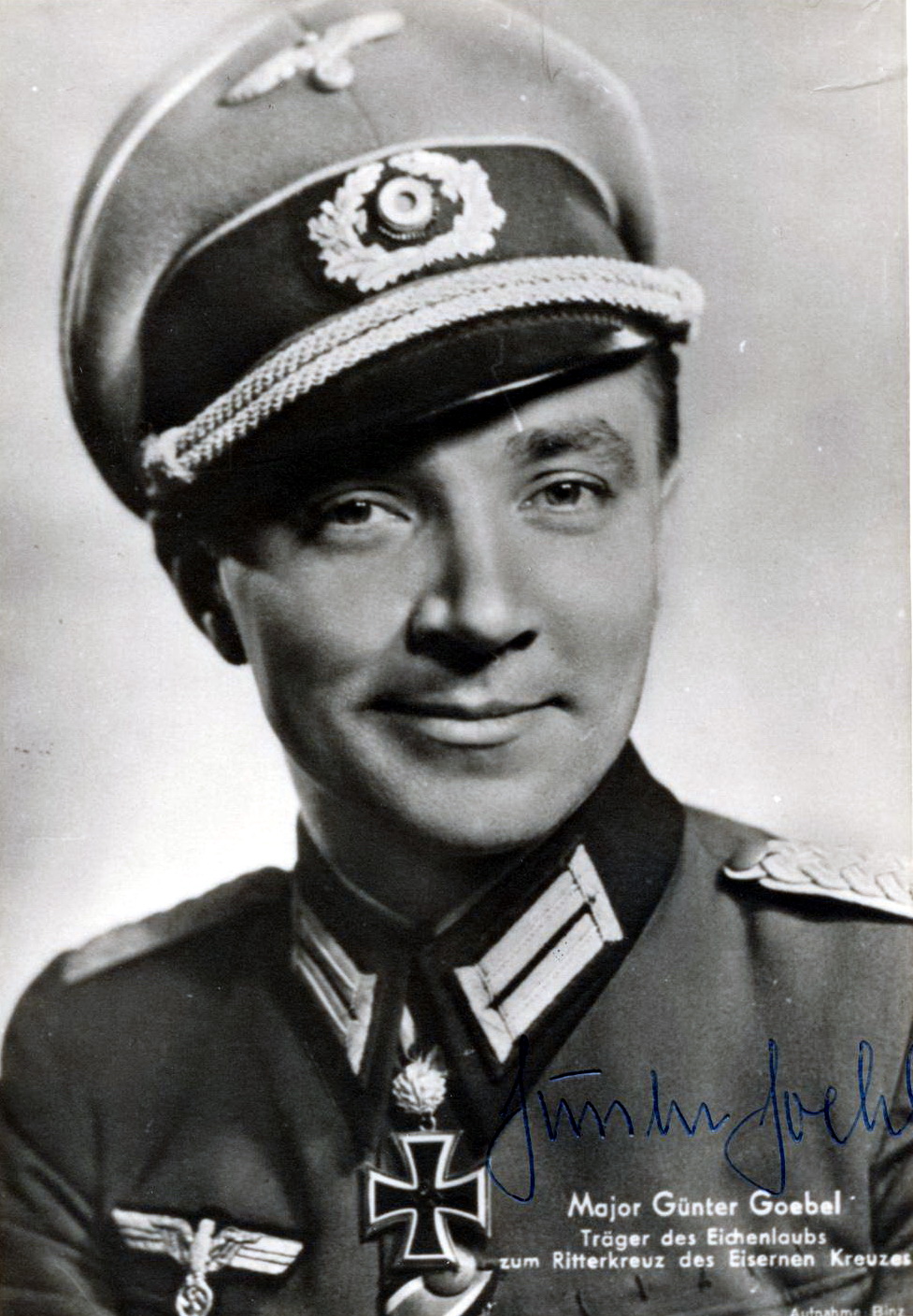
Ritterkreuz Actions of Günter Goebel

Günter Goebel (14 November 1917 - 4 September 1993) received the Ritterkreuz des Eisernen Kreuzes on 18 October 1941 as Adjutant Infanterie-Regiment 208 / 79.Infanterie-Division. On 14 September 1941 Oberleutnant Goebel made the independent decision to take command of a Radfahr-Bataillon that was temporary leaderless. By doing this, and continuing an attack with this unit immediately afterwards, it was possible to push the enemy back and win a lot of ground in a relatively short amount of time. On the very next day Goebel launched another bold attack that stormed a Soviet airfield. In the process a number of aircraft were destroyed on the ground. Along with this success an enemy army-level depot was also captured undamaged. For the sum of his achievements during this time Goebel would receive the Ritterkreuz.

Goebel received the Eichenlaub #180 for his Ritterkreuz on 18 January 1943 as Hauptmann and Führer Kampfgruppe Goebbel / 79.Infanterie-Division. On 17 December 1942 Hauptmann Goebel commanded a Kampfgruppe in the area of the 384. Infanterie-Division, specifically near Nishnij-Tschirskaja (along the Chir river). Starting on this day Goebel would hold his assigned bridgehead for weeks, up until 1 January 1943. By this action he played a major role in holding the Soviets along the Chir river and preventing them from immediately advancing further towards the west and southwest. He would receive the Eichenlaub in recognition of this accomplishment.


Source :
https://www.alexautographs.com/auction-lot/gunter-goebel_2E347D696E
https://www.tracesofwar.com/persons/29961/Goebel-G%C3%BCnter.htm

Bio of Oberstleutnant Günter Goebel (1917-1993)


Günter Goebel

Date of birth : 14 November 1917 at Hagen-Haspe, Westfalen (German Empire)
Date of death : 4 September 1993 at Hagen, Westfalen (Germany)

Promotions:
00.00.1938 Leutnant
01.06.1940 Oberleutnant
01.02.1942 Hauptmann
01.02.1943 Major
01.03.1945 Oberstleutnant

Career:
00.00.1936 Joined Infanterie-Regiment 18
00.00.1939 Adjutant III.Bataillon / Infanterie-Regiment 208
00.00.1942 Attended Generalstabsausbildung
00.00.1943 Attended Kriegsakademie Hirschberg in Silesia
01.04.1944 Posted in the Generalstab des Heeres
00.00.1944 Ib 61. Infanterie-Division
00.00.1944 Stellvertretender Quartiermeister XXXXIII. Armeekorps
00.00.1944 Ia L. Armeekorps
00.00.1944 Ia 218. Infanterie-Division
00.00.1945 Ia 215. Infanterie-Division
00.00.1945 Kommandeur Grenadier-Regiment 189
11.05.1945 Taken prisoner by the Russians
00.10.1955 Released from the POW camp

Awards and Decorations:
04.11.1939 Eisernes Kreuz II.Klasse
18.06.1940 Eisernes Kreuz I.Klasse
00.00.194_ Infanterie-Sturmabzeichen in Silber
18.10.1941 Ritterkreuz des Eisernen Kreuzes, as Oberleutnant and Adjutant Infanterie-Regiment 208 / 79.Infanterie-Division
06.11.1941 Ehrenblattspange des Heeres und Waffen-SS
00.00.1942 Medaille "Winterschlacht im Osten 1941/42" (Ostmedaille)
00.00.194_ Verwundetenabzeichen in Schwarz
00.00.194_ Goldenes HJ-Ehrenzeichen
18.01.1943 Ritterkreuz des Eisernen Kreuzes mit Eichenlaub #180, as Hauptmann and Führer Kampfgruppe Goebel / 79.Infanterie-Division
00.04.1944 Nahkampfspange in Silber


Source :
https://www.alexautographs.com/auction-lot/gunter-goebel_2E347D696E
https://de.metapedia.org/wiki/Goebel,_G%C3%BCnter
https://forum.axishistory.com/viewtopic.php?p=2444035#p2444035
http://www.specialcamp11.co.uk/Oberstleutnant%20Gunter%20Goebel.htm
https://www.tracesofwar.com/persons/29961/Goebel-G%C3%BCnter.htm

Sunday, September 19, 2021

Ritterkreuz Action of Karl-Willi Lumpp

Karl-Willi "Peter" Lumpp (26 June 1915 - 31 March 2001) received the Ritterkreuz des Eisernen Kreuzes on 18 July 1943 as Oberleutnant der Reserve and Führer 3.Kompanie / I.Bataillon / Grenadier-Regiment 226 / 79.Infanterie-Division. Here is his story: After repeated efforts to smash through the centre of the German Blue Line, the Soviet 56th Army shifted its main effort northwards in late May 1943 and tried to advance along the Kiyevskoye–Varenikovskaya road. The German 79.Infanterie-Division had been destroyed at Stalingrad in February but it was quickly reconstituted and sent to the Kuban in mid-May. Yet despite its ad hoc constitution, the new 79.Infanterie-Division proved very solid in the defence, even when attacked by masses of Soviet infantry and tanks on 27 May. The key to the German main line of defence in this sector proved to be the tiny village of Borisovka, just east of Kiyevskoye, held by I./Grenadier-Regiment 226. Relentless Soviet artillery bombardments and attacks decimated the German battalion, reducing it to just 83 men, but the village was held. After the battalion commander was badly wounded, Oberleutnant d. R. Karl-Will Lumpp, commander of 3.Kompanie, assumed command of the survivors. On the morning of 28 May, the Soviet 32nd Guards Rifle Division mounted an all-out attack, supported by tanks and artillery, which overran most of Borisovka. Lumpp was wounded, and after most of their ammunition was exhausted, his men were forced to retreat into one corner of the village. However, German doctrine was always to counterattack before the enemy could consolidate on the objective and Lumpp managed to rally the last 50 survivors and lead them in a desperate effort to recover the village. The Germans surged forward, armed with entrenching tools, bayonets and rifle butts and caught the Soviet infantry by surprise. A frenzied, close-quarter melee ensued, while Lump managed to destroy a Soviet tank with a magnetic mine. The fighting in Borisovka was vicious and typical of the infantry combat in the Kuban. Caught off balance by Lumpp's counterattack, the Soviets abandoned the village and retreated. Lumpp, who was wounded six times, was awarded the Ritterkreuz for his accomplishment in preventing an enemy breakthrough.


Source :
https://www.facebook.com/ILoveMilitaryHistory/posts/1091746604687574
https://www.tracesofwar.com/persons/39271/Lumpp-Karl-Willi-Peter.htm