Showing posts with label 8 Uniform Kradmantel. Show all posts

Tuesday, July 7, 2026

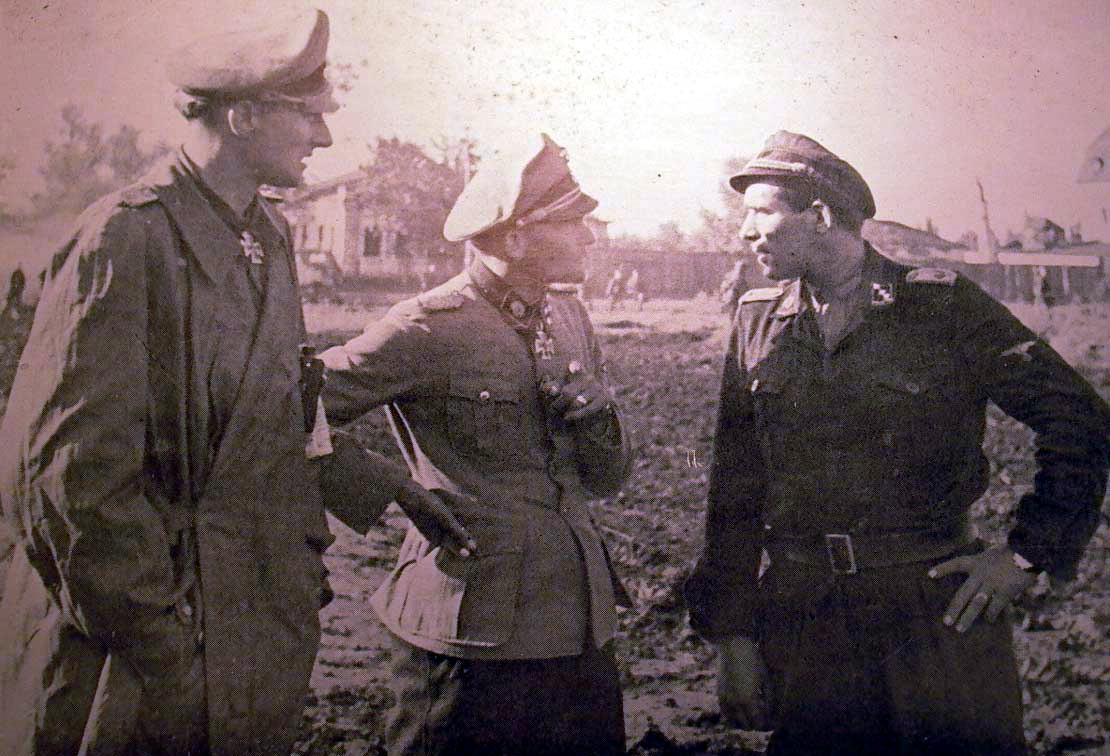
Ritterkreuzträger in Kradmantel


The German Kradmantel, or motorcyclist's protective coat, was a distinctive and highly functional piece of Wehrmacht equipment that played a vital role during World War II. Introduced on November 12, 1934, as the Schutzmantel für Kraftradfahrer, it was specifically designed for motorcycle troops—known as Kradschützen or Kradmelder—including dispatch riders, reconnaissance units, and field police who operated high-mobility BMW R75 and Zündapp KS 750 sidecar motorcycles across Europe's varied terrains. Constructed primarily from rubberized grey-green fabric for waterproofing and wind resistance, the three-quarter-length, double-breasted coat featured a large cut to wear comfortably over standard field uniforms, equipment, and even steel helmets. Early versions had matching rubberized collars, while later M1940 models incorporated a contrasting dark green or field-grey wool collar for added warmth and style. It included pebbled buttons, an inner chest pocket, and versatile fastening options—such as buttoning the hem to form leg coverings or turning up the collar—that allowed troops to adapt it for riding in rain, mud, dust, or cold. Variants included tropical olive linen versions for the Afrika Korps. Popular among soldiers for its rugged durability, protective qualities, and somewhat stylish appearance that evoked a dashing image of mechanized warfare, the Kradmantel saw service from the Blitzkrieg campaigns in Poland and France through the harsh Eastern Front winters and North African deserts. Though production and material quality declined later in the war, originals and reproductions remain prized collector items today, symbolizing the German emphasis on mobile infantry tactics in the early years of the conflict.

------------------------------------------------------------------------------------------------------------

HEER


General der Panzertruppe Leo Geyr von Schweppenburg (1886-1974), born on 2 March 1886 in Potsdam into a Prussian military aristocratic family with a legacy of producing Field Marshals, was a highly regarded German officer who rose to the rank of General der Panzertruppe and became one of the Wehrmacht's foremost experts in armoured warfare. Joining the German Army in 1904, he served with distinction in World War I on multiple fronts as a Rittmeister, remained in the Reichswehr during the interwar period, advanced to Oberst in 1932 and Generalmajor in 1935, and served as military attaché to the United Kingdom, Belgium, and the Netherlands from 1933 to 1937 while based in London. Promoted to Generalleutnant, he assumed command of the 3. Panzer-Division in 1937, leading it effectively during the 1939 invasion of Poland as its most powerful armoured formation with 391 tanks, earning battlefield praise from Hitler for actions at Kulm. In February 1940 he took command of the XXIV. Armeekorps (motorisiert), directing it through the 1940 Battle of France before spearheading advances in Operation Barbarossa as part of Generaloberst Heinz Guderian's 2. Panzerarmee in Army Group Centre. On 9 July 1941, as General der Panzertruppe and Kommandierender General of the XXIV. Armeekorps (motorisiert), Geyr von Schweppenburg was awarded the Ritterkreuz des Eisernen Kreuzes for his masterful leadership during the initial phases of the invasion of the Soviet Union: he skillfully planned his Panzerkorps' crossing of the Bug river, then drove energetically through the challenging terrain of Polesia to Kobryn, directing an unstoppable five-day advance to Bereza Kartuska and Sluck that resulted in the capture or destruction of approximately 150 enemy tanks and a similar number of artillery pieces, while personally exemplifying devotion to duty in the foremost combat zones and contributing decisively to the broader objectives of the Panzergruppe. Later commands included the XXXX. Panzerkorps in the Caucasus, Panzergruppe West (formalised as 5. Panzerarmee) in France where he prepared armoured reserves and attempted counteractions during the 1944 Normandy invasion until wounded in an Allied air attack on his headquarters at La Caine, followed by service as Inspector General of Armoured Troops until 1945. Postwar, after American captivity, he contributed to historical studies and the formation of the Bundeswehr before his death on 27 January 1974 in Irschenhausen.


Source :
https://www.iwm.org.uk/collections/item/object/30100753

Saturday, January 11, 2025

Heinz Guderian and Adolf-Friedrich Kuntzen


General der Panzertruppe Heinz Guderian (Kommandierender General XIX. Armeekorps), inside the Sd.Kfz.251/3 halftrack vehicle, in conversation with Generalleutnant Adolf-Friedrich Kuntzen (Kommandeur 8. Panzer-Division), giving his last instructions before an attack to the enemy. For his bold forward drive and brave attitude during the breakthrough to the Channel coastline - especially in the Battle of Montreuil sur Mer - Divisionskommandeur Kuntzen would receive the Ritterkreuz des Eisernen Kreuzes on 3 June 1940. The picture itself was taken by Kriegsberichter Erich Borchert in France, May 1940.

Source :
Bundesarchiv Bild 101I-769-0229-02A
https://www.gettyimages.com/detail/news-photo/world-war-ii-heinz-guderian-german-general-leader-of-the-news-photo/92423822
https://www.tracesofwar.com/persons/69888/Kuntzen-Adolf-Friedrich.htm

Sunday, August 18, 2024

Heinz Guderian during Operation Barbarossa (Color)


Generaloberst Heinz Guderian (Befehlshaber Panzergruppe 2) with his troops during the first weeks of Unternehmen Barbarossa, German invasion of Soviet Union, July 1941. He is not yet wearing the Eichenlaub for his Ritterkreuz, which he received on 17 July 1941.


These are color slides that was broken-up at eBay back in 2007. It shows Panzergruppe 2 (Generaloberst Heinz Guderian) in the Eastern Front during Unternehmen Barbarossa, July 1941. The slides were taken at the Panzer-Abteilung (Flamm) 100 which operated in the first part of Operation Barbarossa together with 18. Panzer-Divison. The photographer was Bildberichterstatter Heinz Eckert.


Generaloberst Heinz Guderian (Befehlshaber Panzergruppe 2) with his troops during the first weeks of Unternehmen Barbarossa, German invasion of Soviet Union, July 1941. He is not yet wearing the Eichenlaub for his Ritterkreuz, which he received on 17 July 1941.


Generaloberst Heinz Guderian (Befehlshaber Panzergruppe 2) with his troops during the first weeks of Unternehmen Barbarossa, German invasion of Soviet Union, July 1941. He is not yet wearing the Eichenlaub for his Ritterkreuz, which he received on 17 July 1941.


Generaloberst Heinz Guderian (wearing generalmantel, Befehlshaber Panzergruppe 2) with Generalleutnant Walter Model (left, Kommandeur 3. Panzer-Division) during the first weeks of Unternehmen Barbarossa, German invasion of Soviet Union, July 1941.


Generaloberst Heinz Guderian (wearing generalmantel, Befehlshaber Panzergruppe 2) with Generalleutnant Walter Model (left, Kommandeur 3. Panzer-Division) during the first weeks of Unternehmen Barbarossa, German invasion of Soviet Union, July 1941.


Source :
http://alifrafikkhan.blogspot.com/2010/05/foto-foto-terbaik-heinz-guderian.html
https://www.barbarossa1941.com/barbarossa-photo-gallery
https://www.invaluable.com/auction-lot/10-reproduction-color-photos-general-guderian-1760-c-fb34c4f9ec
http://thirdreichcolorpictures.blogspot.com/2010/02/generaloberst-heinz-wilhelm-guderian.html
http://ww2colorfarbe.blogspot.com/2020/08/panzergruppe-2-during-operation.html

Tuesday, June 11, 2024

Heinz von Brese-Winiary and Karl Lorenz


At the end of August 1944, an advance of Panzergrenadier-Division "Grossdeutschland" northwards towards Tukkum and Mitau was made in order to maintain contact with the fellow German units fighting in Courland. The attack stopped in front of Doblen. This picture shows Divisionsführer Oberst Karl Lorenz (right) with Oberst Heinz Wittchow von Brese-Winiary (Kommandeur Panzer-Füsilier-Regiment "Grossdeutschland").


At the end of August 1944, an advance of Panzergrenadier-Division "Grossdeutschland" northwards towards Tukkum and Mitau was made in order to maintain contact with the fellow German units fighting in Courland. The attack stopped in front of Doblen. This picture shows Divisionsführer Oberst Karl Lorenz (right) with Oberst Heinz Wittchow von Brese-Winiary (Kommandeur Panzer-Füsilier-Regiment "Grossdeutschland").


Source :
"Panzergrenadier-Division Großdeutschland" by Horst Scheibert
https://www.ebay.com/itm/194510072741

Sunday, June 2, 2024

Hasso von Manteuffel using Field Telephone on a Halftrack


Generalleutnant Hasso von Manteuffel (Kommandeur Panzergrenadier-Division "Grossdeutschland") chatting through the field telephone while sitting on the Sd.Kfz.250 halftrack, during the battle in the Eastern Front, 1944. At right is a Gefreiter from Nachrichtentruppe (signal unit), possibly a radio operator. Interestingly, the corporal sported a Panzervernichtungsabzeichen in his right sleeve, meaning that he had at least destroyed an enemy tank by hand-held weapon, such a rare feat for a rear-echelon man!
 
Source :
https://onb.digital/result/10DE77E5

Saturday, June 1, 2024

Hasso von Manteuffel Signed Photographs


These two pictures were signed by Hasso von Manteuffel postwar, along with the remark "May 1944". Based from the archive source. It was actually taken in July 1944 by Kriegsberichter Theodor Scheerer and it shows Generalleutnant Hasso von Manteuffel (Kommandeur Panzergrenadier-Division "Grossdeutschland") at his advanced command post in Romania.


Source :
https://www.alexautographs.com/auction-lot/hasso-von-manteuffel_DA24F46861
http://alifrafikkhan.blogspot.com/2010/10/album-foto-general-der-panzertruppe.html
https://www.invaluable.com/auction-lot/ww2-german-general-of-5th-panzer-army-hasso-von-m-115-c-8b14586adb
https://www.rtbf.be/article/la-veste-d-un-general-nazi-repenti-relique-de-la-bataille-des-ardennes-au-bastogne-war-museum-10666202

Sunday, May 26, 2024

Hasso von Manteuffel and Karl Lorenz


Two officers of Grossdeutschland Division in the Eastern Front, summer 1944. From left to right: Oberst Karl Lorenz (Kommandeur Panzergrenadier-Regiment "Grossdeutschland") and Generalleutnant Hasso von Manteuffel (Kommandeur Panzergrenadier-Division "Grossdeutschland"). In the background is a Panther tank belong to the division's Panzer Regiment.

Source :
https://www.magnum-x.pl/artykul/manteuffel
https://www.warrelics.eu/forum/imperial-germany-austro-hungary/kaisers-mena-s-medals-831408-39/

Sunday, May 12, 2024

Hasso von Manteuffel and Romanian Soldier


Generalleutnant Hasso von Manteuffel (Kommandeur Panzergrenadier-Division "Grossdeutschland") views the positions of his troops on the front in Romania, accompanied by a Romanian liaison officer, 11 July 1944. The picture was taken by Kriegsberichter Theodor Scheerer. Original caption: "Bild Deutsch-Rumänischen Waffenbrüderschaft. Schwerterträger Generalleutnant von Manteuffel, Kommandeur der Panzer-Grenadier-Division 'Grossdeutschland' auf seinem vorgeschobenen Gefechtsstand mit einem rumänischen Melder." (Image German-Romanian Brotherhood in Arms. Sword holder Lieutenant General von Manteuffel, commander of the Panzer Grenadier Division 'Grossdeutschland', at his advanced command post with a Romanian signaller)


Generalleutnant Hasso von Manteuffel (Kommandeur Panzergrenadier-Division "Grossdeutschland") in front of a scherenfernrohr (scissor telescope) at his advanced command post with a Romanian soldier, 8 July 1944. The picture was taken by Kriegsberichter Theodor Scheerer. Original caption: "Deutsche rumänische Waffenkameradschaft. Schwerterträger, Generalleutnant von Manteuffel, Kommodere der Panzer Grenadier-Division 'Grossdeutschland' auf seinem vorgeschobenen Gefechtsstand mit einem rumänischen Melder." (German-Romanian comradeship in arms. Sword holder, Lieutenant General von Manteuffel, commander of the Panzer Grenadier Division 'Grossdeutschland' at his advanced command post with a Romanian signaller)


Source :
https://audiovis.nac.gov.pl/obraz/1769/5f215557fcf6d8479a9328d87238a9e6/
https://beeldbankwo2.nl/nl/beelden/detail/da437c9e-0259-11e7-904b-d89d6717b464/media/7c594051-af8e-8035-e650-bcf216bea545?mode=detail&view=horizontal&q=manteuffel&rows=1&page=5
https://dev.wehrmacht-awards.com/forums/forum/community-forums/collections-display-forum/580703-my-collection-of-pics-of-german-generals
https://waralbum.ru/395660/

Friday, January 12, 2024

Visit of Heinrich Himmler to the Swiss Border

From left to right: SS-Hauptsturmführer Joachim "Jochen" Peiper (1. Adjutant Reichsführer-SS), SS-Obergruppenführer Werner Lorenz (Reichskommissar für die Festigung deutschen Volkstums), SS-Gruppenführer und Generalleutnant der Waffen-SS Karl Wolff (Chef des Hauptamtes Persönlicher Stab Reichsführer-SS), SS-Brigadeführer Ulrich Greifelt (Chef des Generalstabes Reichskommissar für die Festigung deutschen Volkstums), Reichsführer-SS Heinrich Himmler (Chef der SS und deutschen Polizei), and Oberst Ferdinand Schörner (Führer 6. Gebirgs-Division). The picture was taken on 15 July 1940 at Verrières-de-Joux, on the border between France and Switzerland, during personal inspection by Reichsführer-SS Himmler. Oberst Schörner, as head of the sector for being the Commander of the 6th Mountain Division, guided him and answered his questions.


The photograph of Heinrich Himmler, head of the SS and Police, on the French-Swiss border of Verrières-de-Joux, has crossed the ages as much as the name of the sad character it depicts. present. This historical episode is not the most important of the Second World War but it left a strong impression on the minds of the inhabitants of Haut-Doubs at the time.

This happened just some time after the Armistice of June 22, 1940. France was then occupied by the Germans who were enjoying their victory. If Himmler's smiling face was immortalized in this place, it is simply because senior Nazi dignitaries took pleasure in visiting occupied countries. Such as Heinrich Himmler, therefore, Reichsführer-SS of the Third Reich, head of the Gestapo, minister and main instigator of the Final Solution, on July 15, 1940, was on the border between France and Switzerland at Verrières-de-Joux in within the framework of the Burgund project (population displacement plan).

Leaning with other officers on the barrier which marks the Franco-Swiss border at Verrières, he looks ironically at Switzerland and the village of Verrières. His dream then, probably, being to invade this neutral country with his powerful army.


From left to right: SS-Hauptsturmführer Joachim "Jochen" Peiper (1. Adjutant Reichsführer-SS), SS-Obergruppenführer Werner Lorenz (Reichskommissar für die Festigung deutschen Volkstums), SS-Gruppenführer und Generalleutnant der Waffen-SS Karl Wolff (Chef des Hauptamtes Persönlicher Stab Reichsführer-SS), SS-Brigadeführer Ulrich Greifelt (Chef des Generalstabes Reichskommissar für die Festigung deutschen Volkstums), Reichsführer-SS Heinrich Himmler (Chef der SS und deutschen Polizei), and Oberst Ferdinand Schörner (Führer 6. Gebirgs-Division). The picture was taken on 15 July 1940 at Verrières-de-Joux, on the border between France and Switzerland, during personal inspection by Reichsführer-SS Himmler. In this picture, Himmler is in conversation with the Swiss Border Guard.


Source :
Bayerische Staatsbibliothek photo archive (Image-No.: 50134384)
https://www.ashsm.ch/CMS/fr/item/221-resume-la-suisse-son-service-de-renseignement-et-la-ss
https://www.estrepublicain.fr/societe/2021/01/29/savez-vous-pourquoi-le-chef-de-la-gestapo-s-est-fait-photographier-aux-verrieres-de-joux
https://forum.axishistory.com/viewtopic.php?f=5&t=94182&hilit=ferdinand+sch%C3%B6rner&start=15
https://www.watson.ch/schweiz/wissen/842190908-die-schweiz-im-krieg-diese-alten-fotos-treffen-mitten-ins-herz

Sunday, December 3, 2023

Paul Hausser and Heinz Harmel at Kursk

The combat briefing of SS-Panzergrenadier-Division "Das Reich" during the Battle of Kursk, summer 1943. From left to right: unknown, SS-Obersturmbannführer Karl Kreutz (Kommandeur SS-Panzer-Artillerie-Regiment 2 "Das Reich"), SS-Standartenführer Heinz Harmel (Kommandeur SS-Panzergrenadier-Regiment "Deutschland"), SS-Obergruppenführer und General der Waffen-SS Paul Hausser (Kommandierender General II. SS-Panzerkorps), and SS-Standartenführer Dipl.-Ing. Heinz Lammerding (Kommandeur Kampfgruppe Lammerding).

Source :
"Kursk 1943: The Tide Turns In The East" by Mark Healy
https://www.akpool.co.uk/postcards/31295047-postcard-general-eines-ss-panzer-korps-ss-obergruppenfuehrer-general-der-waffen-ss-paul-hausser
http://alifrafikkhan.blogspot.com/2018/06/foto-paul-hausser.html
https://dutchmilitaria.com/product/postcard-kommandierende-general-ss-pz-korps-ss-obergruppenfuhrer-und-general-der-waffen-ss-paul-hausser-bei-einer-lagebesprechung/

Sunday, November 26, 2023

German Commanders in the Battle of Arnhem / Operation Market Garden


German commanders in the Western Front discussing the outcome of the Battle of Arnhem at Walter Harzer's headquarters in Villa de Hesselbergh, Nijmegen, 28 September 1944. From left to right: Generalfeldmarschall Walter Model (Oberbefehlshaber Heeresgruppe B), Generaloberst Kurt Student (Oberbefehlshaber 1. Fallschrimarmee), SS-Obergruppenführer und General der Waffen-SS Wilhelm Bittrich (Kommandierender-General II. SS-Panzerkorps), Major Hans-Peter Knaust (Kommandeur Kampfgruppe "Sonnenstuhl" / II.SS-Panzerkorps), and SS-Brigadeführer und Generalmajor der Waffen-SS Heinz Harmel (Kommandeur 10. SS-Panzer-Division "Frundsberg"). This picture was taken by SS-Kriegsberichter Peter Adendorf, minutes after the Ritterkreuz award ceremony for Major Knaust, (as seen from his medal ribbon which is still hanging), and first published on 4 October 1944.


German commanders in the Western Front discussing the outcome of the Battle of Arnhem at Walter Harzer's headquarters in Villa de Hesselbergh, Nijmegen, 28 September 1944. From left to right: Generalfeldmarschall Walter Model (Oberbefehlshaber Heeresgruppe B), SS-Obergruppenführer und General der Waffen-SS Wilhelm Bittrich (Kommandierender-General II. SS-Panzerkorps), unknown Heer officer, SS-Brigadeführer und Generalmajor der Waffen-SS Heinz Harmel (Kommandeur 10. SS-Panzer-Division "Frundsberg"), and SS-Obersturmbannführer Walter Harzer (back to the camera, Ia 9. SS-Panzer-Division "Hohenstaufen" und Führer Kampfgruppe Sperrverband "Harzer"). The picture was taken by SS-Kriegsberichter Peter Adendorf and first published on 4 October 1944.


Two German commanders in the Western Front discussing the outcome of the Battle of Arnhem at Walter Harzer's headquarters in Villa de Hesselbergh, Nijmegen, 28 September 1944. From left to right: Generalfeldmarschall Walter Model (Oberbefehlshaber Heeresgruppe B) and SS-Brigadeführer und Generalmajor der Waffen-SS Heinz Harmel (Kommandeur 10. SS-Panzer-Division "Frundsberg"). The picture was taken by SS-Kriegsberichter Peter Adendorf and first published on 4 October 1944.


Source :
Bayerische Staatsbibliothek (Image-No.: 50071125)
http://alifrafikkhan.blogspot.com/2011/10/album-foto-operasi-market-garden.html
http://www.battle-of-arnhem.com/walter-harzer-the-german-commander-who-eventually-defeated-the-british/
https://en.wikipedia.org/wiki/File:Bundesarchiv_Bild_146-1971-033-49,_Lagebesprechung,_Arnheim.jpg
https://www.gelderlander.nl/arnhem-e-o/archeologen-stuiten-op-resten-van-hoofdkwartier-waffen-ss-in-arnhem~a09799ef/155912085/

Friday, November 3, 2023

Heinrich von Vietinghoff and Walter Krüger


General der Panzertruppe Heinrich von Vietinghoff (center, mit der stellvertretenden Führung 9. Armee beauftragt) in an inspection tour to the operational area of 1. Panzer-Division around Rzhev, central sector of the Eastern Front. At left is Generalmajor Walter Krüger (Kommandeur 1. Panzer-Division). The picture was taken on 6 August 1942 during Unternehmen Seydlitz. In the aftermath of the Soviet winter counteroffensive of 1941–1942, substantial Soviet forces remained in the rear of the German Ninth Army. These forces maintained a hold on the primitive forested swamp region between Rzhev and Bely. On 2 July 1942, the Ninth Army launched Operation Seydlitz to clear the Soviet forces out. The Germans first blocked the natural breakout route through the Obsha valley and then split the Soviet forces into two isolated pockets. The battle lasted eleven days and ended with the elimination of the encircled Soviet forces.

Source :
https://www.alamy.com/stock-photo-von-vietinghoff-scheel-37489392.html?imageid=30027869-E9B6-4D38-B5D0-4149CE0F9102&p=291611&pn=1&searchId=4dbe6e92e3f1e3a6cffc3cbc7786251e&searchtype=0
https://beeldbankwo2.nl/nl/beelden/detail/d8deae1e-0259-11e7-904b-d89d6717b464/media/f1189665-a5d8-5179-d6b3-29f9da16c7cb?mode=detail&view=horizontal&q=vietinghoff&rows=1&page=2
https://en.wikipedia.org/wiki/Battles_of_Rzhev#Operation_Seydlitz
http://rshew-42.narod.ru/grossman/p22.html

Sunday, October 15, 2023

Emil Schuler in the Parade of Jäger-Regiment 206


Soldiers of II.Bataillon / Jäger-Regiment 206 marches past the commander, Major Emil Schuler, during the parade held in Brody, Galicia, on 19 October 1941. The regiment belonged to the 7. Gebirgs-Division, formerly 99. leichte-Division. On 15 November 1941 it was renamed to Gebirgsjäger-Regiment 206. The picture was taken by Kriegsberichter Vinzenz Engel.

Source :
Bayerische Staatsbibliothek photo archive (Image-No.: 50107955)

Thursday, September 14, 2023

Erwin Meierdrees, Georg Bochmann and Waldemar Riefkogel


Three Panzer officers of SS-Panzergrenadier-Division "Totenkopf". From left to right: SS-Hauptsturmführer Erwin Meierdrees (Kommandeur I.Abteilung / SS-Panzer-Regiment 3 "Totenkopf"), SS-Sturmbannführer Georg Bochmann (Kommandeur SS-Panzer-Regiment 3 "Totenkopf"), and SS-Obersturmführer Waldemar Riefkogel (Chef 1.Kompanie / I.Abteilung / SS-Panzer-Regiment 3 "Totenkopf"). The picture was probably taken in autumn 1943.

Source :
http://charkow-43.ucoz.ru/photo/personalii/erwin_meierdress/70

Sunday, January 15, 2023

Ferdinand Neuling in Kremenchug


Generalleutnant Ferdinand Neuling (left, Kommandeur 239. Infanterie-Division) with Oberstleutnant Hans von Ahlfen (Kommandeur Pionier-Regimentsstab z.b.V. 617) in Kremenchug, Ukraine, 7 September 1941. Both units served under Heeresgruppe Süd.

Source :
https://commons.wikimedia.org/wiki/File:Bundesarchiv_B_145_Bild-F016205-25,_Bei_Krementschug,_Oberstleutnant_Hans_v._Ahlfen.jpg

Wednesday, September 14, 2022

Bio of General der Infanterie Friedrich-Wilhelm Müller (1897-1947)

Full name: Friedrich Wilhelm Müller
Nickname: The Butcher of Crete

Date of birth: 29.08.1897 - Barmen, Prussia (German Empire)
Date of death: 20.05.1947 - Athens, Greece (shot by firing squad)

Battles and Operations: World War I, Eastern Front, Occupation of Crete, Dodecanese Campaign, Balkans retreat, East Prussia 1945

NSDAP-Number: No information
SS-Number: No information
Religion: No information
Parents: No information
Siblings: No information
Spouse: No information
Children: No information

Promotions:
26.11.1915 Leutnant d. R.
00.00.19__ Oberleutnant
00.00.19__ Hauptmann
16.03.1936 Major
01.05.1939 Oberstleutnant
01.01.1942 Oberst (mit RDA vom 01.10.1941)
01.08.1942 Generalmajor (mit RDA vom 01.09.1942)
01.04.1943 Generalleutnant
01.07.1944 General der Infanterie

Career:
1915 infantryman with 2. Infanterie-Regiment then Leutnant with 266. Infanterie-Regiment (World War I service)
1936 Major
10 November 1938 - 15 November 1940 commanding officer 3rd Battalion, Infanterie-Regiment 105
15 November 1940 - 30 December 1940 commanding officer 1st Battalion, Infanterie-Regiment 697
30 December 1940 - 1 August 1942 commanding officer Infanterie-Regiment 105
1 August 1942 - 1 September 1942 acting commander 22. Infanterie-Division
1 September 1942 - 15 March 1944 commander 22. Infanterie-Division (Luftlande)
15 March 1944 - 8 April 1944 unemployed
8 April 1944 - 12 April 1944 attached to Army Personnel Office
12 April 1944 - 21 April 1944 at disposal of Army Group North Ukraine
21 April 1944 - 8 May 1944 acting commander LIX. Armeekorps
8 May 1944 - 2 June 1944 acting commander V. Armeekorps
2 June 1944 - 10 June 1944 acting commander LIX. Armeekorps
10 June 1944 - 1 July 1944 unemployed
1 July 1944 - 18 September 1944 commandant of Fortress Crete
18 September 1944 - 18 November 1944 military commander Macedonia
18 November 1944 - 1 December 1944 commander XXXIV. Armeekorps
1 December 1944 - 27 January 1945 commander LXVIII. Armeekorps
27 January 1945 - 29 January 1945 unemployed
29 January 1945 - 8 May 1945 commander 4. Armee (Eastern Front)
1945-1947 prisoner of war

Awards and Decorations:
Eisernes Kreuz 2. Klasse (1914) 25 May 1916
Eisernes Kreuz 1. Klasse (1914) 29 August 1916
Verwundetenabzeichen in Silber (1918)
Ehrenkreuz für Frontkämpfer
Dienstauszeichnung der Wehrmacht 4. Klasse (4 Jahre)
Dienstauszeichnung der Wehrmacht 3. Klasse (12 Jahre)
Dienstauszeichnung der Wehrmacht 2. Klasse (18 Jahre)
Medaille zur Erinnerung an den 13. März 1938
Medaille zur Erinnerung an den 1. Oktober 1938
1939 Spange zum Eisernen Kreuz 2. Klasse 22 December 1939
Infanterie-Sturmabzeichen
1939 Spange zum Eisernen Kreuz 1. Klasse 12 June 1940
Ritterkreuz des Eisernen Kreuzes #521 (22 September 1941) as Oberstleutnant and Kommandeur Infanterie-Regiment 105 / 72.Infanterie-Division. The award recognized his leadership during the pursuit battles around Nikolajew in the opening phase of Operation Barbarossa. Soviet forces had halted the German advance at Warwarowka with determined resistance from entrenched positions amid the rolling Ukrainian steppe. At the head of his Vorausabteilung advance detachment Müller personally rallied his men under heavy fire launching a swift and aggressive assault that shattered the enemy line and recaptured the town in close-quarters fighting. Moments later his troops raced forward to the critical 950-metre-long bridge spanning the Bug River where Soviet engineers were frantically preparing demolition charges. Under intense machine-gun and artillery fire Müller’s forces overran the bridgehead prevented the bridge from being blown and secured an intact crossing. This single act proved decisive not only for his corps but for the entire army enabling the rapid continuation of the advance deep into Soviet territory and earning him the 521st Ritterkreuz.
Wehrmachtbericht 19 January 1942
Ritterkreuz des Eisernen Kreuzes mit Eichenlaub #86 (8 April 1942) as Oberst and Kommandeur Infanterie-Regiment 105 / 72.Infanterie-Division. The medal were awarded for his regiment’s outstanding performance in the bitter winter fighting on the Kerch Peninsula in Crimea particularly the reconquest of Feodosia in mid-January 1942. Soviet amphibious landings had seized the port city creating a dangerous bridgehead that threatened German control of the entire Crimea. In freezing temperatures amid deep snow and gale-force winds Müller’s men spearheaded the counterattack. The Wehrmachtbericht of 19 January 1942 explicitly praised him noting that the Knight’s Cross bearer Oberst Müller had once again distinguished himself through outstanding personal bravery decisive action and prudent leadership of his regiment during the recapture of Feodosia. Leading from the front Müller directed relentless assaults through fortified Soviet positions coordinating infantry advances with supporting artillery while exposing himself repeatedly to enemy fire to maintain momentum. His regiment’s determined push overwhelmed the defenders recapturing the vital harbor and eliminating the Soviet threat in the sector an achievement that stabilized the entire front in southern Russia and proved of great significance for subsequent operations in the area.
Krimschild
Deutsches Kreuz in Gold 18 June 1943
Wehrmachtbericht 18 November 1943
Ritterkreuz des Eisernen Kreuzes mit Eichenlaub und Schwertern #128 (27 January 1945) as General der Infanterie and Kommandierender General LXVIII. Armeekorps. The award recognized his exceptional command achievements during the complex and perilous German withdrawal from the Balkans in late 1944. By October 1944 Allied pressure and partisan activity had turned the retreat into a fighting withdrawal across rugged mountainous terrain with overstretched supply lines. Müller first took ad-hoc command of improvised forces and successfully held the vital supply node of Kraljevo against repeated enemy attempts to seize it despite being outnumbered and short on heavy weapons. His troops fought house-to-house and along key road junctions repelling assaults while keeping the crossroads open for the passage of withdrawing units. Later as full commander of LXVIII. Armeekorps he orchestrated a masterful series of delaying actions and rearguard battles across Macedonia and northern Greece. Facing superior Soviet Bulgarian and partisan forces attempting to cut off and annihilate the evacuating German columns Müller repeatedly shifted his depleted divisions to block encirclement maneuvers coordinated precise withdrawals under constant air and artillery harassment and ensured that thousands of troops equipment and civilians reached safer positions farther north. His calm decisive leadership prevented the total collapse of the Balkan front and allowed the orderly extraction of forces that would otherwise have been trapped a feat conducted under the most desperate conditions of fuel shortages ammunition scarcity and relentless pursuit.
Wehrmachtbericht 10 March 1945
Wehrmachtbericht 30 March 1945

------------------------------------------------------------------------------------------------

Friedrich-Wilhelm Müller was a German general in the Wehrmacht during World War II who rose from infantry service in the First World War to command divisions and corps on the Eastern Front and in occupied Greece and the Balkans. Born on 29 August 1897 in Barmen, Prussia, he earned the Knight's Cross of the Iron Cross with Oak Leaves and Swords for battlefield leadership but became infamous as the Butcher of Crete for ordering brutal reprisals against civilians and prisoners that resulted in hundreds of deaths. He ended the war commanding the German 4th Army in East Prussia before surrendering to Soviet forces and was later extradited to Greece where a military court convicted him of war crimes leading to his execution by firing squad in Athens on 20 May 1947 the sixth anniversary of the German invasion of the island.

Müller entered military service at the outbreak of the First World War in 1915 as an infantryman with the 2nd Infantry Regiment. Later that year he received a commission as second lieutenant and transferred to the 266th Infantry Regiment where he saw frontline combat throughout the conflict. He earned both classes of the Iron Cross for bravery under fire during the grinding trench warfare of the Western and Eastern Fronts. After the armistice he chose to remain in the Reichswehr the small professional army permitted under the Treaty of Versailles steadily advancing through the ranks until he attained the position of major in 1936. Details of his family background early education and personal life remain sparse in historical records reflecting the limited documentation available for many mid-level officers of his generation.

By the late 1930s Müller had risen to command infantry battalions and in November 1938 he took charge of the 3rd Battalion of Infantry Regiment 105. He led that unit into the early campaigns of the Second World War including the invasion of Poland and operations in the west before assuming command of the full regiment in December 1940. Promoted to lieutenant colonel shortly after the outbreak of hostilities he prepared his troops for the massive offensive against the Soviet Union in June 1941. His regiment formed part of the 72nd Infantry Division within Army Group South and participated in the rapid advances across the Ukrainian steppe where Müller demonstrated aggressive tactical skill that would soon bring him national recognition.

During the summer fighting of Operation Barbarossa in 1941 Müller's regiment distinguished itself in the pursuit battles near Nikolayev. Soviet defenders had dug in at Warwarowka halting the German momentum across the open terrain. Leading a forward detachment under heavy artillery and machine-gun fire Müller personally rallied his men for a direct assault that shattered the enemy positions in intense close-quarters combat. Moments later his troops charged forward to seize a vital 950-meter bridge over the Bug River as Soviet engineers prepared demolition charges. Despite withering defensive fire the regiment overran the bridgehead prevented its destruction and secured an intact crossing that allowed the entire corps to surge deeper into Soviet territory. For this decisive action Müller received the Knight's Cross on 22 September 1941. The following winter he earned the Oak Leaves on 8 April 1942 for his regiment's role in the brutal reconquest of Feodosia on the Kerch Peninsula in Crimea. Amid deep snow freezing gales and gale-force winds his soldiers spearheaded a counterattack against a dangerous Soviet amphibious bridgehead. Müller directed relentless assaults from the front coordinating infantry pushes with artillery support and exposing himself repeatedly to enemy fire to maintain momentum. The recapture of the harbor eliminated the immediate threat to German control of the Crimea and was highlighted in the official Wehrmacht communique as a model of personal bravery and prudent leadership.

In August 1942 Müller advanced to command the 22nd Air Landing Infantry Division which had been transferred from the Eastern Front to occupy Crete following the costly German airborne invasion of the island the previous year. Promoted rapidly to major general and then lieutenant general he oversaw garrison duties that quickly escalated into counter-insurgency operations against growing Cretan resistance. Under his leadership troops carried out systematic reprisals including the massacres at Viannos Anogia Amari and Damasta where entire villages were razed and hundreds of civilians including women and children were executed in retaliation for partisan attacks. In 1943 during the Dodecanese Campaign his forces also executed more than one hundred captured Italian officers on the island of Kos burying them in mass graves after Italy's armistice with the Allies. Müller returned briefly to other duties before resuming command of Fortress Crete in July 1944 replacing Bruno Bräuer. He intensified reprisals further with the so-called Holocaust of Kedros in August 1944 ordering the destruction of multiple villages and the killing of at least 164 civilians in response to resistance activity. These actions cemented his notorious reputation as the Butcher of Crete and prompted British Special Operations Executive plans to kidnap him though the mission ultimately captured his successor Heinrich Kreipe instead.

As the war turned against Germany in late 1944 Müller was reassigned to corps-level commands in the Balkans where he orchestrated critical rearguard actions during the German withdrawal. First holding the vital supply hub of Kraljevo against superior partisan and Allied pressure with improvised forces he later assumed full command of LXVIII Army Corps. Facing relentless pursuit by Soviet Bulgarian and partisan units across rugged mountainous terrain he coordinated precise delaying battles and phased retreats that prevented encirclement and allowed thousands of troops and equipment to evacuate northward despite severe shortages of fuel and ammunition. For these achievements he received the Swords to the Knight's Cross on 27 January 1945. Transferred to the Eastern Front he took command of the battered 4th Army in East Prussia on 29 January 1945 conducting desperate defensive operations around the Heiligenbeil Pocket amid the Soviet winter offensive. His forces fought rearguard actions to delay the Red Army advance and facilitate partial evacuations before the army's remnants surrendered to Soviet troops on 8 May 1945.

Müller spent the immediate postwar period as a prisoner of the Soviets before being extradited to Greece in 1946 to face justice for his wartime conduct on Crete. A Greek military court in Athens convicted him of ordering massacres of hostages and civilians in reprisal actions. Sentenced to death on 9 December 1946 he was executed by firing squad alongside former General Bruno Bräuer on 20 May 1947 symbolically timed to coincide with the anniversary of the Axis invasion of Crete. His death marked the end of a career that exemplified both the tactical competence and the ruthless brutality that characterized many senior Wehrmacht officers in the occupied territories.


On 25 October 1942, the legendary Generalfeldmarschall Erwin Rommel (Oberbefehlshaber Panzerarmee "Africa") - a.k.a. "The Desert Fox" - made a brief stop on the Greek island of Crete on his way to his base of operations in North Africa. At Heraklion airfield, he was greeted by Generalmajor Friedrich-Wilhelm Müller (Kommmandeur 22. Infanterie-Division), who was the commander of the German troops on the island. Rommel is wearing a schwimmweste (life jackets). Meanwhile, Müller wore a tropenuniform (tropical uniform). Other pictures from this occasion can be seen HERE.


German and Italian officers at the island of Crete, Greece, 1943. Luftwaffe officer in the middle is Generalleutnant Bruno Bräuer (Kommandant Festung Kreta), while at right facing him is Generalmajor Friedrich-Wilhelm Müller (Kommandeur 22. Infanterie-Division). The picture was taken by Kriegsberichter Feichtenberger from Propaganda Zug Kreta.


From left to right: Oberstleutnant Karl Breunlin (Festungs-Pionierstab 8), Generalfeldmarschall Maximilian Reichsfreiherr von Weichs (Oberbefehlshaber Heeresgruppe F), Lieutenant-General Angelico Carta (Commander of Italian 51st Infantry Division), and Generalleutnant Friedrich-Wilhelm Müller (Kommandeur 22. Infanterie-Division). The picture was taken in Heraklion, Crete, probably taken in August 1943 during Field Marshal Weichs's visit to the island.

On 12 November 1943 German troops from the Kampfgruppe Müller (Müller Combat Group) raided the island of Leros (Greece) which was occupied by a combination of British and Italian troops. Just four days later, the defenders surrendered to the invading forces. This photo was taken by Kriegsberichter Ernst A. Zwilling of Lw KBZ 18 (Luftwaffe Kriegsberichter-Zug 18) in the vicinity of the Ägäis region on November 17, 1943, and shows Generalleutnant Friedrich-Wilhelm Müller (center, Kommandeur Kampfgruppe Müller) having a conversation with Korvettenkapitän der Reserve Dr.med. Günther Brandt (Chef der Minenschiffe Ägaïs). Sitting behind the wheel is Hauptmann Hans von Bargen (Adjutant Schlachtgeschwader 3) who joins the raid force. Kampfgruppe Müller itself is a combination of the Wehrmacht's land, sea and air units whose name is taken from the name of the Commander, Friedrich-Wilhelm Müller, who was originally Commander of the 22. Infanterie-Division stationed at Crete Island. Other pictures from this occasion can be seen HERE.


Source :
https://en.wikipedia.org/wiki/Friedrich-Wilhelm_M%C3%BCller
https://www.historic.de/Militar/Personen/Mueller/Mueller.htm
https://web.archive.org/web/20091027112647fw_/http://www.geocities.com/~orion47/WEHRMACHT/HEER/General2/MUELLER_FRIEDRICH.html