Showing posts with label 2 With Himmler. Show all posts

Saturday, March 28, 2026

Himmler Visiting Totenkopf (1943)

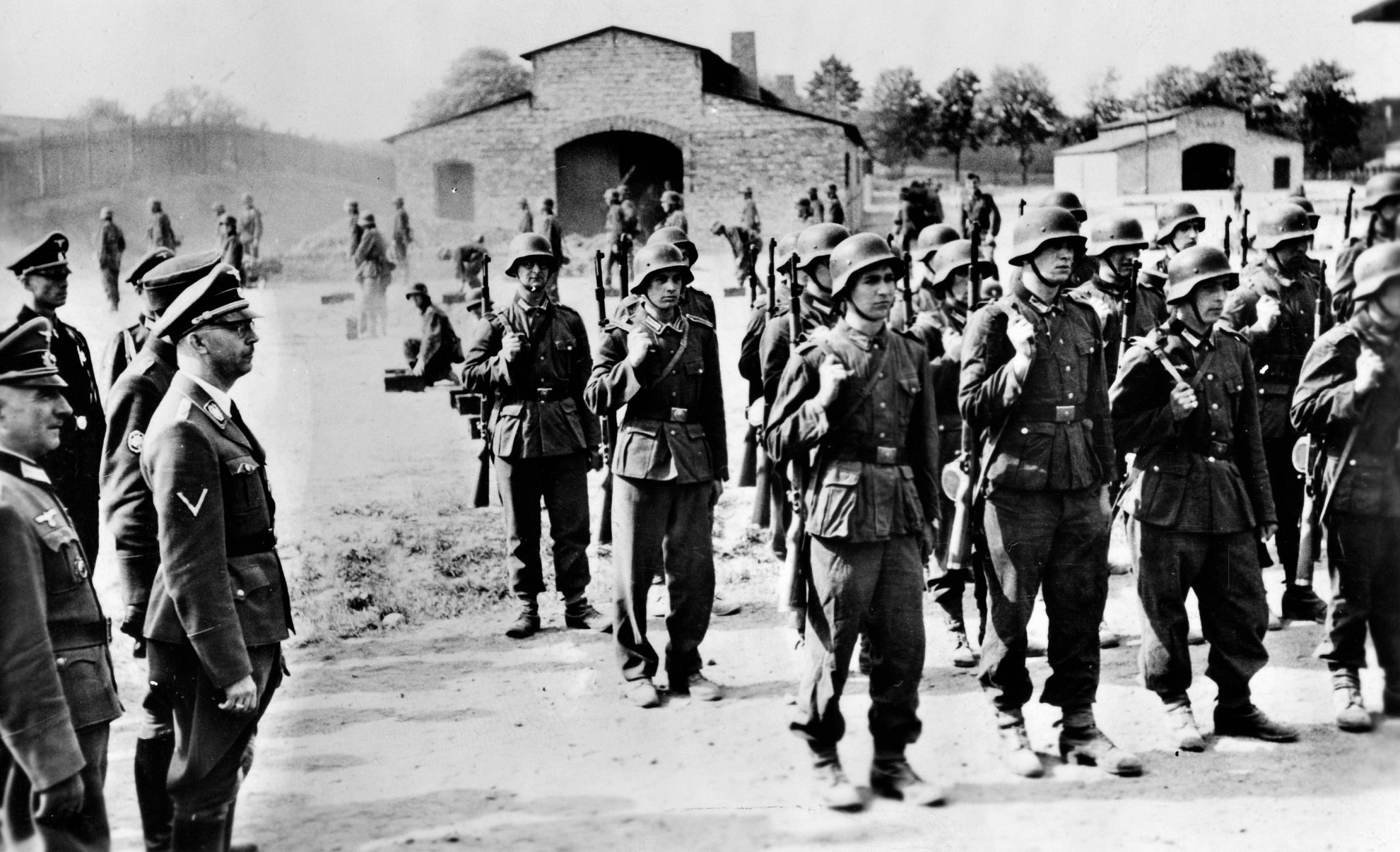
The visit of Reichsführer-SS Heinrich Himmler (Chef der SS und Deutschen Polizei) to the headquarters of the SS-Panzergrenadier-Division "Totenkopf" near Kharkov, Ukraine, 24 April 1943. To the left of Himmler is SS-Oberführer Hermann Prieß (Kommandeur SS-Panzergrenadier-Division "Totenkopf"), while to his right is SS-Obersturmbannführer Otto Baum (Kommandeur SS-Panzergrenadier-Regiment "Totenkopf"). On the far left is SS-Sturmbannführer Otto Kron (Kommandeur SS-Flak-Abteilung "Totenkopf"), while second from the right is likely SS-Hauptsturmführer Anton "Toni" Laackmann (Kommandeur SS-Panzerjäger Abteilung 3 "Totenkopf").


Reichsführer-SS Heinrich Himmler visited the area around Kharkov in spring 1943, during a trip that included inspecting Waffen-SS units from the SS-Panzerkorps (which included the SS Division Totenkopf on 24 April 1943, along with Leibstandarte and Das Reich). On that date, he delivered a speech to SS commanders (a "Kommandeurbesprechung" or meeting of SS division commanders) in Kharkov.

The Totenkopf Division had returned to the Eastern Front in early 1943, participated in the Third Battle of Kharkov (February–March 1943, recapturing the city), and was still operating in the region as part of Heeresgruppe Süd (Army Group South) before shifting toward the Kursk preparations later that spring/summer. Himmler's visit involved addressing senior officers from the SS divisions active there, emphasizing ideological indoctrination, racial theories, and the "dread reputation" of the SS units from the Kharkov fighting. Photos and references to Himmler examining captured Soviet equipment (e.g., a T-34 tank) or SS troops in the Kharkov sector also tie to this period.


The visit of Reichsführer-SS Heinrich Himmler (Chef der SS und Deutschen Polizei) to the headquarters of the SS-Panzergrenadier-Division "Totenkopf" near Kharkov, Ukraine, 24 April 1943. From left to right: SS-Oberführer Hermann Prieß (Kommandeur SS-Panzergrenadier-Division "Totenkopf"), Himmler, and SS-Obersturmbannführer Otto Baum (Kommandeur SS-Panzergrenadier-Regiment "Totenkopf").


The visit of Reichsführer-SS Heinrich Himmler (Chef der SS und Deutschen Polizei) to the headquarters of the SS-Panzergrenadier-Division "Totenkopf" near Kharkov, Ukraine, 24 April 1943. From left to right: SS-Obersturmbannführer Otto Baum (Kommandeur SS-Panzergrenadier-Regiment "Totenkopf"), SS-Hauptsturmführer Josef Kiermaier (persönlicher leibwächter bei Heinrich Himmler), and Himmler.


Source :
https://alifrafikkhan.blogspot.com/2015/02/foto-otto-baum.html

Tuesday, March 24, 2026

Eichenlaub Award Ceremony for Max Wünsche


The proud expression on the face of the SS panzer regiment commander Max Wünsche was clearly visible as he received the Eichenlaub zum Ritterkreuz des Eisernen Kreuzes #548 for his extraordinary dedication in battle, especially since it was pinned on him by the top SS leaders, with the Reichsführer-SS Heinrich Himmler in attendance. From left to right: SS-Oberführer Kurt Meyer (Kommandeur 12. SS-Panzer-Division "Hitlerjugend"), SS-Obersturmbannführer Max Wünsche (Kommandeur SS-Panzer-Regiment 12 / 12.SS-Panzer-Division "Hitlerjugend"), SS-Obergruppenführer und General der Waffen-SS Josef "Sepp" Dietrich (Kommandierender General I. SS-Panzerkorps), Reichsführer-SS Heinrich Himmler, and another "Meyer", SS-Sturmbannführer Hubert Meyer (Ia Erster Generalstabsoffizier 12. SS-Panzer-Division "Hitlerjugend"). The photo was taken on August 11, 1944.


Source :
https://alifrafikkhan.blogspot.com/2012/08/foto-kurt-panzermeyer-meyer.html

Monday, March 23, 2026

Himmler with Walter Krüger and Paul Hausser

From April 23 to 26, 1943, Reichsführer-SS Heinrich Himmler (Chef der SS und Deutschen Polizei) visited the SS-Panzerkorps headquarter in Kharkov (Ukraine). During a meeting with the high-ranking officials of the Waffen-SS corps, Himmler emphasized the racial struggle of the Germanic people—with the Waffen-SS as their main spearhead—in countering the "spread of non-Aryan blood." Ironically, few believed the words of the SS Commander, because for those who were directly involved in the brutal and prolonged battles on the Eastern Front, the issue was no longer about racial and ideological conflicts, but rather a struggle for survival in holding back the increasingly powerful Russian forces over time! This photograph by SS war correspondent Friedrich Zschäckel shows Himmler inspecting the SS-Panzer-Regiment 2, which was part of the SS-Panzergrenadier-Division "Das Reich." Here, the Reichsführer-SS (center) is flanked by SS-Gruppenführer und Generalleutnant der Waffen-SS Walter Krüger (Kommandeur SS-Panzergrenadier-Division "Das Reich") on his left, and SS-Obergruppenführer und General der Waffen-SS Paul Hausser (Kommandierender General SS-Panzerkorps) on his right.


Source :
https://alifrafikkhan.blogspot.com/2018/06/foto-paul-hausser.html
https://www.bild.bundesarchiv.de/dba/en/search/?query=121548872#

Friday, January 12, 2024

Visit of Heinrich Himmler to the Swiss Border

From left to right: SS-Hauptsturmführer Joachim "Jochen" Peiper (1. Adjutant Reichsführer-SS), SS-Obergruppenführer Werner Lorenz (Reichskommissar für die Festigung deutschen Volkstums), SS-Gruppenführer und Generalleutnant der Waffen-SS Karl Wolff (Chef des Hauptamtes Persönlicher Stab Reichsführer-SS), SS-Brigadeführer Ulrich Greifelt (Chef des Generalstabes Reichskommissar für die Festigung deutschen Volkstums), Reichsführer-SS Heinrich Himmler (Chef der SS und deutschen Polizei), and Oberst Ferdinand Schörner (Führer 6. Gebirgs-Division). The picture was taken on 15 July 1940 at Verrières-de-Joux, on the border between France and Switzerland, during personal inspection by Reichsführer-SS Himmler. Oberst Schörner, as head of the sector for being the Commander of the 6th Mountain Division, guided him and answered his questions.


The photograph of Heinrich Himmler, head of the SS and Police, on the French-Swiss border of Verrières-de-Joux, has crossed the ages as much as the name of the sad character it depicts. present. This historical episode is not the most important of the Second World War but it left a strong impression on the minds of the inhabitants of Haut-Doubs at the time.

This happened just some time after the Armistice of June 22, 1940. France was then occupied by the Germans who were enjoying their victory. If Himmler's smiling face was immortalized in this place, it is simply because senior Nazi dignitaries took pleasure in visiting occupied countries. Such as Heinrich Himmler, therefore, Reichsführer-SS of the Third Reich, head of the Gestapo, minister and main instigator of the Final Solution, on July 15, 1940, was on the border between France and Switzerland at Verrières-de-Joux in within the framework of the Burgund project (population displacement plan).

Leaning with other officers on the barrier which marks the Franco-Swiss border at Verrières, he looks ironically at Switzerland and the village of Verrières. His dream then, probably, being to invade this neutral country with his powerful army.


From left to right: SS-Hauptsturmführer Joachim "Jochen" Peiper (1. Adjutant Reichsführer-SS), SS-Obergruppenführer Werner Lorenz (Reichskommissar für die Festigung deutschen Volkstums), SS-Gruppenführer und Generalleutnant der Waffen-SS Karl Wolff (Chef des Hauptamtes Persönlicher Stab Reichsführer-SS), SS-Brigadeführer Ulrich Greifelt (Chef des Generalstabes Reichskommissar für die Festigung deutschen Volkstums), Reichsführer-SS Heinrich Himmler (Chef der SS und deutschen Polizei), and Oberst Ferdinand Schörner (Führer 6. Gebirgs-Division). The picture was taken on 15 July 1940 at Verrières-de-Joux, on the border between France and Switzerland, during personal inspection by Reichsführer-SS Himmler. In this picture, Himmler is in conversation with the Swiss Border Guard.


Source :
Bayerische Staatsbibliothek photo archive (Image-No.: 50134384)
https://www.ashsm.ch/CMS/fr/item/221-resume-la-suisse-son-service-de-renseignement-et-la-ss
https://www.estrepublicain.fr/societe/2021/01/29/savez-vous-pourquoi-le-chef-de-la-gestapo-s-est-fait-photographier-aux-verrieres-de-joux
https://forum.axishistory.com/viewtopic.php?f=5&t=94182&hilit=ferdinand+sch%C3%B6rner&start=15
https://www.watson.ch/schweiz/wissen/842190908-die-schweiz-im-krieg-diese-alten-fotos-treffen-mitten-ins-herz

Monday, December 4, 2023

Eichenlaub Award Ceremony for Harmel and Baum


From left to right: SS-Standartenführer Heinz Harmel (Kommandeur SS-Panzergrenadier Regiment "Deutschland" / SS-Panzergrenadier-Division "Das Reich"), SS-Obersturmbannführer Otto Baum (Kommandeur SS-Panzergrenadier-Regiment 5 “Totenkopf” / SS-Panzergrenadier-Division "Totenkopf"), Adolf Hitler (Führer und Oberster Befehlshaber der Wehrmacht), and Reichsführer-SS Heinrich Himmler (Chef der SS und deutschen Polizei). The picture was taken in October 1943 during the Eichenlaub award ceremony for Harmel and Baum, which were held at Führerhauptquartier Wolfsschanze in Rastenburg, East Prussia. Harmel formally received the Eichenlaub #296 on 7 September 1943, while Baum received the Eichenlaub #277 on 22 August 1943. In this picture, you can see the bandage still wrapped around Harmel's injured neck, a wound he received on the battlefield on 2 October 1943. This photo itself was taken from the book "On the Field of Honor: A History of the Knight's Cross Bearers" by John R. Angolia.


Source :
"On the Field of Honor: A History of the Knight's Cross Bearers" by John R. Angolia
http://alifrafikkhan.blogspot.com/2014/12/foto-adolf-hitler-di-tahun-1943.html

Tuesday, October 24, 2023

Wolfgang Lüth with Himmler


From left to right: Reichsführer-SS Heinrich Himmler (Chef der SS und deutschen Polizei), SS-Obergruppenführer Arthur Greiser (Reichsstatthalter und Gauleiter der NSDAP in Reichsgau Wartheland), and Korvettenkapitän Wolfgang Lüth (Kommandant U 181). This picture was taken on 24 October 1943 when U-boat ace Wolfgang Lüth was being awarded with the Gauehrenabzeichen des Reichsgaues Wartheland. The "Baltendeutscher" (Baltic-German) Lüth was born in Riga, Latvia. In this picture, we can see he is wearing The Wartheland Gau Badge below the Eisernes Kreuz I.Klasse. The badge was also awarded to Martin Bormann, the Chef der “Vomi“ Werner Lorenz, and the SS-Generals Wilhelm Koppe, Jürgen Stroop and Richard Fiedler.


Gauehrenzeichen des Reichsgaues Wartheland für Verdienste im Volkstumskampf (Wartheland Gau Badge)


Source :
https://forum.axishistory.com/viewtopic.php?f=5&t=53534&hilit=wolfgang+l%C3%BCth
https://www.warmilitaria.it/en/politic-badges/1903-gau-wartheland.html

Thursday, October 5, 2023

Incorporation of Legion Wallonie to the Waffen-SS


In May 1943, Himmler ordered the incorporation of the Volunteer Legion " Wallonia” into the Waffen-SS. Léon Degrelle's proactive and demanding attitude is an essential characteristic of German-Walloon military collaboration. Although the German authorities usually positioned themselves skeptically and dismissively from their position of strength, Degrelle's impulsiveness and charisma often put them under pressure.

The Walloon legionnaires spent the winter of 1942/43 recovering at home. During the previous battles in 1942 in the Caucasus, the “Légion Wallonie” was under the command of SS Division "Wiking" (Felix Steiner) for a few weeks. Steiner, who commanded the unit made up of Scandinavians, Dutch and Flemings, paid his respects to the enthusiasm of the Walloon volunteers and asked for the permanent transfer of the Legion to the SS-Division "Wiking" in a letter to the Reichsführer-SS in September 1942. Degrelle was very impressed by the material equipment and ideological orientation of the Wiking. Conversely, at the beginning of January 1943 Degrelle took the initiative and approached the German representative for the Flemish SS, the SS-Brigadeführer Richard Jungclaus, about founding a “Walloon SS”. The head of the SS Main Office, Gottlob Berger, immediately turned to Himmler because the request seemed premature to him: “I would like to ask you to decide whether this question can be addressed today or whether we should put Degrelle off until the spring or summer of 1943.”

Himmler initially left the letter unanswered. Only after Degrelle had formulated his thesis of the “Germanic affiliation” of the Walloons in a media-effective manner at a large rally in the Brussels Sports Palace on January 17, 1943 - on the occasion of the legionnaires' return to the front - did Himmler respond to Berger's request: “About your letter for the establishment of a Walloon SS I thought about it for a long time. At the same time I am sending you the text of the speech given by the clever De Grelle [sic!]. It is very interesting [sic!] that the Walloons are now suddenly remembering that they are Germans.” Himmler expressed reservations about the founding of a “Walloon SS” because he feared that he would dupe the Flemings who were already organized in the SS, but Degrelle's programmatic speech on January 17, 1943 made waves. Although the “Chef de Rex” had already declared the Walloons to be “French-speaking Germans” in August 1941, he was only able to make his voice heard under the changed war conditions in 1943. In the same way, he modified the “Greater Burgundy idea” as a voluntary return to the “Germanic community”:

“Our small fatherland is the West, but our great fatherland is the Germanic community in which our comrades died. We will never again forget the glorious uniform we wear. A German soldier is forever a comrade and brother for us. We comes from the same race […]. In the heart of the resurrected empire we will labor worthily in our western sector.”

From now on, the Reichsführer-SS followed the political change of the “Chef de Rex” closely, and although he could only raise objections to the SS's protection of Degrelle, Himmler recommended Degrelle in a letter to the head of the SS main office, Gottlob Berger, in principle to reinforce his concerns. At the beginning of February 1943, a skeptical Reichsführer-SS gave the head of the SS main office instructions to treat the Degrelle case in a dilatory manner:

“Although it should be taken into account that Degrelles [sic!] has already gone through many changes so far and it should also be taken into account that […] we might be able to gain this small following [Degrelles] if we make the wrong approach, but with that one If we can offend and lose a large Flemish following, I think it would be appropriate for Degrelles [sic!] to be supported in his Germanic ideas so that we can continue to check whether he is serious about his findings.”

In contrast, the head of military administration in occupied Belgium and northern France, Eggert Reeder, reacted quite angrily to Degrelle's “Germanic speech” at the end of January with a nine-page memorandum to the Army High Command (OKH). He warned the German authorities involved not to interfere in the occupation policy matters of the military administration by favoring Degrelle because of their lack of an overview on domestic politics. Although his military achievements should definitely be appreciated, this does not legitimize promoting him as a Rexist leader in domestic political matters:

“For the military administration, one principle must be made clear: As an officer of the Walloon Legion, Leon [sic!] Degrelle must be given every recognition and support that is conceivable. As the leader of the Rex movement, however, he can only be given support to the extent that other currently important interests are not endangered.”

In short, the military administration saw its policy of “peace and order” now seriously disturbed by Degrelle's action. Reeder noted:

“The difficult decisions that the military administration is currently increasingly faced with every day, H.H., [...] make it necessary that the tried and tested political course is steered calmly and without sudden changes right now. […] That is why it is not justifiable if individual Reich German authorities, who cannot possibly have this overall overview, do not have to bear any direct responsibility, through agreements with individual representatives of the local political groups, in this case with the leader of the Rex movement, Leon [ sic!] Have a disgruntled, disruptive influence on political developments in the local area.”

The representative of the Foreign Office in Brussels, Werner von Bargen, also felt compelled to intervene and a few days later wrote a memorandum to his employer in Berlin in a similar style. Von Bargen, who closely observed Degrelle's development and saw him “well on the way” to “becoming a real SS man,” also emphasized his merits within the Legion. However, he expressly recommended refraining from “political experiments” with Degrelle. Here too, the assessment of Degrelle as a domestic troublemaker and an insecure cantonist dominated. However, alarming words from Reeder and Bargen did not achieve the desired effect. Referring to von Bargen's telegram, Hitler ordered at the end of January 1943 to support the “Chef de Rex” “by all means”, because he was “the only really useful Belgian”. Reich Foreign Minister von Ribbentrop immediately commissioned the envoy von Bargen to maintain connection with Degrelle. Under the auspices of Hitler's directive, Degrelle's desire to be accepted into the SS took on new urgency. It was Gottlob Berger who suggested to Himmler that the Walloons be incorporated into an SS unit in February 1943:

“After, as the Foreign Office informs me, the Führer has ordered support for Degrelle, a takeover of the Walloon Legion may be discussed. In addition, the establishment of a French SS regiment would also justify the inclusion of the Walloons in a Waffen-SS association.”

Finally, in the course of March 1943, the question had also been clarified for Himmler to what extent Degrelle was serious about his “Germanic confession” or whether the “Chef de Rex” had just made a tactical about-face. In a letter to the head of the Reich Chancellery, Hans Heinrich Lammers, he told that Degrelle must have undergone an internal change due to his shared front-line experience with other Germanic volunteers from the SS “Wiking” division. Degrelle recognized out of personal conviction "that French-speaking Walloonism must be returned to popular Germanicism." At the same time, the Reichsführer-SS initiated a research project on the "Germanic" descent of the Walloons, so that the head of the expert group appointed - SS-Hauptsturmführer Sommer – had already determined in June 1943 that Wallonia was essentially “Germanic” and that the Walloons, as “descendants of the old Franconians with almost 80% Nordic-Fallic [sic!] blood, were even above the national average.”

While Hitler's maxim of Degrelle as the "only really useful Belgian" had paved the way for the Walloon Legion to become the Waffen-SS and the ideological superstructure was poised with all its might to take it over, a dispute over honor overshadowed the negotiations over the transfer in March and April 1943 : Degrelle's wife Marie had become romantically involved with a special officer in the German Air Force while her husband was at the front. Since she was expecting a child from him, which Degrelle did not want to acknowledge, the affair caused greater waves. The German officer sought to “carry out the bargain of honor,” but Degrelle initially refused a duel, citing a ban on duels ordered by Hitler. The betrayed husband turned to the Reichsführer-SS to obtain support for a duel of satisfaction or – If this is not possible - to obtain a “severe punishment” for the Luftwaffe officer. The head of the SS main office, Berger, immediately took up the case and asked Himmler to take a position: “I […] am now bringing the matter to the attention of the Reichsführer-SS, because Degrelle will certainly come up with the matter at the meeting and Reichsführer [sic !] as the man to whom he joined politically feels imputed and asks to help him.” Even before taking over the Legion, Degrelle relied on the power of the SS in private matters, which naturally took care of the problem of her future protégé. A short time later, Berger reported to Himmler that the Sonderführer had "shot himself" in Brussels and that the problem was solved.

Gottlob Berger and the Flemish fascist politician Jef van der Wiele attended Hochwald in the afternoon of 21 May 1943 for a 3 p.m. meeting when the formation of a Waffen-SS unit of Flemish volunteers was discussed. It was also decided that the Walloon Battalion under the Belgian Rexist leader Léon Degrelle should transfer to the Waffen-SS, culminating in its transfer to SS command in June 1943. Immediately after this meeting, Himmler had an appointment with Admiral Canaris to discuss Abwehr and other intelligence matters. Berger and van der Wiele returned the next day for lunch and a further appointment where details were finalised for the transfer of the Walloon unit. They were joined by Hans Prützmann and then SS-Brigadeführer Karl Cerff after van der Wiele had departed.

On the 23rd/24th In May 1943, the planned meeting between the Reichsführer-SS and Degrelle finally took place in the military training camp near Meseritz, at which the modalities of transferring the Walloon Legion to the Waffen-SS were discussed. Himmler left Hochwald at 10 p.m. by train accompanied by Leon Degrelle and Berger. In a three hour meeting the men ironed out the practical details of forming a new Waffen-SS Walloon volunteer unit, the finer points being decided by the time the train reached Meseritz where he conducted an inspection visit of the Walloon troops. In a secret communiqué, Degrelle confirmed his promise for the Reichsführer-SS. The aim is to return the “Walloons (French-speaking Germans) to the Germanic community and the Reich”. Far from advocating an immediate annexation of the “Germania Inferior” to the Reich, Degrelle set a time period of “25 or 50 years” and demanded that “the increasingly strong desire for a total return to the empire [...] must come spontaneously from the Walloon and Flemish population”. The position paper avoided statements about a concrete roadmap for political reorganization, and the Reichsführer-SS also postponed the "soft-handed integration" of Belgium for an indefinite period of time. However, on the occasion of the takeover of the Legion, Himmler subsequently provided a reason why the Walloons were not transferred into the ranks of the Waffen-SS in the summer of 1941. Accordingly, the Germanization intentions of the Reichsführer-SS with Degrelle would only have resulted in domestic political disadvantages:

“Over the past few years, I have been careful not to get in touch with Degrelle and his party as the Reichsleiter of the NSDAP, who was labeled as 'Pangermanian' and also had such an internal attitude. I would only have harmed the man's movement, which was not yet so advanced at the time. That’s why I refused their request to be accepted into the Waffen-SS when the Legion was set up in 1941.”

On May 24, 1943, Himmler ordered the transfer of around 1,600 Walloon legionnaires into the ranks of the Waffen-SS effective on June 1, 1943 and planned a future expansion of the “SS-Freiwilligen-Brigade-Wallonien” into an “SS-Freiwilligen-Gebirgs-Division”. Command of the brigade was taken over by the Legion’s previous Belgian commander, Hauptmann Lucien Lippert. The uniforms eventually received the SS rank insignia instead of the Wehrmacht one, with the right collar patch showing the Burgundy cross. Contrary to the usual SS guidelines, the Catholic chaplain remained in the unit. Although Himmler had already issued a general order on December 11, 1941, prohibiting the employment of military chaplains in the volunteer units, in the case of the Walloons he “expressly” approved that “the Catholic chaplain remains with the troops.”

In July 1943, the "SS-Sturmbrigade Wallonien'" was relocated to the Wildflecken military training area in the Hohen Rhön for reorganization and, shortly before the start of the Soviet winter offensive in December 1943 ("Dnieper-Carpathian Operation"), to the Ukrainian front to combat partisans. The assault brigade was assigned to the 5. SS-Panzer-Division “Wiking” under the command of SS-Brigadeführer Herbert Gille and managed to break out of the Cherkassy/Korsun pocket in February 1944 with great losses: only 632 of around 1,600 Walloon soldiers survived the operation! Nazi propaganda celebrated the escape of the completely exhausted troops as a historic success. Degrelle received the Ritterkreuz des Eisernen Kreuzes on February 20th, 1944 and the Sturmbrigade paraded through Brussels on April 2nd in front of mostly Rexist party supporters. In the summer of 1944, the SS-Sturmbrigade 'Wallonien'" fought on until it was reorganized as the 8. SS-Freiwilligen-Grenadier-Division "Wallonien‘“ in Estonia. As part of the defensive battles for the city of Dorpat, Degrelle acquired the Eichenlaub to his Ritterkreuz on August 27, 1944.


Meseritz, 24 May 1943: Reichsfuhrer-SS Heinrich Himmler (second from right, Chef der SS und deutschen Polizei) in conversation with Oberleutnant der Reserve Léon Degrelle (third from right, Stellvertretender Kommandeur Wallonische Infanterie-Bataillon 373) during Himmler's inspection to the Legion Wallonie headquarters before their transfer from Heer to the Waffen-SS. In the night before Himmler and Degrelle had met for the first time at the Reichsführer-SS's private train called "Sonderzug Heinrich", which was on its way to Meseritz, Pomerania. A private meeting to discuss the fate of the Walloon volunteers took place from 11:00 PM on 23 May 1943 until 01:00 AM of 24 May 1943.


Reichsfuhrer-SS Heinrich Himmler (Chef der SS und deutschen Polizei) inspecting the Walloon volunteers in Pieske barracks, 8 km from Meseritz, before their transfer from Heer to the Waffen-SS. Beside him - face not seen - is Oberleutnant der Reserve Léon Degrelle (Stellvertretender Kommandeur Wallonische Infanterie-Bataillon 373). The picture was taken on 24 May 1943, while most of the sources wrongfully dated this occasion as happened on 24-26 June 1943, when in reality the Walloon volunteers already changed their uniforms to the SS one!


Reichsfuhrer-SS Heinrich Himmler (second from right, Chef der SS und deutschen Polizei) talking with one of the Walloon volunteer during the visit to their barracks at Pieske, 8 km from Meseritz, Germany. Watching second from left is Oberleutnant der Reserve Léon Degrelle (Stellvertretender Kommandeur Wallonische Infanterie-Bataillon 373). The picture was taken on 24 May 1943, while most of the sources wrongfully dated this occasion as happened on 24-26 June 1943, when in reality the Walloon volunteers already changed their uniforms to the SS one!


Source :
"Heinrich Himmler: A Photo History of the Reichsführer-SS" by Max Williams
"Im übrigen scheinen mir aber politische Erwägungen für seine Schwenkung zur SS bestimmend gewesen zu sein: Léon Degrelle und die Politik der militärischen Kollaboration" by Stephan Horn
http://alifrafikkhan.blogspot.com/2010/10/album-foto-leon-degrelle.html
https://audiovis.nac.gov.pl/obraz/51883/
https://www.gettyimages.com/photos/wallonie-himmler?assettype=image&family=editorial&phrase=wallonie%20himmler&sort=best
https://www.mdr.de/geschichte/ns-zeit/waffen-ss-100_page-2_zc-ad1768d3.html

Friday, September 29, 2023

Award Ceremony for the "Cherkassy Heroes"

Award ceremony with Hitler for the three "Cherkassy Heroes" who led their men escaping from the Red Army encirclement in Korsun-Cherkassy pocket (24 January - 16 February 1944). The ceremony was held at Führerhauptquartier Wolfsschanze in Rastenburg, East Prussia, on 20 February 1944. The recipients are: Generalleutnant Theobald "Theo-Helmut" Lieb (Kommandierender General XXXXII. Armeekorps), SS-Gruppenführer und Generalleutnant der Waffen-SS Herbert Otto Gille (Kommandeur 5. SS-Panzer-Division "Wiking"), and SS-Hauptsturmführer der Reserve Léon Degrelle (Kommandeur 5. SS-Freiwilligen-Sturmbrigade "Wallonien"). Lieb received both the Ritterkreuz (7 February 1944) and Eichenlaub (18 February 1944)  at the same time; Gille received the Schwerter (20 February 1944); while Degrelle received the Ritterkreuz (20 February 1944). The award ceremony was attended by the Reichsführer-SS Heinrich Himmler (Chef der SS und deutschen Polizei) and SS-Brigadeführer und Generalmajor der Waffen-SS Hermann Fegelein (Verbindungsoffizier der Waffen-SS zum Führerhauptquartier).


From the book "Hell’s Gate: The Battle of the Cherkassy Pocket, January-February 1944" by Douglas E. Nash:

Following the breakout of the Cherkassy pocket (16-18 February 1944) and their units were being formed into Gruppe Mattenklott, SS-Gruppenführer Herbert-Otto Gille of SS-Wiking Division, SS-Hauptstürmführer Léon Degrelle of SS-Brigade Wallonien and Generalleutnant Theobald Lieb (m.d.F.b.) of XXXXII. Armeekorps flew to Rastenburg after their conference at Uman aboard a Ju-52, arriving on the evening of 20 February 1944. Here, the two SS officers were whisked away in a limousine to their accommodations by an escort provided by Reichsfiihrer-SS Heinrich Himmler. Degrelle later recalled how out of place he felt, when he stated that "In the automobile which drove me from the airport I could feel hundreds of lice devouring my body. My uniform was filthy." He was also still wearing the heavy felt winter boots he had worn during the breakout and his uniform was torn in several places. While he was led to a waiting hot bath, his first in months, a squad of SS men took his uniform from him and cleaned and mended it as best they could. Prior to dressing, Degrelle discovered that Himmler had presented him a gift of a new undershirt, since his old one was full of holes and lice-ridden. Thus refreshed, Degrelle and Gille joined Himmler for the 40 kilometer drive to Hitler's Wolfschanze.

Here, the group was led into the perimeter of the compound, illuminated by floodlights and heavily guarded. Once led inside the wooden meeting hall, the group was greeted by Hitler himself, who seized Degrelle's hand and said "I've been very worried about you." Degrelle's admiration for the Führer was not lessened by Hitler's frail appearance, in fact, it increased, since he credited it to the fact that Hitler's back was bent from "studying maps interminably and from bearing the weight of the world ..." It did not occur to the Walloon leader at the time that it was Hitler himself who was directly responsible for the destruction of his beloved brigade, since it was he who had decreed that the salient along the Dnieper be held at all costs.

Degrelle and Gille, now reunited with Lieb, were led to a large hall in the building, where Hitler presented the two generals with the Eichenlaub (Oak Leaves) to their Ritterkreuz (Knight's Crosses) and Degrelle with his first award of the Ritterkreuz. The award ceremony was immediately followed by a press conference which was broadcast live throughout Germany and the occupied areas as proof indeed that German forces had fought its way out of the Cherkassy Pocket and had not been destroyed, as the Soviets had claimed. Hitler's press chief, Dr. Otto Dietrich, allowed each of the three men to make a few prepared statements. In the glare of flashbulbs, they briefly related their experiences and how well their troops had fought, stressing repeatedly that the mass of the encircled troops had fought their way free.

In this occasion, a very much alive Theo Lieb found himself in the limelight. Perhaps carried away by the excitement and the media attention, Lieb, when asked who had made the decision to break out of the pocket, declared that he himself had done so on his own responsibility. This provoked an angry inquiry two days later by Generalfeldmarschall Erich von Manstein, who learned about the incident after hearing the interview on the Deutsche Soldatensender (German Armed Forces radio). The field marshal fired off a personal message on 22 February to Hube at 1.Pz.Armee demanding that he set the
record straight, since it was Manstein, through 8.Armee's commander, who had made the decision to order a breakout.

It was here perhaps where Lieb earned the sobriquet that would follow him wherever he went for the rest of his career forever after, he would be known as the "Lion of Cherkassy." While it had probably been coined sarcastically, Lieb wore the title as a badge of honor. Who could deny that he had earned it, for had he not led the assault force that broke out of the encirclement? Despite the honors heaped upon him by Hitler and his superb handling of XXXXII.A.K., Lieb was not selected to command a corps again, though he did command 34.InfDiv. along the Franco-Italian border from June to October 1944. The war's end found him holding a nominal assignment in northern Italy. Perhaps Manstein's wrath had shortened his career, perhaps Lieb had done so himself with his outspokenness...

BTW, many notes on the books and websites mention the awards ceremony was on 18 February. Also note that the “official” date for Lieb’s award is 18 February while Gille and Degrelle’s date for their respective awards is 20 February. The ceremony actually took place on 20 February 1944.

Note how Hitler is warm to Degrelle in the photos below. Upon meeting Degrelle, Hitler would have mentioned “I’ve been very worried about you”. Degrelle apparently received the Eichenlaub on 25. August 1944. Upon receiving his Eichenlaub, Hitler would have told him, "Si j'avais eu un fils, j'aurais aimé qu'il fût comme vous" - "If I had a son, I would want him to be like you." (Interview given by Léon Degrelle to Jean Kapel in Histoire magazine; No. 19, septembre 1981). This statement is contested by Degrelle’s biographer, Jean-Marie Frérotte in Léon Degrelle, le dernier fasciste (Bruxelles, Paul Legrain, 1987). After the ceremony Degrelle would have said of Hitler, “I saw in his eyes that he looked at me like a son”.

Although taken 6 months earlier, the photos of the Cherkassy ceremony show a warmth that Hitler rarely demonstrates to other soldiers.


Adolf Hitler (Führer und Oberster Befehlshaber der Wehrmacht) congratulates SS-Gruppenführer und Generalleutnant der Waffen-SS Herbert Otto Gille (Kommandeur 5. SS-Panzer-Division "Wiking") during the award ceremony for "Cherkassy Heroes" which were held at the Führerhauptquartier Wolfsschanze in Rastenburg, East Prussia, on 20 February 1944. At left is another recipient, SS-Hauptsturmführer der Reserve Léon Degrelle (Kommandeur 5. SS-Freiwilligen-Sturmbrigade "Wallonien"), while at right is SS-Brigadeführer und Generalmajor der Waffen-SS Hermann Fegelein (Verbindungsoffizier der Waffen-SS zum Führerhauptquartier) and Reichsführer-SS Heinrich Himmler (Chef der SS und deutschen Polizei).


Adolf Hitler (Führer und Oberster Befehlshaber der Wehrmacht) congratulates SS-Hauptsturmführer der Reserve Léon Degrelle (Kommandeur 5. SS-Freiwilligen-Sturmbrigade "Wallonien") during the award ceremony for "Cherkassy Heroes" which were held at the Führerhauptquartier Wolfsschanze in Rastenburg, East Prussia, on 20 February 1944. In the center is another recipient, SS-Gruppenführer und Generalleutnant der Waffen-SS Herbert Otto Gille (Kommandeur 5. SS-Panzer-Division "Wiking"), while second from right is SS-Brigadeführer und Generalmajor der Waffen-SS Hermann Fegelein (Verbindungsoffizier der Waffen-SS zum Führerhauptquartier).


Adolf Hitler (Führer und Oberster Befehlshaber der Wehrmacht) congratulates SS-Hauptsturmführer der Reserve Léon Degrelle (Kommandeur 5. SS-Freiwilligen-Sturmbrigade "Wallonien") during the award ceremony for "Cherkassy Heroes" which were held at the Führerhauptquartier Wolfsschanze in Rastenburg, East Prussia, on 20 February 1944. Note how Hitler is warm to Degrelle in the photos that surfaced from the ceremony. Upon meeting Degrelle, Hitler would have mentioned “I’ve been very worried about you”. Degrelle apparently received the Eichenlaub on 25. August 1944. Upon receiving his Eichenlaub, Hitler would have told him, "Si j'avais eu un fils, j'aurais aimé qu'il fût comme vous" - "If I had a son, I would want him to be like you." (Interview given by Léon Degrelle to Jean Kapel in Histoire magazine; No. 19, septembre 1981). This statement is contested by Degrelle’s biographer, Jean-Marie Frérotte in Léon Degrelle, le dernier fasciste (Bruxelles, Paul Legrain, 1987). After the ceremony Degrelle would have said of Hitler, “I saw in his eyes that he looked at me like a son”. Although taken 6 months earlier, the photos of the Cherkassy ceremony show a warmth that Hitler rarely demonstrates to other soldiers.


Adolf Hitler (Führer und Oberster Befehlshaber der Wehrmacht) congratulates Generalleutnant Theobald "Theo-Helmut" Lieb (Kommandierender General XXXXII. Armeekorps) during the award ceremony for "Cherkassy Heroes" which were held at the Führerhauptquartier Wolfsschanze in Rastenburg, East Prussia, on 20 February 1944. Although Gille and Degrelle was also awarded the medals on this same day at the FHQ, it seems that Lieb received the Eichenlaub alone. However, there are several photos showing both Degrelle, Gille, Lieb and Press Chief Dietrich taken after the two ceremonies (see below).


Press conference held at the Reichspropagandaministerium in Berlin on 21 February 1944, one day after the award ceremony for the heroes of the Battle of Cherkassy at the Führerhauptquartier Wolfsschanze. From left to right: SS-Hauptsturmführer der Reserve Léon Degrelle (Kommandeur 5. SS-Freiwilligen-Sturmbrigade "Wallonien"), Generalleutnant Theobald "Theo-Helmut" Lieb (Kommandierender General XXXXII. Armeekorps), SS-Obergruppenführer Dr.rer.pol. Otto Dietrich (Reichspressechef der NSDAP), and SS-Gruppenführer und Generalleutnant der Waffen-SS Herbert Otto Gille (Kommandeur 5. SS-Panzer-Division "Wiking").


Press conference held at the Reichspropagandaministerium in Berlin on 21 February 1944, one day after the award ceremony for the heroes of the Battle of Cherkassy at the Führerhauptquartier Wolfsschanze. Generalleutnant Theobald "Theo-Helmut" Lieb (standing, Kommandierender General XXXXII. Armeekorps) is making a speech, while behind him are, from left to right: SS-Hauptsturmführer der Reserve Léon Degrelle (Kommandeur 5. SS-Freiwilligen-Sturmbrigade "Wallonien"), SS-Obergruppenführer Dr.rer.pol. Otto Dietrich (Reichspressechef der NSDAP), SS-Gruppenführer und Generalleutnant der Waffen-SS Herbert Otto Gille (Kommandeur 5. SS-Panzer-Division "Wiking"), and two unknown civilian.


Three "Heroes of Cherkassy" with SS-Obergruppenführer Dr.rer.pol. Otto Dietrich (right, Reichspressechef der NSDAP). From left to right: SS-Gruppenführer und Generalleutnant der Waffen-SS Herbert Otto Gille (Kommandeur 5. SS-Panzer-Division "Wiking"), Generalleutnant Theobald "Theo-Helmut" Lieb (Kommandierender General XXXXII. Armeekorps), and SS-Hauptsturmführer der Reserve Léon Degrelle (Kommandeur 5. SS-Freiwilligen-Sturmbrigade "Wallonien". The picture was taken by the unknown photographer from Presse-Illustrationen Heinrich Hoffmann at the Reichspropagandaministerium in Berlin on 21 February 1944, one day after the award ceremony at the Führerhauptquartier Wolfsschanze in Rastenburg, East Prussia.


Three "Heroes of Cherkassy" with SS-Obergruppenführer Dr.rer.pol. Otto Dietrich (right, Reichspressechef der NSDAP). From left to right: SS-Gruppenführer und Generalleutnant der Waffen-SS Herbert Otto Gille (Kommandeur 5. SS-Panzer-Division "Wiking"), Generalleutnant Theobald "Theo-Helmut" Lieb (Kommandierender General XXXXII. Armeekorps), and SS-Hauptsturmführer der Reserve Léon Degrelle (Kommandeur 5. SS-Freiwilligen-Sturmbrigade "Wallonien"). The picture was taken by the unknown photographer from Presse-Illustrationen Heinrich Hoffmann at the Reichspropagandaministerium in Berlin on 21 February 1944, one day after the award ceremony at the Führerhauptquartier Wolfsschanze in Rastenburg, East Prussia.


Reichsführer-SS Heinrich Himmler (Chef der SS und deutschen Polizei) sharing a lighter moment with two of the "Cherkassy Heroes" from Waffen-SS: SS-Gruppenführer und Generalleutnant der Waffen-SS Herbert Otto Gille (left, Kommandeur 5. SS-Panzer-Division "Wiking") and SS-Hauptsturmführer der Reserve Léon Degrelle (right, Kommandeur 5. SS-Freiwilligen-Sturmbrigade "Wallonien"). The picture was taken by the unknown photographer from Presse-Illustrationen Heinrich Hoffmann on 21 February 1944, one day after the award ceremony at the Führerhauptquartier Wolfsschanze in Rastenburg, East Prussia.


SS-Gruppenführer und Generalleutnant der Waffen-SS Herbert Otto Gille (Kommandeur 5. SS-Panzer-Division "Wiking") photographed by Presse-Illustrationen Heinrich Hoffmann at the Führerhauptquartier Wolfsschanze in Rastenburg, East Prussia, after the Schwerter award ceremony for the "Heroes of Cherkassy" with Hitler on 20 February 1944. The medal was formally awarded on the same day for the extremely distinguished leadership of his division during the breakout from the Cherkassy pocket. In this time his division was the spearhead of the German forces trapped within the pocket, and it played an invaluable role in allowing the encircled troops to escape.


SS-Gruppenführer und Generalleutnant der Waffen-SS Herbert Otto Gille (Kommandeur 5. SS-Panzer-Division "Wiking") photographed by Walter Frentz at the Führerhauptquartier Wolfsschanze in Rastenburg, East Prussia, after the Schwerter award ceremony for the "Heroes of Cherkassy" with Hitler on 20 February 1944. The medal was formally awarded on the same day for the extremely distinguished leadership of his division during the breakout from the Cherkassy pocket. In this time his division was the spearhead of the German forces trapped within the pocket, and it played an invaluable role in allowing the encircled troops to escape.


Generalleutnant Theo-Helmut "Theobald" Lieb (Kommandierender General XXXXII. Armeekorps) photographed by Presse-Illustrationen Heinrich Hoffmann at the Führerhauptquartier Wolfsschanze in Rastenburg, East Prussia, after the award ceremony for the "Heroes of Cherkassy" with Hitler on 20 February 1944. Although Gille and Degrelle was also awarded the medals on this same day at the FHQ, it seems that Lieb received the Eichenlaub alone. However, there are several photos showing both Degrelle, Gille, Lieb and Press Chief Dietrich taken after the two ceremonies. Lieb himself received the Eichenlaub for his further achievements during the battle for the Cherkassy pocket. Especially during the breakout from the pocket he would show great bravery and energy. He collected a Bataillon of stragglers from the Korpsabteilung B and the 5. SS Panzer-Division “Wiking” and broke through a Soviet armoured group south of the road Potschapinzy-Lissjanka. With his horse Lieb then swam over the Gniloi-Tikitsch and reached safety at Lissjanka. For his role in this battle he would be christened the “Lion of Cherkassy” and be awarded the Eichenlaub directly from Hitler himself.


Generalleutnant Theobald "Theo-Helmut" Lieb (Kommandierender General XXXXII. Armeekorps) photographed by Walter Frentz at the Führerhauptquartier Wolfsschanze in Rastenburg, East Prussia, after the award ceremony for the "Heroes of Cherkassy" with Hitler on 20 February 1944. Lieb himself received the Eichenlaub for his further achievements during the battle for the Cherkassy pocket. Especially during the breakout from the pocket he would show great bravery and energy. He collected a Bataillon of stragglers from the Korpsabteilung B and the 5. SS Panzer-Division “Wiking” and broke through a Soviet armoured group south of the road Potschapinzy-Lissjanka. With his horse Lieb then swam over the Gniloi-Tikitsch and reached safety at Lissjanka. For his role in this battle he would be christened the “Lion of Cherkassy” and be awarded the Eichenlaub directly from Hitler himself.


SS-Hauptsturmführer der Reserve Léon Degrelle (Kommandeur 5. SS-Freiwilligen-Sturmbrigade "Wallonien") photographed by Presse-Illustrationen Heinrich Hoffmann at the Führerhauptquartier Wolfsschanze in Rastenburg, East Prussia, after the award ceremony for the "Heroes of Cherkassy" with Hitler on 20 February 1944. Degrelle’s Ritterkreuz recommendation reads as follows: "The SS-Sturmbrigade ‘Wallonien’ belongs to the formations of the Heer and Waffen-SS that defied all enemy attacks during the weeks of combat in the Cherkassy pocket, fighting all alone. Degrelle took over leadership of the Brigade after its former brave commander, SS-Sturmbannführer Lucien Lippert, died in battle on 13 February 1944 after a shot to the chest. Prior to this Degrelle had already distinguished himself several times through his personal bravery, and in his new role he demonstrated outstanding leadership during the decisive breakthrough fighting of the last days. He and his brave Walloons acquitted themselves very well as they struggled side by side with soldiers of the Heer and the Germanic men of the Waffen-SS in a true comradely fashion."


SS-Hauptsturmführer der Reserve Léon Degrelle (Kommandeur 5. SS-Freiwilligen-Sturmbrigade "Wallonien") photographed by Walter Frentz at the Führerhauptquartier Wolfsschanze in Rastenburg, East Prussia, after the award ceremony for the "Heroes of Cherkassy" with Hitler on 20 February 1944. Degrelle’s Ritterkreuz recommendation reads as follows: "The SS-Sturmbrigade ‘Wallonien’ belongs to the formations of the Heer and Waffen-SS that defied all enemy attacks during the weeks of combat in the Cherkassy pocket, fighting all alone. Degrelle took over leadership of the Brigade after its former brave commander, SS-Sturmbannführer Lucien Lippert, died in battle on 13 February 1944 after a shot to the chest. Prior to this Degrelle had already distinguished himself several times through his personal bravery, and in his new role he demonstrated outstanding leadership during the decisive breakthrough fighting of the last days. He and his brave Walloons acquitted themselves very well as they struggled side by side with soldiers of the Heer and the Germanic men of the Waffen-SS in a true comradely fashion."


Source :
Bayerische Staatsbibliothek photo archive (Image-No.: 30028861)
Mark C. Yerger photo collection
"Hell’s Gate: The Battle of the Cherkassy Pocket, January-February 1944" by Douglas E. Nash
https://www.akg-images.de/CS.aspx?VP3=SearchResult&ITEMID=2UMDHUNUH2AI
https://www.alexautographs.com/auction-lot/theo-helmut-lieb_9D243A48C5
http://alifrafikkhan.blogspot.com/2010/10/album-foto-leon-degrelle.html
https://beeldbankwo2.nl/nl/beelden/detail/cfeb4812-0259-11e7-904b-d89d6717b464/media/53a04baf-8a8f-d652-fcf5-ff0a4e601ce5?mode=detail&view=horizontal&q=gille&rows=1&page=1
https://forum.axishistory.com/viewtopic.php?f=5&t=46430&p=1375350&hilit=gille&sid=4efb5f6b5be120d761949f74f47aa14e#p1375350
https://www.gettyimages.com/detail/news-photo/gille-herbert-general-of-the-waffen-ss-germanyfrom-left-to-news-photo/545336087
http://pantorijn.blogspot.com/2014/06/hoffmann-postcards-knight-cross-holders_41.html
https://waralbum.ru/364716/
https://www.warrelics.eu/forum/photos-papers-propaganda-third-reich/signatures-waffen-ss-knights-cross-winners-6478-2/
https://www.wehrmacht-awards.com/forums/forum/wehrmacht-era-militaria/photos-and-paper-items-forum/379950-original-presse-hoffmann-photos?t=379638
https://x.com/GermanScholarrr/status/1802039067288191330?lang=zh

Friday, February 10, 2023

Eichenlaub Award Ceremony for Karl Ullrich

Eichenlaub award ceremony for SS-Standartenführer Karl Ullrich (Kommandeur SS-Panzergrenadier-Regiment 6 “Theodor Eicke” / 3.SS-Panzer-Division “Totenkopf”), which were held at Führerhauptquartier Wolfsschanze in Rastenburg, East Prussia, on 1 August 1944. Ullrich received the Eichenlaub #480 on 14 May 1944 previously for his outstanding leadership and bravery in the many battles against the Red Army in the Eastern Front, from March 1943 to March 1944. From left to right: Adolf Hitler (Führer und Oberster Befehlshaber der Wehrmacht), Reichsführer-SS Heinrich Himmler (Chef der SS und Polizei), SS-Standartenführer Ullrich, and SS-Gruppenführer und Generalleutnant der Waffen-SS Hermann Fegelein (Verbindungsoffizier zwischen dem Reichsführer-SS und dem Führerhauptquartier).

Source :
KL Archive

Friday, August 14, 2020

Keitel Göring Dönitz Himmler Bormann

High ranking Nazi officials in conversation at Platterhof Hotel, Obersalzberg. They are waiting for Hitler to come. From left to right: Generalfeldmarschall Wilhelm Keitel (Chef Oberkommando der Wehrmacht), Reichsmarschall Hermann Göring (Oberbefehlshaber der Luftwaffe), Großadmiral Karl Dönitz (Oberbefehlshaber der Kriegsmarine), Reichsführer-SS Heinrich Himmler (Chef der SS und Deutschen Polizei), and Reichsleiter Martin Bormann (Leiter Parteikanzlei der NSDAP und Privatsekretär Führer und Reichskanzler). The picture was taken in May 1944 by Heinrich Hoffmann.

Source :
https://www.facebook.com/photo.php?fbid=2838528286414648&set=gm.1517702435081841&type=3&theater&ifg=1

Tuesday, March 27, 2018

Eichenlaub Award Ceremony for Panzer Ace Otto Carius

Reichsführer-SS Heinrich Himmler (Oberbefehlshaber Heeresgruppe Oberrhein) awarded the Ritterkreuz des Eisernen Kreuzes mit Eichenlaub #535 to Oberleutnant der Reserve Otto Carius from schwere Panzer-Abteilung 502. The picture was taken by SS-Kriegsberichter Ege on 2 January 1945 at the outskirts of Salzburg (Austria). The ceremony was quite extraordinary because Carius had already received the announcement of his award from 27 July 1944, but the ceremony was postponed until five months later! This is because the panzer ace was seriously injured by a multiple shot in the seven parts of his body (including the neck!) only a few days before he suppsosedly received the Eichenlaub, so he had to be taken to the intensive care for months at Feldlazarett (Field Hospital). Carius received the news of his award through newspapers when lying weak on the bed, and was only able to walk with his feet in September 1944. When this photograph was taken, he was no longer in charge of schwere Panzer-Abteilung 502 but had already been transferred to Panzer-Ersatz- und Ausbildungs-Abteilung 500. Another interesting fact is that the handed-over ceremony was performed by Himmler, whereas the Eichenlaub-grade medal ceremony and above was usually attended by Hitler directly. This is because from the end of 1944 the Führer began to restrict his public activities - along with the deterioration of the war situation - so that such activities were then represented to his closest confidants such as Himmler and Göring. Carius dedicated a chapter about this moment in his book 'Tigers in the Mud': "My first impressions of this man, whom his opponents called a 'bloodhound', had really pleasantly surprised me. I wasn't apprehensive about the upcoming 'cozy' conversation anymore. I described my visit with Heinrich Himmler in such detail, because he really surprised me. After the conversation in his staff headquarters , I gathered some hope for a successful conclusion to the war. That was after I had already considered a defeat almost certain."


Source :
https://audiovis.nac.gov.pl/obraz/36771/16681a180a83d321351d3a71c29af66e/

Saturday, December 9, 2017

Himmler and the Ritterkreuztrüger from Panzertruppen

Reichsführer-SS Heinrich Himmler and the Ritterkreuzträger from Panzertruppen: This picture was taken on April 1942 by Bildberichter Haine and showing, from left to right: Hauptmann Artur Wollschlaeger (Ritterkreuz on 12 January 1942 as Oberleutnant and Chef 2.Kompanie / I.Abteilung / Panzer-Regiment 35 / 4.Panzer-Division), Hauptmann Hans-Günther Bethke (Ritterkreuz on 4 September 1940 as Oberleutnant and Führer 5.Kompanie / II.Abteilung / Panzer-Regiment 11 / 6.Panzer-Division), Heinrich Himmler (Reichsführer-SS und Chef der deutschen Polizei), and Hauptmann Wilhelm Renner (Ritterkreuz on 5 August 1940 as Oberleutnant and Chef 8.Kompanie / II.Bataillon / Schützen-Regiment 2 / 2.Panzer-Division).


Source :
https://audiovis.nac.gov.pl/obraz/35837/16681a180a83d321351d3a71c29af66e/