Sunday, August 7, 2022

Ritterkreuz Action of Friedrich Kimmich

Friedrich Kimmich (13 July 1890 - 20 October 1962) received the Ritterkreuz des Eisernen Kreuzes on 11 December 1942 as Major der Landwehr and Führer II.Bataillon / Grenadier-Regiment 554 / 342.Infanterie-Division. The following newspaper excerpt (dated 17 December 1942) describes why Kimmich received the Ritterkreuz: “Major der Landwehr Kimmich and his Grenadier-Bataillon stormed a strongly fortified and heavily defended enemy hill. Those determined Bolshevik counterattacks that followed were crushed in the face of the inspiring leadership of the commander and the bravery of his Grenadiers. This action took place in the central section of the Eastern front at the end of this past September.”


Source ;
https://forum.axishistory.com/viewtopic.php?p=2422535#p2422535
https://www.tracesofwar.com/persons/79697/Kimmich%C2%A0Friedrich-Grenadier-Regiment-554.htm

Wednesday, August 3, 2022

Ritterkreuz Action of Josef Portsteffen


Josef Portsteffen (4 October 1913 - 21 June 1974) received the Ritterkreuz des Eisernen Kreuzes on 21 May 1940 as Oberfeldwebel and Stoßtruppführer in 1.Kompanie / Pionier-Bataillon 51 (motorisiert). Following the German aerial assault on the Eben Emael fortress, it was vital for the ground troops to link up with the Fallschirmjäger as soon as possible. The initial efforts were thwarted however due to the destruction of the bridge over the Albert Canal at Kanne, which prevented a swift push to the fortress. The initial efforts of the Pionier-Bataillon 51 on the afternoon of 10 May 1940 to cross the canal were stopped dead by fierce Belgian fire, as were two further attempts later that day.

Finally, during the evening, an assault team lead by Oberfeldwebel Portsteffen launched a crossing under cover of darkness. Paddling furiously, they managed to cross the canal unscathed along the NW side of the fortress. They immediately scaled the hill up to the top and began destroying the Belgian fortifications there. One of the most important ones destroyed was the so-called Werk 4. Armed with flamethrowers, the Pioniere forced the Belgians to close the shutters which then allowed the assault team to close in and knock it out with explosives. In doing so the path was cleared for further German troops to move up on the NW side of the fortress.

By the early morning of the next day Portsteffen and his team became the first German ground troops to make contact with the Fallschirmjäger, and were joined by the rest of the Bataillon later that day. Portsteffen would receive the Ritterkreuz for his efforts in securing the German victory in this battle.


Source :
https://forum.axishistory.com/viewtopic.php?p=2422005#p2422005
https://www.tracesofwar.com/persons/84334/Portsteffen-Josef.htm

Sunday, July 24, 2022

Bruno Bräuer and Friedrich-Wilhelm Müller

German and Italian officers at the island of Crete, Greece, 1943. Luftwaffe officer in the middle is Generalleutnant Bruno Bräuer (Kommandant Festung Kreta), while at right facing him is Generalmajor Friedrich-Wilhelm Müller (Kommandeur 22. Infanterie-Division). The picture was taken by Kriegsberichter Feichtenberger from Propaganda Zug Kreta.

Source :
Bundesarchiv Bild 101I-780-0115-02A

Ritterkreuz Action of Benno Kosch

Benno Kosch (12 March 1900 - 16 June 1975) received the Ritterkreuz des Eisernen Kreuzes on 1 October 1940 as Oberstleutnant and Gruppenkommandeur II.Gruppe / Kampfgeschwader 1 (KG 1) "Hindenburg". The following newspaper article (dated 29 October 1940) describes why Kosch received the Ritterkreuz: "Oberstleutnant Kosch has led his bomber Gruppe from success to success right from the very outbreak of the war, and in this capacity he has provided a shining example of courage for his crews. His Gruppe was particularly successful in its operations against the Albert Marth airfield, the Potez factory, the main aviation department Paris-Monterne and the port facilities at Le Havre, Cherbourg, Brest, Lorient and Bordeaux. The Gruppe was able to destroy 80 aircraft on the ground. Later, during the attacks against England, Oberstleutnant Kosch went on to lead his Gruppe against its assigned targets with bitter determination despite the very strong enemy fighter defenses. A notable case of this was during an attack on London. During this attack the other aircraft in Oberstleutnant Kosch’s Kette were put out of action, while he personally received two bullet wounds in the shoulder and one in the head. Despite this he fearlessly kept up his attack until his engine was also shot up. After dropping his bombs onto the southern part of London he succeeded in landing his damaged aircraft safely at his airbase despite encountering powerful enemy fighter attacks en-route."


Source :
https://www.alexautographs.com/auction-lot/benno-kosch_EF8449EAEE
https://www.tracesofwar.com/persons/44936/Kosch-Benno.htm

Saturday, July 23, 2022

Bio of Oberleutnant d.R. Horst Haase (1910-1991)

Full name: Horst Hermann Haase
Nickname: unknown
Date of Birth: 29 January 1910 in Tremessen, Posen (German Empire)
Date of Death: 7 March 1991 in Wuppertal, Nordrhein-Westfalen (Germany)
Religion: Protestant
Blood group: B
NSDAP Number: no
SS Number: no
Academic Title: no
Family: Arnold Haase and Ana Zech (parents), Ester Hoabitz (wife, married on 12 April 1939 and have two children)
Physical Feature: unknown

Beförderungen (Promotion):
01.09.1940 Oberschütze
01.11.1940 Gefreiter
01.08.1941 Obergefreiter
01.04.1942 Unteroffizier
06.06.1943 Fahnenjunker der Reserve
01.10.1943 Fahnenjunker-Feldwebel der Reserve
01.12.1943 Leutnant der Reserve
01.01.1945 Oberleutnant der Reserve

Karriere (Career):
18.07.1939 - 26.08.1939 Enlisted in 4.Kompanie (erganzungs) / Panzer-Abwehr-Abteilung 3 in Frankfurt
27.08.1939 - 29.01.1940 transferred to 1.Kompanie / Panzer-Abwehr-Ersatz-Abteilung 3
28.08.1939 received his Soldbuch number 58 and Erkennungsmarke 98 1/P (E) 3
18.12.1939 - 28.12.1939 granted Christmas leave (Weinachtsurlaub) to Küstrin
29.01.1940 - 12.10.1940 transferred to 2.Kompanie / Panzerjäger-Abteilung 257
10.07.1940 - 26.07.1940 granted leave (Heimaturlaub) to his hometown in Küstrin
12.09.1940 - 20.09.1940 granted leave (Arbeitsurlaub) to his hometown in Küstrin
12.10.1940 - 18.01.1942 transferred to 3.Kompanie / Panzerjäger-Abteilung 123
21.12.1940 - 28.12.1940 granted leave (Festtagsurlaub) to his hometown in Küstrin
18.01.1942 - 05.05.1942 trapped inside Cholm pocket with Besatzungsgruppe Scherer
28.05.1942 - 01.12.1943 back to his old unit, now changed as 3.Kompanie / Schnelle Abteilung 123
01.07.1942 - 22.07.1942 granted leave (Heimaturlaub) to Küstrin and Breslau
02.12.1942 - 24.12.1942 granted leave (Erholungsurlaub) to Küstrin and Breslau
06.06.1943 Bought a Walther PP pistol
13.07.1943 - 26.07.1943 granted leave (Einsatzurlaub) to Küstrin and Breslau
01.10.1943 - 05.10.1943 granted leave (Sonderurlaub) to Küstrin
17.11.1943 Bought a UNIQUE 7.65 mm pistol s/n 61431
23.11.1943 - 05.12.1943 granted leave (Sonderurlaub) to Küstrin
02.12.1943 - 03.08.1944 transferred to 2.Kompanie / Schnelle Abteilung 123
04.08.1944 - 14.10.1944 transferred to Panzerjäger-Abteilung 1572
07.09.1944 - 21.09.1944 granted leave (Einsatzurlaub) to Küstrin and Breslau
15.10.1944 - 19.02.1945 Führer Panzerjäger-Kompanie 1162 / 62.Volksgrenadier-Division
16.12.1944 wounded from an artillery shrapnel on his left hand
19.02.1945 - 08.05.1945 Chef Panzerjäger-Kompanie 1162 / 62.Volksgrenadier-Division
27.02.1945 - 10.03.1945 granted leave (Sonderurlaub) to Berlin und Gotha

Orden und Ehrenzeichen (Medals and Decorations):
23.08.1939 Wehrmacht-Führerschein III.Klasse
03.10.1941 Wehrmacht-Führerschein II.Klasse
21.10.1941 Eisernes Kreuz II.Klasse
20.04.1942 Eisernes Kreuz I.Klasse
05.07.1942 Infanterie-Sturmabzeichen in Silber
16.07.1942 Medaille "Winterschlacht im Osten 1941/42" (Ostmedaille)
31.10.1942 Cholmschild
08.02.1943 Kraftfahrbewährungsabzeichen in Bronze
10.03.1942 Allgemeines-Sturmabzeichen
28.06.1944 Nahkampfspange in Bronze (for 25 close-combat days)
30.01.1945 Verwundetenabzeichen 1939 in Schwarz
01.02.1945 Ritterkreuz des Eisernen Kreuzes, sebagai Oberleutnant der Reserve dan Führer Panzerjäger-Kompanie 1162 / 62.Volksgrenadier-Division  

------------------------------------------------------------------------------


Source :
Angel Farré photo collection
https://de.metapedia.org/wiki/Haase,_Horst_(1910)
https://www.tracesofwar.com/persons/87038/Haase%C2%A0Horst.htm
https://www.wehrmacht-awards.com/forums/forum/wehrmacht-era-militaria/eric-jan-bakker-wehrpass-and-soldbuch-forum/984828-old-group-newest-research-kc-holder

Monday, July 18, 2022

Hitler with Keitel and Blaskowitz

 
From left to right: unknown, Generalmajor Hans-Gustav Felber (Chef des Generalstabes 2. Armee), Generaloberst Wilhelm Keitel (Chef Oberkommando der Wehrmacht), unknown, unknown (back to the camera), General der Infanterie Johannes Blaskowitz (Oberbefehlshaber 8. Armee), and Adolf Hitler (Führer und Oberster Befehlshaber der Wehrmacht). The picture was taken in 1939, possibly during the German invasion of Poland.

Source :
https://www.alexautographs.com/

Saturday, July 16, 2022

Laying of a Wreath by Nikolaus von Falkenhorst

While the question of the demarcation line was being discussed in the house of the former voivodship in Bialystok between the commander of the German troops there and the Russian military, Generalleutnant Nikolaus von Falkenhorst (Kommandierender General XXI. Armeekorps) laid a wreath at the monument of the Heroes' Cemetery in Bialystok, Poland, where German and Russian soldiers who died in the Great War are buried together. The picture was taken by Kriegsberichter Ernst Schwahn on 21 September 1939.

Source :
Bundesarchiv Bild 183-E11067

Sunday, July 10, 2022

Walter Model in Award Ceremony

Generaloberst Walter Model (Oberbefehlshaber 9. Armee) in an Eisernes Kreuz II.Klasse award ceremony), possibly in Rzhev sector, Eastern Front, 1942. He is wearing the Eichenlaub zum Ritterkreuz des Eisernen Kreuzes in his neck, which he received on 17 February 1942.

Source :
https://www.icollector.com/FERDINAND-HEIM_i14049521

Bio of General der Infanterie Kuno-Hans von Both (1884-1955)


General der Infanterie Kuno-Hans von Both
Born: 09 Apr 1884 in Zabern, Alsace (Elsaß)
Died: 22 May 1955 in Ehlen, Habichtswald, District Kassel-Land

Promotions:
Fahnenjunker-Gefreiter (01 Aug 1903); Fahnenjunker-Unteroffizier (29 Aug 1903); Fähnrich (19 Dec 1903); Leutnant (18 Aug 1904); Oberleutnant (18 Aug 1913); Hauptmann (25 Feb 1915); Major (01 Jan 1928); Oberstleutnant (01 Apr 1931); Oberst (01 Dec 1933); Generalmajor (01 Jan 1937); Generalleutnant (01 Oct 1938); General der Infanterie (01 Jun 1940)

Career:
Entered Army Service (24 Apr 1903)
Fahnenjunker in the 89th Grenadier-Regiment (24 Apr 1903-01 Oct 1912)
Detached to the War-School Glogau (01 Nov 1903-25 Jul 1904)
Detached to the Gun Factory and Artillery-Workshop (04 Apr 1910-07 May 1910)
Adjutant and Court-Officer of the II. Battalion of the 89th Grenadier-Regiment (01 Oct 1912-04 Aug 1914)
Leader of the 8th Company of the 90th Reserve-Infantry-Regiment (04 Aug 1914-25 Jan 1915)
Taken ill, in Hospital (25 Jan 1915-04 Feb 1915)
Leader of the 8th Company of the 90th Reserve-Infantry-Regiment (04 Feb 1915-09 Mar 1915)
Leader of the MG-Company of the 90th Reserve-Infantry-Regiment (09 Mar 1915-25 Sep 1916)
At the same time, Temporary-Leader of III. Battalion of the 90th Reserve-Infantry-Regiment (02 May 1915-15 May 1915)
At the same time, Temporary-Leader of I. Battalion 90th Reserve-Infantry-Regiment (09 Aug 1915-13 Aug 1915)
At the same time, Temporary-Leader of II. Battalion of the 90th Reserve-Infantry-Regiment (15 Aug 1915-25 Aug 1915)
At the same time, Temporary-Leader of I. Battalion of the 90th Reserve-Infantry-Regiment (26 Aug 1915-26 Sep 1915)
At the same time, Temporary-Leader of II. Battalion of the 90th Reserve-Infantry-Regiment (03 Dec 1915-13 Dec 1915)
At the same time, Temporary-Leader of II. Battalion of the 90th Reserve-Infantry-Regiment (20 Jun 1916-23 Jun 1916)
At the same time, Temporary-Leader of III. Battalion of the 90th Reserve-Infantry-Regiment (01 Aug 1916-15 Aug 1916)
MG-Officer with the Staff of the 90th Reserve-Infantry-Regiment (25 Sep 1916-25 Nov 1917)
Detached to AA-Training-Grounds on the Troop-Exercise-Grounds at Rczoy (10 Apr 1917-16 Apr 1917)
At the same time, Temporary-Leader of the I. Battalion of the 90th Reserve-Infantry-Regiment (22 Jun 1917-30 Jun 1917)
At the same time, Temporary-Leader of the II. Battalion of the 90th Reserve-Infantry-Regiment (19 Jul 1917-14 Nov 1917)
At the same time, Regiments-Gas-Protection-Officer of the 90th Reserve-Infantry-Regiment (21 Oct 1917-14 Nov 1917)
At the same time, Temporary-Leader of the III. Battalion of the 90th Reserve-Infantry-Regiment (03 Nov 1917-05 Nov 1917)
Commander of the I. Battalion of the 90th Reserve-Infantry-Regiment (25 Nov 1917-22 Oct 1918)
At the same time, Detached as Director of Training of the March-Battalion of the 54th Infantry-Division (16 Apr 1918-29 Apr 1918)
At the same time, Temporary-Leader of the 90th Reserve-Infantry-Regiment (05 Oct 1918-22 Oct 1918)
Adjutant with the Staff of the 226th Infantry-Division (22 Oct 1918-04 Nov 1918)
Transferred to the Replacement-Battalion of the 89th Grenadier-Regiment (04 Nov 1918-06 Jan 1919)
Commander of the Replacement-Battalion of the 89th Grenadier-Regiment (06 Jan 1919-06 Feb 1919)
Leader of Volunteer-Battalion von Both (I/89) (06 Feb 1919-01 May 1919)
Company-Leader in the 17th Reichswehr-Infantry-Regiment (01 May 1919-01 Oct 1920)
Company-Chief in the 6th Infantry-Regiment (01 Oct 1920-01 Oct 1922)
Transferred into the Staff of the 4th Division (01 Oct 1922-01 Oct 1927)
At the same time, Detached to the 4th Motor-Transport-Battalion (07 Jan 1927-28 Feb 1927)
Transferred into the Staff of Artillery-Leader IV (01 Oct 1927-01 Feb 1930)
Tactics-Instructor at the Infantry School Dresden (01 Feb 1930-01 Oct 1931)
Commander of the II. Battalion of the 5th Infantry-Regiment (01 Oct 1931-01 Feb 1934)
Commander of the 6th Infantry-Regiment (01 Feb 1934-01 Oct 1934)
Commander of Infantry-Regiment Lübeck (01 Oct 1934-15 Oct 1935)
Commander of the 6th Infantry-Regiment (15 Oct 1935-06 Oct 1936)
Commander of the War-School Hannover (06 Oct 1936-10 Nov 1938)
Commander of the 21st Division (10 Nov 1938-20 Oct 1939)
Detached to the General-Staff of the General-Command of the I. Army-Corps (20 Oct 1939-26 Oct 1939)
Commanding General of I. Army-Corps (26 Oct 1939-01 Apr 1943)
Commanding General of Security-Troops and Commander in Army-Area North (01 Apr 1943-01 Apr 1944)
German Commander in Operations-Area East Hungary (01 Apr 1944-20 Apr 1944)
Führer-Reserve OKH (20 Apr 1944-01 Jul 1944)
Commander of German-Troops in Rear-Operations-Area of Army-Group South Ukraine (01 Jul 1944-23 Sep 1944)
Commander of German-Troops in Rear-Operations-Area of Army-Group Army-Group South (23 Sep 1944-08 Apr 1945)
Führer-Reserve OKH (08 Apr 1945-02 May 1945)
In captivity (02 May 1945-17 Apr 1947)
Released (17 Apr 1947)

Awards & Decorations:
- Pour le mérite: am 10.04.1918 als Hauptmann und Führer I. Bataillon / Reserve-Infanterie-Regiment 90
- Ritterkreuz (338): am 09.07.1941 als Generalleutnant und Kommandierender General des I. Armee-Korps
- Deutsches Kreuz in Gold (153/1): am 09.09.1942 als General der Infanterie und Kommandierender General des I. Armee-Korps
- Ritterkreuz des Kgl. Preuss. Hausordens von Hohenzollern mit Schwertern: 23.12.1917
- 1914 EK I. 09.02.1915
- 1914 EK II: 22.09.1914
- k.u.k. Österr. Franz-Joseph-Orden: 27.01.1911
- Ehrenkreuz IV. Klasse des Fürstl. Lippisches Hausordens: 18.06.1914
- Grossherzoglich Mecklenburg-Strelitzsches Verdienstkreuz für Auszeichnung im Kriege II. Klasse: 18.09.1914
- Grossherzoglich Mecklenburg-Strelitzsches Verdienstkreuz für Auszeichnung im Kriege I. Klasse: 25.11.1915
- Ehrenritter des Johanniter-Ordens: 26.02.1917
- Grossherzoglich Mecklenburg-Schwerinsches Militär-Verdienstkreuz II. Klasse: 20.03.1917
- Verwundetenabzeichen, 1918 in Schwarz: 10.05.1918
- Kgl. Bayer. Militär-Verdienstorden IV. Klasse mit Schwertern: 27.06.1918
- Ehrenkreuz für Frontkämpfer. 20.12.1934
- Wehrmacht-Dienstauszeichnung IV. bis I. Klasse
- Medaille "Winterschlacht im Osten 1941/1942"
- Blutorden der NSDAP


Source :
https://www.alexautographs.com/auction-lot/kuno-hans-von-both_3D54CF6981
http://www.oocities.org/~orion47/WEHRMACHT/HEER/General/BOTH_KUNO.html

Ernst Busch and Erich Jaschke


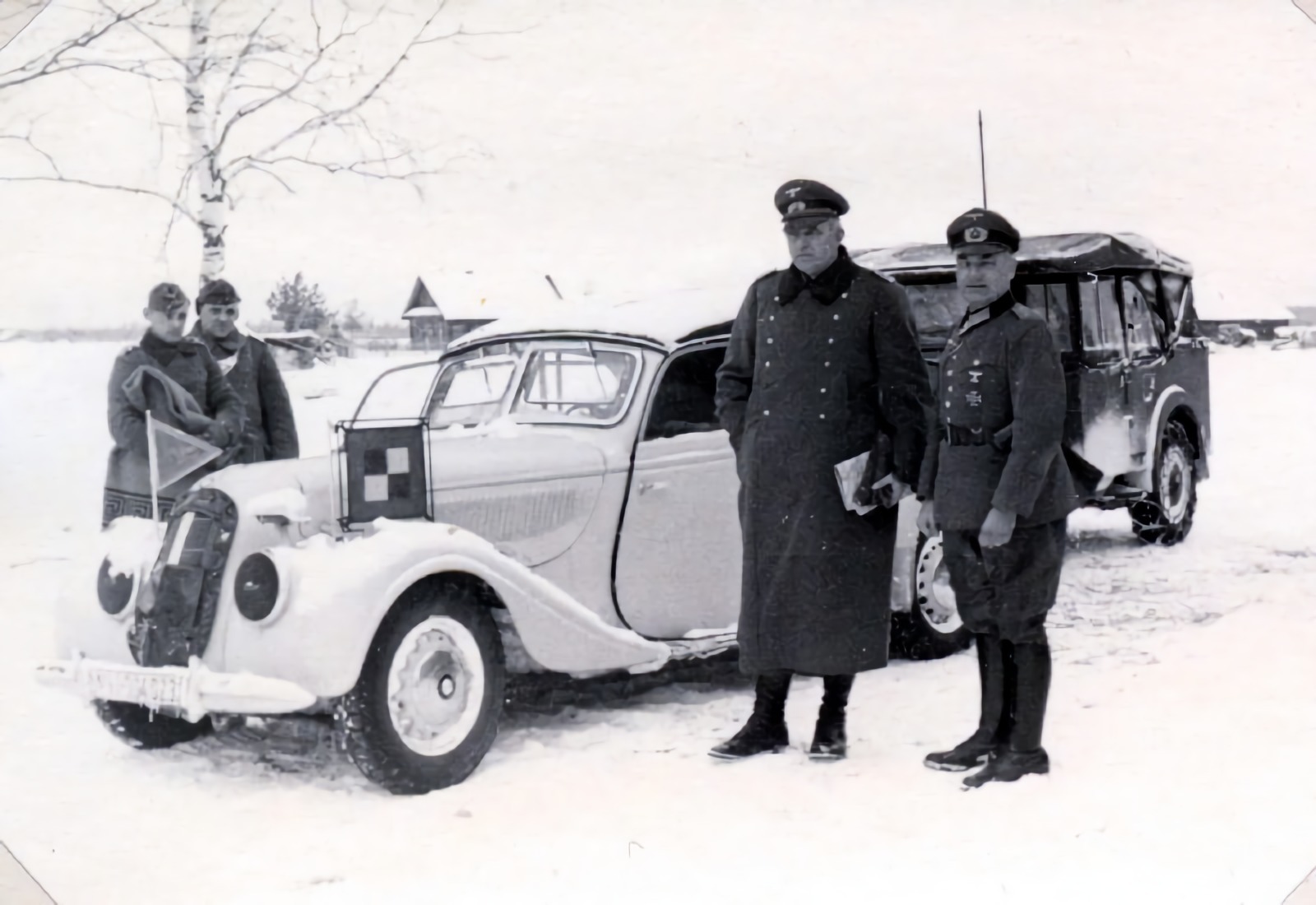
Generaloberst Ernst Busch (Oberbefehlshaber 16. Armee) poses with Oberst Erich Jaschke (right, Kommandeur Infanterie-Regiment 90 / 20.Infanterie-Division) in front of a BMW 335. This photo was most likely taken on the Volkhov front, northern sector of the Eastern Front, in the winter of 1941/42. At that time the Germans were not yet equipped with the winter white clothes and gear, so they wore the standard Wehrmacht coats or any other thick garment they could find in the field.

Source :
https://forum.axishistory.com/viewtopic.php?f=23&t=174130&hilit=k%C3%BCchler


Friday, June 24, 2022

Bio of Feldwebel d.R. Alois Gugganig (1906-1944)

 
Feldwebel Alois Gugganig (Zugführer in 12.Kompanie / III.Bataillon / Gebirgsjäger-Regiment 91) with the recently acquired Ritterkreuz, 1943.

Full name: Alois Gugganig
Nickname: Lois
Date of Birth: 8 June 1906 in Bad Gastein, Bischofshofen, Salzburg (Austro-Hungarian Empire)
Date of Death: 6 January 1944 in Vinnitsa, Ukraine (Soviet Union)
NSDAP Number: unknown (joined in 1931)
SS Number: no
Academic Title: no
Family Member:Anton Gugganig and Maria Herzog (parents)
Physical Feature: unknown

Beförderungen (Promotion):
01.06.1941 Gefreiter
01.11.1941 Unteroffizier

Karriere (Career):
00.00.1912 - 00.00.1920 attended elementary school in Bad Gastein
00.00.1916 - 00.00.1918 attended his first ski course which was organized by his school
00.00.1920 learned the profession of a shoemaker
00.00.1927 - 10.06.1929 attended the mountain guide course
04.05.1930 head of the ski school in Badgastein
17.04.1940 ski train driver in Infanterie-Regiment 738
27.05.1940 - 29.04.1941 served in Gebirgsjäger-Ersatz-Regiment 136
27.05.1940 - 04.07.1940 completed the basic training in Gebirgsjäger-Ersatz-Regiment 136
30.04.1941 - 07.02.1942 served in 6.Kompanie / II.Bataillon / Infanterie-Regiment 738
11.08.1941 - 06.09.1941 Unterführer-Lehrgang II.Bataillon / Infanterie-Regiment 738
08.02.1942 - 26.06.1942 served in 2.Kompanie / Gebirgsjäger-Bataillon 99
03.04.1942 - 09.04.1942 Heeresbergführer-Lehrgang
26.06.1942 transferred to the Hochgebirge staff in Berchtesgaden
27.06.1942 transferred to 2.Kompanie / Hochgebirgsbatallions 2
12.10.1942 wounded for the first time by bullet fire
13.02.1943 - 06.01.1944 transferred to 2.Kompanie /  Gebirgsjäger-Regiment 91
00.03.1943 received home leave which he spent with his family in Badgastein
19.10.1943 went back to the front to his old unit
06.01.1944 killed in action

Orden und Ehrenzeichen (Medals and Decorations):
13.04.1935 SA Wehrsport-Abzeichen                                               
24.12.1941 Kriegsverdienstkreuz II.Klasse mit Schwertern              
20.02.1941 Eisernes Kreuz II.Klasse                                                   
27.09.1942 Eisernes Kreuz I.Klasse                                                   
02.10.1942 Verwundetenabzeichen in Schwarz                               
09.04.1943 Ritterkreuz des Eisernen Kreuzes, as Feldwebel and Zugführer in 12.Kompanie / III.Bataillon / Gebirgsjäger-Regiment 91 / 4.Gebirgs-Division                         
01.07.1943 Heeres-Bergführerabzeichen                                           
10.09.1943 Infanterie Sturmabzeichen                                              
20.11.1943 Medalia comemorativa Cruciada Impotriva Comunismului (Romania)                        

------------------------------------------------------------------------------

Alois Gugganig was born on June 8, 1906, in Badgastein to Anton and Maria Gugganig. From 1912 to 1920, he attended the elementary school in Badgastein. He was enthusiastic about skiing and mountaineering very early on. From 1916 to 1918, he attended his first ski course, which was organized by his school. During this time he was able to achieve some downhill victories. In 1920, he learned the profession of a shoemaker. In his free time, he regularly went on mountain and ski tours. In 1927, he was invited by the Austrian Alpine Association to attend the mountain guide course, which he completed in 1929 together with his training as a ski instructor. In 1930, he became head of the ski school in Badgastein. In 1931, he became a member of the NSDAP, and in 1932 he became a member of the SA.

Gugganig completed his basic training at the Gebirgsjäger-Ersatz-Regiment 136 in Innsbruck. After completing basic training, he was transferred to Fulpmes due to his civilian mountain guide training. Here he completed his first army mountain guide course from August 22 to September 4, 1940, and then completed the first winter course from February 3 to April 17, 1940. Then he went straight to the front, to Infanterie-Regiment 738, where he was used as a ski train driver. Here he was also awarded the Iron Cross 2nd Class and the War Merit Cross 2nd Class. He then took part in the first Unterführer course in the II. Battalion of Infanterie-Regiment 738. After graduation, he was transferred to the Gebirgsjäger-Battalion 99 in Sonthofen. From 04/04 to 05/01 in 1942, he took part in the second army mountain guide course in Fulpmes. He was present here until June 26, until being transferred to the Hochgebirge staff in Berchtesgaden, from where he was transferred directly to the 2nd company of the Hochgebirgsbatallions 2 on June 27. Here he was wounded on October 12, 1942, for the first time by bullet fire. After recovery in the hospital, he came to the Jäger-Regiment 91, 2 Company on February 13, 1943. Here he was awarded the Ritterkreuz on March 27, 1943. Then he received home leave which he spent with his family in Badgastein. From there he went on to Fulpmes where he was awarded the Heeresbergführer. On October 19, 1943 he went back to the front to his old unit.

How He Won His Ritterkreuz: Gugganig was ordered to hold the edge of a village against any attack by the enemy with his platoon to protect the flank of his division. During the night however, several hundred Russians suddenly broke into the village through a front hatch to the left of his position. They overran three heavy gun positions and penetrated ever deeper into the defensive line. To counter the danger of being overrun, Gugganig decided to counterattack with his platoon. With his troops he attacked a twenty-fold superior force. A murderous hand-to-hand fight broke out, house after house was reconquered by Gugganig and his men as well as the three heavy gun positions. After hours of fighting, he managed to occupy the old main battle line and capture almost 100 Russians and left more than 180 dead on the battlefield. Through his action and others of this kind, the Kuban bridgehead was created.

On January 6, 1944, at around 3 am, the Russians carried out a surprise attack against the position of Gugganig and his platoon. Here he was severely wounded by a shot in the belly and grenade splinters in the back. He died in the hands of a comrade who then wrote a letter to his mother and told her the last words and wishes from her son. He was admitted to the field hospital in Winniza at 1 am, on January 7, where he was declared dead and buried there the same day.


Source :
https://www.alamy.com/sergeant-alois-gugganig-12gebirgsjaegerregiment-91-with-the-knights-cross-1941-image385783729.html
https://www.edelweiss-antiques.com/alois-gugganig
https://www.ratisbons.com/auctions-archive/25th-contemporary-history-auction/grouping-to-heeresbergfuehrer-kc-recipient-fw-gugganig.html
https://www.tracesofwar.com/persons/85736/Gugganig-Alois.htm

Tuesday, June 21, 2022

Oldwig von Natzmer with Entfernungsmesser


General der Infanterie Rudolf Schmundt (second from left, Chefadjutant des Heeres beim Führer und Oberbefehlshaber der Wehrmacht) and Oberst im Generalstab Oldwig von Natzmer (second from right, Ia Erster Generalstabsoffizier Panzergrenadier-Divisionland "Großdeutschland") near the German air defense installation in the Eastern Front, June 1944. The installation was named Entfernungsmesser (range finder) of the type Kdo.​Ger.40 (Kommandogerät 40), and was commonly used by anti-aircraft units using the heavy Flak 18 or Flak 40. The apparatus is used to determine the position of the enemy aircraft as well as calculate its distance from the ground. It takes at least five crew to operate this rangefinder, while its weight of almost 1 ton - 915 kg to be exact - makes its scope of use limited only as a means of self-defense and not attack support. Even so, the super quality lens it uses and the well-tested accuracy of its target locking make the Kommandogerät 40 the mainstay of the Wehrmacht's gun fire controllers. This photo was made by Kriegsberichter Gottert, and was first published in the "Berliner Verlag" in June 1944.

Sumber :
https://audiovis.nac.gov.pl/obraz/1802/
https://www.gettyimages.ca/detail/news-photo/the-picture-from-national-socialist-reporting-shows-news-photo/1058609836


Sunday, June 19, 2022

German Generals in the Paris Parade 1940


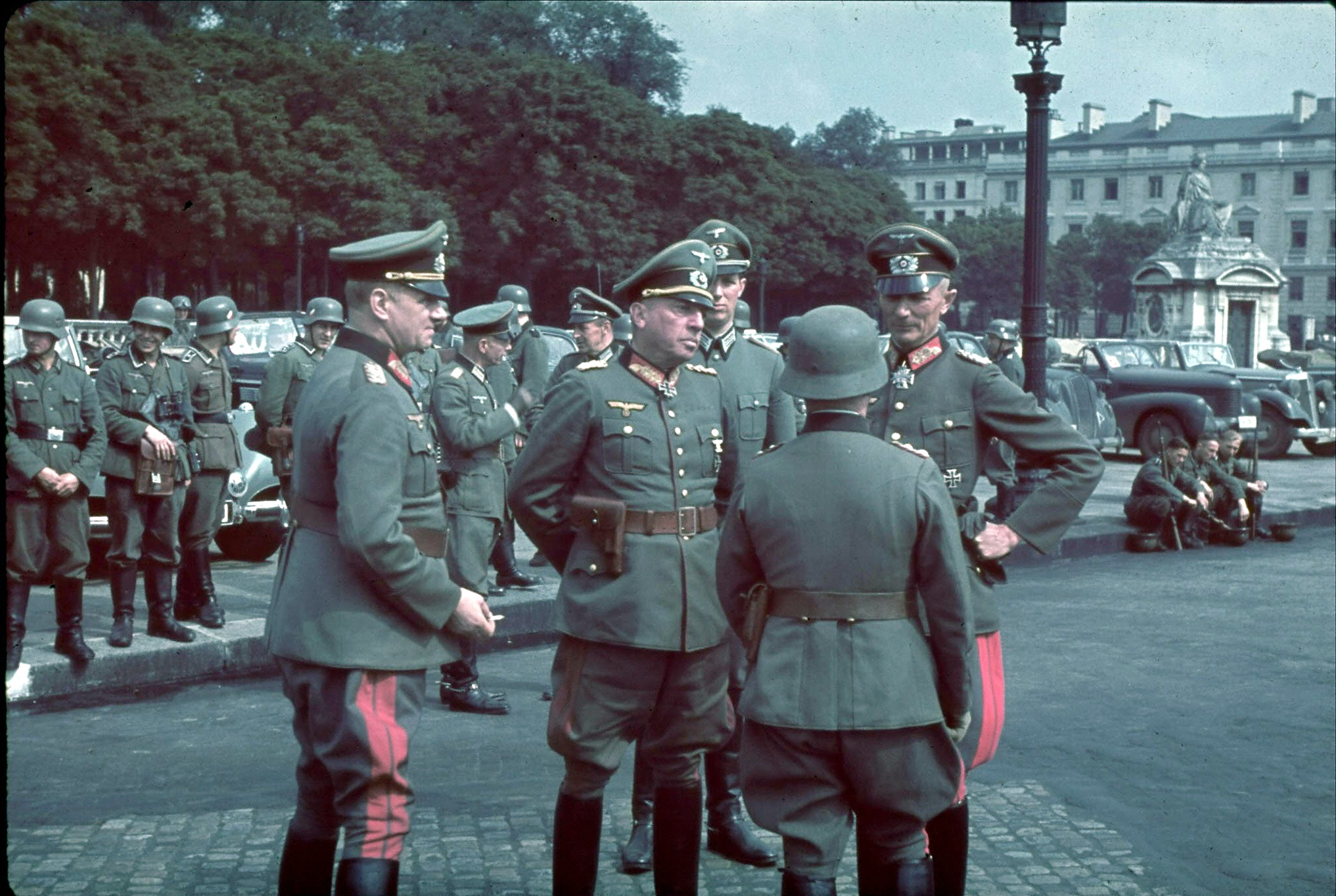
Wehrmacht high ranking officers gathered at the victory parade of the German troops at the Place de la Concorde, Paris, which held on Friday, June 14, 1940. On that day the French capital fell to the Nazis, while 2,000,000 of its citizens had already fled. In preparation for the parade, the new authorities forbade local residents to approach the vicinity of the Place de la Concorde from 08:00 AM until the afternoon. Front row from left to right: Generalleutnant Hans von Salmuth (Chef des Generalstabes Heeresgruppe B), General der Artillerie Georg von Küchler (Oberbefehlshaber 18. Armee), Oberleutnant der Reserve Heinrich Graf von Lehndorff-Steinort (Adjutant Oberbefehlshaber Heeresgruppe B), General der Kavallerie Georg Stumme (with his back to the camera, Kommandierender General XXXX. Panzerkorps), and Generaloberst Fedor von Bock (Oberbefehlshaber Heeresgruppe B). In the background were rows of parked luxury cars, which were most likely the special rides of the high-ranking German officers who attended the event. The three cars on the right are, in order from left to right: Opel Admiral, Opel Kapitän, and Horch 830 BL. This original color photo was taken by one of Hitler's personal photographers, Hugo Jaeger, who "toured" together with Heeresgruppe B in the invasion of the Low Countries (Netherlands Belgium Luxemburg) and France in the summer of 1940.

Source :
https://artsandculture.google.com/search?q=kuechler&hl=en

Sepp Dietrich and Kurt Meyer

SS-Obergruppenführer und General der Waffen-SS Josef "Sepp" Dietrich (Kommandeur Infanterie-Regiment "Leibstandarte-SS Adolf Hitler") and SS-Hauptsturmführer Kurt "Panzermeyer" Meyer (Kommandeur SS-Aufklärungs-Abteilung / Infanterie-Regiment "Leibstandarte-SS Adolf Hitler") in the background. No other information available, but the picture was possibly taken in 1930 or 1940 during the award ceremony of LSSAH.

Source :
https://clio-historia.livejournal.com/380042.html

Kurt Herzog and His Division Staff

 
Divisionsstab of Generalleutnant Kurt Herzog (2nd from left, Kommandeur 291. Infanterie-Division) in Latvia during Unternehmen Barbarossa, summer of 1941. The "Elch" (Elke) division managed to advance 44 miles in the first 34 hours of the campaign in the Baltic States, but after being assigned the mission of clearing the Baltic coast, was temporarily stopped in their tracks at the naval base of Libau where Soviet Marines and 67th Rifle Division repelled their first attempt to rush the town on 25th June. Resorting to point blank artillery fire, Herzog’s men finally overran the town after four days of fierce fighting and continued advancing up the Baltic Coast before reaching the Latvian capital of Riga which was already under attack from the East by Philipp Kleffel’s 1. Infanterie Division, the following day.

Source :
https://www.axishistory.com/books/150-germany-heer/heer-divisionen/3546-291-infantrie-division
https://clio-historia.livejournal.com/380042.html

Sunday, June 5, 2022

Ritterkreuz Award Ceremony of Hubert-Erwin Meierdrees


ECPAD archives (DAT 1154 L02)

SS-Obersturmführer Hubert-Erwin Meierdrees / Meierdress (Führer Sturmgeschütz-Batterie / SS-Totenkopf-Artillerie-Regiment / SS-Division 'Totenkopf'). Wounded in the Demjansk pocket and extracted after being wounded in action. Ritterkreuz des Eisernen Kreuzes awarded on 13 March 1942. The Ritterkreuz recommendation of Erwin Meierdrees by the Divisionskommandeur Eicke reads as follows: “Meierdrees was serving as part of Kampfgruppe Bochmann when the Russians penetrated friendly lines south of Staraya Russa at the beginning of January 1942, and in response to this development Meierdrees was initially deployed northeast and southeast of the city. His numerous bold attacks brought valuable relief to the hard-pressed Heer units in this area, and heavy losses were inflicted on the foe in the process. After the Kampfgruppe commander became a casualty SS-Obersturmführer Meierdrees rallied the remnants of the Gruppe and proceeded to conduct a determined defense of the village of Bjakowa (located on the Staraya Russa—Demyansk road). Since the end of January Meierdrees has held this village in a heroic struggle against overwhelming enemy attacks despite being encircled from all sides. Whenever the Russians fought their way into the village with strong tank and aircraft support they were always forced to retreat from their gains in the face of the bravely fighting troops under the bold and skillful leadership of SS-Obersturmführer Meierdrees. The defenders of Bjakowa continue to stand their ground under the guidance of their heroic commander. The holding of this village is of critical importance for the integrity of Fortress Demyansk, as the capture of this village would place another section of the road into enemy hands and bring them one step closer to linking up with those Russian forces pushing southwards from Gortschizy. I ask that SS-Obersturmführer Meierdrees be awarded the Ritterkreuz des Eisernen Kreuzes on account of his heroic struggle and the success he has achieved.”

Meierdrees was awarded the Eichenlaub #310 for his Ritterkreuz on 5 October 1943 as SS-Hauptsturmführer and Kommandeur I.Abteilung / SS-Panzer-Regiment 3 "Totenkopf" / SS-Panzergrenadier-Division "Totenkopf". The Eichenlaub recommendation of Erwin Meierdrees reads as follows…

“1.) During the attack against the Uljanowka agricultural estate on 1 March 1943 our Panzers were unable to advance due to the threat from a strong Pakfront. SS-Hauptsturmführer Meierdrees bypassed this Pakfront with his Panzer and attacked it from the flank with magnificent spirit. He personally crushed 4 heavy anti-tank guns beneath his tracks, and his brave deed opened up the enemy’s front for a pursuit thrust by our forces.

2.) During the early morning hours of 3 March 1943 Meierdrees and his Panzer-Abteilung had a surprise encounter with a Russian column stretching 7 km in length (consisting of mostly artillery and anti-tank guns) whilst advancing towards Schljachowaja. SS-Hauptsturmführer Meierdrees immediately attacked this column on his own initiative, and by driving at the very spearhead of the attack he gave his troops the highest example of dutifulness and personal bravery.

The success was total. Several artillery detachments, over 40 anti-tank guns and several hundred trucks together with abundant quantities of assorted war materiel were destroyed or captured.

The 15 T-34s that were escorting the Russian column were all destroyed in the process.

3.) On 7 July 1943 the enemy commenced their anticipated flanking thrust from Ternowka towards the Radin—Schopino road with strong infantry and tank forces. In response SS-Hauptsturmführer Meierdrees engaged the attackers as the first friendly unit to do so (they therefore did not even have infantry support at first). Whilst driving amongst his point Kompanie he identified a large assembly of about a regiment’s worth of Russian infantry in the Dolshik ravine. These were presumably awaiting the arrival of their own armoured forces, which were located about 1.5 km to the east at the time.

SS-Hauptsturmführer Meierdrees immediately ordered his light Kompanie to attack these infantry. He personally led the Kompanie into the opposing ranks, and the foe was routed with heavy losses. After this he led both of his medium Kompanien in an attack against the hostile armoured forces. By skillfully inserting his forces into battle it was possible to destroy 5 tanks in a very short time (of which he personally took out 3). The remaining tanks pulled back to the east at top speed. This determined and energetic intervention by SS-Hauptsturmführer Meierdrees prevented the Russians from blocking the road.

4.) SS-Hauptsturmführer Meierdrees and his Abteilung repeatedly distinguished themselves during the seizure and defense of the Psel bridgehead. During the attack against the hutment near Kljutschi on 12 July 1943 his Abteilung assailed a strongly fortified Russian defensive system which was occupied by infantry forces that were quite ready for defense against armour. As the rest of the Abteilung rolled over the trenches and proceeded to engage the enemy infantry further in the rear, the Panzer of SS-Hauptsturmführer Meierdrees was immobilized. He proceeded to bail out, rally the other bailed out crews of his Abteilung and then clear out the hostile positions in man-to-man close combat.

5.) During the attack against Hill 213.9 (on the Mius) Meierdrees and his Abteilung were amongst those in the first wave. He led his men forwards with indefatigable aggressiveness, and did not waver from even the strongest defensive fire. During this fighting his Panzer was knocked out twice, forcing him to bail out and engage in infantry combat with his crew. On 1 August 1943 he rolled out with his Abteilung for the fifth time, and finally he and his men managed to circumvent the hostile anti-tank/artillery fire and take control of the hill. Strong infantry counterthrusts that were supported by tanks were repulsed.

6.) During the establishment of the Kolontajew bridgehead on 19-20 August 1943 SS-Hauptsturmführer Meierdrees and his Abteilung distinguished themselves once again. Disregarding the strong enemy artillery and anti-tank fire that was falling on the village, he drove through the hostile gunfire, captured Hill 167.5 (located NE of the village) and held it against the strongest of opposing pressure. Here SS-Hauptsturmführer Meierdrees was wounded for the fifth time.”


ECPAD archives (DAT 1154 L01)


Source :
https://imagesdefense.gouv.fr/fr/
https://www.tracesofwar.com/persons/21806/Meierdrees-Hubert-Erwin-aka-Meierdress.htm

Wednesday, June 1, 2022

Welcoming Ceremony for Georg Dörffel

These photos was taken around Kharkov on July 20, 1943 by Kriegsberichter Jütte, and shows the welcoming ceremony for the Hauptmann Georg Dörffel (Gruppenkommandeur I.Gruppe / Schlachtgeschwader 1) who had just returned from the 800th "feindflug" (combat mission). Holding a bouquet of flowers and standing beside the Focke-Wulf Fw 190 he had just landed, Dörffel eagerly drank the liquor given by Major Alfred Druschel (Geschwaderkommodore Schlachtgeschwader 1).


From left to right: Oberleutnant der Reserve Johannes Gehrmann (Staffelkapitän 3.Staffel / I.Gruppe / Schlachtgeschwader 1), Hauptmann Georg Dörffel (Gruppenkommandeur I.Gruppe / Schlachtgeschwader 1), and Leutnant Johannes Meinicke (Staffelführer 1.Staffel / I.Gruppe / Schlachtgeschwader 1). On the same day, Oberleutnant d.R. Gehrmann flew his 400th mission.

From left to right: Oberleutnant der Reserve Johannes Gehrmann (Staffelkapitän 3.Staffel / I.Gruppe / Schlachtgeschwader 1), Major Alfred Druschel (Geschwaderkommodore Schlachtgeschwader 1), Hauptmann Georg Dörffel (Gruppenkommandeur I.Gruppe / Schlachtgeschwader 1), and Leutnant Johannes Meinicke (Staffelführer 1.Staffel / I.Gruppe / Schlachtgeschwader 1).


Source :
https://www.bild.bundesarchiv.de/dba/de/search/?topicid=dcx-thes_personen_774u7o51p5xr4b6jden
http://forum.12oclockhigh.net/showthread.php?t=59973
http://historical-media.com/einzel/2013.9.13/_x2013.9.13.html

Gehrmann, Dörffel and Meinicke


Welcoming ceremony for two pilots of I.Gruppe / Schlachtgeschwader 1 (SG 1). From left to right: Oberleutnant der Reserve Johannes Gehrmann (Staffelkapitän 3.Staffel / I.Gruppe / Schlachtgeschwader 1), Hauptmann Georg Dörffel (Gruppenkommandeur I.Gruppe / Schlachtgeschwader 1), and Leutnant Johannes Meinicke (Staffelführer 1.Staffel / I.Gruppe / Schlachtgeschwader 1). The picture was taken in the summer of 1943 by Kriegsberichter Jütte.

Source :
https://www.bild.bundesarchiv.de/dba/de/search/?topicid=dcx-thes_personen_774u7o73gz7u6hfvdfs

Bio of Oberstleutnant Georg Dörffel (1914-1944)


Full name: Georg Dörffel
Nickname: Orge
Date of Birth: 27 July 1914 in Rengersdorf, Kreis Görlitz, Niederschlesien (German Empire)
Date of Death: 26 May 1944 in Rome (Italy)
NSDAP Number: unknown
SS Number: unknown
Academic Title: unknown
Family Member: unknown
Physical Feature: unknown

Beförderungen (Promotion):
00.00.1939 Leutnant
01.09.1943 Major
00.00.1944 Oberstleutnant (posthumous)

Karriere (Career):
00.00.1937 transferred from the Heer to the Luftwaffe and trained as a Beobachter (observer/navigator) in a Kampfgruppe before being approved for the Stuka branch
01.07.1939 transferred from II.(Schl.)/LG 2 to III.(Aufkl.)/LG 2
10.05.1940 Flugzeugführer in 5.Staffel (Stuka) / II.Gruppe / Lehrgeschwader 2 (LG 2)
30.10.1940 Staffelkapitän 5.Staffel (Stuka) / II.Gruppe / Lehrgeschwader 2 (LG 2)
13.01.1942 Staffelkapitän 5.Staffel (Stuka) / II.Gruppe / Schlachtgeschwader 1 (SG 1)
02.03.1943 Gruppenführer I.Gruppe / Schlachtgeschwader 1 (SG 1)
11.06.1943 Gruppenkommandeur I.Gruppe / Schlachtgeschwader 1 (SG 1)
24.09.1943 Kommandeur Ergänzungs-Schlachtgruppe
07.10.1943 flew his 1,001st combat mission and was banned from further operational flying
15.11.1943 Gruppenkommandeur I.Gruppe / Schlachtgeschwader 152 (SG 152)
00.05.1944 Geschwaderkommodore Schlachtgeschwader 4 (SG 4)
25.05.1944 KIA – shot down north of Rome while engaging a formation of P-47 escorted 4-engine bombers from 15th USAAF. Another and better researched account states that he engaged P-47 fighter-bombers in the vicinity of Lake Bracciano on 26.05.44 and baled out 15 km NW of Rome, and that no 4-engine bombers operated that day). Posthumously promoted to Oberstleutnant. Credited with 1,004 combat missions and at least 30 air victories

Orden und Ehrenzeichen (Medals and Decorations):
00.00.19__ Flugzeugführerabzeichen
21.05.1940 Eisernes Kreuz II.Klasse
21.05.1940 Eisernes Kreuz I.Klasse
21.08.1941 Ritterkreuz des Eisernen Kreuzes, as Oberleutnant and Staffelkapitän 5.Staffel (Stuka) / II.Gruppe / Lehrgeschwader 2 (LG 2)
17.11.1941 Luftwaffe Ehrenpokale für besondere Leistungen im Luftkrieg
24.01.1942 Deutsches Kreuz in Gold
00.00.1942 Medaille "Winterschlacht im Osten 1941/42" (Ostmedaille)
00.00.194_ Frontflugspange für Kampfflieger in Gold mit Sternanhänger "1000"
14.04.1943 Ritterkreuz des Eisernen Kreuzes mit Eichenlaub #231, as Hauptmann and Gruppenführer I.Gruppe / Schlachtgeschwader 1 (SG 1)

------------------------------------------------------------------------------

Georg Dörffel joined the military service in Infanterie-Regiment 22 (22nd infantry regiment) in 1933. In 1935 he transferred to the Luftwaffe holding the rank of Oberfähnrich (senior officer candidate). At first he served as an observer in a Kampfgeschwader (ground attack wing) before transferring as to the 5.(Schlacht)/Lehrgeschwader 2 (5.(S)/LG 2—5th ground attack squadron of the 2nd demonstration wing) flying the Henschel Hs 123 ground attack aircraft.

With this squadron as part of the II.(Schlacht)/LG 2 (2nd ground attack group of the 2nd demonstration wing) he flew as a Leutnant (Second Lieutenant) and pilot during the Invasion of Poland and Battle of France. The group was responsible of repelling a large enemy tank formation north of Cambrai on 17 May 1940 which threatened the flank of the German advance. Dörffel received the Iron Cross 2nd and 1st Class for this action on 21 May 1940.

Dörffel was shot down twice during the campaign in the west, the first time on 14 May 1940 near Tirlemont, Belgium and in June 1940 near Dunkirk. He was wounded on both occasions. In October 1940 he was appointed Staffelkapitän (squadron leader) of the 5.(S)/LG 2, which was re-designated 5./Schlachtgeschwader 1 (5th squadron of the 1st ground attack wing) in early 1942. In this role and position he flew in the Battle of Britain and from April 1941 in the Balkans Campaign.

With the beginning of Operation Barbarossa, the German invasion of the Soviet Union in June 1941, Dörffel was transferred to the Eastern Front, particularly in support of the central and southern sectors, providing air support to the German ground forces. Together with the squadron leader of the 2.(S)/LG 2, Oberleutnant Alfred Druschel, he was awarded the Knight's Cross of the Iron Cross on 21 August 1941 after over 200 combat missions. He was shot down near Skvorin at the Don River on 1 July 1942. Dörffel flew his 600th combat mission on 16 August 1942. He was appointed acting Gruppenkommandeur (group commander) of the I./SG 1 (1st group of the 1st ground attack wing) on 2 March 1943 followed by his official appointment as group leader on 11 June 1943.

Dörffel flew his 800th mission of the war in July 1943 followed by his 900th mission one month later. He was promoted to Major on 1 September 1943. In early October 1943 he flew 19 combat missions on one day against the attacking Red Army forces crossing the Dnieper River near Kiev. He flew his 1,000th combat mission of the war on 6 October 1943, claiming his 30th aerial victory on that flight. He was grounded one day later and transferred and appointed commander of the Schlachtfliegerschule (ground attack fliers school) at Prossnitz. In early May 1944 he took command of Schlachtgeschwader 4 (SG 4—4th ground attack wing) stationed in Italy as Geschwaderkommodore (wing commander).

Georg Dörffel was killed in action on 26 May 1944 north-west of Rome, Italy. Dörffel was forced to bail out of his Focke-Wulf Fw 190 F-8 (Werknummer—factory number—580 464) following an attack on a four-engined bomber formation. He probably struck his head on the tailplane; his parachute failed to open. He was buried in Pomezia, Italy, and posthumously promoted to Oberstleutnant (Lieutenant Colonel).


Source :
"Luftwaffe Officer Career Summaries" by Henry L. deZeng IV and Douglas G. Stankey
https://www.bild.bundesarchiv.de/dba/de/search/?yearfrom=&yearto=&query=D%C3%B6rffel#
https://en.wikipedia.org/wiki/Georg_D%C3%B6rffel
https://forum.axishistory.com/viewtopic.php?p=2412079#p2412079
https://www.tracesofwar.com/persons/29083/D%C3%B6rffel-Georg.htm

Heino von Rantzau in Luftwaffe Award Ceremony

 
Generalleutnant Heino von Rantzau (Kommandeur 2. Flak-Division) in an award ceremony. Rantzau (8 March 1894 – 2 November 1946) was a highly decorated Generalleutnant in the Luftwaffe during World War II. He was also a recipient of the Ritterkreuz des Eisernen Kreuzes, which he received on 29 August 1943. Heino von Rantzau was captured by American troops in April 1945, and died in captivity on 2 November 1946.

Source :
https://forum.axishistory.com/viewtopic.php?p=2412116#p2412116