Friday, December 9, 2022

Bio of Korvettenkapitän Georg Schewe (1909-1990)

Georg Schewe
Korvettenkapitän (Crew 32)

Successes
16 ships sunk, total tonnage 85,779 GRT

Date of birth: 24 November 1909 in Ueckermünde, Pomerania (German Empire)
Date of death: 14 October 1990 (80 y.o.) in Hamburg, Germany
    
Ranks
01.04.1932 Offiziersanwärter
01.07.1934 Fähnrich zur See
01.09.1935 Oberfähnrich zur See
01.01.1936 Leutnant zur See
01.10.1937 Oberleutnant zur See
01.10.1939 Kapitänleutnant
01.08.1943 Korvettenkapitän

Decorations
20.12.1939 Eisernes Kreuz II.Klasse
24.01.1940 U-Boots-Kriegsabzeichen
13.06.1940 Eisernes Kreuz I.Klasse
23.05.1941 Ritterkreuz des Eisernen Kreuzes, as Kapitänleutnant and commander of U-105

U-boat Commands
U-boat      From               To   
U-60 - 22 Jul 1939 - 19 Jul 1940 - 6 patrols (104 days)
U-105 - 10 Sep 1940 - 6 Jan 1942 - 4 patrols (236 days)

Georg Schewe began his naval career as a seaman in October 1928. In 1932 he commenced officer training and received his commission in 1936. In the same year he transferred to the U-boat force, receiving a thorough pre-war training. In July 1939 he commissioned the type IIC U-boat U-60. After six patrols (with only one sinking) he left the boat in August 1940 to commission the much larger type IXB U-boat U-105.

From January 1941 U-105 operated mostly in Atlantic waters. During her second patrol in spring 1941 Kptlt Schewe achieved remarkable success when he sank 12 ships with a total of 71,450 tons. It was the second most successful patrol of the whole war, only beaten by Hessler's with U-107 a few months later. Georg Schewe left U-105 in February 1942 for a shore posting.

He became a staff member of the FdU Mittelmeer (U-boat Command Mediterranean). After more than two years in this position, in autumn 1944 he took over command of the 33rd Flotilla for a month. From October 1944 he was on the OKM (Naval High Command) staff. Following Germany's surrender he spent a year in allied captivity.


Source :
https://www.ebay.com/itm/283063009520
https://en.wikipedia.org/wiki/Georg_Schewe
https://www.tracesofwar.com/persons/39270/Schewe-Georg.htm
https://uboat.net/men/schewe.htm

Thursday, December 8, 2022

Günther von Kluge Visited 4. Armee

Front row, from left to right: Oberst i.G. Hellmuth Stieff (Ia Generalstabsoffizier 4. Armee), Generalfeldmarschall Günther von Kluge (Oberbefehlshaber Heeresgruppe Mitte), General der Infanterie Gotthard Heinrici (Oberbefehlshaber 4. Armee), and Oberstleutnant i.G. Erich Helmdach (Ic Generalstabsoffizier 4. Armee). This picture was taken in May 1942 when Von Kluge visited the HQ of 4. Armee in the central sector of the Eastern Front.

Source :
https://www.alamy.com/stock-photo-hans-guenther-von-kluge-gotthard-heinrici-and-hellmuth-stieff-1942-37000064.html
https://www.lavanguardia.com/historiayvida/historia-contemporanea/20221022/8575345/heinrici-batalla-seelow-zhukov-berlin-1945.html
https://ww2gravestone.com/people/heinrici-gotthard-our-poison-dwarf/

Ritterkreuz Action of Julius Spari

Julius Spari (2 February 1910 - 12 December 1944) received the Ritterkreuz des Eisernen Kreuzes on 10 September 1944 as Stabsfeldwebel and Zugführer in 7.Kompanie / II.Bataillon / Gebirgsjäger-Regiment 138 / 3.Gebirgs-Division. During August of 1944, in the fighting along the Carpathian front, the frontline of the Gebirgsjäger-Regiment 138 consisted of a chain of scattered hilltop strongpoints. This position was put to the test on the 19 August 1944 when the Soviets launched an attack here. One of these strongpoints (Ötztal), consisting of a Gebirgsjäger Zug as well as an HMG and mortar squad, was commanded by Julius Spari. He received a radio message from his commander to defend the position, after which communications to the hill were broken. An initial attempt to relieve the hill, which had been surrounded by the Soviets, failed. However the strongpoint managed to hold against all hostile attacks for 4 days before finally being relieved by the troops of Hauptmann Giehrl. For his outstanding defensive effort here, Stabsfeldwebel Spari received the Ritterkreuz.


Source :
https://www.facebook.com/photo/?fbid=195158639701741&set=basw.AboIOASPC_GskRdFIFwsHjkYc3sYFwE-9JLqcWBO0mkw2-dxEUqYOwGmTr9n5y-v-VgKW5oiddFl3VYJaeLVBrtTeY2KKAbBGdU0UaUrAB_VJB6i49d9RiitXhEr4kOw5wSfTxVwFPMXFZw84Jce2NBj128guOfpkPxngLlWFknaqiR78VcBA4_A5i696s6Pnvw&opaqueCursor=AboNFM_74Ahwc4lB6GvgktmsLwtVR8IFMqkvKfvdV205U2IBH_j2-_P5n7D3I9PQ3NcgZ6HBt2v12Ek3ufA3GzY8qL-VrjwXMMNSKfrOx1QRkC4mRFD4Ij2SKTv3TV_RjLoXqO9ZQ-WpZZ-2b3OVj0xDijtcoqr6Qp7gJHcRc8PYT2d1Fik8kCCl9L0tFHp8Kt1GZdDNQEI36gX3BFNag8E7Q5RlW1MdHGXcKua2H8gyjVi_wBo3F_3Yopkjemmylm-0X5pqRB2n5LIraPuC66RJJBcKkMQlrONJkXrfXg6XKxith3mrMvIY45GHmRL0Rg4PvnoyyzLl39plyH2S7EZne5gCOJ_8alfkND7v7cYxtRoh4B0HTf_0i-DI1dpqWG83W3PN0T1kmaXTOXI6v_jpvmWwhgUaIB_3_KFM06Ri2s9H3AjhC3cqzk8BdELvnpclc1x2R9h1oQK3iyaBaceHmbLdfcrbsKOh2O_DkGnM02YDNoNCX8NXzG6wsXBfqJsxiblgnyMnOrCvnYMjj61hpMdFvvi39aCPc9TTfbCnNOZfPc_BWQeTYCztjVQvTcA-A5XvNz_zmB9nnD5M2tRxBG_tepHCQ8qCcDuZBCMqL6dkRPHOosEZBzON_nO2jHVvZbAhbSlWo3yccvffiajU3fN-htZokgH2PX5l02U_48n8WjwP2Dk30hV_8FG2092uXgwPPg_F4XcQkI7xWUIB4YxcZiTXHYZq7JhgVxwHXouTYz_b4_qecvF6hAk4wir63z-uPmyax6_0gbCi1bFRe2mm364g2MXFbRxVOfqVVAmJFwt2VAeDwn3sxDstLR4
https://www.tracesofwar.com/persons/66755/Spari-Julius.htm

Bio of Oberwachtmeister Adolf Stück (1915-1984)

Adolf Stück
Wachtmeister der Reserve
SA-Sturmführer


* 11.03.1915 in Rodebach/Kreis Eschwege/Hessen-Nassau.
† 31.10.1984 in Bad Soden-Allendorf/Main-Taunus-Kreis/Regierungsbezirk Darmstadt/Hessen.


NSDAP-Nr.:

Promotions:
Wachtmeister d. R.
SA:
00.00.193_ SA-Mann
00.00.19__ SA-Scharführer
00.00.1943 SA-Truppführer (mit Wirkung vom 09.11.1943)
00.00.1943 SA-Sturmführer

Career:
ca. 1921-ca. 1925 Volksschule (?). Jungbauer.
SA service with Sturm 23/SA-Standarte 173 (Hollstein bei Walburg).
03.11.1937 Entered military service. 1. Batterie/Artillerie-Regiment 251.

Decorations & Awards:
26.10.1943 Ritterkreuz des Eisernen Kreuzes as Wachtmeister d. R. and Vorgeschobener Beobachter in 1. Batterie/I. Abteilung/Artillerie-Regiment 251/251. Infanterie-Division. Vorschlagsliste Nr. 2258.
21.10.1944 Deutsches Kreuz in Gold as Wachtmeister d. R. and Vorgeschobener Beobachter (?) in 4. Batterie/II. Abteilung/Artillerie-Regiment 251/251. Infanterie-Division/Korps-Abteilung 3.
00.00.194_ 1939 Eisernes Kreuz I. Klasse
00.00.194_ 1939 Eisernes Kreuz II. Klasse
00.00.194_ Nahkampfspange I. Stufe (Bronze)
00.00.194_ Allgemeines-Sturmabzeichen
00.00.1942 Medaille “Winterschlacht im Osten 1941/42”

Notes:
* Parents (Married in Germerode/Hessen, 15.06.1915):
- Father: Adolf George Adolph Stück (*14.03.1890 in Reichenbach/Hessen, †10.09.1962), a farmer.
- Mother: Dorothea Luise Stück, geb. Heinemann (*08.10.1888)
* Siblings: Two.
* Religion: Protestant.
* Married in 1940 to Agnes Böttner.
One daughter (*20.12.1940).


Source :
https://forum.axishistory.com/viewtopic.php?p=2444852#p2444852
https://www.forum-der-wehrmacht.de/index.php?thread/58224-st%C3%BCck-adolf-ritterkreuz/
https://www.tracesofwar.com/persons/19363/St%C3%BCck-Adolf.htm

Ritterkreuz Action of Eduard Wintershoff

Eduard Wintershoff (25 November 1921 - 18 January 1944) received the Ritterkreuz des Eisernen Kreuzes on 25 August 1942 as Unteroffizier and Geschützführer in 2.Kompanie / Panzerjäger-Abteilung 8 / 8.Infanterie-Division. The following newspaper excerpt (dated 7 September 1942) describes why Wintershoff received the Ritterkreuz: "Unteroffizier Eduard Wintershoff… eliminated 8 Bolshevik tanks within 24 hours whilst conducting defensive combat against heavy enemy attacks in the northern sector of the Eastern front during the middle of August. Although he was wounded in this action he continued to operate the gun alone after his fellow Panzerjäger had become casualties. The bravery he displayed here in the face of strong enemy fire significantly contributed to the successful defense.”

Source :
https://forum.axishistory.com/viewtopic.php?p=2444598#p2444598
https://www.tracesofwar.com/persons/35153/Wintershoff-Eduard.htm

Tuesday, December 6, 2022

German Generals Captured at Stalingrad

German generals captured at Stalingrad. From left to right: Generalmajor Erich Magnus (Kommandeur 389. Infanterie-Division. Surrendered 2 February 1943), Generalmajor Hans-Georg Leyser (Kommandeur 29. Infanterie-Division. Surrendered 31 January 1943), Generalleutnant Arno von Lenski (Kommandeur 24. Panzer-Division. Surrendered 2 February 1943), Generalleutnant Carl Rodenburg (Kommandeur 76. Infanterie-Division. Surrendered 31 January 1943), Generalmajor Martin Lattmann (Kommandeur 389. Infanterie-Division. Surrendered 2 February 1943), Generalleutnant Werner Sanne (Kommandeur 100. Jäger-Division. Surrendered 31 January 1943), and General der Infanterie Karl Strecker (Kommandierender General XI. Armeekorps. Surrendered 2 February 1943).

Source :
https://mmna.ru/2020/02/04/elita-plena/

Sunday, December 4, 2022

Maximilian von Weichs in Lodz

General der Kavallerie Maximilian Reichsfreiherr von Weichs (Kommandierender General XIII. Armeekorps) gives a military salute to his troops entering the city of Lodz on 9 September 1939, one day after the city in central Poland fell to the Germans. For three days (6-8 September 1939) both sides fought fiercely, and the fall of the city of Lodz opened the way for the invaders to continue their assault on their main goal: the capital Warsaw.

Source :
https://en.wikipedia.org/wiki/Battle_of_%C5%81%C3%B3d%C5%BA_(1939)

Gerd von Rundstedt and Maximilian von Weichs Having Lunch

Two Wehrmacht generals discussing the recent situation while having a meal in the garden under a tree in newly occupied France, June 1940. from left to right: Generaloberst Gerd von Rundstedt (Oberbefehlshaber Heeresgruppe A) and General der Kavallerie Maximilian Reichsfreiherr von Weichs (Oberbefehlshaber 2. Armee). Photo by Kriegsberichter Harren of PK (Propaganda-Kompanie) 670.

Source :
https://www.sitytrail.com/en/poi/5001009-houffalize--le-char-panther/#lg=1&slide=3
https://ww2db.com/image.php?image_id=10198

Oldwig von Natzmer in Gift Ceremony

An unknown Unteroffizier (non-commissioned officer) of the "Großdeutschland" division was honored by Oberst i.G. Oldwig von Natzmer (Ia im Generalstab Panzergrenadier-Division "Großdeutschland"). The picture was taken in the end of summer 1943 by Kriegsberichter Bauer of PK (Propaganda-Kompanie) Division "Großdeutschland", in the central sector of the Eastern Front.

Source :
https://www.worldwarphotos.info/gallery/germany/units/grossdeutschland/

Divisionskommandeur Hans Schmidt during Barbarossa

From left to right: Oberst Gustav Wenninger (Kommandeur Infanterie-Regiment 470 / 260.Infanterie-Division) and Generalleutnant z.V. Hans Schmidt (Kommandeur 260. Infanterie-Division). The picture was taken during Unternehmen Barbarossa (German invasion to Soviet Union), summer of 1941.


Oberst Gustav Wenninger (Kommandeur Infanterie-Regiment 470 / 260.Infanterie-Division) using field telephone.


Source :
https://www.forum-der-wehrmacht.de/index.php?thread/45807-bilder-meines-gro%C3%9Fvaters-heribert-gihr-angeh%C3%B6riger-der-260-infanteriedivision-1/&pageNo=5

Hermann Göring in Vienna


Generalfeldmarschall Hermann Göring (Oberbefehlshaber der Luftwaffe) - The later "Reichskommissar fuer die Wiedervereinigung Oesterreichs" (Commissar of the reunification of Austria) - saluting with his marschallstab. Behind Göring at right is SS-Oberführer Franz Langoth (Leiter der Nationalsozialistische Volkswohlfahrt in Österreich), while at left is SS-Gruppenführer Paul Körner (Staatssekretär, ständiger Stellvertreter und Leiter der Geschäftsstelle des Beauftragten für den Vierjahresplan). The head without the hat at the back is Dr.jur. Hans Fischböck (Minister für Wirtschaft und Arbeit zum Minister für Finanzen in Österreich). Also, SS-Brigadeführer Anton Reinthaler (Minister für Land- und Forstwirtschaft in Österreich) on the right side. The picture was taken by Agentur Schirner in Vienna, 28 March 1938.

Source :
https://www.dhm.de/lemo/bestand/objekt/hermann-goering-um-1941.html
https://forum.axishistory.com/viewtopic.php?p=2435712#p2435712

Saturday, December 3, 2022

Fritz Witt and Sepp Dietrich near Kharkov

SS-Obergruppenführer und General der Waffen-SS Josef "Sepp" Dietrich (Kommandeur SS-Panzergrenadier-Division "Leibstandarte SS Adolf Hitler") pays a visit to the headquarters of SS-Standartenführer Fritz Witt (Kommandeur SS-Panzergrenadier-Regiment 1 / SS-Panzergrenadier- Division "Leibstandarte SS Adolf Hitler") at Olchowatka, Belgorod, near Kharkov, in March 1943. Dietrich wore a sheepskin coat which had the official name "Sous-vetementent en peau fourrée Modele 1938", with an added collar, lace and zipper. Even so, it seems that the Divisionskommandeur still felt the weather is too cold so he prepared a thicker fur coat stored in the car seat, a stark contrast when compared to Witt who looked quite comfortable even though he was only wearing a standard uniform! Dietrich's trousers were of the stiefelhose, combined with the Luftwaffe's Flieger-Pelztiefel (aviation boots) with a furry top. The car used by Dietrich was of the Einheits-Pkw Horch 40 type with a very low number plate (SS-502). In addition, jerrycans for spare gasoline have been modified so that they can be attached to the side of the car. This photo was taken by SS-Kriegsberichter Johan King, who accompanied the Leibstandarte Division in the many heavy battles on the Eastern Front in 1943 and 1944.

Source :
https://fjm44.com/product/large-18x24-cm-original-waffen-ss-press-photo-with-sepp-dietrich/

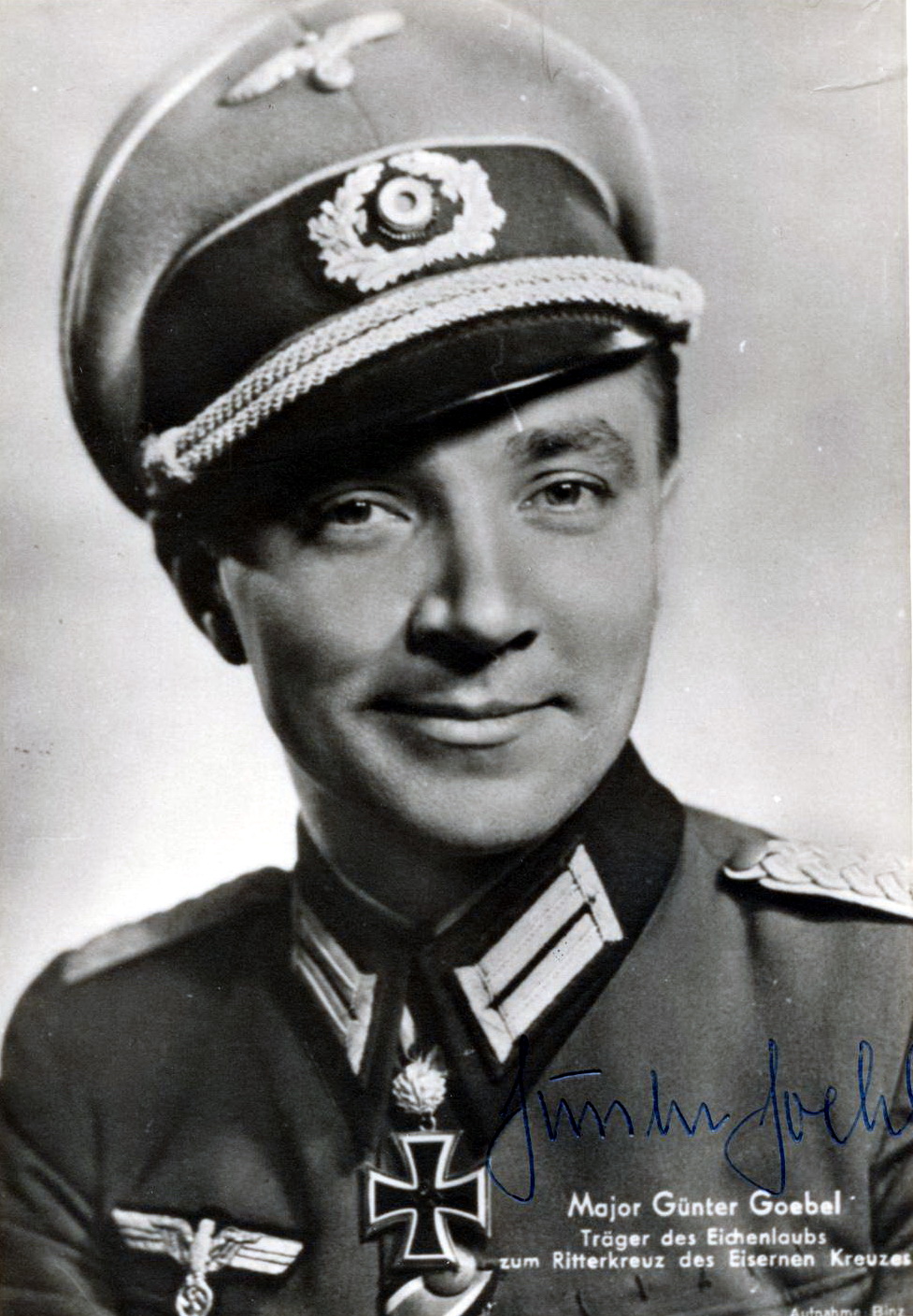
Ritterkreuz Actions of Günter Goebel

Günter Goebel (14 November 1917 - 4 September 1993) received the Ritterkreuz des Eisernen Kreuzes on 18 October 1941 as Adjutant Infanterie-Regiment 208 / 79.Infanterie-Division. On 14 September 1941 Oberleutnant Goebel made the independent decision to take command of a Radfahr-Bataillon that was temporary leaderless. By doing this, and continuing an attack with this unit immediately afterwards, it was possible to push the enemy back and win a lot of ground in a relatively short amount of time. On the very next day Goebel launched another bold attack that stormed a Soviet airfield. In the process a number of aircraft were destroyed on the ground. Along with this success an enemy army-level depot was also captured undamaged. For the sum of his achievements during this time Goebel would receive the Ritterkreuz.

Goebel received the Eichenlaub #180 for his Ritterkreuz on 18 January 1943 as Hauptmann and Führer Kampfgruppe Goebbel / 79.Infanterie-Division. On 17 December 1942 Hauptmann Goebel commanded a Kampfgruppe in the area of the 384. Infanterie-Division, specifically near Nishnij-Tschirskaja (along the Chir river). Starting on this day Goebel would hold his assigned bridgehead for weeks, up until 1 January 1943. By this action he played a major role in holding the Soviets along the Chir river and preventing them from immediately advancing further towards the west and southwest. He would receive the Eichenlaub in recognition of this accomplishment.


Source :
https://www.alexautographs.com/auction-lot/gunter-goebel_2E347D696E
https://www.tracesofwar.com/persons/29961/Goebel-G%C3%BCnter.htm

Bio of Oberstleutnant Günter Goebel (1917-1993)


Günter Goebel

Date of birth : 14 November 1917 at Hagen-Haspe, Westfalen (German Empire)
Date of death : 4 September 1993 at Hagen, Westfalen (Germany)

Promotions:
00.00.1938 Leutnant
01.06.1940 Oberleutnant
01.02.1942 Hauptmann
01.02.1943 Major
01.03.1945 Oberstleutnant

Career:
00.00.1936 Joined Infanterie-Regiment 18
00.00.1939 Adjutant III.Bataillon / Infanterie-Regiment 208
00.00.1942 Attended Generalstabsausbildung
00.00.1943 Attended Kriegsakademie Hirschberg in Silesia
01.04.1944 Posted in the Generalstab des Heeres
00.00.1944 Ib 61. Infanterie-Division
00.00.1944 Stellvertretender Quartiermeister XXXXIII. Armeekorps
00.00.1944 Ia L. Armeekorps
00.00.1944 Ia 218. Infanterie-Division
00.00.1945 Ia 215. Infanterie-Division
00.00.1945 Kommandeur Grenadier-Regiment 189
11.05.1945 Taken prisoner by the Russians
00.10.1955 Released from the POW camp

Awards and Decorations:
04.11.1939 Eisernes Kreuz II.Klasse
18.06.1940 Eisernes Kreuz I.Klasse
00.00.194_ Infanterie-Sturmabzeichen in Silber
18.10.1941 Ritterkreuz des Eisernen Kreuzes, as Oberleutnant and Adjutant Infanterie-Regiment 208 / 79.Infanterie-Division
06.11.1941 Ehrenblattspange des Heeres und Waffen-SS
00.00.1942 Medaille "Winterschlacht im Osten 1941/42" (Ostmedaille)
00.00.194_ Verwundetenabzeichen in Schwarz
00.00.194_ Goldenes HJ-Ehrenzeichen
18.01.1943 Ritterkreuz des Eisernen Kreuzes mit Eichenlaub #180, as Hauptmann and Führer Kampfgruppe Goebel / 79.Infanterie-Division
00.04.1944 Nahkampfspange in Silber


Source :
https://www.alexautographs.com/auction-lot/gunter-goebel_2E347D696E
https://de.metapedia.org/wiki/Goebel,_G%C3%BCnter
https://forum.axishistory.com/viewtopic.php?p=2444035#p2444035
http://www.specialcamp11.co.uk/Oberstleutnant%20Gunter%20Goebel.htm
https://www.tracesofwar.com/persons/29961/Goebel-G%C3%BCnter.htm

Thursday, December 1, 2022

Erhard Milch during 'Tag der Luftwaffe'

Berlin-Gatow, 21 April 1936 - The dedication of pilot flags ceremony during 'Tag der Luftwaffe' (Day of the Air Force), on the occasion of the 18th anniversary of the death of Manfred von Richthofen, the famous German flying ace in World War I. From left to right: General der Flieger Leonhard Kaupisch (Befehlshaber vom Luftkreiskommando II in Berlin), General der Flieger Erhard Milch (Generalinspekteur der Luftwaffe), and unknown. The picture was taken by Georg Pahl.

Source :
https://forum.axishistory.com/viewforum.php?f=5

Josef Peters Explains his Experiences

German flight crew sits in a field of flowering shrubs with an airplane in the background. Translated German caption from photo reverse: "This is you. Ritterkreuzträger (Knight's Cross recipient), Oberleutnant Josef Peters, one of the most successful German torpedo airmen, he explains the experiences of his missions to a new crew - series of 19 photos with 21 exposures, Photo 2. Southern France, April 1944." Peters received the Ritterkreuz des Eisernen Kreuzes on 6 April 1944 as Beobachter in 12.Staffel / IV.Gruppe / Kampfgeschwader 26 (KG 26), awarded for his participation in numerous successful sorties in the maritime bombardment role. By war's end he had partaken in just about 100 sorties, but in this time was involved in the sinking/damaging of about 110000 GRT of shipping.

Source :
https://www.tracesofwar.com/persons/25520/Peters-Josef-Richard.htm
https://www.ww2online.org/image/german-flight-crew-sits-field-france-1944

Happy Moment of Heinz Kemethmüller

Group of smiling Luftwaffe members. Translation of official German caption on photo reverse: "Ritterkreuzträger (Knight's Cross recipient) Oberfeldwebel Heinz Kemethmüller, Northern France, 12 April 1944." Kemethmüller received the Ritterkreuz des Eisernen Kreuzes on 2 October 1942 as Feldwebel and Flugzeugführer in 8.Staffel / III.Gruppe / Jagdgeschwader 3 (JG 3) “Udet”, after he scores 59 aerial victories. During his career Heinz Kemethmüller flew 463 missions, and was credited with 89 aerial victories, 71 on the Eastern Front (including 20 2-engined bombers and 26 Ilyushin Il-2 Stormovik Soviet ground attack aircraft) He also claimed 18 over the Western Front, including three USAAF heavy bombers and 7 P-47 fighters shot down.

Source :
https://en.wikipedia.org/wiki/Heinz_Kemethm%C3%BCller
https://www.tracesofwar.com/persons/23752/Kemethm%C3%BCller-Heinz.htm
https://www.ww2online.org/image/group-smiling-luftwaffe-pilots-france-april-1944

Wednesday, November 30, 2022

Fritz Fliegel Putting on Flight Suit


Hauptmann Fritz Fliegel (Gruppenkommandeur I.Gruppe / Kampfgeschwader 40) putting on flight suit before mission. The wing of an FW 200 long-range aircraft can be seen in the background. The picture was taken in Bordeaux, France. Translation of official German caption on the photo reverse: "Picture 4 of Photo Report No. 68. Captain Fliegel before the start of an attack on an English convoy. France, July 1941." On 18 July 1941, Fliegel and his crew—copilot Leutnant (Second Lieutenant) Wolf-Dietrich Kadelke, first radio operator Oberfeldwebel (Staff Sergeant) Johannes Rottke, second radio operator Gefreiter (Airman) Karl Becker, flight engineer Unteroffizier (Sergeant) Johann Kothe and air gunner Unteroffizier Karl Meurer—were reported missing in action over the Atlantic in the vicinity northwest of Ireland. Their Fw 200 C-3 "F8+AB" (Werknummer 0043—factory number) was shot down in an attack on convoy OB 346. During the attack on the freighter Pilar de Larrinaga, the gunners on board the freighter scored a hit on the Fw 200's starboard wing which tore it off. At the time of his death, Fliegel was credited with seven ships sunk plus further six damaged. He was promoted to Major (major) posthumously.

Source :
https://en.wikipedia.org/wiki/Fritz_Fliegel
https://photoshistoriques.info/le-commandant-du-1er-groupe-bombardirovochnoi-escadrilles-de-la-luftwaffe-kg-40-fritz-dependance-avant-le-depart/
https://waralbum.ru/387762/
https://www.ww2online.org/image/luftwaffe-captain-fritz-fliegel-puts-flight-suit-france-july-1941

Tuesday, November 29, 2022

Bio of Oberst Paul Adam (1892-1969)

Paul Adam

Date of birth: March 23rd, 1892 (St. Arnual/Saarbrücken, Germany)
Date of death: December 1st, 1969 (German Democratic Republic)

Promotions:
00.00.1914 Kriegsfreiwilliger
00.00.1915 Vizefeldwebel
00.00.1916 Leutnant der Reserve
01.07.1936 Oberleutnant der Reserve
14.05.1941 Major der Reserve
07.08.1943 Oberstleutnant der Reserve
10.03.1944 Oberst im Generalstab der Reserve

Career:
01.07.1936 Officer in Artillerie-Regiment 45
31.03.1937 Chef 5.Batterie / Artillerie-Regiment 36
13.05.1940 Stab II.Abteilung / Artillerie-Regiment 36
18.08.1942 Führer Grenadier-Regiment 158
01.05.1943 Kommandeur Artillerie-Regiment 132
01.01.1944 Ia 302. Infanterie-Division
00.05.1945 Captured by the Soviets
00.00.1953 Released from POW camp

Awards & Decorations
03.02.1915 1914 Eisernes Kreuz II.Klasse
15.04.1918 1914 Eisernes Kreuz I.Klasse
00.00.19__ Kampfwagen-Erinnerungsabzeichen
29.12.1934 Ehrenkreuz für Frontkämpfer 1914-1918
00.00.193_ Deutsches Reichssportabzeichen in Silber
26.09.1939 1939 Spange zum 1914 Eisernes Kreuz II.Klasse
05.07.1940 Verwundetenabzeichen in Schwarz
00.00.1941 Kriegsverdienstkreuz II.Klasse mit Schwertern
12.07.1941 1939 Spange zum 1914 Eisernes Kreuz I.Klasse
08.08.1942 Medaille "Winterschlacht im Osten 1941/42" (Ostmedaille)
17.11.1942 Allgemeines-Sturmabzeichen
18.04.1943 Ritterkreuz des Eisernen Kreuzes, as Major der Reserve and Führer Grenadier-Regiment 158 / 82.Infanterie-Division
14.10.1944 Verwundetenabzeichen in Silber
05.05.1945 Ärmelband "KURLAND"


Source :
https://www.andreas-thies.de/auctions/65-750580
https://imagesdefense.gouv.fr/fr/catalogsearch/result/?q=paul+adam&avec_visuel=1
https://www.lexikon-der-wehrmacht.de/Personenregister/A/AdamP-R.htm
https://military-history.fandom.com/wiki/Paul_Adam_(German_soldier)
https://www.tracesofwar.com/persons/28048/Adam-Paul-Grenadier-Regiment-158.htm

Ritterkreuz Award Ceremony for Three Aces of JG 2

Three Ritterkreuzträger (Knight's Cross holders) of Jagdgeschwader 2 (JG 2) "Richthofen). From left to right: Oberleutnant Erich Leie (Flugzeugführer im Stab der I. Gruppe / Jagdgeschwader 2), Oberleutnant Rudolf Pflanz (Flugzeugführer in 1.Staffel / I.Gruppe / Jagdgeschwader 2), and Leutnant Egon Mayer (Flugzeugführer in 7.Staffel / III.Gruppe / Jagdgeschwader 2 "Richthofen"). The picture was taken when the three Luftwaffe fighter aces from JG 2 receives the Ritterkreuz des Eisernen Kreuzes from Generalfeldmarschall Hugo Sperrle (Chef Luftflotte 3) on 1 August 1941: Leie awarded after 21 aerial victories, Pflanz after 20 aerial victories, and Mayer after after 20 aerial victories. Behind Mayer is future Ritterkreuzträger Oberst i.G. Karl Koller.(Chef des Generalstabes Luftflotte 3).

Source :
https://forum.axishistory.com/viewtopic.php?p=2443194#p2443194
http://forum.12oclockhigh.net/showthread.php?t=62688