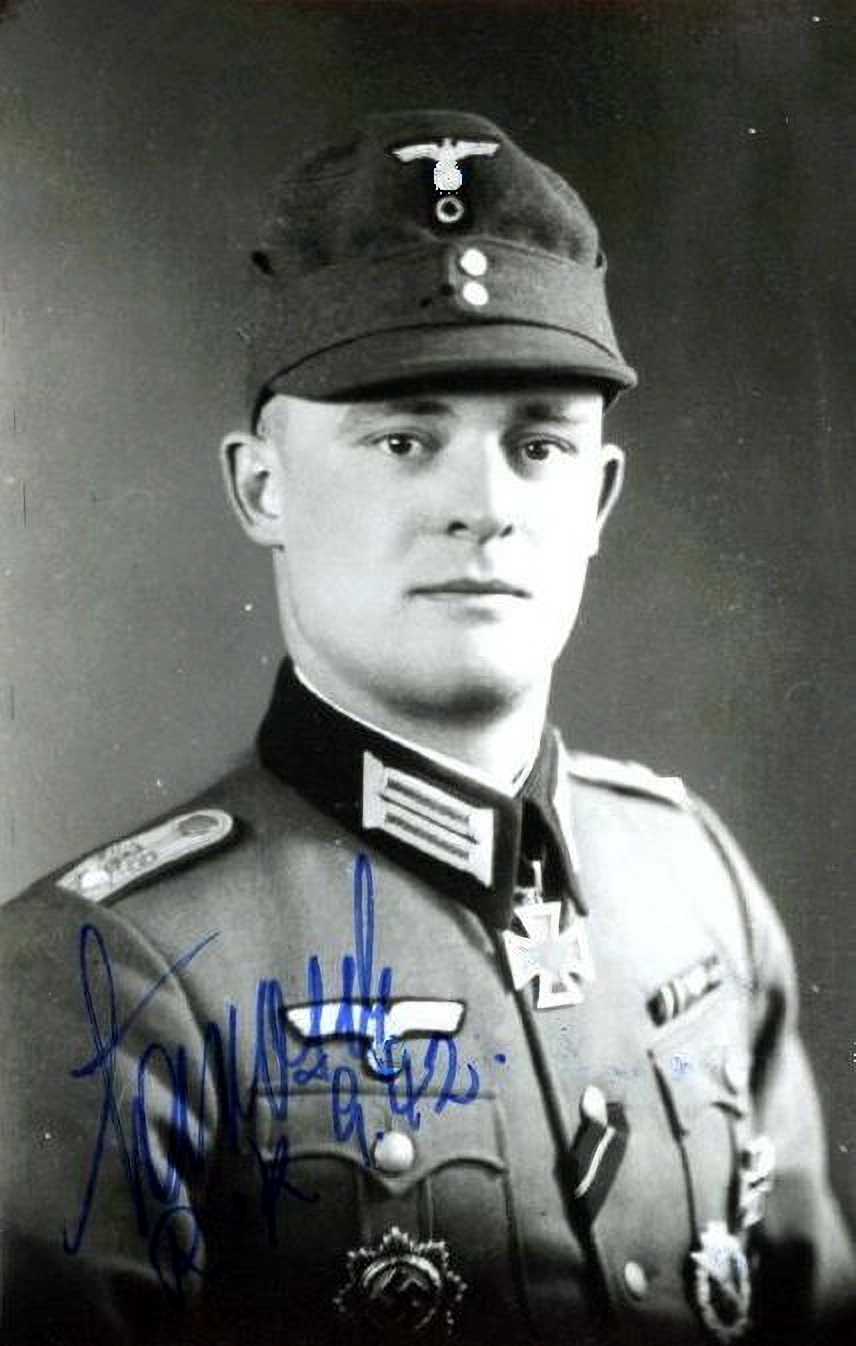
Hermann-Ernst Bolm (28 February 1919 - 20 October 1944) received the Ritterkreuz des Eisernen Kreuzes on 20 April 1944 as Hauptmann der Reserve and Führer II.Bataillon / Grenadier-Regiment 434 / 131.Infanterie-Division. The following newspaper article describes why Bolm was awarded the Ritterkreuz:
“The First Breakthrough to Kovel - Hauptmann Bolm Awarded the Ritterkreuz.
A Lower-Saxonian Infanterie-Division had been involved in weeks of heavy combat west of the city of Kovel, which had been encircled on all sides by the enemy. On 29 March 1944 a Regiment (reinforced by Panzers and Sturmgeschütze) of this Division commenced an attack.
Hauptmann Ernst Bolm, commander of the Regiment’s II. Bataillon, stormed at the head of his Grenadiers in the area north of the railway Ch.—K. He and his foremost Grenadiers succeeded in seizing a strongly garrisoned Bolshevik strongpoint following a brief but fierce battle. The Bolsheviks suffered heavy losses in this engagement; during which 7 guns and numerous other weapons fell into the hands of the victors.
The young Bataillon commander realized in this moment that the enemy in his sector had been shaken by the heavy casualties they had just sustained. Thus, he concluded that now was the time to strike in order to effect a breakthrough towards the East. Acting swiftly, he once again placed himself at the spearhead of the assault group. His encouragement and example here inspired his exhausted Grenadiers to once again press forwards. While the Panzers captured a hill west of the village of Cz., Hauptmann Bolm penetrated into the village itself with his now brought-up reserve Kompanie. The village was cleared of the enemy by nightfall following hard close combat.
After this he [Bolm] immediately dispatched reconnaissance elements into the wooded terrain east of Cz. The results of this reconnaissance were surprisingly favourable; the woods were only weakly occupied by the enemy. The Soviets had clearly not had enough time to reposition their forces in the wake of Cz.’s loss. No communications existed with the Regiment at this time; the young officer would have to act on his own initiative.
After a short conference with the Kompanie commander of the Panzers, it was resolved that the existing moment of opportunity had to be exploited. Hauptmann Bolm thus moved out before dawn on the following morning and was able to break through to Kovel in a rapid advance. The encirclement ring around the city was not broken just yet however, as the Red flood once again closed behind the Bataillon after it had entered Kovel proper. However the breakthrough of Bolm’s Bataillon and the Panzer-Kompanie brought about significant aid and moral relief for the hard-pressed defenders of Kovel.”
The village of Cz. referred to in the article was the village of Czerkasy, located along the Chelm—Kovel railway line. The Panzer-Kompanie that broke through to Kovel in conjunction with Bolm’s Bataillon was the 8./SS-Pz.Rgt. 5 “Wiking”, commanded by SS-Obersturmführer Karl Nicolussi-Leck (he also received the Ritterkreuz).
Source :
https://www.generalassaultmilitaria.com/product/hermann-ernst-bolm-portrait/
https://www.tracesofwar.com/persons/2452/Bolm-Hermann-Ernst.htm
Ritterkreuz des Eisernen Kreuzes, Knight's Cross of the Iron Crosses, Ritterkreuzträger, Recipients, Holders, RKT, Eichenlaub, Schwerter, Brillanten, Oak Leaves, Swords, Diamonds, War Heroes, German, Germany, Nazi, Third Reich, Wehrmacht, Heer, Kriegsmarine, Luftwaffe, Waffen-SS, Armed Forces, Army, Navy, Air Force, RAD, Reichsarbeitsdienst, Generals, Admirals, Officers, Soldiers, Soldat, Sailors, Kameraden, Military, World War II, WW2, High quality pictures, Resolution, HD, HQ, pixel,
Tuesday, June 20, 2023
Ritterkreuz Action of Hermann-Ernst Bolm
Bio of Hauptmann Hermann-Ernst Bolm (1919-1944)
Hermann-Ernst Bolm
Date of Birth: 28.02.1919 - Magdeburg, Sachsen (Germany)
Date of Death: 20.10.1944 - Ebenroda, Ostpreussen (Germany)
Promotions:
06.01.1941 Leutnant der Reserve (with RDA from 01.11.1940)
17.10.1942 Oberleutnant der Reserve (with RDA from 01.11.1942)
29.02.1944 Hauptmann der Reserve (with RDA from 01.01.1944)
30.04.1944 Hauptmann (with RDA from 01.03.1944)
Career:
00.08.1938 3.Kompanie / Infanterie-Regiment 17
01.04.1940 1.Kompanie (Schützen) / Infanterie-Ersatz-Bataillon 17
17.04.1940 2.Kompanie (Schützen) / Infanterie-Ersatz-Bataillon 17
20.08.1940 6.Kompanie (Schützen) / Infanterie-Ersatz-Bataillon 17
05.10.1940 10.Kompanie / Infanterie-Regiment 434
05.04.1941 11.Kompanie / Infanterie-Regiment 434
09.06.1941 10.Kompanie / Infanterie-Regiment 434
03.10.1941 11.Kompanie / Infanterie-Regiment 434
00.00.1942 9.Kompanie / Infanterie-Regiment 434
19.03.1942 10.Kompanie / Infanterie-Regiment 434
00.04.1942 2.Kompanie / Infanterie-Regiment 434
07.07.1942 Sicherungs-Bataillon Usocki
14.02.1943 9.Kompanie / Infanterie-Regiment 434
24.08.1943 Stabsoffizier 131. Infanterie-Division
00.09.1943 Feld-Ersatz-Bataillon 131
19.12.1943 Chef 5.Kompanie / Grenadier-Regiment 434
00.12.1943 Führer II.Bataillon / Grenadier-Regiment 434
12.08.1944 Kommandeur I.Bataillon / Grenadier-Regiment 434
Awards and Decorations:
25.11.1941 Eisernes Kreuz II.Klasse
08.01.1942 Eisernes Kreuz I.Klasse
00.00.194_ Infanterie-Sturmabzeichen in Silber
00.00.194_ Verwundetenabzeichen in Schwarz
00.00.1942 Medaille "Winterschlacht im Osten 1941/42" (Ostmedaille)
00.00.194_ Nahkampfspange in Bronze
10.02.1944 Deutsches Kreuz in Gold
04.04.1944 Mentioned in Wehrmachtbericht
20.04.1944 Ritterkreuz des Eisernen Kreuzes, as Hauptmann der Reserve and Führer II.Bataillon / Grenadier-Regiment 434 / 131.Infanterie-Division. The following newspaper article describes why Bolm was awarded the Ritterkreuz: “The First Breakthrough to Kovel - Hauptmann Bolm Awarded the Knight’s Cross: A Lower-Saxonian Infanterie-Division had been involved in weeks of heavy combat west of the city of Kovel, which had been encircled on all sides by the enemy. On the 29.03.1944 a Regiment (reinforced by Panzers and Sturmgeschütze) of this Division commenced an attack. Hauptmann Ernst Bolm, commander of the Regiment’s II. Bataillon, stormed at the head of his Grenadiers in the area north of the railway Ch.—K. He and his foremost Grenadiers succeeded in seizing a strongly garrisoned Bolshevik strongpoint following a brief but fierce battle. The Bolsheviks suffered heavy losses in this engagement; during which 7 guns and numerous other weapons fell into the hands of the victors. The young Bataillon commander realized in this moment that the enemy in his sector had been shaken by the heavy casualties they had just sustained. Thus, he concluded that now was the time to strike in order to effect a breakthrough towards the East. Acting swiftly, he once again placed himself at the spearhead of the assault group. His encouragement and example here inspired his exhausted Grenadiers to once again press forwards. While the Panzers captured a hill west of the village of Cz., Hauptmann Bolm penetrated into the village itself with his now brought-up reserve Kompanie. The village was cleared of the enemy by nightfall following hard close combat. After this he [Bolm] immediately dispatched reconnaissance elements into the wooded terrain east of Cz. The results of this reconnaissance were surprisingly favourable; the woods were only weakly occupied by the enemy. The Soviets had clearly not had enough time to reposition their forces in the wake of Cz.’s loss. No communications existed with the Regiment at this time; the young officer would have to act on his own initiative. After a short conference with the Kompanie commander of the Panzers, it was resolved that the existing moment of opportunity had to be exploited. Hauptmann Bolm thus moved out before dawn on the following morning and was able to break through to Kovel in a rapid advance. The encirclement ring around the city was not broken just yet however, as the Red flood once again closed behind the Bataillon after it had entered Kovel proper. However the breakthrough of Bolm’s Bataillon and the Panzer-Kompanie brought about significant aid and moral relief for the hard-pressed defenders of Kovel.” The village of Cz. referred to in the article was the village of Czerkasy, located along the Chelm—Kovel railway line. The Panzer-Kompanie that broke through to Kovel in conjunction with Bolm’s Bataillon was the 8./SS-Pz.Rgt. 5 “Wiking”, commanded by SS-Obersturmführer Karl Nicolussi-Leck (he also received the Knight’s Cross).
------------------------------------------------------------------------------------
Hermann-Ernst Bolm was born on February 28, 1919 in Magdeburg and, according to a report from August 1938, joined the 3rd company of the 17th Infantry Regiment. According to a report dated April 1, 1940, after taking part in the Polish campaign, Bolm switched to the 1st (sniper) company of the 17th Infantry Replacement Battalion. With the report dated April 17, 1940, he was in the 2nd (sniper) company of the battalions.
Without taking part in the western campaign, Bolm switched to the 6th company of his old regiment with a report from August 20, 1940, or to the 10th company of the 434th Infantry Regiment with a report from October 5, 1940.
On April 5th, 1941 he was transferred to the 11th company, only to briefly return to the 10th company on June 9th, 1941. With this he also took part in the eastern campaign, but switched back to the 11th company on October 3rd, 1941. Later he was transferred to the 9th company, from which he returned to the 10th company with a report dated March 19, 1942. In the next few weeks he was then transferred to the 2nd company, from there he was commanded to the Usocki security battalion, with a report dated July 7th, 1941, and after his return to the company, with a report dated February 14th, 1943, he was assigned to the 9th company.
With a report dated August 24, 1943, Bolm was assigned to the staff of the 131st Infantry Division and from there to Field Replacement Battalion 131, from where he transferred to the 5th Company of the regiment with a report dated December 19, 1943, and there too was appointed leader of the II. Battalion.
On April 1, 1944, the 131st Infantry Division attacked Cherkassy on the Luboml-Kovel railway line in order to free the trapped Kovel garrison. On April 4, 1944, the hard-fought division reached the edge of a forest about seven kilometers west of Kovel. Also in action in the north of Kowel, Bolm showed exceptional bravery, for which he was named in the Wehrmacht report on April 4, 1944. On April 27, 1944, the mission to relieve Kowel was successfully completed. Bolm received the Knight's Cross for his successful attack and defense measures on April 20, 1944, as a reserve captain and commander of the 2nd Battalion of the 434th Grenadier Regiment. Furthermore, on April 30, 1944, with effect from March 1, 1944, the transfer to the active officer corps took place.
With a report dated August 12, 1944, he switched to the staff of the 1st Battalion and was killed two months later, on October 20, 1944, as commander of the battalion near Ebenrode in East Prussia.
Source :
https://forum.axishistory.com/viewtopic.php?t=91104
https://www.generalassaultmilitaria.com/product/hermann-ernst-bolm-portrait/
https://military-history.fandom.com/wiki/Hermann-Ernst_Bolm
http://www.ritterkreuztraeger.info/rk/b.html
https://www.tracesofwar.com/persons/2452/Bolm-Hermann-Ernst.htm
https://web.archive.org/web/20111228124514fw_/http://www.ritterkreuztraeger-1939-45.de/Infanterie/B/Bo/Bolm-Hermann-Ernst.htm
Sunday, June 18, 2023
Bio of Hauptmann Alfred Jarosch (1915-2001)
Alfred Karl Max Jarosch
Date of Birth: 10.10.1915 - Skrebenski-Golkowitz, Oberschlesien (German Empire)
Date of Death: 30.08.2001 - Wilhelmsfeld, Baden-Württemberg (Germany)
Promotions:
00.00.194_ Hauptmann
00.00.19__ Major der Reserve (Bundeswehr)
Career:
00.04.1934 joined the Reichswehr and posted in 7. (Preußische) Infanterie-Regiment
00.00.194_ Führer 8.Kompanie / II.Bataillon / Jäger-Regiment 38 / 8.Jäger-Division
00.00.194_ Kommandeur Sturm-Bataillon in 16. Armee and Leiter Lehrstabes "Infanterie" of Armee-Waffenschule 16. Armee
00.00.1956 Reserveoffizier in the Bundeswehr
Awards and Decorations:
00.00.193_ Medaille zur Erinnerung an den 1. Oktober 1938
00.00.193_ Medaille zur Erinnerung an den 1. Oktober 1938 mit Spange "Prager Burg"
00.00.19__ Dienstauszeichnung der Wehrmacht IV.Klasse (4 Jahre)
00.00.194_ Eisernes Kreuz II.Klasse
00.00.194_ Infanterie-Sturmabzeichen in Silber
00.00.194_ Eisernes Kreuz I.Klasse
00.00.194_ Verwundetenabzeichen in Schwarz
00.00.194_ Verwundetenabzeichen in Silber
00.00.194_ Verwundetenabzeichen in Gold
19.05.1942 Deutsches Kreuz in Gold
00.00.1942 Medaille "Winterschlacht im Osten 1941/42" (Ostmedaille)
24.09.1942 Ritterkreuz des Eisernen Kreuzes, as Leutnant and Führer 8.Kompanie / II.Bataillon / Jäger-Regiment 38 / 8.Jäger-Division
00.00.194_ Nahkampfspange in Silber
07.07.1943 Vapaudenristin ritarikunta, with Swords (Finland)
---------------------------------------------------------------------------------
After graduating from high school in April 1934, Jarosch joined the Reichswehr in the 7th (Prussian) Infantry Regiment. In the course of the expansion of the Reichswehr, the regiment was renamed the Schweidnitz Infantry Regiment in 1934. At the same time, the regiment also formed the Breslau Infantry Regiment. In 1936 the 1st Battalion then moved from Breslau to Schweidnitz. In addition, the II. (Jäger) Battalion was renamed from the regiment in Glatz to the II. Battalion of the 38th Infantry Regiment. In 1938 the I. Battalion of the regiment became the III. Renamed 38th Infantry Regiment Battalion. 1941/42 the I. and III. Battalion of Infanterie-Regiment 38 renamed Jäger-Regiment 38. The 14th company was renamed the 16th company of Jäger-Regiment 38 at the same time. In 1942 the 13th company was canceled. At the same time, the regimental staff and the 2nd Battalion were also renamed Jäger-Regiment 38 (under Eichenlaubträger Johann-Heinrich Eckhardt).
In the end of the war, Jarosh, who was wounded six times during the war, was commander of an assault battalion in Army High Command 16 and head of the infantry teaching staff at Army Weapons School AOK 16.
After the war and being a prisoner of war, Jarosch, who was 60% disabled, became an entrepreneur with his own production facility (from April 1950) and became a member of the Gemeinschaft der Ritterkreuzträger / community of Knight's Cross recipients (application dated May 4, 1952). He received his ID card on June 9, 1952. In 1955/56 he became a reserve officer in the Bundeswehr, with the last rank as a Major der Reserve.

Application for the membership of OdR (Ordensgemeinschaft der Ritterkreuzträger e. V.) belong to Alfred Jaroch, dated 4 May 1952.
Source :
Jim Haley photo collection
Bernd R. photo collection
https://de.metapedia.org/wiki/Jarosch,_Alfred
https://forum.axishistory.com/viewtopic.php?p=1403301#p1403301
http://www.ritterkreuztraeger.info/rk/j.html
https://www.tracesofwar.com/persons/7371/Jarosch-Alfred-J%C3%A4ger-Regiment-38.htm
Ritterkreuz Award ceremony for Fritz Vogt
Vogt's Ritterkreuz recommendation reads as follows:
“With this document the SS-Aufkl.Abt. is recommending SS-Obersturmführer Fritz Vogt (born in Munich on 17 March 1918) for the Ritterkreuz on account of the great successes he has achieved thanks to his extraordinary bravery.
Obersturmführer Vogt has already distinguished himself in the Polish campaign as a patrol leader and Zugführer. For his accomplishments in this time he was awarded the Eisernes Kreuz II.Klasse and recommended for the Eisernes Kreuz I.Klasse.
On 10 May 1940 Obersturmführer Vogt was tasked with taking the Maas-Waal Canal bridge at Neerbosch with a small assault group. This assault group consisted of 2 armoured cars, 3 motorcycle squads and 1 Pak gun, with a Kompanie from M.G. Bataillon 15 following up close behind the assault group as support. However the Dutch were not caught off guard as had been hoped. During the night the bridges were blown, however at the Neerbosch bridge the demolitions only destroyed part of the structure (individual soldiers could still cross).
As the assault group approached the bridge it began taking heavy fire from the bunker line on the western bank (this consisted of concrete embrasures or armoured cupolas every 80-100 metres). Vogt stormed the bridge under covering fire from the Pak and a few MGs; 2 men fell in the process, and Vogt reached the opposite bank with just 4 men initially. Vogt himself was lightly wounded by a shot through the upper arm, yet he continued to fight. By immediately rolling up the bunker line Vogt enabled the remainder of his assault troop as well as the reinforcing M.G. Bataillon 15 to cross. In total over 200 prisoners were taken at this location, and many weapons were captured.
For this deed Vogt was awarded the Eisernes Kreuz I.Klasse.
On 23 May 1940 Vogt was conducting reconnaissance in the direction of Aire with a force consisting of 2 light armoured cars, 1 Pak, 1 radio vehicle and 2 motorcycle squads.
At Mazinhem he identified a French infantry battalion that was retreating towards Lys along a route perpendicular to his own march road. Vogt let his Pak open fire whilst he took his armoured cars and motorcyclists to get around the enemy. By utilizing a hill he was able to get within very close range of the enemy and pour MG fire into their ranks. A short battle ensued that saw the enemy suffer casualties, but eventually 650 men laid down their weapons.
Through this bold deed Vogt succeeded in eliminating the only still combat-capable French battalion in his Division’s sector before it reached the Lys. If this battalion had reached the Lys river it would have made it very difficult for the Division to continue advancing forwards. But, instead, the Division was able to swiftly get across the river and thereby secure a decisive success.
To this it must be added that Vogt only had a reconnaissance mission on this particular day, and he would have faced no consequences or blame if he had instead chosen to desist from attacking such a numerically superior foe.
Vogt subsequently distinguished himself in a commendable fashion once again. On 7 June 1940 he led a patrol (consisting of 2 armoured cars and 2 motorcycle squads) along the route Mahericourt—Caux—Harbonnières. He managed to intercept 2 enemy artillery pieces at Caux, and at Harbonnières he spotted 250 Frenchmen pulling back in a westerly direction. By ruthlessly striking against them he compelled this much larger enemy force to capitulate.”
Ritterkreuz Actions of Hinrich Schuldt
Hinrich Schuldt (14 June 1901 - 15 March 1944) received the Ritterkreuz des Eisernen Kreuzes on 5 April 1942 as SS-Obersturmbannführer and Kommandeur SS-Infanterie-Regiment 4 "Reichsführer-SS" / 17.Infanterie-Division. Awarded the Ritterkreuz for the following actions: 1) The rapid seizure of a vital piece of high ground near Schopina. This objective had been suggested by XXXXIII. Armeekorps, but not ordered due to Schuldt's own weak forces. He nonetheless recognized a favourable situation and was able to capture the place even so. In doing this he created a flank guard for the Army, which forced the enemy to delay his encirclement of the Kaluga position for several days.
2) Creating the preconditions for the closure of the gap that had formed north of 4. Panzerarmee, and later covering the flank of the unit (17. Infanterie-Division) that was assigned for carrying out this task. The closure of this gap proved to be of vital importance to the whole Heeresgruppe.
Schuldt received the Eichenlaub #220 for his Ritterkreuz on 2 April 1943 as SS-Standartenführer and Kommandeur SS-Brigade Schuldt / XXIX.Armeekorps. Schuldt’s Eichenlaub recommendation reads as follows: "On 19 December 1942 SS-Standartenführer Schuldt with three Leibstandarte Kompanies and one-and-a-half Kompanies from the SS-Polizei Division were moving in the billeting area assigned by the XXIX. Armeekorps in Meschkoff. On the way they met the Italians from Armeeoberkommando 8 falling back and rushing in disorder, closely pursued by the Russians. In a quick and bold resolution. SS-Standartenführer Schuldt switched over from the march to counter attack and took the high ground east and north east of Meschkoff that dominated the entire area. The Russians were thrown back in the whole area and the high ground held. Then a report about the failure of the Italian defensive front was sent to the XXIX. Armeekorps (this was the first report that the German Command received about the collapse of the Italian Front).
Schuldt displayed a clear and widespread knowledge of the tactical situation. Due to the resolute and energetic leadership of the commander and the bravery of his SS men, the majority of the Italian troops could be saved from being completely annihilated.
Under the personal leadership of Schuldt, the positions in Meschkoff were held against strong enemy infantry and tank attacks. Meanwhile two Russian Tank Corps broke through the left flanking unit towards the west and in the course of the following day completely encircled the XXIX. Armeekorps. The entire XXIX. Armeekorps staff with the Korps commander, straggling German troops and Italian units in disorder all found themselves in the cauldron. They were harassed by the tanks of the attacking opponent from all sides. The only significant combat power at hand was in the elements of SS-Kampfgruppe Schuldt . Again it must be credited to the energetic and precise leadership of the Brigade commander that, after hard fighting, the breakout of the Armeekorps to reach the lines of Heeresgruppe Don on 29 December 1942 could be successful.
On 15 January 1943, in spite of the strongest defense, parts of the SS-Brigade 'Schuldt' were surrounded at the bridgehead and blocking positions near Nowo-Jerochin and Klitwenezkaja. The order of the XXX. Armeekorps to disengage and fall back to Kamensk did not reach the Kampfgruppe because the radio station was destroyed by a direct hit. In that moment, when the position in Nowo-Jerochin was almost completely surrounded by 15 Russian tanks, the vigorous leadership of SS-Standartenführer Schuldt was proven again. He ordered that all the forces engaged in Nowo-Jerochin should break out towards Kamensk. Schuldt, with a small group of SS men and officers attracted the attention of the enemy to facilitate the escape of our troops. The next morning the commander with one officer and five men finally reached Kamensk, after having gone through the Russian formations already deployed in front of Kamensk.
In the night from 31 January to 1 February 1943 the enemy attacked SS-Brigade 'Schuldt' by surprise with strong forces reinforced with tanks. The area became our defensive front over the Donez. In an extremely hard and bloody fight the positions in Woroschilow and Shiroky were held for two days and two nights. They thwarted a complete breakthrough of the opponent that severely hit the Brigade's defensive positions, which had the end goal of reaching Krassnodon. This success must be credited to the energetic and lively leadership of the commander and his personal performance.
After the withdrawal of the defensive front to the Wodjanoj position, it was only thanks to the compelling personality of the commander, often by force, that the newly attached elements of the 304th Infantry Division held back the enemy. He forced them to build up their positions so that the massive attacks of the opponent were resisted until the order to withdraw was given. The opponent recognized the Brigade's hard defensive willpower and, with the support of tank forces, tried repeatedly to force a breakthrough either by the right or the left flank. That put the Brigade in extreme danger and in a serious situation. Only through the bravery of the Brigade and attached units under the energetic and prudent leadership of its' commander could the situation be stabilized. In this period. the Brigade destroyed 24 tanks and three armoured attack airplanes of the enemy.
To finish off a local enemy break-in to the west of the Olchowaja sector, SS-Brigade 'Schuldt' was transferred on 22 February 1943 into the area of Nikitowka-Bachtewitsch. On 23 February, after moving into the assembly position, they attacked the opponent in Wassjukowa-Schl. with an assault group under the command of the SS-Sturmbannführer Dietrich. They had the objective of enabling the recapture of the main fighting line by Gruppe 'Hunten'. With the attack progressing, the battle developed more and more into close combat by assault detachments at short range. After a hard fight under the personal leadership of the Brigade commander, who in the course of the battle was wounded by a shell splinter above the right eye, the old main fighting line could be reached and occupied.
In the meantime, on 24 February 1943, the Russians managed to penetrate the left flank of Gruppe 'Hunten' with strong forces. At that moment, when the whole defensive front in the right sector of Gruppe 'Kreysing' threatened to collapse, this sector was subordinated to SS-Brigade 'Schuldt' with the following words of General Kreysing, "Herr Schuldt, you must do it, I rely on you." The commander of the Brigade, SS-Standartenführer Schuldt, recognized quickly that hills 287.4 and 227.4 were essential for the defense and also as a rallying point for any counterattack. They had to be held at any price. Schuldt's energy, which he stressed to the officers subordinated to him and at the same time was passed along to all of the fighting troops, must be thanked. The heights were again snatched away from the opponent in a surprise counterthrust, and with this the impending breakthrough could be halted as well.
After a very hard initial battle, on 26 February 1943, a counterattack (again under the personal leadership of the commander) destroyed the massive enemy forces in the Ssereschina-Schl. in two-and-a-half hours. The day's objective and with it the old main fighting line were reached. During the attack the Commander was wounded for the second time by mortar splinters in the shoulder and back. After that time the assignment of the Kampfgruppe was fulfilled and the disengagement of the Brigade began."
Hinrich Schuldt received the Schwerter #56 for his Ritterkreuz posthumously on 25 March 1944 as SS-Oberfuhrer and Kommandeur 2. "lettische" SS-Freiwilligen-Brigade. Schuldt’s Schwerter recommendation reads as follows: "Eichenlaubträger SS-Oberführer Schuldt has activated and trained the 2. Latvian Volunteer Brigade in the Wolchow bridgehead under the most difficult conditions. The fact he managed to build a combat unit capable of the highest performance in mobile warfare from mostly untrained Latvian volunteers in a dangerous, swampy land in only a few months is due to his organizational talent, high military knowledge and unequalled energy. The brigade is result of his work.
In mid-January the Russians, with far superior forces, forced back the right adjacent division. The break-in from Podbereshje threatened to widen to a full break-through. SS-Oberführer Schuldt, recognizing clearly the extreme seriousness of the situation, decided to hit the enemy—which was moving west—with a severe blow in the flank. He inflicted heavy losses on the Russian assault divisions and gained at least forty-eight hours of decisive significance for the battle command of the Korps and for the operations of the Army. The road Kampfgruppe Schuldt kept open allowed an Armeekorps with five subordinate divisions to pull back.
To achieve the highest possible concentration of forces for the active defense, SS-Oberführer Schuldt removed men from his line not attacked initially by Spaskaja Powistj so that in every Kompanie sector one NCO and two to four men simulated a complete garrison through noise and movement. This was done although the idea of a strong enemy thrust against this sector seemed completely possible.
He gave the order for the retreat of his southern wing that was threatened in the deep flank. This was done only after he accomplished, with the minimal forces available and great difficulty, the recovery of the last stationary positioned weapons.
When the advance of the newly committed Russian divisions on the road Raglizy-Sselo-Gorka towards the west was no ionger preventable with diminishing forces, SS-Oberführer Schuldt proposed letting himself become encircled with his Kampfgruppe. He wanted to cause the highest possible damage to the enemy, who was attacking from all sides, and then break through.
That this decisive success could be achieved—and Kampfgruppe Schuldt in the ensuing bitter and heavy retreat battles with its left flank almost always open against strong Partisan troops in the rear was successful—is due to SS-Oberführer Schuldt. He reached his objective in strict order and must be thanked. Besides the bravery and hardness of the Latvian volunteers, Schuldt's outstanding personal bravery, power of decision, superior calmness, and almost unique energy is to be credited.
SS-Oberführer Schuldt, who was killed on 15 March 1944 amongst his grenadiers, whose name far beyond his unit has served as a standard for the success of even the heaviest and seemingly meaningless undertakings, is considered especially worthy of being awarded the Schwerter to the Ritterkreuz des Eisernen Kreuzes mit Eichenlaub."
Source :
https://en.wikipedia.org/w/index.php?title=Hinrich_Schuldt&oldformat=true#SS_Brigade_Schuldt
https://www.tracesofwar.com/persons/13926/Schuldt-Hinrich.htm
Bio of SS-Brigadeführer Hinrich Schuldt (1901-1944)
Rudolf Hinrich Schuldt
Date of Birth: 14.06.1901 - Blankenese, Hamburg (German Empire)
Date of Death: 15.03.1944 - Ostrov, Pskov Oblast (Soviet Union)
Burial: 1 Meza kapi, Riga (Latvia)
Battles and Operations: Polenfeldzug 1939, Westfeldzug 1940, Ostfront
1941-1944 (including SS-Totenkopf units in Russia, Don-Front near
Stalingrad, actions at Meschkoff, breakout near Nowo-Jerochin, defense
at Woroschilow and Shiroky, counterattacks at Nikitowka-Bachtewitsch,
Peipus Lake, Ilmen Lake, Wolchow bridgehead, flank attacks at
Podbereshje)
NSDAP-Nr.: 975 664 (Joined 01.02.1932)
SS-Nr.: 242 677 (Joined 12.12.1933)
Parents: Rudolf Schuldt and Meta Hinrichsen
Promotions:
01.04.1922 Offiziersanwärter
00.09.1922 Seekadett
01.04.1924 Fähnrich zur See
00.04.1926 Oberfähnrich zur See
00.10.1926 Leutnant zur See
12.12.1933 SS-Sturmführer
10.01.1935 SS-Obersturmführer (with RDA from 01.01.1935)
08.03.1935 SS-Hauptsturmführer (with RDA from 10.03.1935)
09.11.1938 SS-Sturmbannführer
01.09.1941 SS-Obersturmbannführer der Waffen-SS
01.08.1942 SS-Standartenführer der Waffen-SS
24.12.1943 SS-Oberführer der Waffen-SS (with RDA from 09.11.1943)
25.03.1944 SS-Brigadeführer und Generalmajor der Waffen-SS (posthumously)
Career:
01.04.1922 joined the Reichsmarine (Crew 22) as Offiziersanwärter
00.04.1922 - 00.09.1922 basic training as a Seekadett at the 2. Korporalschaft in Kiel-Holtenau
00.10.1922 - 00.03.1924 on-board training at the ships Braunschweig, Niobe and Berlin
00.01.1928 left the Reichsmarine after a racist remark
00.00.1929 - 00.12.1933 maritime and military teacher at the Hanseatic Yacht School in Sierksdorf
12.12.1933 - 00.01.1934 Zugführer in SS-Standarte "Adolf Hitler"
00.00.1934 - 00.06.1934 serving in the Marinestürme der SA
11.06.1934 - 00.10.1934 Zugführer in Leibstandarte SS "Adolf Hitler"
00.10.1934 - 00.11.1938 Führer 3.Sturm / I.Sturmbann / LSSAH
00.10.1938 took part in the annexation of the Sudetenland
01.11.1938 - 00.06.1939 Stabsoffizier I.Sturmbann / SS-Standarte "Germania" in Hamburg
00.06.1939 - 00.09.1939 Kommandeur I.Sturmbann / SS-Standarte "Deutschland"
00.09.1939 Kommandeur Kampfgruppe "Schuldt" / SS-Standarte "Deutschland"
00.09.1939 - 00.12.1939 reassigned to SS-Regiment "Germania"
01.01.1940 - 31.03.1940 Kommandeur Polizei-Aufklärungs-Abteilung
01.04.1940 - 30.04.1940 Stabsoffizier 4. SS-Totenkopfstandarte "Ostmark"
30.04.1940 Kommandeur I.Bataillon / 4.SS-Totenkopfstandarte "Ostmark"
15.07.1941 Kommandeur I.Bataillon / SS-Infanterie-Regiment 5
13.09.1941 - 20.04.1942 Kommandeur SS-Infanterie-Regiment 4
20.04.1942 - 01.12.1942 Kommandeur SS-Schnelle-Schützen-Regiment "Langemarck"
21.12.1942 - 15.03.1943 Kommandeur SS-Brigade "Schuldt" / Kampfgruppe "Schuldt"
23.02.1943 wounded by shrapnel in Nikitowka-Bakhtevich area
26.02.1943 wounded again by shrapnel in Nikitowka-Bakhtevich area
00.03.1943 - 30.06.1943 taken to the SS hospital in Berlin-Lichterfelde for his wounds
01.09.1943 - 15.03.1944 Kommandeur 2. Lettische SS-Freiwilligen-Brigade
15.03.1944 fatally hit by a direct anti-tank hit near the village of Petschane
Awards and Decorations:
00.02.1934 Ehrenwinkel für alte Kämpfer
16.12.1935 Julleuchter der SS
00.00.193_ Totenkopfring der SS
00.00.1937 Deutsches Olympia-Ehrenzeichen II.Klasse
01.12.1937 Ehrendegen des Reichsführers-SS
01.12.1937 SA-Sportabzeichen in Bronze
01.12.1937 Deutsches Reichssportabzeichen in Bronze
00.00.193_ Abzeichen der Deutschen Lebensrettungsgesellschaft (DLRG) in Bronze
00.00.193_ Lebensrettungsmedaille in Silber
00.00.193_ SA-Sportabzeichen in Gold
00.00.19__ SS-Dienstauszeichnungen
24.10.1939 Eisernes Kreuz II.Klasse
00.10.1941 Eisernes Kreuz I.Klasse
00.00.194_ Dienstauszeichnung der NSDAP in Bronze
00.00.194_ Infanterie-Sturmabzeichen in Silber
00.00.194_ Verwundetenabzeichen in Silber
00.00.1942 Medaille “Winterschlacht im Osten 1941/42” (Ostmedaille)
05.04.1942 Ritterkreuz des Eisernen Kreuzes #949, as SS-Obersturmbannführer and Kommandeur SS-Infanterie-Regiment 4 "Reichsführer-SS". Awarded the or the following actions: 1) The rapid seizure of a vital piece of high ground near Schopina. This objective had been suggested by XXXXIII. Armee-Korps, but not ordered due to Schuldt's own weak forces. He nonetheless recognized a favourable situation and was able to capture the place even so. In doing this he created a flank guard for the Army, which forced the enemy to delay his encirclement of the Kaluga position for several days. 2) Creating the preconditions for the closure of the gap that had formed north of 4. Panzerarmee, and later covering the flank of the unit (17. Infanterie-Division) that was assigned for carrying out this task. The closure of this gap proved to be of vital importance to the whole Heeresgruppe.
02.04.1943 Ritterkreuz des Eisernen Kreuzes mit Eichenlaub #220, as SS-Standartenführer and Kommandeur SS-Brigade Schuldt. Schuldt’s Eichenlaub recommendation reads as follows: "On 19.12.1942 SS-Standartenführer Schuldt with three Leibstandarte Kompanies and one-and-a-half Kompanies from the SS-Polizei Division were moving in the billeting area assigned by the XXIX. Armeekorps in Meschkoff. On the way they met the Italians from Armeeoberkommando 8 falling back and rushing in disorder, closely pursued by the Russians. In a quick and bold resolution. SS-Standartenführer Schuldt switched over from the march to counter attack and took the high ground east and north east of Meschkoff that dominated the entire area. The Russians were thrown back in the whole area and the high ground held. Then a report about the failure of the Italian defensive front was sent to the XXIX. Armeekorps (this was the first report that the German Command received about the collapse of the Italian Front). Schuldt displayed a clear and widespread knowledge of the tactical situation. Due to the resolute and energetic leadership of the commander and the bravery of his SS men, the majority of the Italian troops could be saved from being completely annihilated. Under the personal leadership of Schuldt, the positions in Meschkoff were held against strong enemy infantry and tank attacks. Meanwhile two Russian Tank Corps broke through the left flanking unit towards the west and in the course of the following day completely encircled the XXIX. Armeekorps. The entire XXIX. Armeekorps staff with the Korps commander, straggling German troops and Italian units in disorder all found themselves in the cauldron. They were harassed by the tanks of the attacking opponent from all sides. The only significant combat power at hand was in the elements of SS-Kampfgruppe Schuldt . Again it must be credited to the energetic and precise leadership of the Brigade commander that, after hard fighting, the breakout of the Armeekorps to reach the lines of Heeresgruppe Don on 29.12.1942 could be successful. On 15.01.1943, in spite of the strongest defense, parts of the SS-Brigade 'Schuldt' were surrounded at the bridgehead and blocking positions near Nowo-Jerochin and Klitwenezkaja. The order of the XXX. Armeekorps to disengage and fall back to Kamensk did not reach the Kampfgruppe because the radio station was destroyed by a direct hit. In that moment, when the position in Nowo-Jerochin was almost completely surrounded by 15 Russian tanks, the vigorous leadership of SS-Standartenführer Schuldt was proven again. He ordered that all the forces engaged in Nowo-Jerochin should break out towards Kamensk. Schuldt, with a small group of SS men and officers attracted the attention of the enemy to facilitate the escape of our troops. The next morning the commander with one officer and five men finally reached Kamensk, after having gone through the Russian formations already deployed in front of Kamensk. In the night from 31.01. to 01.02.1943 the enemy attacked SS-Brigade 'Schuldt' by surprise with strong forces reinforced with tanks. The area became our defensive front over the Donez. In an extremely hard and bloody fight the positions in Woroschilow and Shiroky were held for two days and two nights. They thwarted a complete breakthrough of the opponent that severely hit the Brigade's defensive positions, which had the end goal of reaching Krassnodon. This success must be credited to the energetic and lively leadership of the commander and his personal performance. After the withdrawal of the defensive front to the Wodjanoj position, it was only thanks to the compelling personality of the commander, often by force, that the newly attached elements of the 304th Infantry Division held back the enemy. He forced them to build up their positions so that the massive attacks of the opponent were resisted until the order to withdraw was given. The opponent recognized the Brigade's hard defensive willpower and, with the support of tank forces, tried repeatedly to force a breakthrough either by the right or the left flank. That put the Brigade in extreme danger and in a serious situation. Only through the bravery of the Brigade and attached units under the energetic and prudent leadership of its' commander could the situation be stabilized. In this period. the Brigade destroyed 24 tanks and three armoured attack airplanes of the enemy. To finish off a local enemy break-in to the west of the Olchowaja sector, SS-Brigade 'Schuldt' was transferred on 22.02.1943 into the area of Nikitowka-Bachtewitsch. On 23.02, after moving into the assembly position, they attacked the opponent in Wassjukowa-Schl. with an assault group under the command of the SS-Sturmbannführer Dietrich. They had the objective of enabling the recapture of the main fighting line by Gruppe 'Hunten'. With the attack progressing, the battle developed more and more into close combat by assault detachments at short range. After a hard fight under the personal leadership of the Brigade commander, who in the course of the battle was wounded by a shell splinter above the right eye, the old main fighting line could be reached and occupied. In the meantime, on 24.02.1943, the Russians managed to penetrate the left flank of Gruppe 'Hunten' with strong forces. At that moment, when the whole defensive front in the right sector of Gruppe 'Kreysing' threatened to collapse, this sector was subordinated to SS-Brigade 'Schuldt' with the following words of General Kreysing, "Herr Schuldt, you must do it, I rely on you." The commander of the Brigade, SS-Standartenführer Schuldt, recognized quickly that hills 287.4 and 227.4 were essential for the defense and also as a rallying point for any counterattack. They had to be held at any price. Schuldt's energy, which he stressed to the officers subordinated to him and at the same time was passed along to all of the fighting troops, must be thanked. The heights were again snatched away from the opponent in a surprise counterthrust, and with this the impending breakthrough could be halted as well. After a very hard initial battle, on 26.02.1943, a counterattack (again under the personal leadership of the commander) destroyed the massive enemy forces in the Ssereschina-Schl. in two-and-a-half hours. The day's objective and with it the old main fighting line were reached. During the attack the Commander was wounded for the second time by mortar splinters in the shoulder and back. After that time the assignment of the Kampfgruppe was fulfilled and the disengagement of the Brigade began."
21.04.1943 Deutsches Kreuz in Gold
29.02.1944 Mentioned in Wehrmachtbericht
25.03.1944 Ritterkreuz des Eisernen Kreuzes mit Eichenlaub und Schwertern #56 (posthumously), as SS-Oberfuhrer and Kommandeur 2. "lettische" SS-Freiwilligen-Brigade. Schuldt’s Schwerter recommendation reads as follows: "Oakleaves holder SS-Oberführer Schuldt has activated and trained the 2. Latvian Volunteer Brigade in the Wolchow bridgehead under the most difficult conditions. The fact he managed to build a combat unit capable of the highest performance in mobile warfare from mostly untrained Latvian volunteers in a dangerous, swampy land in only a few months is due to his organizational talent, high military knowledge and unequalled energy. The brigade is result of his work. In mid-January the Russians, with far superior forces, forced back the right adjacent division. The break-in from Podbereshje threatened to widen to a full break-through. SS-Oberführer Schuldt, recognizing clearly the extreme seriousness of the situation, decided to hit the enemy—which was moving west—with a severe blow in the flank. He inflicted heavy losses on the Russian assault divisions and gained at least forty-eight hours of decisive significance for the battle command of the Korps and for the operations of the Army. The road Kampfgruppe Schuldt kept open allowed an Armeekorps with five subordinate divisions to pull back. To achieve the highest possible concentration of forces for the active defense, SS-Oberführer Schuldt removed men from his line not attacked initially by Spaskaja Powistj so that in every Kompanie sector one NCO and two to four men simulated a complete garrison through noise and movement. This was done although the idea of a strong enemy thrust against this sector seemed completely possible. He gave the order for the retreat of his southern wing that was threatened in the deep flank. This was done only after he accomplished, with the minimal forces available and great difficulty, the recovery of the last stationary positioned weapons. When the advance of the newly committed Russian divisions on the road Raglizy-Sselo-Gorka towards the west was no ionger preventable with diminishing forces, SS-Oberführer Schuldt proposed letting himself become encircled with his Kampfgruppe. He wanted to cause the highest possible damage to the enemy, who was attacking from all sides, and then break through. That this decisive success could be achieved—and Kampfgruppe Schuldt in the ensuing bitter and heavy retreat battles with its left flank almost always open against strong Partisan troops in the rear was successful—is due to SS-Oberführer Schuldt. He reached his objective in strict order and must be thanked. Besides the bravery and hardness of the Latvian volunteers, Schuldt's outstanding personal bravery, power of decision, superior calmness, and almost unique energy is to be credited. SS-Oberführer Schuldt, who was killed on 15.03.1944 amongst his grenadiers, whose name far beyond his unit has served as a standard for the success of even the heaviest and seemingly meaningless undertakings, is considered especially worthy of being awarded the Swords to the Oakleaves of the Knight's Cross of the Iron Cross."
-----------------------------------------------------------------------------------------
Hinrich Schuldt was the son of the HAPAG captain and later ship owner Rudolf Schuldt and his wife Meta née Hinrichsen. At the age of 21, Hinrich Schuldt joined the Reichsmarine on April 1, 1922 (crew 22) as an officer cadet. The sea cadet completed his basic training from April to September 1922 at the 2nd corporal body in Kiel-Holtenau. He completed the subsequent practical on-board training from October 1922 to the end of March 1924 on the ships Braunschweig, Niobe and Berlin. On board these ships, Schuldt traveled to Italy, Portugal, Spain and France. During this time, Schuld earned his private pilot's license. On April 1, 1924 he was promoted to ensign at sea. In April 1926 he was promoted to Oberfähnrich zur See and in October of the same year he was promoted to Leutnant zur See. In January 1928, Schuldt left the Reichsmarine after a racist remark. The background to this was his statement to a Jewish member of the Imperial Navy that non-Aryans were in principle not fit to be soldiers.
From 1929 to December 1933 he worked as a maritime and military teacher at the Hanseatic Yacht School in Sierksdorf. During this time, Schuldt joined the National Socialist German Workers' Party (NSDAP) in December 1931, which confirmed his admission on February 1, 1932 with membership number 975,664. On the same day he also joined the SA as an SA man. With effect from December 12, 1933, Schuldt changed to the rank of SS-Sturmfuhrer for the SS-Standard "Adolf Hitler", but without officially switching to the SS. He then acted as a platoon commander in this SS standard until January 1934. After that he was again in the service of the SA. later he was a training officer in the inspection of the SA naval storms under the SA Untersturmfuhrer and later NSFK Obergruppenfuhrer Alfred Krüger.
On April 25, 1934, Schuldt asked the Reichsfuhrer SS Heinrich Himmler to be accepted into the SS. At the same time, he turned his old crewmate Heydrich on to the matter. On June 11, 1934, Schuldt's wish was granted and he joined the Leibstandarte SS “Adolf Hitler” as an SS man. After that, Schuldt was a platoon commander in the renamed Leibstandarte-SS “Adolf Hitler” until October 1934. After that he was until November 1938 leader of the 3rd storm in the local I. Sturmbann. During this time he was promoted to SS Obersturmfuhrer on January 10, 1935 and to SS Hauptsturmfuhrer in March 1935. In October 1938, Schuldt took part in the annexation of the Sudetenland, where he had an accident with a car and sustained injuries that led to a three-week hospital stay in Plauen, later he had to undergo two more operations. On November 1, 1938, he was posted to the SS Standard "Germania" in Hamburg, where Schuldt was employed on the staff of the I. Sturmbann. There he was promoted to SS-Sturmbannfuhrer on November 9 of the same year. In June 1939 he was transferred to the SS-Standard "Deutschland" in Munich, where he was employed as a battalion commander.
At the beginning of the Second World War, Schuldt was the leader of the "Kampfgruppe Schuldt" named after him in the SS-Standard "Deutschland", which took part in the Polish campaign as part of the Panzer Division Kempf. After the end of the fighting in Poland, Schuldt was assigned to the SS regiment "Germania", where he was in charge of all regiment units. In mid-December 1939, Schuldt was assigned to the police reconnaissance department, which he headed from January 1 to the end of March 1940. He was then transferred to the staff of the 4th SS Totenkopfstandarte "Ostmark" and from April 30, 1940 battalion commander of the 1st Battalion. He took part in the western campaign and was transferred to the SS Infantry Regiment 5 on July 15, 1941, after the start of the Russian campaign, where he took over the leadership of the 1st Battalion. On September 1, 1941, he was promoted to SS Obersturmfuhrer. From September 13 to April 20, 1942 he led the SS Infantry Regiment 4 in the northern section of the Eastern Front. On April 20, 1942, his regiment received the honorary title of Langemarck for its combat merits and was renamed the SS Regiment "Langemarck", which Schuldt continued to command until December 1, 1942, since August 7 SS Standartenfuhrer. By this time the regiment had been transferred to France for refresher training, where Schuldt said goodbye to his regiment in Tessy in November 1942.
On December 1, 1942, Schuldt became leader of the Kampfgruppe Schuldt named after him on the Don Front. His combat group was a mixture of various units of the Waffen SS, including parts of the "Leibstandarte Adolf Hitler", SS police units and other parts of the SS Panzer Grenadier Division "Das Reich". On February 23 and February 26, 1943, Schuldt was wounded twice by shrapnel in the Nikitowka-Bakhtevich area within a few days. For this reason, he was taken to the SS hospital in Berlin-Lichterfelde at the beginning of March 1943, and his group was withdrawn from combat operations the following day. On March 15, 1943, his combat group in Debica was disbanded. On May 11, 1943, Adolf Hitler presented him with the Oak Leaves for the Knight's Cross of the Iron Cross on the Obersalzberg for his past services. Still in the recovery phase, Schuldt wrote on June 29, 1943 to SS-Obergruppenfuhrer Hans Jüttner, requesting that he be transferred to a new front-line operation. Thereupon Reichsfuhrer SS Himmler determined that Schuldt had to take over the 2nd (Latvian) SS Volunteer Brigade of the Latvian SS units after his health had been restored. After Schuldt was released from the hospital in the same month, he was given command of the brigade intended for him with effect from September 1, 1943. On September 5, 1943, he assumed command and on November 9, 1943, Schuldt was promoted to SS Oberfuhrer. The combat area of his unit was in the Peipussee and Ilmensee area and in the Volkhov bridgehead on the northern section of the eastern front. The Brigade Schuldts was renamed twice more in the course of its existence. Once in the 2nd Latvian SS Volunteer Brigade and on 7 January 1944 in the 19th Waffen Grenadier Division of the SS (Latvian No. 2). From January 1944, the division was subordinate to the XXXVIII. Panzer Corps. On March 15, 1944, Schuldt was fatally hit by a direct anti-tank hit near the village of Petschane. His burial took place in Riga in the local Forest Cemetery II at the Riga Cathedral. On March 16, 1944, Schuldt was posthumously promoted to SS-Brigadefuhrer and nominated by General of the XXXVIII Army Corps Herzog for the award of the Swords to Oak Leaves, which he was awarded on March 25, 1944. On June 1, 1944, Hitler provided Schuldt's mother with a monthly allowance of 150 Reichsmarks, and on January 15, 1945, the 43rd Waffen Grenadier Regiment of the SS (Lat. No. 2) received the honorific "Hinrich Schuldt".
From left to right: SS-Obersturmführer Franz Lang and SS-Hauptsturmführer Hinrich Schuldt. This photo was taken during the closing of platoon commander course for the cadets of the Junkerschulen Tölz and Braunschweig in Dachau (Übungslager) during February and March 1937. Chef 1. Sturm (company) was SS-Hstuf. Schuldt, while Chef 2. Sturm was SS-Ostuf. Lang. Hinrich Schuld would receive the Ritterkreuz des Eisernen Kreuzes mit Eichenlaub und Schwertern with the last rank as SS-Brigadeführer, both posthumously after his death (15 March 1944).

Hinrich Schuldt (front) marching with his men.

The first months of the German occupation in the Netherlands (May to November 1940). Transfer from I.Bataillon / 4.SS-Totenkopfstandarte "Ostmark" to the National Commissioner for DOO RDE occupied Dutch areas, Reichsminister Dr. Seyss-Inquart. The Bataillonskommandeur is SS-Sturmbannführer Hinrich Schuldt (in the picture). The picture was taken on 19 June 1940. The video from this sequence can be seen HERE.

From
left to right: SS-Sturmbannführer Jakob "Jopp" Fick (Kommandeur
I.Bataillon [Kradschützen] / SS-Schnelle-Schützen-Regiment “Langemarck”.
Ritterkreuz on 23 April 1943), unknown SS-Obersturmführer from
Totenkopf, and SS-Obersturmbannführer Hinrich Schuldt (Kommandeur
SS-Schnelle-Schützen-Regiment “Langemarck”. Ritterkreuz on 5 April 1942,
Eichenlaub on 2 April 1943, and Schwerter posthumously on 25 March
1944).
SS-Standartenführer Hinrich Schuldt with the Ritterkreuz.
SS-Standartenführer Hinrich Schuldt with the Eichenlaub.

SS-Standartenführer Hinrich Schuldt on the phone in a special train belong to Reichsführer-SS Heinrich Himmler, July-August 1943. Smoking beside him is SS-Hauptsturmführer Rupert Dangl. Schuldt is wearing the Eichenlaub on his neck and "Langemarck" sleeve stripes. The picture was taken when the train stopped at Angerburg, East Prussia. Still in the recovery phase after his wounds in previous March, Schuldt wrote on 29 June 1943 to SS-Obergruppenfuhrer Hans Jüttner, requesting that he be transferred to a new front-line operation. Thereupon Reichsfuhrer SS Himmler determined that Schuldt had to take over the 2nd (Latvian) SS Volunteer Brigade of the Latvian SS units after his health had been restored. After Schuldt was released from the hospital in the same month, he was given command of the brigade intended for him with effect from September 1, 1943. Other pictures from the same sequence can be seen HERE.
Source :
Bayerische Staatsbibliothek photo archive
Hoffmann collection NARA photo archive
Denis Daum photo collection
Phil Nix photo collection
Sebastian Möller photo collection
Michael D. Miller archive
https://www.akg-images.de/archive/-2UMEBMBUOH9Y5.html
http://alifrafikkhan.blogspot.com/2010/09/daftar-ss-brigadefuhrer-pimpinan.html
https://www.findagrave.com/memorial/195965196/hinrich-schuldt
https://forum.axishistory.com/viewtopic.php?f=38&t=120236&hilit=hinrich+schuldt
https://www.generalassaultmilitaria.com/product/ss-officer-kc-holder-press-photo-on-kodak-paper/
https://www.imago-images.de/st/0163960821
https://www.tracesofwar.com/persons/13926/Schuldt-Hinrich.htm
Saturday, June 17, 2023
Hinrich Schuldt in Netherlands (1940)

The
first months of the German occupation in the Netherlands (May to
November 1940). Transfer from I.Bataillon / 4.SS-Totenkopfstandarte
"Ostmark" to the National Commissioner for DOO RDE occupied Dutch areas,
Reichsminister Dr. Seyss-Inquart. The Bataillonskommandeur is
SS-Sturmbannführer Hinrich Schuldt (in the picture). The picture was
taken on 19 June 1940.
Source :
https://www.imago-images.de/st/0163960821
Hinrich Schuldt on the Phone

SS-Standartenführer Hinrich Schuldt on the phone in a special train belong to Reichsführer-SS Heinrich Himmler, July-August 1943. Smoking beside him is SS-Hauptsturmführer Rupert Dangl. Schuldt is wearing the Eichenlaub on his neck and "Langemarck" sleeve stripes. The picture was taken when the train stopped at Angerburg, East Prussia. Still in the recovery phase after his wounds in previous March, Schuldt wrote on 29 June 1943 to SS-Obergruppenfuhrer Hans Jüttner, requesting that he be transferred to a new front-line operation. Thereupon Reichsfuhrer SS Himmler determined that Schuldt had to take over the 2nd (Latvian) SS Volunteer Brigade of the Latvian SS units after his health had been restored. After Schuldt was released from the hospital in the same month, he was given command of the brigade intended for him with effect from September 1, 1943.
Source:
Bayerische Staatsbibliothek
Jakob Fick and Hinrich Schuldt

From left to right: SS-Sturmbannführer Jakob "Jopp" Fick (Kommandeur I.Bataillon [Kradschützen] / SS-Schnelle-Schützen-Regiment “Langemarck”. Ritterkreuz on 23 April 1943), unknown SS-Obersturmführer from Totenkopf, and SS-Obersturmbannführer Hinrich Schuldt (Kommandeur SS-Schnelle-Schützen-Regiment “Langemarck”. Ritterkreuz on 5 April 1942, Eichenlaub on 2 April 1943, and Schwerter posthumously on 25 March 1944).
Source :
https://www.generalassaultmilitaria.com/product/ss-officer-kc-holder-press-photo-on-kodak-paper/
Friday, June 16, 2023
Ritterkreuz Action of Wilhelm Bredemeier
Wilhelm Bredemeier (19 January 1916 - 4 June 1995) received the Ritterkreuz des Eisernen Kreuzes on 9 November 1942 as Feldwebel and Zugführer in 12.Kompanie (Maschinengewehr) / III.Bataillon / Gebirgsjäger-Regiment 91 / 4.Gebirgs-Division. The following press article describes why Bredemeier was awarded the Ritterkreuz:
"During the mountain combat in the Caucasus in 1942 the vanguard of a Kampfgruppe received the order to take control of an important pass. Feldwebel Bredemeier’s Zug was sent ahead as the lead unit. During the morning hours Feldwebel Bredemeier and a few Jäger reached the point that was thought to be the pass position following a very difficult climb. However he immediately ascertained that the actual pass was still more than a kilometre away from the reached position. It was known that a Russian force of 400-500 men was approaching the pass from the south.
Without hesitation he resolved to immediately thrust to the pass despite the exhausted state of his Jäger in order to prevent the enemy from establishing themselves there. However he and his men would have to make it there at top speed.
Along with two squads from his Zug, he rushed up the steep slope and reached the pass. But from here it could be seen that an approximately 400 metre ridge that fell steeply to either side led from the pass towards the south. It was therefore necessary to also occupy this ridge. Feldwebel Bredemeier clashed with the enemy just a few steps away from the end of the ridge. The Jäger proceeded to struggle with the enemy over control of the hill for several hours with machine-pistols and hand grenades while under the inspiring leadership of their Feldwebel. They did this until friendly reinforcements from the Kompanie arrived. During the following night the Bolsheviks utilized a sudden burst of rain to gain a foothold on the ridge under the cover of darkness. However it was once again Feldwebel Bredemeier who threw himself with his few Jäger against the enemy, forcing them off the ridge in a bitter man-to-man fight. The fighting then continued for another 6 days and nights, until the enemy finally gave up.
The occupation of this pass and ridge was of decisive importance for the operations of the Kampfgruppe. If the Soviets had managed to bring both terrain features into their possession then the entire forward advance of the Gruppe would have been cast into doubt, and at the same time a danger would have existed that our friendly forces further to the east might have been cut off.
However this outcome was prevented thanks to the determined action and personal bravery of Feldwebel Bredemeier.”
The aforementioned action took place on 28 August 1942 at the Bgalar Pass and the nearby mountain ridge. From here it was only a 22 km straight line distance to the Black Sea.
Source :
https://www.tracesofwar.com/persons/46495/Bredemeier-Wilhelm.htm
https://www.weitze.com/militaria/35/Heer_Originalunterschrift_von_Ritterkreuztraeger_Oberfeldwebel_Wilhelm_Bredemeier__303835.html


.jpg)


.jpg)
.jpg)
.jpg)
.jpg)

.jpg)
.jpg)
%20dan%20Paul%20Hausser%20dalam%20sebuah%20acara%20parade.jpg)