Friday, June 24, 2022

Bio of Feldwebel d.R. Alois Gugganig (1906-1944)

 
Feldwebel Alois Gugganig (Zugführer in 12.Kompanie / III.Bataillon / Gebirgsjäger-Regiment 91) with the recently acquired Ritterkreuz, 1943.

Full name: Alois Gugganig
Nickname: Lois
Date of Birth: 8 June 1906 in Bad Gastein, Bischofshofen, Salzburg (Austro-Hungarian Empire)
Date of Death: 6 January 1944 in Vinnitsa, Ukraine (Soviet Union)
NSDAP Number: unknown (joined in 1931)
SS Number: no
Academic Title: no
Family Member:Anton Gugganig and Maria Herzog (parents)
Physical Feature: unknown

Beförderungen (Promotion):
01.06.1941 Gefreiter
01.11.1941 Unteroffizier

Karriere (Career):
00.00.1912 - 00.00.1920 attended elementary school in Bad Gastein
00.00.1916 - 00.00.1918 attended his first ski course which was organized by his school
00.00.1920 learned the profession of a shoemaker
00.00.1927 - 10.06.1929 attended the mountain guide course
04.05.1930 head of the ski school in Badgastein
17.04.1940 ski train driver in Infanterie-Regiment 738
27.05.1940 - 29.04.1941 served in Gebirgsjäger-Ersatz-Regiment 136
27.05.1940 - 04.07.1940 completed the basic training in Gebirgsjäger-Ersatz-Regiment 136
30.04.1941 - 07.02.1942 served in 6.Kompanie / II.Bataillon / Infanterie-Regiment 738
11.08.1941 - 06.09.1941 Unterführer-Lehrgang II.Bataillon / Infanterie-Regiment 738
08.02.1942 - 26.06.1942 served in 2.Kompanie / Gebirgsjäger-Bataillon 99
03.04.1942 - 09.04.1942 Heeresbergführer-Lehrgang
26.06.1942 transferred to the Hochgebirge staff in Berchtesgaden
27.06.1942 transferred to 2.Kompanie / Hochgebirgsbatallions 2
12.10.1942 wounded for the first time by bullet fire
13.02.1943 - 06.01.1944 transferred to 2.Kompanie /  Gebirgsjäger-Regiment 91
00.03.1943 received home leave which he spent with his family in Badgastein
19.10.1943 went back to the front to his old unit
06.01.1944 killed in action

Orden und Ehrenzeichen (Medals and Decorations):
13.04.1935 SA Wehrsport-Abzeichen                                               
24.12.1941 Kriegsverdienstkreuz II.Klasse mit Schwertern              
20.02.1941 Eisernes Kreuz II.Klasse                                                   
27.09.1942 Eisernes Kreuz I.Klasse                                                   
02.10.1942 Verwundetenabzeichen in Schwarz                               
09.04.1943 Ritterkreuz des Eisernen Kreuzes, as Feldwebel and Zugführer in 12.Kompanie / III.Bataillon / Gebirgsjäger-Regiment 91 / 4.Gebirgs-Division                         
01.07.1943 Heeres-Bergführerabzeichen                                           
10.09.1943 Infanterie Sturmabzeichen                                              
20.11.1943 Medalia comemorativa Cruciada Impotriva Comunismului (Romania)                        

------------------------------------------------------------------------------

Alois Gugganig was born on June 8, 1906, in Badgastein to Anton and Maria Gugganig. From 1912 to 1920, he attended the elementary school in Badgastein. He was enthusiastic about skiing and mountaineering very early on. From 1916 to 1918, he attended his first ski course, which was organized by his school. During this time he was able to achieve some downhill victories. In 1920, he learned the profession of a shoemaker. In his free time, he regularly went on mountain and ski tours. In 1927, he was invited by the Austrian Alpine Association to attend the mountain guide course, which he completed in 1929 together with his training as a ski instructor. In 1930, he became head of the ski school in Badgastein. In 1931, he became a member of the NSDAP, and in 1932 he became a member of the SA.

Gugganig completed his basic training at the Gebirgsjäger-Ersatz-Regiment 136 in Innsbruck. After completing basic training, he was transferred to Fulpmes due to his civilian mountain guide training. Here he completed his first army mountain guide course from August 22 to September 4, 1940, and then completed the first winter course from February 3 to April 17, 1940. Then he went straight to the front, to Infanterie-Regiment 738, where he was used as a ski train driver. Here he was also awarded the Iron Cross 2nd Class and the War Merit Cross 2nd Class. He then took part in the first Unterführer course in the II. Battalion of Infanterie-Regiment 738. After graduation, he was transferred to the Gebirgsjäger-Battalion 99 in Sonthofen. From 04/04 to 05/01 in 1942, he took part in the second army mountain guide course in Fulpmes. He was present here until June 26, until being transferred to the Hochgebirge staff in Berchtesgaden, from where he was transferred directly to the 2nd company of the Hochgebirgsbatallions 2 on June 27. Here he was wounded on October 12, 1942, for the first time by bullet fire. After recovery in the hospital, he came to the Jäger-Regiment 91, 2 Company on February 13, 1943. Here he was awarded the Ritterkreuz on March 27, 1943. Then he received home leave which he spent with his family in Badgastein. From there he went on to Fulpmes where he was awarded the Heeresbergführer. On October 19, 1943 he went back to the front to his old unit.

How He Won His Ritterkreuz: Gugganig was ordered to hold the edge of a village against any attack by the enemy with his platoon to protect the flank of his division. During the night however, several hundred Russians suddenly broke into the village through a front hatch to the left of his position. They overran three heavy gun positions and penetrated ever deeper into the defensive line. To counter the danger of being overrun, Gugganig decided to counterattack with his platoon. With his troops he attacked a twenty-fold superior force. A murderous hand-to-hand fight broke out, house after house was reconquered by Gugganig and his men as well as the three heavy gun positions. After hours of fighting, he managed to occupy the old main battle line and capture almost 100 Russians and left more than 180 dead on the battlefield. Through his action and others of this kind, the Kuban bridgehead was created.

On January 6, 1944, at around 3 am, the Russians carried out a surprise attack against the position of Gugganig and his platoon. Here he was severely wounded by a shot in the belly and grenade splinters in the back. He died in the hands of a comrade who then wrote a letter to his mother and told her the last words and wishes from her son. He was admitted to the field hospital in Winniza at 1 am, on January 7, where he was declared dead and buried there the same day.


Source :
https://www.alamy.com/sergeant-alois-gugganig-12gebirgsjaegerregiment-91-with-the-knights-cross-1941-image385783729.html
https://www.edelweiss-antiques.com/alois-gugganig
https://www.ratisbons.com/auctions-archive/25th-contemporary-history-auction/grouping-to-heeresbergfuehrer-kc-recipient-fw-gugganig.html
https://www.tracesofwar.com/persons/85736/Gugganig-Alois.htm

Tuesday, June 21, 2022

Oldwig von Natzmer with Entfernungsmesser


General der Infanterie Rudolf Schmundt (second from left, Chefadjutant des Heeres beim Führer und Oberbefehlshaber der Wehrmacht) and Oberst im Generalstab Oldwig von Natzmer (second from right, Ia Erster Generalstabsoffizier Panzergrenadier-Divisionland "Großdeutschland") near the German air defense installation in the Eastern Front, June 1944. The installation was named Entfernungsmesser (range finder) of the type Kdo.​Ger.40 (Kommandogerät 40), and was commonly used by anti-aircraft units using the heavy Flak 18 or Flak 40. The apparatus is used to determine the position of the enemy aircraft as well as calculate its distance from the ground. It takes at least five crew to operate this rangefinder, while its weight of almost 1 ton - 915 kg to be exact - makes its scope of use limited only as a means of self-defense and not attack support. Even so, the super quality lens it uses and the well-tested accuracy of its target locking make the Kommandogerät 40 the mainstay of the Wehrmacht's gun fire controllers. This photo was made by Kriegsberichter Gottert, and was first published in the "Berliner Verlag" in June 1944.

Sumber :
https://audiovis.nac.gov.pl/obraz/1802/
https://www.gettyimages.ca/detail/news-photo/the-picture-from-national-socialist-reporting-shows-news-photo/1058609836


Sunday, June 19, 2022

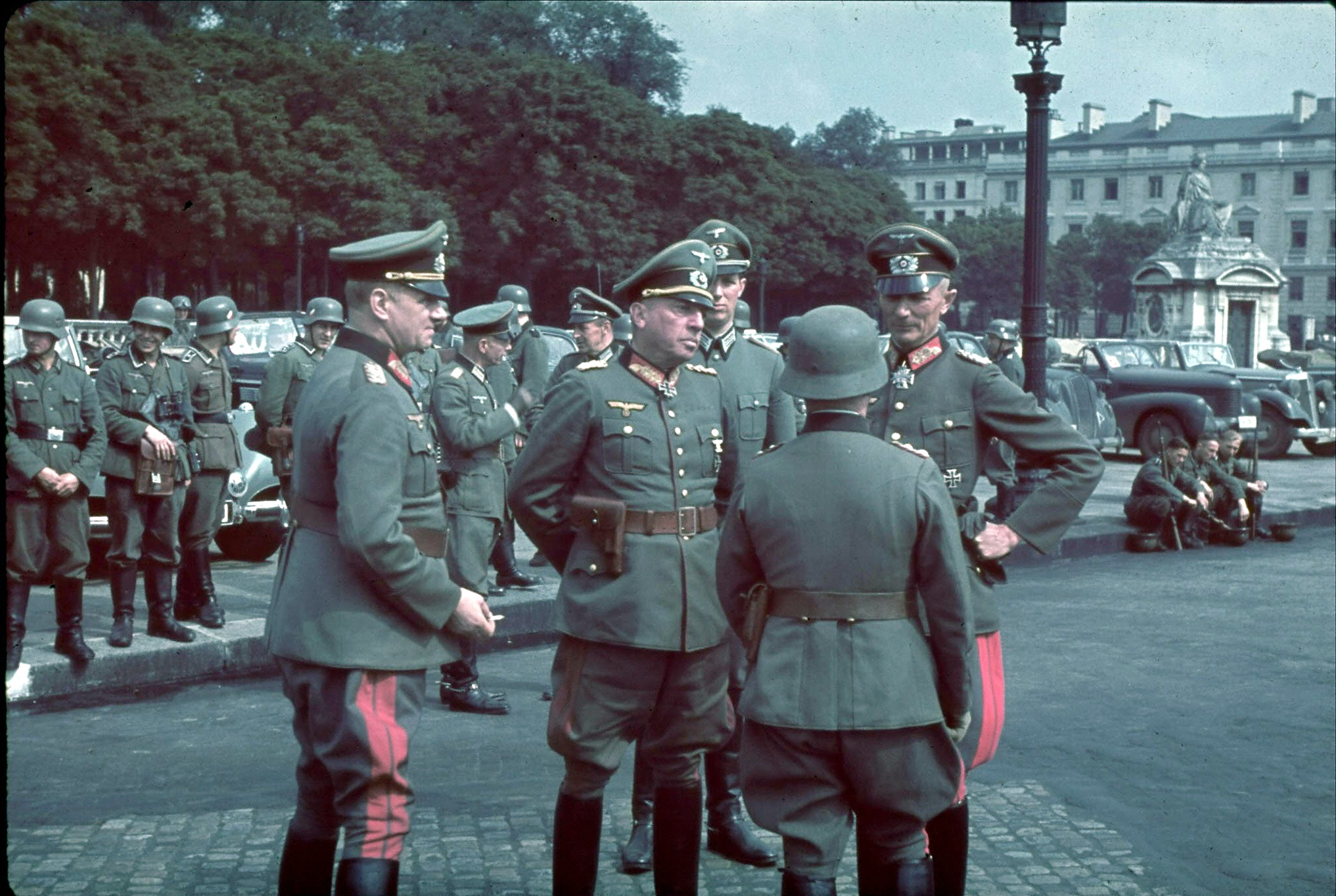
German Generals in the Paris Parade 1940


Wehrmacht high ranking officers gathered at the victory parade of the German troops at the Place de la Concorde, Paris, which held on Friday, June 14, 1940. On that day the French capital fell to the Nazis, while 2,000,000 of its citizens had already fled. In preparation for the parade, the new authorities forbade local residents to approach the vicinity of the Place de la Concorde from 08:00 AM until the afternoon. Front row from left to right: Generalleutnant Hans von Salmuth (Chef des Generalstabes Heeresgruppe B), General der Artillerie Georg von Küchler (Oberbefehlshaber 18. Armee), Oberleutnant der Reserve Heinrich Graf von Lehndorff-Steinort (Adjutant Oberbefehlshaber Heeresgruppe B), General der Kavallerie Georg Stumme (with his back to the camera, Kommandierender General XXXX. Panzerkorps), and Generaloberst Fedor von Bock (Oberbefehlshaber Heeresgruppe B). In the background were rows of parked luxury cars, which were most likely the special rides of the high-ranking German officers who attended the event. The three cars on the right are, in order from left to right: Opel Admiral, Opel Kapitän, and Horch 830 BL. This original color photo was taken by one of Hitler's personal photographers, Hugo Jaeger, who "toured" together with Heeresgruppe B in the invasion of the Low Countries (Netherlands Belgium Luxemburg) and France in the summer of 1940.

Source :
https://artsandculture.google.com/search?q=kuechler&hl=en

Sepp Dietrich and Kurt Meyer

SS-Obergruppenführer und General der Waffen-SS Josef "Sepp" Dietrich (Kommandeur Infanterie-Regiment "Leibstandarte-SS Adolf Hitler") and SS-Hauptsturmführer Kurt "Panzermeyer" Meyer (Kommandeur SS-Aufklärungs-Abteilung / Infanterie-Regiment "Leibstandarte-SS Adolf Hitler") in the background. No other information available, but the picture was possibly taken in 1930 or 1940 during the award ceremony of LSSAH.

Source :
https://clio-historia.livejournal.com/380042.html

Kurt Herzog and His Division Staff

 
Divisionsstab of Generalleutnant Kurt Herzog (2nd from left, Kommandeur 291. Infanterie-Division) in Latvia during Unternehmen Barbarossa, summer of 1941. The "Elch" (Elke) division managed to advance 44 miles in the first 34 hours of the campaign in the Baltic States, but after being assigned the mission of clearing the Baltic coast, was temporarily stopped in their tracks at the naval base of Libau where Soviet Marines and 67th Rifle Division repelled their first attempt to rush the town on 25th June. Resorting to point blank artillery fire, Herzog’s men finally overran the town after four days of fierce fighting and continued advancing up the Baltic Coast before reaching the Latvian capital of Riga which was already under attack from the East by Philipp Kleffel’s 1. Infanterie Division, the following day.

Source :
https://www.axishistory.com/books/150-germany-heer/heer-divisionen/3546-291-infantrie-division
https://clio-historia.livejournal.com/380042.html

Sunday, June 5, 2022

Ritterkreuz Award Ceremony of Hubert-Erwin Meierdrees


ECPAD archives (DAT 1154 L02)

SS-Obersturmführer Hubert-Erwin Meierdrees / Meierdress (Führer Sturmgeschütz-Batterie / SS-Totenkopf-Artillerie-Regiment / SS-Division 'Totenkopf'). Wounded in the Demjansk pocket and extracted after being wounded in action. Ritterkreuz des Eisernen Kreuzes awarded on 13 March 1942. The Ritterkreuz recommendation of Erwin Meierdrees by the Divisionskommandeur Eicke reads as follows: “Meierdrees was serving as part of Kampfgruppe Bochmann when the Russians penetrated friendly lines south of Staraya Russa at the beginning of January 1942, and in response to this development Meierdrees was initially deployed northeast and southeast of the city. His numerous bold attacks brought valuable relief to the hard-pressed Heer units in this area, and heavy losses were inflicted on the foe in the process. After the Kampfgruppe commander became a casualty SS-Obersturmführer Meierdrees rallied the remnants of the Gruppe and proceeded to conduct a determined defense of the village of Bjakowa (located on the Staraya Russa—Demyansk road). Since the end of January Meierdrees has held this village in a heroic struggle against overwhelming enemy attacks despite being encircled from all sides. Whenever the Russians fought their way into the village with strong tank and aircraft support they were always forced to retreat from their gains in the face of the bravely fighting troops under the bold and skillful leadership of SS-Obersturmführer Meierdrees. The defenders of Bjakowa continue to stand their ground under the guidance of their heroic commander. The holding of this village is of critical importance for the integrity of Fortress Demyansk, as the capture of this village would place another section of the road into enemy hands and bring them one step closer to linking up with those Russian forces pushing southwards from Gortschizy. I ask that SS-Obersturmführer Meierdrees be awarded the Ritterkreuz des Eisernen Kreuzes on account of his heroic struggle and the success he has achieved.”

Meierdrees was awarded the Eichenlaub #310 for his Ritterkreuz on 5 October 1943 as SS-Hauptsturmführer and Kommandeur I.Abteilung / SS-Panzer-Regiment 3 "Totenkopf" / SS-Panzergrenadier-Division "Totenkopf". The Eichenlaub recommendation of Erwin Meierdrees reads as follows…

“1.) During the attack against the Uljanowka agricultural estate on 1 March 1943 our Panzers were unable to advance due to the threat from a strong Pakfront. SS-Hauptsturmführer Meierdrees bypassed this Pakfront with his Panzer and attacked it from the flank with magnificent spirit. He personally crushed 4 heavy anti-tank guns beneath his tracks, and his brave deed opened up the enemy’s front for a pursuit thrust by our forces.

2.) During the early morning hours of 3 March 1943 Meierdrees and his Panzer-Abteilung had a surprise encounter with a Russian column stretching 7 km in length (consisting of mostly artillery and anti-tank guns) whilst advancing towards Schljachowaja. SS-Hauptsturmführer Meierdrees immediately attacked this column on his own initiative, and by driving at the very spearhead of the attack he gave his troops the highest example of dutifulness and personal bravery.

The success was total. Several artillery detachments, over 40 anti-tank guns and several hundred trucks together with abundant quantities of assorted war materiel were destroyed or captured.

The 15 T-34s that were escorting the Russian column were all destroyed in the process.

3.) On 7 July 1943 the enemy commenced their anticipated flanking thrust from Ternowka towards the Radin—Schopino road with strong infantry and tank forces. In response SS-Hauptsturmführer Meierdrees engaged the attackers as the first friendly unit to do so (they therefore did not even have infantry support at first). Whilst driving amongst his point Kompanie he identified a large assembly of about a regiment’s worth of Russian infantry in the Dolshik ravine. These were presumably awaiting the arrival of their own armoured forces, which were located about 1.5 km to the east at the time.

SS-Hauptsturmführer Meierdrees immediately ordered his light Kompanie to attack these infantry. He personally led the Kompanie into the opposing ranks, and the foe was routed with heavy losses. After this he led both of his medium Kompanien in an attack against the hostile armoured forces. By skillfully inserting his forces into battle it was possible to destroy 5 tanks in a very short time (of which he personally took out 3). The remaining tanks pulled back to the east at top speed. This determined and energetic intervention by SS-Hauptsturmführer Meierdrees prevented the Russians from blocking the road.

4.) SS-Hauptsturmführer Meierdrees and his Abteilung repeatedly distinguished themselves during the seizure and defense of the Psel bridgehead. During the attack against the hutment near Kljutschi on 12 July 1943 his Abteilung assailed a strongly fortified Russian defensive system which was occupied by infantry forces that were quite ready for defense against armour. As the rest of the Abteilung rolled over the trenches and proceeded to engage the enemy infantry further in the rear, the Panzer of SS-Hauptsturmführer Meierdrees was immobilized. He proceeded to bail out, rally the other bailed out crews of his Abteilung and then clear out the hostile positions in man-to-man close combat.

5.) During the attack against Hill 213.9 (on the Mius) Meierdrees and his Abteilung were amongst those in the first wave. He led his men forwards with indefatigable aggressiveness, and did not waver from even the strongest defensive fire. During this fighting his Panzer was knocked out twice, forcing him to bail out and engage in infantry combat with his crew. On 1 August 1943 he rolled out with his Abteilung for the fifth time, and finally he and his men managed to circumvent the hostile anti-tank/artillery fire and take control of the hill. Strong infantry counterthrusts that were supported by tanks were repulsed.

6.) During the establishment of the Kolontajew bridgehead on 19-20 August 1943 SS-Hauptsturmführer Meierdrees and his Abteilung distinguished themselves once again. Disregarding the strong enemy artillery and anti-tank fire that was falling on the village, he drove through the hostile gunfire, captured Hill 167.5 (located NE of the village) and held it against the strongest of opposing pressure. Here SS-Hauptsturmführer Meierdrees was wounded for the fifth time.”


ECPAD archives (DAT 1154 L01)


Source :
https://imagesdefense.gouv.fr/fr/
https://www.tracesofwar.com/persons/21806/Meierdrees-Hubert-Erwin-aka-Meierdress.htm

Wednesday, June 1, 2022

Welcoming Ceremony for Georg Dörffel

These photos was taken around Kharkov on July 20, 1943 by Kriegsberichter Jütte, and shows the welcoming ceremony for the Hauptmann Georg Dörffel (Gruppenkommandeur I.Gruppe / Schlachtgeschwader 1) who had just returned from the 800th "feindflug" (combat mission). Holding a bouquet of flowers and standing beside the Focke-Wulf Fw 190 he had just landed, Dörffel eagerly drank the liquor given by Major Alfred Druschel (Geschwaderkommodore Schlachtgeschwader 1).


From left to right: Oberleutnant der Reserve Johannes Gehrmann (Staffelkapitän 3.Staffel / I.Gruppe / Schlachtgeschwader 1), Hauptmann Georg Dörffel (Gruppenkommandeur I.Gruppe / Schlachtgeschwader 1), and Leutnant Johannes Meinicke (Staffelführer 1.Staffel / I.Gruppe / Schlachtgeschwader 1). On the same day, Oberleutnant d.R. Gehrmann flew his 400th mission.

From left to right: Oberleutnant der Reserve Johannes Gehrmann (Staffelkapitän 3.Staffel / I.Gruppe / Schlachtgeschwader 1), Major Alfred Druschel (Geschwaderkommodore Schlachtgeschwader 1), Hauptmann Georg Dörffel (Gruppenkommandeur I.Gruppe / Schlachtgeschwader 1), and Leutnant Johannes Meinicke (Staffelführer 1.Staffel / I.Gruppe / Schlachtgeschwader 1).


Source :
https://www.bild.bundesarchiv.de/dba/de/search/?topicid=dcx-thes_personen_774u7o51p5xr4b6jden
http://forum.12oclockhigh.net/showthread.php?t=59973
http://historical-media.com/einzel/2013.9.13/_x2013.9.13.html

Gehrmann, Dörffel and Meinicke


Welcoming ceremony for two pilots of I.Gruppe / Schlachtgeschwader 1 (SG 1). From left to right: Oberleutnant der Reserve Johannes Gehrmann (Staffelkapitän 3.Staffel / I.Gruppe / Schlachtgeschwader 1), Hauptmann Georg Dörffel (Gruppenkommandeur I.Gruppe / Schlachtgeschwader 1), and Leutnant Johannes Meinicke (Staffelführer 1.Staffel / I.Gruppe / Schlachtgeschwader 1). The picture was taken in the summer of 1943 by Kriegsberichter Jütte.

Source :
https://www.bild.bundesarchiv.de/dba/de/search/?topicid=dcx-thes_personen_774u7o73gz7u6hfvdfs

Bio of Oberstleutnant Georg Dörffel (1914-1944)


Full name: Georg Dörffel
Nickname: Orge
Date of Birth: 27 July 1914 in Rengersdorf, Kreis Görlitz, Niederschlesien (German Empire)
Date of Death: 26 May 1944 in Rome (Italy)
NSDAP Number: unknown
SS Number: unknown
Academic Title: unknown
Family Member: unknown
Physical Feature: unknown

Beförderungen (Promotion):
00.00.1939 Leutnant
01.09.1943 Major
00.00.1944 Oberstleutnant (posthumous)

Karriere (Career):
00.00.1937 transferred from the Heer to the Luftwaffe and trained as a Beobachter (observer/navigator) in a Kampfgruppe before being approved for the Stuka branch
01.07.1939 transferred from II.(Schl.)/LG 2 to III.(Aufkl.)/LG 2
10.05.1940 Flugzeugführer in 5.Staffel (Stuka) / II.Gruppe / Lehrgeschwader 2 (LG 2)
30.10.1940 Staffelkapitän 5.Staffel (Stuka) / II.Gruppe / Lehrgeschwader 2 (LG 2)
13.01.1942 Staffelkapitän 5.Staffel (Stuka) / II.Gruppe / Schlachtgeschwader 1 (SG 1)
02.03.1943 Gruppenführer I.Gruppe / Schlachtgeschwader 1 (SG 1)
11.06.1943 Gruppenkommandeur I.Gruppe / Schlachtgeschwader 1 (SG 1)
24.09.1943 Kommandeur Ergänzungs-Schlachtgruppe
07.10.1943 flew his 1,001st combat mission and was banned from further operational flying
15.11.1943 Gruppenkommandeur I.Gruppe / Schlachtgeschwader 152 (SG 152)
00.05.1944 Geschwaderkommodore Schlachtgeschwader 4 (SG 4)
25.05.1944 KIA – shot down north of Rome while engaging a formation of P-47 escorted 4-engine bombers from 15th USAAF. Another and better researched account states that he engaged P-47 fighter-bombers in the vicinity of Lake Bracciano on 26.05.44 and baled out 15 km NW of Rome, and that no 4-engine bombers operated that day). Posthumously promoted to Oberstleutnant. Credited with 1,004 combat missions and at least 30 air victories

Orden und Ehrenzeichen (Medals and Decorations):
00.00.19__ Flugzeugführerabzeichen
21.05.1940 Eisernes Kreuz II.Klasse
21.05.1940 Eisernes Kreuz I.Klasse
21.08.1941 Ritterkreuz des Eisernen Kreuzes, as Oberleutnant and Staffelkapitän 5.Staffel (Stuka) / II.Gruppe / Lehrgeschwader 2 (LG 2)
17.11.1941 Luftwaffe Ehrenpokale für besondere Leistungen im Luftkrieg
24.01.1942 Deutsches Kreuz in Gold
00.00.1942 Medaille "Winterschlacht im Osten 1941/42" (Ostmedaille)
00.00.194_ Frontflugspange für Kampfflieger in Gold mit Sternanhänger "1000"
14.04.1943 Ritterkreuz des Eisernen Kreuzes mit Eichenlaub #231, as Hauptmann and Gruppenführer I.Gruppe / Schlachtgeschwader 1 (SG 1)

------------------------------------------------------------------------------

Georg Dörffel joined the military service in Infanterie-Regiment 22 (22nd infantry regiment) in 1933. In 1935 he transferred to the Luftwaffe holding the rank of Oberfähnrich (senior officer candidate). At first he served as an observer in a Kampfgeschwader (ground attack wing) before transferring as to the 5.(Schlacht)/Lehrgeschwader 2 (5.(S)/LG 2—5th ground attack squadron of the 2nd demonstration wing) flying the Henschel Hs 123 ground attack aircraft.

With this squadron as part of the II.(Schlacht)/LG 2 (2nd ground attack group of the 2nd demonstration wing) he flew as a Leutnant (Second Lieutenant) and pilot during the Invasion of Poland and Battle of France. The group was responsible of repelling a large enemy tank formation north of Cambrai on 17 May 1940 which threatened the flank of the German advance. Dörffel received the Iron Cross 2nd and 1st Class for this action on 21 May 1940.

Dörffel was shot down twice during the campaign in the west, the first time on 14 May 1940 near Tirlemont, Belgium and in June 1940 near Dunkirk. He was wounded on both occasions. In October 1940 he was appointed Staffelkapitän (squadron leader) of the 5.(S)/LG 2, which was re-designated 5./Schlachtgeschwader 1 (5th squadron of the 1st ground attack wing) in early 1942. In this role and position he flew in the Battle of Britain and from April 1941 in the Balkans Campaign.

With the beginning of Operation Barbarossa, the German invasion of the Soviet Union in June 1941, Dörffel was transferred to the Eastern Front, particularly in support of the central and southern sectors, providing air support to the German ground forces. Together with the squadron leader of the 2.(S)/LG 2, Oberleutnant Alfred Druschel, he was awarded the Knight's Cross of the Iron Cross on 21 August 1941 after over 200 combat missions. He was shot down near Skvorin at the Don River on 1 July 1942. Dörffel flew his 600th combat mission on 16 August 1942. He was appointed acting Gruppenkommandeur (group commander) of the I./SG 1 (1st group of the 1st ground attack wing) on 2 March 1943 followed by his official appointment as group leader on 11 June 1943.

Dörffel flew his 800th mission of the war in July 1943 followed by his 900th mission one month later. He was promoted to Major on 1 September 1943. In early October 1943 he flew 19 combat missions on one day against the attacking Red Army forces crossing the Dnieper River near Kiev. He flew his 1,000th combat mission of the war on 6 October 1943, claiming his 30th aerial victory on that flight. He was grounded one day later and transferred and appointed commander of the Schlachtfliegerschule (ground attack fliers school) at Prossnitz. In early May 1944 he took command of Schlachtgeschwader 4 (SG 4—4th ground attack wing) stationed in Italy as Geschwaderkommodore (wing commander).

Georg Dörffel was killed in action on 26 May 1944 north-west of Rome, Italy. Dörffel was forced to bail out of his Focke-Wulf Fw 190 F-8 (Werknummer—factory number—580 464) following an attack on a four-engined bomber formation. He probably struck his head on the tailplane; his parachute failed to open. He was buried in Pomezia, Italy, and posthumously promoted to Oberstleutnant (Lieutenant Colonel).


Source :
"Luftwaffe Officer Career Summaries" by Henry L. deZeng IV and Douglas G. Stankey
https://www.bild.bundesarchiv.de/dba/de/search/?yearfrom=&yearto=&query=D%C3%B6rffel#
https://en.wikipedia.org/wiki/Georg_D%C3%B6rffel
https://forum.axishistory.com/viewtopic.php?p=2412079#p2412079
https://www.tracesofwar.com/persons/29083/D%C3%B6rffel-Georg.htm

Heino von Rantzau in Luftwaffe Award Ceremony

 
Generalleutnant Heino von Rantzau (Kommandeur 2. Flak-Division) in an award ceremony. Rantzau (8 March 1894 – 2 November 1946) was a highly decorated Generalleutnant in the Luftwaffe during World War II. He was also a recipient of the Ritterkreuz des Eisernen Kreuzes, which he received on 29 August 1943. Heino von Rantzau was captured by American troops in April 1945, and died in captivity on 2 November 1946.

Source :
https://forum.axishistory.com/viewtopic.php?p=2412116#p2412116

Thursday, May 26, 2022

Erwin Rommel Pushing a Car


This propaganda photo was taken by Kriegsberichter (War correspondent) Clement Valtingojer, and first published on February 9, 1942. It shows an iconic picture of Generaloberst Erwin Rommel (Oberbefehlshaber Panzerarmee Afrika) as the "Common Man", helping to free up his staff car alongside his men. Bundesarchiv identified the man behind Rommel as Oberstleutnant i.G. Siegfried Westphal, Ia a.k.a. Head of Operations of Panzerarmee Afrika. But I'm (Alif) definitely sure that this identification is wrong, because his face is 100% more like Major Friedrich-Wilhelm von Mellenthin, Ic a.k.a  Head of Intelligence of Panzerarmee Afrika. The Bundesarchiv (German National Archives) made a lot of mistakes in the identification of person and the timeline from his collection of photographs. An example is this photo itself, which is said to have been taken in January 1941, even though in that month Rommel had not yet arrived in Africa! Usually, when I see a difference in the date, place or identification of a person in a photo, I trust the caption from the Bayerische Staasbibliothek (Bavarian Archives) rather than the Bundesarchiv, because it is almost always more accurate.

Sumber :
https://en.wikipedia.org/wiki/File:Bundesarchiv_Bild_183-B20800,_Nordafrika,_Rommel_und_Westphal_schieben_Auto.jpg

Sunday, May 22, 2022

Erwin Rommel and Wilhelm Bach at Halfaya Pass


Together with his staff officers, on 2 July 1941 General der Panzertruppe Erwin Rommel (left, Kommandierender General Deutsches Afrikakorps) made a visit to the headquarters of I.Bataillon / Schützen-Regiment 104 / 15.Panzer-Division at Halfaya Pass in the Sollum front, which is on the border Libya-Egypt. During this visit, in particular "Der Wüstenfuchs" (The Desert Fox) congratulated the commander of the battalion, Hauptmann der Reserve Wilhelm Bach (walking at the forefront with Rommel), who in the battle a month earlier managed to withstand the British tank forces who were trying to break through the Halfaya Pass in order to free their comrades who were besieged in Tobruk, in a mass attack codenamed Operation Battleaxe (15-17 June 1941). For three full days Bach and his men endured wave after wave of enemy tank attacks, with only a platoon of Flak 88 cannons as their main weapon. Although Rommel himself had ordered the Bataillonskommandeur to retreat to a more adequate defensive location "if possible", Bach interpreted his commander's last words in the opposite direction: a counterattack that succeeded in repelling the British troops! For this phenomenal achievement, Bach - who is a former priest (!) - was awarded the prestigious Ritterkreuz des Eisernen Kreuzes on July 9, 1941, just a week after this photo was taken. The Flak 88 itself was originally an anti-aircraft gun, but it can be just as good when it comes to hitting tank targets on the ground. BTW, in April 1941 - which was only one month after Rommel arrived in North Africa - German forces managed to defeat the invading British army and driven it out of Libya, except for one stubborn ANZAC garrison which remained in the port city of Tobruk (despite being besieged by a combined force of Italian and German Afrikakorps). Over the next year, the re-capture of Tobruk became Rommel's biggest obsession, because without it all German efforts to conquer Egypt would be vulnerable. When the port city was finally occupied in June 1942, a grateful Hitler rewarded Rommel with an extraordinary promotion to Generalfeldmarschall.


General view of the German command post at the Halfaya position. The picture was taken during the inspection by General der Panzertruppe Erwin Rommel (Kommandierender General Deutsches Afrikakorps) on 2 July 1941.


During the inspection of the German and Italian troops stationed in the Halfaya on 2 July 1941, General der Panzertruppe Erwin Rommel (second from right, Kommandierender General Deutsches Afrikakorps) and Generalmajor Alfred Gause (right, Verbindungsoffizier beim Italienischen Oberkommando in Nordafrika) visit the strategic hills overlooking the Halfaya.


During the inspection of the German and Italian troops stationed in the Halfaya on 2 July 1941, General der Panzertruppe Erwin Rommel (Kommandierender General Deutsches Afrikakorps) and Generalmajor Alfred Gause (Verbindungsoffizier beim Italienischen Oberkommando in Nordafrika) surrounded by a group of Afrikakorps officers near a captured British armored vehicle.


During the inspection of the German and Italian troops stationed in the Halfaya on 2 July 1941, General der Panzertruppe Erwin Rommel (Kommandierender General Deutsches Afrikakorps) and Generalmajor Alfred Gause (Verbindungsoffizier beim Italienischen Oberkommando in Nordafrika) listen to a soldier's report. In the background, a Horch-Commandeur-Cabriolet (Kfz-21) carrying the pennant of an army corps commander.


During the inspection of the German and Italian troops stationed in the Halfaya on 2 July 1941, General der Panzertruppe Erwin Rommel (Kommandierender General Deutsches Afrikakorps) listen to a soldier's report.


During the inspection of the German and Italian troops stationed in the Halfaya on 2 July 1941, General der Panzertruppe Erwin Rommel (Kommandierender General Deutsches Afrikakorps) and Generalmajor Alfred Gause (Verbindungsoffizier beim Italienischen Oberkommando in Nordafrika) listen to a report from an unknown officer with the rank of Leutnant. Between the two in the background is Rommel's aide, Major Hans-Joachim Schraepler. Behind the group of officers, a cameraman immortalizes the scene with a 35 mm Arriflex.


During the inspection of the German and Italian troops stationed in the Halfaya on 2 July 1941, General der Panzertruppe Erwin Rommel (Kommandierender General Deutsches Afrikakorps) and Generalmajor Alfred Gause (Verbindungsoffizier beim Italienischen Oberkommando in Nordafrika) leave the bunker of an 8.8 cm FlaK gun, surrounded by a group of Afrikakorps officers. The tall officer second from left is Major Hans-Joachim Schraepler, Rommel's aide.


During the inspection of the German and Italian troops stationed in the Halfaya on 2 July 1941, General der Panzertruppe Erwin Rommel (Kommandierender General Deutsches Afrikakorps) and Generalmajor Alfred Gause (Verbindungsoffizier beim Italienischen Oberkommando in Nordafrika) stopped in front of a trench occupied by infantrymen of I.Bataillon / Schützen-Regiment 104 / 15.Panzer-Division. The tall officer at left is Major Hans-Joachim Schraepler, Rommel's aide.


During the inspection of the German and Italian troops stationed in the Halfaya on 2 July 1941, General der Panzertruppe Erwin Rommel (Kommandierender General Deutsches Afrikakorps) and Generalmajor Alfred Gause (Verbindungsoffizier beim Italienischen Oberkommando in Nordafrika) listen to a report from a Leutnant.


From left to right: General der Panzertruppe Erwin Rommel (Kommandierender General Deutsches Afrikakorps), Generalmajor Alfred Gause (Verbindungsoffizier beim Italienischen Oberkommando in Nordafrika), and Hauptmann der Reserve Wilhelm Bach (Führer I.Bataillon / Schützen-Regiment 104 / 15.Panzer-Division). The picture was taken during the inspection by General Rommel to the German and Italian troops stationed in the Halfaya Pass, Libya, on 2 July 1941.


During the inspection of the German and Italian troops stationed in the Halfaya on 2 July 1941, General der Panzertruppe Erwin Rommel (right, Kommandierender General Deutsches Afrikakorps) chats with Hauptmann der Reserve Wilhelm Bach (left, Führer I.Bataillon / Schützen-Regiment 104 / 15.Panzer-Division), while surrounded by Afrikakorps soldiers and officers.


During the inspection of the German and Italian troops stationed in the Halfaya on 2 July 1941, General der Panzertruppe Erwin Rommel (center, Kommandierender General Deutsches Afrikakorps) and Generalmajor Alfred Gause (hand in face, Verbindungsoffizier beim Italienischen Oberkommando in Nordafrika) surrounded by a group of Afrikakorps soldiers and officers from the first battalion of Schützen-Regiment 104 / 15.Panzer-Division, including their commander, Hauptmann der Reserve Wilhelm Bach (with Hitler moustache). The tall officer behind Gause is Major Hans-Joachim Schraepler, Rommel's aide.


During the inspection of the German and Italian troops stationed in the Halfaya on 2 July 1941, General der Panzertruppe Erwin Rommel (center, Kommandierender General Deutsches Afrikakorps) listen to an Afrikakorps non-commissioned officer's explanation of the fighting while surrounded by a group of soldiers and officers from the first battalion of Schützen-Regiment 104 / 15.Panzer-Division, including their commander, Hauptmann der Reserve Wilhelm Bach (with Hitler moustache). Behind Rommel is Generalmajor Alfred Gause (Verbindungsoffizier beim Italienischen Oberkommando in Nordafrika), while the tall officer behind Gause is Major Hans-Joachim Schraepler, Rommel's aide.


A group of Afrikakorps artillerymen surrounds Generals Erwin Rommel and Alfred Gause (not visible in the photo) during their inspection to the German and Italian troops stationed in the Halfaya on 2 July 1941. In the foreground a trench and sandbags. Helmets, gas mask cans, crates, rifle cases, while in the background is a captured "Mammoth" armored vehicle (the AEC Dorchester command car of British origin is named "Mammoth" in the German ranks).


Graves of German soldiers topped with helmets in Halfaya Pass. They were all killed on 16 June 1941. From left to right: Leutnant Erhard Alfred Slevogt (born 29 August 1919), Unteroffizier Ernst Maiwald (born 29 September 1919), and Obergefreiter Kurt Perschmann (born 20 December 1920). The picture was taken during the inspection by General der Panzertruppe Erwin Rommel (Kommandierender General Deutsches Afrikakorps) on 2 July 1941.


During the inspection of the German and Italian troops stationed in the Halfaya on 2 July 1941, General der Panzertruppe Erwin Rommel (Kommandierender General Deutsches Afrikakorps) and Generalmajor Alfred Gause (Verbindungsoffizier beim Italienischen Oberkommando in Nordafrika) - both standing in the rear seat of a Horch Cabriolet commander's car - talk with Hauptmann der Reserve Wilhelm Bach (back to the camera near the driver, Führer I.Bataillon / Schützen-Regiment 104 / 15.Panzer-Division). In the background we can see Halfaya position.


A column of German Afrikakorps Kfz-15 cars on Via Balbia, a highway that is the only major road that runs along the entire east-west length of the Libyan Mediterranean coastline. The picture was taken during the inspection by General der Panzertruppe Erwin Rommel (Kommandierender General Deutsches Afrikakorps) on 2 July 1941.


An unknown Leutnant of the Afrikakorps holds a bunch of grapes in his hand. The picture was taken during the inspection by General der Panzertruppe Erwin Rommel (Kommandierender General Deutsches Afrikakorps) on 2 July 1941.


Source :
Bayerische Staatsbibliothek archive
https://www.bridgemanimages.com/en/search?filter_group=all&filter_region=GBR&filter_text=Erwin%20Rommel
https://imagesdefense.gouv.fr/fr/catalogsearch/result/?avec_visuel=1&q=rommel+bach&p=2

Saturday, April 23, 2022

Bio of SS-Obersturmbannführer Albrecht Krügel (1913-1945)


Full name: Albrecht Krügel
Nickname: Unknown
Date of Birth: 22 April 1913 in Nordhorn, Grafschaft Bentheim, Hannover (German Empire)
Date of Death: 15 March 1945 on the Bahnhof from Altdamm to Stettin, Pommern (Germany)
NSDAP Number: 419 297 (joined 1 February 1931)
SS Number: 11 433 (joined 1 August 1931)
Academic Title: unknown
Family Member: unknown
Physical Feature: unknown

Beförderungen (Promotion):
01.09.1930 SA-Mann
00.08.1931 SA-Anwärter (?)
00.00.1931 SS-Mann (?)
20.04.1934 SS-Scharführer
15.04.1935 SS-Junker
00.00.1935 SS-Standartenjunker
00.00.1936 SS-Standartenoberjunker
20.04.1936 SS-Untersturmführer
20.04.1938 SS-Obersturmführer
09.11.1939 SS-Hauptsturmführer
20.04.1943 SS-Sturmbannführer
01.09.1944 SS-Obersturmbannführer

Karriere (Career):
01.09.1930 - 01.08.1931 Sturmabteilung training
01.04.1933 - 15.04.1934 wachsturm (guard) at SS-Unterführerschule Merkers/Rhon
00.05.1933 - 00.09.1934 served in 9.Sturm / III.Sturmbann / 35.SS-Standarte
01.10.1934 - 31.03.1935 attended Führeranwarterlehrgang Ellwangen
24.04.1935 - 31.01.1936 attended SS-Führerschule Braunschweig - 2. Friedens-Junker-Lehrgang
01.03.1936 - 15.04.1936 attended Zugführerlehrgang Dachau
15.04.1936 - 05.06.1936 Sachbearbeiter at SS-Oberabschnitt "Nord"
05.06.1936 - 01.07.1936 trained with 3.Sturm / 9. SS-Standarte
01.09.1936 - 01.10.1937 Zugführer in 3.Sturm / 9. SS-Standarte
01.10.1937 - 01.11.1938 Adjutant SS-Sturmbann "N" (Nürnberg) at Dachau
01.11.1938 - 16.02.1939 Zugführer in SS-Sturmbann "N" (Nürnberg)
16.02.1939 - 16.05.1940 Zugführer in SS-Kradschützen-Ausbildungs-und Ersatz-Bataillon Ellwangen
01.04.1939 attended SS-Junkerschule Braunschweig
16.05.1940 - 21.06.1940 Kompanieführer in Marsch-Bataillon / SS-Verfügungstruppe
21.06.1940 - 16.11.1940 Nachrichtenoffizier und Führer 13.Kompanie / SS-Standarte "Deutschland"
01.08.1940 attended Kompanieführerlehrgang Elsenborn
16.11.1940 - 00.00.1940 Sachbearbeiter IIb / Stab SS-Division "Wiking"
00.00.1940 - 00.02.1941 Führer Nachrichtenzug / SS-Division "Wiking"
01.03.1941 - 16.03.1941 Adjutant SS-Regiment "Germania" / SS-Division "Wiking"
16.03.1941 - 00.02.1942 Chef 6.Kompanie / SS-Infanterie-Regiment “Westland”
12.07.1941 Führer III.Bataillon / SS-Infanterie-Regiment "Nordland"
00.07.1941 recovery for his wounds
00.02.1942 - 00.11.1942 Chef 6. Kompanie / SS-Infanterie-Regiment "Nordland"
01.12.1942 - 00.04.1943 Kommandeur II.Bataillon / SS-Infanterie-Regiment "Nordland"
01.06.1943 - 25.02.1944 Kommandeur II.Bataillon / SS-Panzergrenadier-Regiment "Norge"
25.02.1944 - 14.03.1944 Führer SS-Panzergrenadier-Regiment "Norge"
14.03.1944 - 09.04.1944 Kommandeur II.Bataillon / SS-Panzergrenadier-Regiment "Norge"
09.04.1944 - 15.03.1945 Kommandeur SS-Freiwilligen-Panzergrenadier-Regiment 24 "Danmark"
00.11.1944 granted leave
15.03.1945 Killed in action not long after returned to the front
 
Orden und Ehrenzeichen (Medals and Decorations):
00.00.193_ Abzeichen des SA-Treffens Braunschweig 1931
00.00.193_ Abzeichen der Deutschen Lebensrettungsgesellschaft (DLRG) in Bronze
00.00.1936 Ehrendegen des Reichsführers-SS
00.12.1936 Julleuchter der SS
01.12.1937 Deutsches Reichssportabzeichen in Bronze
01.12.1937 SA-Sportabzeichen in Bronze
01.12.1937 Totenkopfring der SS
00.00.1938 Medaille zur Erinnerung an den 13. März 1938
00.00.1939 Medaille zur Erinnerung an den 1. Oktober 1938
00.00.1940 SS-Dienstauszeichnung (8. jährige)
00.00.194_ Dienstauszeichnung der NSDAP in Bronze
13.07.1941 Eisernes Kreuz II.Klasse
02.09.1941 Verwundetenabzeichen in Schwarz
13.09.1941 Eisernes Kreuz I.Klasse
20.04.1942 Infanterie-Sturmabzeichen in Bronze
20.08.1942 Infanterie-Sturmabzeichen in Silber
10.09.1942 Medaille "Winterschlacht im Osten 1941/42" (Ostmedaille)
10.01.1943 Deutsches Kreuz in Gold, as SS-Hauptsturmführer and Chef 6.Kompanie / SS-Infanterie-Regiment "Nordland" / SS-Panzergrenadier-Division "Wiking"
12.03.1944 Ritterkreuz des Eisernen Kreuzes, as SS-Sturmbannführer and Kommandeur II.Bataillon / SS-Freiwilligen-Panzergrenadier-Regiment 23 "Norge" (norwegisch Nr. 1) / 11.SS-Freiwilligen-Panzergrenadier-Division "Nordland" / III.(germanische) SS-Panzerkorps / Heeresgruppe Nord (Vorschlag dated 15.02.1944 and signed by Divisionskommandeur Fritz von Scholz; countersigned 16.02.1944 by Korpskommandeur Felix Steiner, presented by Matthias Kleinheisterkamp)
15.06.1944 Red krune kralja Zvonimira (Kroatisches Kriegsordens der Krone des Königs Zvonimir / Croatian Order of the Crown of King Zvonimir) 2nd Class with "War Decoration" (given only as "Kroatische Auszeichnung" - Croatian decoration - on his Eichenlaub Vorschlag, but confirmed through photographic evidence in the book "Die Ritterkreuzträger der Waffen-SS" by Ernst-Günther Krätschmer)
12.07.1944 Nahkampfspange in Bronze
16.11.1944 Ritterkreuz des Eisernen Kreuzes mit Eichenlaub #651, as SS-Obersturmbannführer and Kommandeur SS-Freiwilligen-Panzergrenadier-Regiment 24 "Danmark" (dänische Nr. 1) / 11.SS-Freiwilligen-Panzergrenadier-Division "Nordland" / III.(germanische) SS-Panzerkorps / Heeresgruppe Nord (Vorschlag dated 31.11.1944 and signed by Divisionskommandeur Joachim Ziegler; countersigned 29.11.1944 by Korpskommandeur Georg Keppler)
28.03.1945 Mentioned in Wehrmachtbericht (posthumously)

------------------------------------------------------------------------------

Albrecht Krügel was born on 22.4.13 as the son of a commercial clerk, in Nordhorn, near the Dutch-German border. After attending elementary and secondary school, Krügel pursued employment in the business sector until joining the SA in 1930. He transferred to the SS in August 1931. The first recorded employment of Krügel within the SS states that between 1.4.33 and 15.4.34 he served on the guard detail at the SS-Unterführerschule Merkers/Rhon, which appears to have dealt predominantly with shooting and rifle training. Later that year between 1.10.34 and 31.3.35 Krügel attended the Führeranwarterlehrgang (Officer candidates training course). As part of the early officer candidate selection process, most but not all candidates underwent a psychological screening and evaluation process designed to measure their aptitude and capability for becoming an SS officer. Krügel’s own psychological evaluation, dated 11.4.35, found that:

“The candidate is mentally in order. He concentrates well, although at times he is even a little constricted. His temperament is very controlled, which makes him seem somewhat lifeless. His serious, sober, rather rigid attitude of will often makes him seem cool and strange. But once you have won his trust, he is open and natural. Some of his character can be explained by a hard youth. He is a man of duty who gives his all. He must become freer inwardly and more informal outwardly.”

Following the completion of the Officer candidates training course Krügel was assigned to attend the SS-Führerschule “Braunschweig”. The course leader noted of Krügel’s performance on 29.9.35 that:

“SS-Junker Krügel is a firm character who is eager to achieve his goal. His serious nature, which seldom makes him cheerful, makes him seem uncomradely, But when he trusts someone, he becomes free and easy. He is an open, natural person who has already experienced difficult things in his youth and therefore does not trust everyone immediately, and gaining his trust takes time. Krügel is confident in front of people and knows how to assert himself. He will acquire the knowledge he lacks by the end of the course, possibly in a second course.”

It is alluded to in both early evaluations that Krügel appears to have possessed a somewhat closed, serious personality, and that he suffered hardship as a child of the post-WWI generation, though this is never explored further in any detail.

Krügel graduated from the 2nd platoon leader’s course at the SS-Führerschule “Braunschweig”, ranked 85th in the course attendance. Krügel’s marks on the course reflected his mediocre ranking, generally achieving a rating of “Sufficient” in the following areas of evaluation from Krügel's

assessment report dated 31.1.36:

In world view (Weltanschauung): Sufficient.
In tactics: Conditionally sufficient.
In skill at arms: Fairly good.
In terrain: Sufficient.
In military service: Fairly good.
In physical training: Good.
In weaponry: Sufficient.
In pioneer service: Sufficient.
In general military service: Fairly good.
In riding: Sufficient.
In signals: Sufficient.
In motoring: Sufficient.
In aviation: Sufficient
In cartography: Sufficient.

Krügel’s overall grade emerged as a mediocre “Sufficient”, and the course leader wrote of his performance during the course:

“Krügel is a firm, open, decent character, however, he is a little too serious in his nature, which seldom gives rise to happiness. This often makes him appear to be uncooperative, but he is not in any way. He has an impeccable soldierly manner and knows how to assert himself. Mentally he is in order. He just needs to make the most of the abilities he possesses. Suitable for leadership.”

On 27.4.36, Krügel received a verbal request from the Stettin draft board, through the police, to present himself to the draft board for the purpose of being mustered out for military service, with the rest of the class of 1913. A day later he attended an interview with the chairman of the draft board and received a request from him to present himself for draft by 8 May 1936. Krügel, newly commissioned as SS-Untersturmführer, clearly wished to pursue a career in the SS, as he wrote to the head of SS-Oberabschnitt Nord requesting clarification from the Reichsführer-SS as to whether he was obliged to present himself for Army service on the date stated.

Shortly afterwards, on 30.4.36 the chief of the SS-Personal-Hauptamt responded, stating that as Krügel “has successfully attended the SS-Fuhrerschule Braunschweig (war school course), he is therefore to be recruited into the SS-VT for the purpose of completing his compulsory military service.”

The chief of the SS-Oberabschnitt Nord wrote of Krügel in a memorandum of 2.6.36,

“Krügel was assigned to the training office of the SS-Oberabschnitt Nord from 15.4.36 to 31.5.36. During this time, Krügel was occupied with all the work that occurred in the IA, IO, I/Sp. Departments where he was encouraged to work as independently as possible. He displayed great skill in all his work and showed great prudence, especially in the organisational questions that arose in the course of the reorganisation of SS-Oberabschnitt Nord. He conducted himself very well during this time, both on and off duty. His special gift, however, seems to lie in the field of practical SS service. Krügel seems to be somewhat overworked at the moment.”

While Krügel certainly had a flair for administrative tasks, and applied himself diligently, it seems that his true vocation was of an altogether more active and practical nature. It is noteworthy that the head of SS-Oberabschnitt Nord summarised that Krugel seemed somewhat overworked; it is possible that this was due to Krügel’s health issues, which would further threaten to derail his SS career in the near future.

Between 5 June and 1 July 1936 Krügel was ordered by the 9. SS-Standarte to train with SS-Sturm 3/9 at Pyritz. From 6 June onwards, Krügel was assigned to lead the 1st platoon of Sturm 3/9. According to a superior within the unit, written on 20.7.36:

“His performance in practical service was good, as was his aptitude for this service. Krügel had a good command of the subject matter and knew how to organise the lessons in a planned manner. The topics covered in the ideological lessons were presented by Krügel in an effective and understandable manner. His off-duty behaviour gave no cause for complaint. For the men of the Sturm, Ustuf Krügel was a good comrade when he was off duty and his conduct in front of the men was confident and determined. Krügel is more suitable for front-line service.”

In December 1938, whilst serving with the SS Battalion “Nurnberg" at Dachau, Krügel’s health issues would finally cause the situation he likely least hoped for. On 8.12.38, the commander of SS Battalion “Nurnberg” SS-Obersturmbannführer Ernst Deutsch wrote in praise of Krügel’s character on 8.12.38, stating that:

“Ostuf Krügel is of a quiet nature, but knows how to stand firm and assert himself. He is a decent and honest character, conscientious and reliable, of correct appearance and modest. He has a good general education and his service record is also good. He fulfilled the role of platoon leader to the full and is considered capable of development if his health improves.”

Regarding Krügel’s health, and its potential adverse effect on his career, Deutsch wrote,

“Ostuf Krügel is subject to extraordinary fluctuations in his working habits, which have caused him to work inconsistently and with the necessary diligence for a long time. I attribute this to the state of his health; Krügel suffers from Graves' disease (Hyperthyroidism). His inhibitions and fluctuations in all areas are attributed to this. The examination of his state of health by the troop doctor has ordered by myself.” Deutsch summarised with an air of finality; “His further deployment in the armed forces is dependent on this medical assessment.”

Deutsch related the problem regarding Krügel’s health to the troop doctor of the SS Battalion “Nurnberg”, writing:

“Krügel's state of health is to be subjected to a thorough examination. For some time now I have noticed that the work of SS-Ostuf Krügel as adjutant is subject to very strong fluctuations. In particular, an extraordinary forgetfulness is noticeable, which is not acceptable from an official point of view. I therefore transferred Krügel to a rifle company, because I believed that the best way to compensate for this was in frontline service. I relate this to Krügel's predisposition to Graves' disease and his Hyperthyroidism. It seems advisable to place Krügel under permanent medical observation. By 1.4.39 it must be checked and reported whether Krügel still meets the health requirements for military service.”

While Deutsch clearly saw in Krügel a competent officer capable of advancement and development, his hands were essentially tied. SS-Obersturmbannführer Walter Krüger appended Deutsch’s appraisal, which appeared to seal Krügel’s fate within the SS:

“Krügel is of impeccable character. His appearance is modest and determined. His performance on duty is severely impaired by his current state of health. It is doubtful whether Krügel will be fully fit for duty again. I do not consider him suitable for an adjutant's post because of the above issues.”

A year later, a month before the proscribed date, Walter Krüger, commander of the SS-VT Standarte "z.b.V", Ellwangen, 14.3.39 provided an updated appraisal of Krügel’s health:

“Regarding Krügel: Krügel has only been in Ellwangen for a short time and I can only judge him from that time. He had very little experience of leading from the front, as Deutsch very soon took him on to his staff at SS "N". In my opinion, he was not suitable for use as a troop adjutant. Deutsch, who praised him highly at the beginning, later dismissed him again. SS "N" did not make much effort to train him. His extensive activity with the staff did not take its toll on his health. As far as I can judge Krügel, his strengths lie more in the scientific field and less in practical military matters. I will keep Krügel and try to fill his gaps in the military field as his current state of health makes this quite possible. In view of his maturity and character, I consider him otherwise suitable for use in the General SS or as a police officer, where he will probably have greater prospects in terms of aptitude.”

Krügel, saved from the ignominious prospect of being relegated to the Allgemeine-SS, and promoted to SS-Hauptsturmführer, was transferred to the SS-Junkerschule “Braunschweig”, where on 10.6.40 SS-Standartenführer Lothar Debes, head of the Junkerschule wrote succinctly in favour of Krügel, observing that he was, “Quite suitable as a company commander, skilled both in training and in leading a rifle company” and “conscientious, soldierly and correct.”

By 27.10.40. SS-Hauptsturmführer Krügel had been assigned as signals officer to the “Deutschland” Standarte, where the commander of the Regiment’s signals (SS-Oberführer ??) assessed Krügel’s performance in the following words:

“Conscientious, dutiful character, hard-working, ambitious, energetic. Mentally agile in both verbal and written communication. Tactically well-disposed, organisationally gifted, fully suited as a company commander. Currently serving as Regimental Intelligence Officer in the Regimental Staff, and has acquainted himself with these duties with remarkable skill, great aptitude and obvious interest. In personal appearance, he is confident, skilful, modest and tactful. A Pleasant comrade.”

Krügel was transferred to the then forming SS-Division “Wiking” on 16.11.40 where he served as adjutant (a position he was previously deemed unsuitable for by Walter Krüger). Reassigned as commander of the signals platoon until February 1941, he then reverted to the position of adjutant, this time to the “Germania” Regiment for a month before being reassigned to the 6./SS-Infanterie-Regiment “Westland”.

During the heavy fighting in the East in the summer of 1941, Krügel became ill and developed a fever, which according to the loss reports from the period, confirmed he died of on 25.7.41. Krügel’s hyperthyroidism was possibly exacerbated by the weakening of his immune system due to this fever. The bureaucrats in Berlin did not notice this error until 1.11.41, when the matter was finally rectified, and Krügel’s existence officially reinstated, by this time, following his convalescence, Krügel was assigned to command 6./SS-Infanterie-Regiment “Nordland”. During this period Krügel was recommended for the German Cross in Gold, which was awarded on 8.2.43, however like several other officers who received that award during the same period (for example Jürgen Wagner and Wolfgang Joerchel), no written recommendation exists.

 In January 1942 an incident occurred that seemed outside his usual character as described in peer assessments, and which would see Krügel investigated by the SS courts, accused of causing bodily harm and besmirching the reputation of the SS.

During the night of 19 to 20 January 1942, at about 0.30 a.m., a fight broke out in the bar of the Regina Palace Hotel in Munich between 3 SS officers and 2 civilians. The SS officers were in uniform. The civilians later turned out to be a Leutnant of the Luftwaffe and an Obergefreiter of the Wehrmacht. In the course of the brawl, a lady who was the bride of the army Obergefreiter was also hit in the face.

The accused and the two other SS officers (whose names remain unknown) claimed that the brawl was provoked by the behaviour of the "civilians". Among other things, they allegedly asked, "What do these strange Waffen-SS men want?” When confronted, the Obergefreiter did not give a satisfactory explanation, and the brawl broke out.

Leutnant Dankworth of the Luftwaffe and Graf von Spreti, Obergefreiter in the Wehrmacht, however, gave a much different account of the events; they claimed to have remained calm and in no way challenged the SS officers.

On 31.3.42 the SS und Polizei Gericht I, Munchen decided to discontinue the preliminary proceedings against Hstuf Krügel for bodily harm as a result of lack of sufficient evidence on the following grounds:

“Since impartial witnesses were also unable to say anything about the origins of the brawl or the reasons for it, only the contradictory testimonies of the participants could be taken into account. However, a clear picture of the events could not be gained from the contradictory testimonies, so that the discontinuation of the proceedings was justified by the lack of sufficient evidence. However, this discontinuation does not affect the disciplinary settlement of the incident.”

SS-Gruppenführer Juttner, head of the SS-Fuhrungshauptamt finally decided on 28.9.42 that on the subject of disciplinary proceedings against Hstuf Krügel, SS-Inf.Ers.Btl. "Westland",

“Hstuf Krügel is punished with a severe reprimand for violating soldierly discipline and order and for damaging the image of the SS, because he went to the bar of the Regina Hotel in Munich on 19.1.42 in uniform, contrary to the order of the RF-SS of 19.7.40, and because he got into a fight with civilians there in uniform, although he had other means at his disposal to preserve his honour.”

The severe reprimand was duly noted in Krügel’s personnel file, although it did not appear to damage his career as he was promoted to command II./SS-Infanterie-Regiment “Nordland” in December 1942.

Krügel had clearly found his niche as an infantry commander, and applied his skills accordingly, as by 24.2.43, the commander of SS-Pz.Gren.Rgt. "Nordland", SS-Obersturmbannführer Wolfgang Joerchel proposed his promotion from SS-Hauptsturmführer to SS-Sturmbannführer. Joerchel cited as grounds for Krügel’s promotion his three-month command of the II. Bataillon in the defensive fighting in the Caucasus, the war of movement in the Don region and the offensive fighting in the Donets region, further reinforcing his recommendation by writing,

“Krügel is mature with a high sense of duty and decisiveness, and knows how to lead his men. His tactical knowledge, coupled with his own readiness for action, enable him to lead his battalion securely. His SS attitude is impeccable. His family circumstances and economic situation are in order. Krügel's performance in his current position can be described as very good. The regiment considers him to be a preferred candidate.”

At divisional level, the commander, Felix Steiner appended Joerchel’s words, praising Krügel as,

“A battalion commander who is fully secure and matured in all positions and who fills his position to the full. His promotion is warmly endorsed.”

As with its parent unit, “the SS-Division “Wiking”, Krügel was one of the officers selected to form the leadership cadre of the newly activated 11. SS-Freiwiligen-Panzergrenadier-Division “Nordland”.

The III. SS (Germanisches) Panzerkorps, after its formation period in Croatia during summer 1943 was transported to the Leningrad Front in January 1944, where it was flung into the breach caused by the Soviet breakout from the Oranienbaum Kessel. The Korps would then participate in the long-planned retrograde to the Narwa front.

SS-Sturmbannführer Krügel was assigned to command the II./SS-Panzergrenadier-Regiment 23 “Norge”, and for his achievements in the Pahklemae sector was recommended for the Knight’s Cross by divisional commander SS-Gruppenführer Fritz von Scholz. The recommendation reads as follows,

“After a successful enemy penetration outside of the Division’s sector, SS-Sturmbannführer Krügel took over command of a Kampfgruppe (formed from 3 companies) that was occupying a hastily erected blocking position opposite it. With it he fended off 2 enemy attacks from the break-in area (Vepsküla—Vasa—Forest west of Vasa) along the line Pühklemäe—Woods 1 km north of Germansberg. After the Kampfgruppe had been reinforced by 2 additional Kompanien, and the enemy had been shaken up by sustained artillery fire, Krügel launched an attack on his own initiative in defiance of his orders. Launched at night, this boldly led attack threw the enemy back onto the opposite bank of the Narwa river.

By doing this Krügel succeeded in eliminating the infantry threat to the Narva—Reval road and preventing the capture of the commanding castle at Germansberg. If the enemy had managed to seize this castle then the continued holding of the Narva bridgehead would have been an extraordinarily difficult proposition. Krügel also destroyed the bulk of the enemy’s 131st Rifle Division over the course of his defense and the subsequently launched counterthrusts.”

The award was confirmed on March 12th, 1944.

Shortly afterwards on 4.5.44 Krügel assumed overall command of the SS-Panzergrenadier-Regiment 24 “Danmark”.

SS-Gruppenführer von Scholz, commander of the 11. SS-Panzergrenadier-Division "Nordland" wrote of the newly appointed commander of the “Danmark” Regiment on 13.6.44:

“Krügel is of fresh, lively personality, straight and open, and has tackled every task energetically. Reliable. Good comprehension, physically fit. Good military knowledge, experienced on the front, clear tactical views.

Appearance determined, yet modest. Respected as superior, comrade and subordinate in equal measure. For all his hard work, he cares a great deal for the men under his command.

He is an old SS member, of clear ideological orientation, fresh and convincing manner of speaking. Proven before the enemy again and again.

Fulfilled his position to the full. Appointment as regimental commander was proposed.”

SS-Obergruppenführer Steiner concurred succinctly but enthusiastically with von Scholz’ assessment, stating,

“Fully agreed! A personality full of energy and verve, which has an invigorating effect on the troops.”

Promoted to SS-Obersturmbannführer on 1.9.44 Krugel continued to demonstrate steady, competent leadership of the “Danmark” Regiment. This led to the divisional commander SS-Brigadeführer und Generalmajor der Waffen-SS Joachim Ziegler (who had assumed command after the death of von Scholz) proposing Krugel for the award of the Oakleaves to the Knight’s Cross. Ziegler wrote in his recommendation,

“After being extracted from the heavy defensive battles along the Narva and Düna rivers, the Division Nordland found itself located right in the path of the Soviets’ crushing blows during the fighting in Courland.

During this time SS-Obersturmbannführer Krügel distinguished himself through his heroic example on multiple occasions. His masterful regimental leadership is in large part responsible for the fact that decisive crisis situations could be resolved in our favour.

Through his flexible combat leadership and conscientious decisiveness, SS-Obersturmbannführer Krügel significantly aided the divisional command. Over the whole period he showed outstanding fighting spirit and tactical acumen.”

The Oakleaves having been awarded on 16.11.44 (651st award) Ziegler noted of Krügel’s performance on 25.11.44,

“In attack and defence a highly effective officer... Equally mastering leadership and judgement, he is expected to become a divisional commander of the highest quality in the shortest possible time. With his clear attitude and great ability, he was always excellently suited for commanding a Junkerschule, and has the unconditional allegiance of officers and men alike."

Having overcome the initial setbacks and barriers to his early career, Krügel had developed from being deemed “suitable for the Allgemeine-SS or Police” into one of the most competent mid-level combat commanders the Waffen-SS could field, and was slated, along with Otto Weidinger to become one of the next SS divisional commanders. Krügel was also almost unique among officers of his experience and rank in that he survived the duration of the war without having been wounded, until his death on 15.3.45 when, newly returned from leave, he was killed whilst leading a counterattack on the Altdamm Bahnhof. Marc Yerger states that Krügel is buried in Stettin, however the German Commission for War Graves states that Krügel’s remains were probably transferred to the military cemetery at Stare Czarnowo.


SS-Sturmbannfuhrer Albrecht Krügel, newly Commander of SS-Freiwilligen-Panzergrenadier-Regiment 24 "Danmark" (dänische Nr. 1) / 11.SS-Freiwilligen-Panzergrenadier-Division "Nordland", presents the Eisernes Kreuzes II.Klasse to particularly proven members of the his regiment, in an award ceremony held in April 1944. The picture was taken by SS-Kriegsberichter Fabiger


SS-Obersturmbannführer Albrecht Krügel as Commander of SS-Freiwilligen-Panzergrenadier-Regiment 24 "Danmark" (dänische Nr. 1) / 11.SS-Freiwilligen-Panzergrenadier-Division "Nordland". The picture was taken by SS-Kriegsberichter Stille between September - November 1944


Portrait of SS-Obersturmbannführer Albrecht Krügel (Kommandeur SS-Freiwilligen-Panzergrenadier-Regiment 24 "Danmark" / 11.SS-Freiwilligen-Panzergrenadier-Division "Nordland") with the Eichenlaub zum Ritterkreuz des Eisernen Kreuzes, which he received on 16 November 1944 (and awarded to him by Reichsführer-SS Heinrich Himmler in a ceremony dated 16 December 1944). The picture was taken by SS-Kriegsberichter Hermann Ege in January 1945


Source :
SS-Personalakte
Bundesarchiv photo collection
"Führerliste der Waffen-SS" by John P. Moore
"German Cross in Gold Holders of the SS and Police Volume 3, Regiment and Division Nordland" by Mark C. Yerger
https://forum.axishistory.com/search.php?keywords=albrecht+kr%C3%BCgel&terms=all&author=&sc=1&sf=all&sr=topics&sk=t&sd=d&st=0&ch=300&t=0&submit=Search
http://historyofthewaffenss.com/community/knights-cross-holders-richs-ss-biographies/ss-obersturmbannfuhrer-albrecht-krugel-biography/?fbclid=IwAR2PnGGMdJClSbrwssw6qGKBsPbW_Klv7c0O048vwyvbOozbgURPQAZ8K1w#post-299
https://www.tracesofwar.com/persons/13295/Kr%C3%BCgel-Albrecht.htm
https://twitter.com/AxisBiographic1/status/1517523764740714497?fbclid=IwAR0ye0l9NQ3xDXfj3gsvNCXmGGcVC7UxQuzWSNjqhOsyiGvoQSPrgymucWk