Monday, October 18, 2021

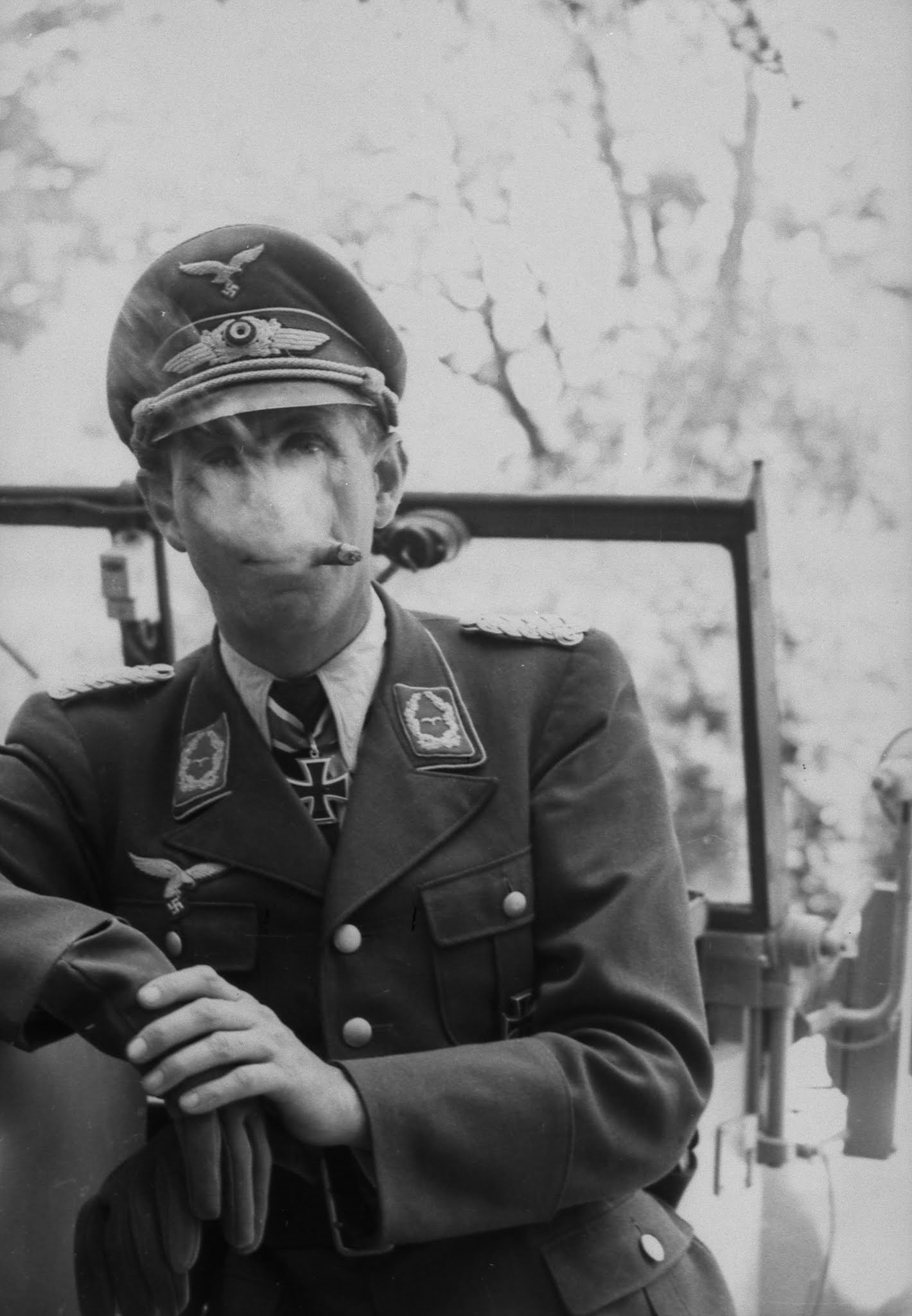
Bio of Hauptmann Rudolf Abrahamczik (1920-1996)


Full nama: Rudolf Franz Joseph Abrahamczik
Nickname: Rudi
Date of Birth: 17 April 1920 at Kurzendorf, Niederschlesien (Germany)
Date of Death: 4 December 1996 at Ibbenbüren, Nordrhein-Westfalen (Germany)
NSDAP Number: unknown
SS Number: unknown
Academic Title: unknown
Family Member: unknown
Physical Feature: unknown

Beförderungen (Promotion):
01.04.1941 Leutnant
01.05.1943 Oberleutnant
01.05.1944 Hauptmann

Karriere (Career):
15.11.1939 Entered the Luftwaffe
09.01.1940 Began to train with Flieger-Ausbildungs-Regiment 61
21.08.1940 Transferred to FFS C 1 (Flugzeugführerschule C 1)
18.12.1940 Transferred to BFS 1 (Blindflugschule 1)
18.01.1941 Transferred to Grosse KFS 4 (Kantonaler Führungsstab 4)
01.04.1941 Member of KG 2 (Kampfgeschwader 2)
21.08.1941 Transferred to 3.Staffel / I.Gruppe / Kampfgeschwader 2
08.09.1942 Transferred to 6.Staffel / II.Gruppe / Kampfgeschwader 40
01.04.1943 Appointed Technischer-Offizier of II.Gruppe / Kampfgeschwader 40
20.06.1943 Transferred to 16.Staffel / V.Gruppe / Kampfgeschwader 2 due to unit renaming
14.07.1943 Unhurt after bailing out of his Me 410 A-1 (U5+BJ) after having propeller problems
17.09.1943 - 06.02.1944 Staffelkapitän 14.Staffel / V.Gruppe / Kampfgeschwader 2
06.02.1944 Staffelkapitän 4.Staffel / II.Gruppe / Kampfgeschwader 51
24.02.1944 - 14.10.1944 Staffelkapitän 12.Staffel / IV.Gruppe / Kampfgeschwader 51
00.08.1944 Retrained on Me 262
08.10.1944 - 30.04.1945 Staffelkapitän 2.Staffel / I.Gruppe / Kampfgeschwader 51

Orden und Ehrenzeichen (Medals and Decorations):
00.00.194_ Eisernes Kreuz II.Klasse
00.00.194_ Eisernes Kreuz I.Klasse
00.00.194_ Frontflugspange für Kampfflieger
21.09.1942 Luftwaffe Ehrenpokale für besondere Leistungen im Luftkrieg
12.01.1943 Deutsches Kreuz in Gold
29.02.1944 Ritterkreuz des Eisernen Kreuzes, as Oberleutnant and Staffelkapitän 14.Staffel / V.Gruppe / Kampfgeschwader 2. Awarded after flying about 165 bombing sorties

----------------------------------------------------------------------------------

* Rudolf Abrahamczik flew a total of 233 bombing sorties during World War II (including 69 with the Me 262). 69 were flown in the East and 164 in the West. He also flew 7 sorties as a fighter pilot, shooting down 3 aircraft in this capacity.


Source :
"Luftwaffe Officer Career Summaries" by Henry L. deZeng IV and Douglas G. Stankey
https://forum.axishistory.com/viewtopic.php?p=2369018#p2369018
https://www.tracesofwar.com/persons/21454/Abrahamczik-Rudolf.htm

Sunday, October 17, 2021

Hans von Bargen with a Captured American Jeep

 
Hauptmann Johann "Hans" von Bargen (Adjutant Schlachtgeschwader 3) posed with a captured American Willys MB Jeep at Leros Island, Greece, November 1943. Bargen received the Ritterkreuz des Eisernen Kreuzes on 19 September 1942 as Oberleutnant and adjutant/Technishes Offizier of the I./Sturzkampfgeschwader 3 (awarded after flying 200 ground attack sorties). In the Battle of Leros (26 September 1943 - 16 November 1943), Bargen became the member of Kampfgruppe Müller, led by Generalleutnant Friedrich-Wilhelm Müller. The picture was taken by Kriegsberichter Ernst A. Zwilling from Luftflotte Südost.

Source :
Bundesarchiv Bild 101I-528-2370-16

Bio of Kapitänleutnant Albert Müller (1913-2005)

Full nama: Albert Müller
Nickname: Müller
Date of Birth: 3 April 1913 at Beesenstedt, Sachsen-Anhalt (German Empire)
Date of Death: 3 April 2005 at Dahn, Rheinland-Pfalz (Germany)
Crewzugehörigkeit (Crew Membership): Crew 36
NSDAP Number: unknown
SS Number: unknown
Academic Title: unknown
Family Member: unknown
Physical Feature: unknown

Beförderungen (Promotion):
00.00.1937 Seekadett
14.05.1937 Fähnrich zur See
01.07.1938 Oberfähnrich zur See
01.10.1938 Leutnant zur See
01.10.1940 Oberleutnant zur See
01.07.1943 Kapitänleutnant
01.04.1956 Korvettenkapitän (Bundesmarine)
00.00.1962 Fregattenkapitän (Bundesmarine)
00.00.1964 Kapitän zur See (Bundesmarine)

Karriere (Career):
00.01.1937 - 30.04.1937 Seekadett at Schiffsstammabteilung and Schiffsartillerieschule
01.05.1937 - 27.11.1937 Participant in Offizierslehrgang Marineschule Mürwik
00.11.1938 Zugführer in 11. Schiffsstammabteilung
00.09.1939 - 00.01.1941 ???
00.09.1940 - 19.10.1940 Kommandant S 1
00.12.1940 - 22.12.1940 Kommandant S 12
22.12.1940 - 06.07.1943 Kommandant S 59
10.04.1942 - 20.04.1942 Kommandant i.V. S 33
20.04.1942 - 10.05.1942 Kommandant i.V. S 34
09.07.1943 - 16.07.1943 Flottillenchef i.V. 3. Schnellboot-Flottille
00.09.1943 - 00.10.1943 Kommandant i.V. (in der Werft) S 56
31.08.1944 - 13.10.1944 Flottillenchef 3. Schnellboot-Flottille
01.04.1961 - 31.12.1961 Kommandeur 7. Schnellbootgeschwader (Bundesmarine)
01.01.1962 - 30.09.1964 Kommandeur 5. Schnellbootgeschwader (Bundesmarine)

Erfolge (Successes):
24.12.1940 Sinking of Dutch Freighter "Stad Maastricht" (6552 GRT)
22.06.1941 Sinking of Latvian Steamer "Gaisma" (3077 BRT)
27.06.1941 Torpedoing of the Soviet destroyer "Storoshevoj" (together with S 31)
13.08.1942 Torpedoing of the British freighter "Glenorchy" (8982 BRT) (questionable, possibly also sunk by the Italian submarine Ms 31)

Orden und Ehrenzeichen (Medals and Decorations):
00.00.19__ Schnellboot-Kriegsabzeichen ohne Brillianten
20.12.1939 Medaille zur Erinnerung an die Heimkehr des Memellandes
12.04.1940 Eisernes Kreuz II.Klasse
08.03.1941 Eisernes Kreuz I.Klasse
30.06.1941 Mentioned in Wehrmachtbericht
00.00.194_ Ärmelband Afrika
04.11.1942 Medaglia de bronzo al Valore (Italy)
21.11.1942 Deutsches Kreuz in Gold
13.12.1943 Ritterkreuz des Eisernen Kreuzes, as Kapitänleutnant and Kommandant S-Begleitschiff “Hermann von Wissmann” / 3.Schnellbootsflottille
27.08.1971 Verdienstkreuz I.Klasse des Verdienstordens der BRD

----------------------------------------------------------------------------------


* Albert Müller (3 April 1913 - 3 April 2005) received the Ritterkreuz des Eisernen Kreuzes on 13 December 1943 as Kapitänleutnant and Kommandant S-Begleitschiff “Hermann von Wissmann” / 3.Schnellbootsflottille. The medal was awarded for his successes as an S-Boat commander. As the captain of S 59 he participated in approximately 85 sorties, during which he sank 6 ships with 30000 GRT and 2 destroyers. Later, as the acting Flottille commander, he sank a further 2 destroyers, 2 large landing craft and shot down an aircraft.


Source :
https://www.historisches-marinearchiv.de/projekte/s_boote/lebenslauf_kommandant.php?where_value=126
http://www.s-boot.net/englisch/sboats-kriegsmarine-knights-crosses.html
https://www.tracesofwar.com/persons/14984/M%C3%BCller-Albert-KM-Schnellboot.htm

Friday, October 15, 2021

Siegfried Westphal and Albert Kesselring

Generalfeldmarschall Albert Kesselring (back to the camera, Oberbefehlshaber Süd) is standing in front of the German quarters in the Monte Soratte sector, Italian Front, while in conversation with the officers of the Luftwaffe, an armed guard in front of it. Nearest to the camera and getting into a Mercedes Benz is Generalmajor Siegfried Westphal (Chef des Generalstabes Oberbefehlshaber Süd). The picture was taken on 5 October 1943 by Kriegsberichter Engel from PK (Propaganda-Kompanie) 699.


Source :
Bundesarchiv Bild 101I-305-0662-15

Sunday, October 10, 2021

Ritterkreuz Actions of Siegfried Wuppermann

Siegfried Wuppermann (15 December 1916 - 15 April 2005) received the Ritterkreuz des Eisernen Kreuzes on 3 August 1941 as Oberleutnant zur See and Kommandant Schnellboot "S 60" / 3.Schnellbootsflottille. The medal was awarded for the successes achieved by him and his boat on all fronts. In the Norwegian campaign he sunk a freighter with 3000 GRT. On the night of 27-28 May 1940 he sunk the French destroyer "Sirocco" and a tanker with 1000 GRT. As the deputy commander of the 3. Schnellbootsflottille, he achieved a notable success on 7 March 1941 near Great Yarmouth / Lowestoft. In three attack runs he sank two destroyers, two freighters with 5700 GRT and a tanker with 8000 GRT. Later on, in actions against the Soviets, he destroyed two armed Soviet freighters with 3577 GRT on 22 June 1941, and two days later the Soviet submarine S 3. On 27 June 1941 his and three other boats engaged with 7 Soviet destroyers and 1 torpedo boat. In a half hour fight he and his ships sunk 2 of these destroyers and also the torpedo boat.

Wuppermann received the Eichenlaub #226 for his Ritterkreuz on 14 April 1943 as Oberleutnant zur See and Kommandant Schnellboot "S 56" / 3.Schnellbootsflottille. It was achieved due to further successes as the commander of S-56. He sank a Soviet patrol vessel on 18 August 1941. Sank a British patrol vessel in the Mediterranean on 7 May 1942. Sank another British patrol vessel and a submarine chaser on 10 May 1942. Torpedoed and severely damaged the British cruiser "Newcastle" on 14 June 1942. Destroyed a number of British ships as they attempted to flee the port of Tobruk when it fell on 21 June 1942 (3 small ships with 350 GRT, 4 barges, 1 freighter with 5000 GRT that had already been damaged by the Luftwaffe, 1 steamship with 6810 GRT, 1 large and 2 smaller landing craft).


Source :
Bundesarchiv Bild 101II-MW-2061-35
https://www.tracesofwar.com/persons/34509/Wuppermann-Otto-Joseph-Siegfried.htm

Bio of Kapitänleutnant Siegfried Wuppermann


Siegfried Wuppermann (15 December 1916 – 15 April 2005) was a captain with the Kriegsmarine during World War II and later served with the Bundesmarine. He was a recipient of the Knight's Cross of the Iron Cross with Oak Leaves of Nazi Germany.

Siegfried Wuppermann was born on 15 December 1916 in Berlin. He joined the Kriegsmarine in 1936 and was transferred to the Schnellboot service in March 1939, where he took command of a boat in the 1. Schnellbootflottille. During the Invasion of Poland he participated on patrols in the North Sea, Baltic Sea and in the English Channel.

In early November 1940 he took charge of a Gruppe in the 3. Schnellbootflottille and took command of Schnellboot "S 60" on 21 December 1940. Siegfried saw action with this boat near Boulogne. In February 1941 he became acting commander of the 3. Schnellbootflottille because Friedrich Kemnade was on vacation. Wuppermann led a patrol on 7 March 1941 against Allied convoys.

On S 60 he participated in Operation Barbarossa. On the night of 21/22 June 1941, just after hostilities with the Soviet Union began, S 60 together with S 59 sank the cargo ship Gaisma off Ventspils,[1] while on the night of 26/27 June, the 3. Schnellbootflottille clashed with Soviet naval forces on minelaying duties, with S 60 being credited (along with S 35) with sinking the Soviet minesweeper T208.[2] Wuppermann received the Knight's Cross of the Iron Cross on 3 August 1941 during these battles.

After the 3. Schnellbootflottille was transferred to the Mediterranean to guard the Axis convoys to North Africa. Wuppermann received the coveted Oak Leaves to his Knight's Cross on 14 April 1943.

Kapitänleutnant Wuppermann helped establish the 21. and 22. Schnellbootflottillen in Eckernförde in May 1943 and was then transferred to the Stab of the Führer der Schnellboote. In March 1945 he took command of the 1. Schnellboot Division and fought with this unit in the Adriatic Sea.

After the war he joined the Bundesmarine. Siegfried Wuppermann died on 15 April 2005 in Osnabrück.

Awards
Iron Cross 2nd Class (20 April 1940) and 1st Class (28 May 1940)
Fast Attack Craft War Badge (16 December 1940) with Diamonds (10 June 1943)
War Cross for Military Valor with Swords (Italy, 10 May 1942)
Bronze Medal of Military Valor (Italy, 21 May 1942)
Silver Medal of Military Valor (Italy, 24 January 1943)
Knight's Cross on 3 August 1941 as Oberleutnant zur See and commander of "S-60" in the 3. Schnellbootflottille
226th Oak Leaves on 14 April 1943 as Oberleutnant zur See and commander of "S-56" in the 3. Schnellbootflottille


Source :
Bundesarchiv Bild 101II-MW-2061-35
http://das-ritterkreuz.de/index_search_db.php4?modul=search_result_det&wert1=7198&searchword=wuppermann
https://en.wikipedia.org/wiki/Siegfried_Wuppermann
http://www.historicalwarmilitariaforum.com/topic/6937-ritterkreuztr%C3%A4ger-photos-in-color-thread/page-3
http://www.s-boot.net/englisch/sboats-kriegsmarine-knights-crosses.html

Ritterkreuz Actions of Friedrich Mieth

Friedrich Mieth (4 June 1888 - 2 September 1944) received the Ritterkreuz des Eisernen Kreuzes on 2 November 1943 as General der Infanterie and Kommandierender General IV. Armeekorps. The medal was awarded for his leadership of the IV. Armeekorps during the fighting on the Mius front and east of Nikopol in mid-1943. Previously, when the Rumanian armies collapsed around Stalingrad, Hitler upgraded headquarters’ of 11. Armee to Headquarters of Heeresgruppe Don, and called upon the brilliant Generalfeldmarschall Erich von Manstein to stabilize the front and save the besieged 6. Armee. Manstein hastily summoned Generalleutnant Mieth and named him commander of security and rear-area troops for the new army group. Because of the rapid speed of the Soviet breakthroughs, however, Mieth’s real function was to organize ad hoc units and lead them into combat to help stem the Russian tide. On New Year’s Day 1943, for example, he was in the Zymlia sector, commanding four ad hoc combat groups, each of approximately regimental strength, plus the 336. Infanterie-Division and what was left of the 7. Luftwaffe Feld-Division. With these forces he was conducting a delaying action near the Don River. His hastily organized headquarters was already known as Korps Mieth. From January to July 1943, Mieth fought in the battles along the Don, in the Donetz, and in the retreat to the Mius. During this period he had to maintain constant flexibility because his units were always changing, as the southern sector of the Eastern Front underwent crisis after crisis. On March 4, for example, Mieth controlled the 336. and 384. Infanterie divisions and the 23. Panzer-Division. Five weeks later all these units had been transferred, and Mieth was directing the 3. Gebirgs and the 304. and 335. Infanterie divisions. Mieth, however, proved himself to be an excellent field commander, and on April 20, 1943 (Hitler’s birthday), he was promoted to General der Infanterie. His headquarters was recognized as a permanent formation on July 20, when it was upgraded to IV. Armeekorps—named after a unit destroyed at Stalingrad. In the meantime, it received its corps units, including the 404th Artillery Command (Arko 404), the 44th Signal Battalion, and the 404th Supply Troop.

Mieth received the Eichenlaub #409 for his Ritterkreuz on 1 March 1944 as General der Infanterie and Kommandierender General IV. Armeekorps. The medal was awarded for his continued distinguished Korps command during the fighting for the Nikopol bridgehead in the winter of 1943/44. Here the Germans inflicted heavy losses on the Soviet forces that sought to crush this position. Wehrmachtbericht 18 February 1944: "In the heavy fighting in the area of Nikopol, the Ostmark, Bavaria, Rhineland-Westphalia, Saxony, Mecklenburg, Pomerania and East Prussia Division under the command of the General of Mountain Troops Schörner and the generals Brandenberger, Mieth and Kreysing in the time frame of 5 November 1943 to 15 February 1944 in offensive and defensive actions, prevented Bolsheviks attempts to break through with cold steel and inflicted heavy losses. Thereby have been captured or destroyed 1754 tanks, 533 guns, many other weapons and other military equipment. Also 56 enemy aircraft have been shot down by infantry weapons."


Source :
https://stalinogorsk.ru/112pd
https://www.tracesofwar.com/persons/12134/Mieth-Friedrich.htm
https://weaponsandwarfare.com/2020/01/26/friedrich-mieth/

Georg Tyroller and Luftwaffe Oberst

ECPAD archives (LFT3 F2837 L16)

Oberstleutnant Georg Tyroller (right, Kommandeur gemischte Flak Abteilung 193 / Flak-Regiment 15 / 13.Flak-Division) in the summer of 1943, with unknown Oberst of the Luftwaffe. Tyroller received the Ritterkreuz des Eisernen Kreuzes on 23 December 1942 as Oberstleutnant and Kommandeur of.Flak-Abteilung 84 / Führer Kampfgruppe Tyroller (Flugplatz Kantemirovka-Süd).


ECPAD archives (LFT3 F2837 L14)

Source :
ECPAD Archives

Ritterkreuz Award Ceremony for Alexander von Hartmann


Ritterkreuz award ceremony for Generalmajor Alexander von Hartmann (Kommandeur 71. Infanterie-Division), which was held on October 8, 1942 in Stalingrad. The two generals who put the medal were Hartmann's two bosses, from left to right: General der Artillerie Walther von Seydlitz-Kurzbach (Kommandierender General LI. Armeekorps) and General der Panzertruppe Friedrich Paulus (Oberbefehlshaber 6. Armee). When his division (and all 6. Armee) could no longer escape from the Soviet siege around the city, Hartmann spoke to his officers calmly: "It is a great honor when an officer died in a battle. I will not kill myself, but I will sell my life dearly." He then took the rifle and headed for the embankment of the Stalingrad train located in the south. In front of the remaining members of his division (3 officers, 7 noncommissioned officers, and 183 soldiers), von Hartmann started firing at the Russian soldier who was invading ... while standing still! At 8:00 a.m. on January 26, 1943, he finally fell as he wished, shot right in the head. Also killed in the same day and in the same embankment were Oberstleutnant Kurt Corduan (Kommandeur Infanterie-Regiment 191) and Major Bayerlein (Kommandeur Infanterie-Regiment 211). Hartmann was promoted to General der Infanterie posthumously (he was promoted to Generalleutnant previously, on December 1942).


Source :
http://ww2images.blogspot.com/2020/06/ritterkreuz-award-ceremony-for.html

Bio of General der Infanterie Alexander von Hartmann

General der Infanterie Alexander von Hartmann

Born: 11 Dec 1890 in Berlin
Died: 26 Jan 1943 on Zariza Railway Embankment, Stalingrad (KIA)

Promotions:
Fähnrich (03 Mar 1910); Leutnant (20 Mar 1911); Oberleutnant (18 Jun 1915); Hauptmann (20 Jun 1918); Major (01 Apr 1931); Oberstleutnant (01 Aug 1934); Oberst (01 Jan 1937); Generalmajor (01 Jan 1941); Generalleutnant (01 Dec 1942); General der Infanterie (nachträglich) (15 Feb 1943)

Career:
Entered Army Service (03 Mar 1910)
Fähnrich in the 94th Infantry-Regiment (03 Mar 1910-02 Aug 1914)
In the Field as Platoon-Leader in the MG-Company of the 94th Infantry-Regiment (02 Aug 1914-14 Jul 1915)
Wounded (19 Nov 1914)
Wounded, in Hospital, later Leader of 1st MG-Replacement-Detachment, Kassel (14 Jul 1915-01 Dec 1916)
Transferred to the Adjutant's Office of the Prussian War Ministry (01 Dec 1916-01 Oct 1919)
Auxiliary-Officer in the RWM (01 Oct 1919-01 Oct 1921)
Company-Chief in the 17th Infantry-Regiment (01 Oct 1921-01 Nov 1925)
Hauptmann with the Staff of II. Battalion of the 7th Infantry-Regiment (01 Nov 1925-01 May 1926)
Company-Chief in the 7th Infantry-Regiment (01 May 1926-01 Apr 1931)
Major with the Staff of the Training-Battalion of the 7th Infantry-Regiment (01 Apr 1931-01 Oct 1933)
Liaison-Officer of the Army with the Reichsmarine-Service-Office Hamburg (01 Oct 1933-01 Oct 1934)
Commander of III. Battalion of Infantry-Regiment Osnabrück (01 Oct 1934-15 Oct 1935)
Commander of III. Battalion of the 37th Infantry-Regiment (15 Oct 1935-01 Feb 1937)
Commander of the 37th Infantry-Regiment (01 Feb 1937-24 Mar 1941)
Führer-Reserve (24 Mar 1941-28 Mar 1941)
Commander of the 71st Infantry-Division (28 Mar 1941-26 Jan 1943)
Killed-in-Action (26 Jan 1943)

Awards & Decorations
- Ritterkreuz: am 08.10.1942 als Generalmajor und Kommandeur der 71. Infanterie-Division
- 1914 EK I
- 1914 EK II
- Ritterkreuz II. Klasse des Grossherzoglich Sachsen-Weimarischen Hausordens der Wachsamkeit oder vom weissen Falken mit Schwertern
- Grossherzoglich Sachsen-Weimarisches Wilhelm Ernst-Kriegskreuz
- Ehrenkreuz IV. Klasse (I. Stufe) des Fürstl. Lippischen Hausordens
- k.u.k. Österr. Militär-Verdienstkreuz III. Klasse mit der Kriegsdekoration
- Türkischer Eiserner Halbmond
- Verwundetenabzeichen, 1918 in Schwarz
- Ehrenkreuz für Frontkämpfer
- Wehrmacht-Dienstauszeichnung IV. bis I. Klasse
- Spange zum EK I
- Spange zum EK II


Source :
http://alifrafikkhan.blogspot.com/2010/03/daftar-general-der-infanterie-heer.html
https://forum.axishistory.com/viewtopic.php?p=2367726#p2367726
https://www.liveauctioneers.com/item/50647795_alexander-von-hartmann#&gid=1&pid=1
http://www.oocities.org/~orion47/WEHRMACHT/HEER/General/HARTMANN_ALEXANDER.html
http://ww2images.blogspot.com/2020/06/ritterkreuz-award-ceremony-for.html

Tuesday, October 5, 2021

Ritterkreuz Action of Georg Ritter von Hengl


Georg Ritter von Hengl (21 October 1897 - 19 March 1952) received the Ritterkreuz des Eisernen Kreuzes on 25 August 1941 as Oberstleutnant and Kommandeur Gebirgsjäger-Regiment 137 / 2.Gebirgs-Division. Here follows an excerpt describing Hengl’s Ritterkreuz action: “On 29 June 1941 the Gebirgskorps Norwegen began its attack against the Russian border positions from the area east of Petsamo. During this operation the successful breakthrough against the heavily occupied (and defended to the last man) bunker line commanded by Oberstleutnant von Hengl was of extraordinary importance for the further successful attack of the whole of Gebirgskorps.”


Source :
Bundesarchiv Bild 146-1989-078-16A
https://www.tracesofwar.com/persons/6333/Hengl-Ritter-von-Georg.htm

Ritterkreuz Action of Karl-Georg Feig

Karl-Georg Feig (27 February 1899 - 12 February 1970) received the Ritterkreuz des Eisernen Kreuzes on 4 December 1941 as Oberleutnant der Reserve and Chef 3.Kompanie / I.Bataillon / Schützen-Regiment 113 / 1.Panzer-Division. The following wartime excerpt describes why Feig would receive the Ritterkreuz: “On 14 October 1941 Oberleutnant Feig had the mission of thrusting into the inner part of Kalinin that was located on the left of the road that led into the city. In an unstoppable forward drive, Oberleutnant Feig secured the crossing over the deeply incised creek and took control of the stadium. Oberleutnant Feig then decided to capture the Volga bridge. Although aware of the enemy guns, MG bunkers and field positions on the northern bank of the river, Oberleutnant Feig stormed across the Volga bridge with a few men and prevented the demolition of the bridge through his swift action. An ignition wire was personally cut by Oberleutnant Feig.”


Source :
https://www.facebook.com/photo/?fbid=1171580836639666&set=pcb.1137751820053589
https://www.tracesofwar.com/persons/4259/Feig-Karl-Georg.htm?fbclid=IwAR1UegXCtYQCpUzdfY-YPGy6S6AEDretzyE7K0gVCpnTWL5N73KgNj2zEkA

Monday, October 4, 2021

Bio of Oberstleutnant d.R. Karl-Georg Feig (1899-1970)


Full nama: Karl-Georg Feig / Georg Feig
Nickname: unknown
Date of Birth: 27 February 1899 at Annaberg, Sachsen (German Empire)
Date of Death: 12 February 1970 at Wiesbaden, Hessen (West Germany)
NSDAP Number: unknown
SS Number: unknown
Academic Title: unknown
Family Member: unknown
Physical Feature: unknown

Beförderungen (Promotion):
10.03.1935 Gefreiter der Reserve / Reserve-Offizier-Anwärter
03.01.1937 Unteroffizier der Reserve / Reserve-Offizier-Anwärter
08.10.1937 Wachtmeister der Reserve / Reserve-Offizier-Anwärter
30.01.1938 SA-Obersturmbannführer
01.01.1939 Leutnant der Reserve (RDA 01.01.1939 - 69)
01.04.1940 Oberleutnant der Reserve (RDA 01.10.1940 - 153)
01.01.1942 Hauptmann der Reserve (RDA 01.01.1942)
00.01.1942 SA-Standartenführer
01.02.1943 Major der Reserve (RDA 01.02.1943)
01.06.1944 Oberstleutnant der Reserve (RAD 01.06.1944)

Karriere (Career):
00.00.19__ Volks- and Handelsschule in Annaberg
00.00.1916 kaufmännischer Angestellter (Lace-maker)
20.06.1917 - 01.04.1919 At 2.Kompanie / Grenadier-Regiment 101
Chief of a greater toy-shop
00.00.1934 participant in exercises at IR 11 and IR 10
00.00.1935 exercises (as Gefreiter) with the new SR 1
00.00.1937 Unteroffizier, some months later Feldwebel
00.00.1938 Führer SA-Standarte 94
00.00.1938 After the next exercises, he entered duty as professional military
15.11.1938 Führer SA-Standarte 80
01.08.1939 - 30.09.1939 Schützen-Regiment 1 at Weimar
01.10.1939 - 20.10.1939 Zugführer in 8.Kompanie / Schützen-Regiment 1
21.10.1939 - 25.06.1940 Chef 7.Kompanie / Schützen-Regiment 1
26.06.1940 - 05.11.1940 Chef 8.Kompanie / Schützen-Regiment 1
06.11.1940 - 25.06.1941 Chef 3.Kompanie / Schützen-Regiment 113
26.06.1941 - 05.09.1941 Panzergrenadier-Ersatz-Abteilung 1 at Weimar
06.09.1941 - 20.10.1941 Chef 3.Kompanie / Panzergrenadier-Regiment 113
21.10.1941 - 31.08.1942 Wounded through the thigh at Kalinin area. Recuperated in the homeland before posted to Panzergrenadier-Ersatz-Abteilung 1 at Weimar
07.09.1942 - 00.11.1943 Returned to the 1. Panzer-Division as Kommandeur II.Bataillon / Panzergrenadier-Regiment 113
00.11.43 - 21.01.1944 Wounded near Gnilez (stab with a knife at the back), in hospital
21.01.1944 - 13.02.1944 returned to the frontline as Kommandeur I. / Panzergrenadier-Regiment 113
14.02.1944 - 15.03.1944 Kommandeur "Gruppe Feig" with verstärktes II./PGR 1, SPW from 2. and 4./PGR 1, Panzer, Panzerartillerie, Pioniere (Lissjanka)
16.03.1944 - 04.04.1944 Führer Panzergrenadier-Regiment 113
04.04.1944 - 05.05.1944 Fracture from a bullet (Schussbruch) left thigh
06.05.1944 - 05.02.1945 Panzergrenadier-Ersazt-Bataillon 1
06.02.1945 - 26.04.1945 Regimentskommandeur in Weimar and Chef Offiziersbewerberschule for 1. and 7. Panzer-Division
26.04.1945 - 00.00.1947 POW (Prisoner of War)

Orden und Ehrenzeichen (Medals and Decorations):
12.09.1918 1914 Eisernes Kreuz II.Klasse
06.11.1939 Medaille zur Erinnerung an den 1. Oktober 1938
26.05.1940 1939 spange zum 1914 Eisernes Kreuz II.Klasse
25.07.1940 1939 Eisernes Kreuz I.Klasse
01.11.1940 Panzerkampfabzeichen (ohne Zahl)
04.11.1941 Ritterkreuz des Eisernen Kreuzes, as Oberleutnant der Reserve and Chef 3.Kompanie / I.Bataillon / Schützen-Regiment 113 / 1.Panzer-Division / XXXXI.Armeekorps / 4.Panzergruppe / Heeresgruppe Nord
07.03.1942 Verwundetenabzeichen in Schwarz
30.01.1944 Verwundetenabzeichen in Silber
23.05.1944 Deutsches Kreuz in Gold
29.06.1944 Nahkampfspange in Bronze

----------------------------------------------------------------------------------

* After World War II, Georg Feig became the head of a department in the large scale industry.

Georg Feig came from the Saxon Ore Mountains. At the age of 18, Georg Feig joined the 101st Grenadier Regiment in 1917 and took part in the First World War. Even before 1933 he was interested in National Socialist ideas and joined the NSDAP and SA. As Obersturmführer, he headed the SA aid camps in Ellrich and Ober Maßfeld. The Ellrich-Juliushütte subcamp was established in 1944 on the premises of the Ellrich relief agency camp he directed. Afterwards he worked as an educator at the SA-Führerschule Gruppe Thuringia in the Schortental near Eisenberg (Thuringia).

From 1937 to 1939 he was Obersturmbannführer of SA Standard 94 "Gustav Zongel" in Weimar, after which he took over SA Standard 80 (Kurpfalz Group) in Wiesbaden. A month before the outbreak of the Second World War, Georg Feig was mobilized in Weimar and called up as a lieutenant in the reserve for the local 1st Rifle Regiment. With this rifle regiment he went into the field in 1939.

As a first lieutenant, he was wounded in the Battle of Tula in 1941. On October 14, 1941, he and his raiding party took the Volga road bridge near Kalinin on their own with a skillful blow. He was wounded again a day later. For this act he was awarded the Knight's Cross of the Iron Cross by Adolf Hitler in December 1941 and celebrated as a hero by his contemporaries. He received the award personally in January 1942 from the SA chief of staff in Berlin. At the same time he was promoted to SA-Standartenführer.

Towards the end of the war he was deployed in Thuringia as the Gaustabsführer of the Volkssturm. Most recently he lived as a lieutenant colonel a. D. in Wiesbaden, where he died shortly before his 71st birthday in 1970.

Source :
Keith Snyder photo collection
https://de.wikipedia.org/wiki/Georg_Feig
https://www.facebook.com/photo/?fbid=1171580836639666&set=pcb.1137751820053589
https://forum.axishistory.com/viewtopic.php?t=100023
https://www.tracesofwar.com/persons/4259/Feig-Karl-Georg.htm?fbclid=IwAR1UegXCtYQCpUzdfY-YPGy6S6AEDretzyE7K0gVCpnTWL5N73KgNj2zEkA

Unknown Ritterkreuzträger from Heer

Unknown Oberleutnant with two Hitlerjugend member during the training of map reading. The original caption is written: "Soldaten von morgen. In einem Wehrertüchtigungslager der HJ. Ein Ritterkreuzträger geht mit den Hitler-Jungen ins Gelände und erteilt Unterricht im Kartenlesen" (Tomorrow's soldiers. In a military training camp of the Hitler Youth,  Knight's Cross holder goes into the area with the Hitler boys and gives lessons in map reading). Some sources identified the Oberleutnant as Bernhard Klemz, but Klemz received the Ritterkreuz when he was a Hauptmann, while our mysterious guy is still an Oberleutnant but already got the medal.

Source :
Bundesarchiv Bild 146-2000-001-12
https://www.bild.bundesarchiv.de/dba/de/search/?yearfrom=1933&yearto=1945&query=Ritterkreuztr%C3%A4ger

Saturday, October 2, 2021

Bio of Leutnant d.R. Arno Geelhaar (1920-2009)


Full nama: Arno Geelhaar
Nickname: unknown
Date of Birth: 23 December 1920 at Tilsit, Ostpreußen (Germany)
Date of Death: 14 December 2009 at Mainz, Rheinland-Pfalz (Germany)
NSDAP Number: unknown
SS Number: unknown
Academic Title: unknown
Family Member: unknown
Physical Feature: unknown

Beförderungen (Promotion):
00.00.194_ Leutnant der Reserve

Karriere (Career):
Unknown

Orden und Ehrenzeichen (Medals and Decorations):
00.00.194_ Eisernes Kreuz II.Klasse
00.00.194_ Eisernes Kreuz I.Klasse
00.00.194_ Nahkampfspange in Bronze
16.04.1944 Ritterkreuz des Eisernen Kreuzes, as Leutnant der Reserve and Führer 7.Kompanie / II.Bataillon / Grenadier-Regiment 151 / 61.Infanterie-Division

----------------------------------------------------------------------------------


Source :
https://forum.axishistory.com/viewtopic.php?p=2366386#p2366386
http://www.ritterkreuztraeger.info/rk/g.html
https://www.tracesofwar.com/persons/44931/Geelhaar-Arno.htm

Bio of Hauptmann Heinrich Schmetz (1914-2004)


Full nama: Heinrich Schmetz
Nickname: unknown
Date of Birth: 22 October 1914 at Essen, Ruhr (Germany)
Date of Death: 22 July 2004 at Gauting, Münich (Germany)
NSDAP Number: unknown
SS Number: unknown
Academic Title: unknown
Family Member: unknown
Physical Feature: unknown

Beförderungen (Promotion):
00.00.1938 Leutnant der Reserve
01.10.1943 Hauptmann

Karriere (Career):
Fall of 1935 Joined the Luftwaffe, training initially with Fl.Üb.Stelle at Weimar-Nohra
00.00.1936 Assigned to I./KG 253 at Gotha as a Beobachter
00.09.1937 Given leave to resume his studies in aircraft design
00.00.1938 Leutnant der Reserve in IV./KG 254 at Gütersloh
00.09.1939 Posted in 7./KG 4
31.05.1940 7./KG 4 unhurt when his Ju 88 A-1 (5J+JR) was shot down by fighters near Vlisseghem/Belgium, force landing safely
15.10.1940 Now in III./KG 30 due to unit renaming, becoming a member of Hajo Herrmann's crew
00.01.1942 Began pilot training with FFS A/B 61, then with FFS C 2. (n.d.) transfer to 3./KGr. 21
01.02.1943 Staffelkapitän 3./KGr. 21 (renamed as 9./KG 100 on 29.04.43)
00.02.1943 Transfer to Erprobungskommando 21 at Garz/Usedom
00.05.1943 Transfer to III./KG 100
15.04.1944 - 15.06.1944 Staffelkapitän 11./KG 100
16.07.1944 Acting Gruppenkommandeur III./KG 100
00.08.1944 - 07.09.1944 Gruppenkommandeur III./KG 100
00.09.1944 Temporarily assigned to the General der Kampfflieger to be the course director at the Verbandsführerschule
00.11.1944 Acting Gruppenkommandeur II./KG 100
00.02.1945 Ia in Stab/Bevollmächtigten zur besonderen Verwendung für Sonderwaffen der Luftwaffe
00.00.1956 Joined the postwar Bundewehr and served as an Oberst

Orden und Ehrenzeichen (Medals and Decorations):
20.05.1940 Medaille zur Erinnerung an den 1. Oktober 1938
20.05.1940 Eisernes Kreuz II.Klasse
27.09.1940 Eisernes Kreuz I.Klasse
25.05.1941 Frontflugspange für Kampfflieger in Gold
05.09.1941 Medaglia de bronzo al Valore (Italy)
30.09.1941 Ehrenpokal der Luftwaffe
18.05.1943 Deutsches Kreuz in Gold
12.09.1944 Verwundetenabzeichen 1939 in Schwarz
28.09.1944 Ärmelband Kreta
29.10.1944 Ritterkreuz des Eisernen Kreuzes, as Hauptmann and Gruppenkommandeur III.Gruppe / Kampfgeschwader 100 (awarded after flying over 250 sorties as a bomber pilot/observer, and for leading his Gruppe to great success against Allied warships and merchant shipping in the Mediterranean.)

----------------------------------------------------------------------------------


Source :
"Luftwaffe Officer Career Summaries" by Henry L. deZeng IV and Douglas G. Stankey
https://www.tracesofwar.com/persons/26387/Schmetz-Heinrich.htm

Friday, October 1, 2021

Ritterkreuz Award Ceremony of Wolf-Werner Graf von der Schulenburg


Ritterkreuz award ceremony for Major Wolf-Werner Graf von der Schulenburg (Kommandeur I.Bataillon / Fallschirmjäger-Regiment 1 / 1.Fallschirmjäger-Division), which were held at Avignon, Southeastern France, on 20 June 1943. Generalmajor Richard Heidrich (Kommandeur 1. Fallschirmjäger-Division) decorated the Major in front of the battalion. The medal was awarded because of Schulenburg battalion's efforts in unison with the 78. Sturm-Division during the fighting near Orel. The picture was taken by Bildberichter Dahm from XI. Fliegerkorps Propaganda-Kompanie and were first published on 6 July 1943.


Major Wolf-Werner Graf von der Schulenburg (2nd from left, Kommandeur I.Bataillon / Fallschirmjäger-Regiment 1 / 1.Fallschirmjäger-Division) sitting on a terrace at a meeting, 20 June 1943. In the center facing the camera is Oberstleutnant Karl-Lothar Schulz (Kommandeur Fallschirmjäger-Regiment 1 / 1.Fallschirmjäger-Division).


Interview after the award ceremony


Source :
https://www.bild.bundesarchiv.de/dba/de/search/?yearfrom=1933&yearto=1945&query=wolf+schulenburg#